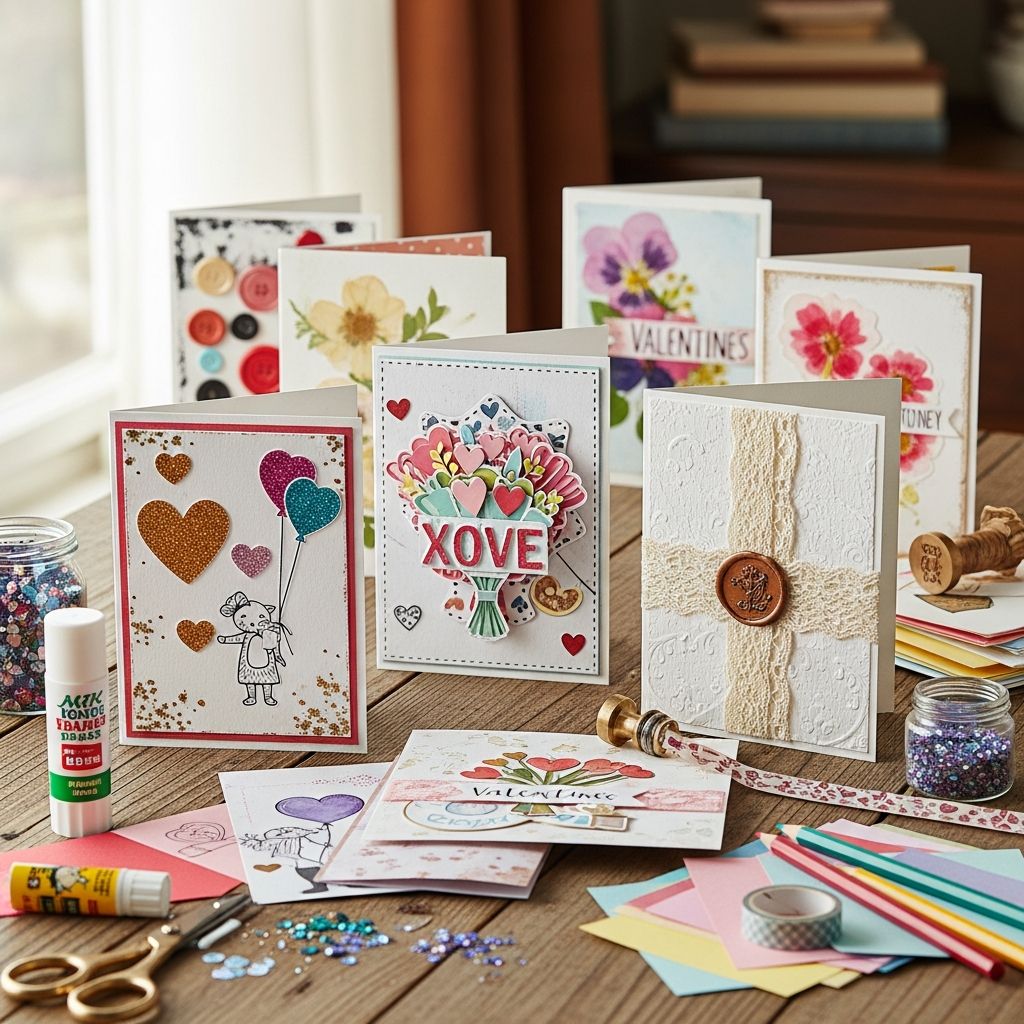
Handmade Valentine cards turn a quick holiday errand into a meaningful memory. Whether you are crafting with a classroom of kids, planning a family afternoon at the table, or making a one-of-a-kind note for someone special, simple materials and a little creativity are all you need.
This guide offers fresh, easy-to-follow ideas inspired by classic kids’ crafts and modern DIY trends. Every project is designed to be:
- Simple enough for beginners and young children
- Flexible so you can adapt to the supplies you already have
- Budget-friendly and largely based on paper, recyclables, and basic art supplies
- Scalable for making a single keepsake card or a whole class set
Getting Ready: Supplies and Setup
You do not need a craft store haul to make memorable Valentine cards. Research on children’s creativity emphasizes that open-ended materials and the chance to experiment are more important than fancy tools. Focus on variety and choice rather than perfection.
Core Supplies
- Cardstock or construction paper (reds, pinks, whites, plus a few bright colors)
- Child-safe scissors and a glue stick or white glue
- Washable markers, crayons, colored pencils
- Scrap paper, magazines, or gift wrap for collage
- Optional: stickers, washi tape, sequins, buttons, ribbon, or yarn
Helpful Setup Tips
- Cover the table with newspaper or an old cloth for easy cleanup.
- Pre-fold card bases (simply folded rectangles) for younger kids.
- Sort decorations into small bowls so kids can see their choices.
- Offer a few sample cards, but encourage children to change the design.
Idea 1: Crayon-Resist Secret Message Hearts
This project feels like magic to kids: a hidden message appears when they paint. It uses a simple art technique called wax resist, where crayon wax repels watercolor or diluted paint.
Materials
- White cardstock or watercolor paper
- White or very light-colored crayons
- Watercolor paints or very diluted food coloring
- Paintbrushes and water cups
How to Make It
- Fold the paper into a card shape.
- Use the crayon to draw hearts, doodles, or a message such as “Be Mine” or “You are loved.” The lines will be hard to see at first.
- Paint gently over the front of the card with watercolor. The crayon drawings will resist the paint and stay light while the background turns colorful.
- Let dry completely before writing a note inside.
Variations
- Draw a maze or small puzzle and invite the recipient to trace it.
- Use two or three paint colors for a soft ombré effect.
- Turn it into a mini science lesson about how wax and water do not mix easily, which helps demonstrate principles of surface tension in a kid-friendly way.
Idea 2: Torn-Paper Collage Hearts
Torn-paper collage is forgiving, great for fine motor skills, and ideal for using up scraps. Studies on early childhood art experiences show that tearing and pasting support hand strength, coordination, and planning.
Materials
- Construction paper or scrap paper in multiple colors
- Plain card bases
- Glue sticks
- Optional: metallic candy wrappers or tissue paper for shine
Steps
- Tear colored paper into small pieces (about thumbnail size).
- Lightly draw a heart shape on the front of the card as a guide.
- Fill the heart shape using glue and overlapping torn pieces.
- Leave the background plain, or fill it with a different color family for contrast.
Make It Your Own
- Combine warm colors (reds, oranges, pinks) inside the heart and cool colors (blues, greens) outside for a striking look.
- Write a simple message underneath, such as “You color my world.”
- Use a larger sheet and frame it as wall art for a more permanent gift.
Idea 3: Fingerprint Friends and Families
Fingerprint art turns every card into a tiny portrait. It can be especially meaningful for families, classrooms, or groups of friends because every print is unique—just like the people you are celebrating.
Materials
- Washable stamp pads or non-toxic, washable paint
- Plain cards or folded cardstock
- Fine-tip markers
- Damp cloth or wipes for quick clean-up
Steps
- Press a fingertip into ink or paint, then stamp onto the front of the card.
- Repeat to make several prints, spaced apart, in a row or a cluster.
- Use markers to turn each print into a small character with faces, arms, and legs—think tiny friends, a family, or a group of animals.
- Add a message that connects to the scene, such as “Our hearts stick together.”
Tips and Adjustments
- Label each fingerprint person with a name in small print for a family keepsake.
- For toddlers, let them simply stamp prints and have an adult add the faces later.
- Use thumbprints to form heart shapes by stamping two prints at an angle.
Idea 4: Window Cards with Peekaboo Shapes
Window cards look impressive but are surprisingly easy. They add a playful, interactive element that many kids love and also invite simple discussions about shapes and symmetry.
Materials
- Cardstock folded into a card base
- Scissors or a craft knife (adults only for cutting windows)
- Colored paper, photos, or drawings to place behind the window
- Glue or double-sided tape
Basic Steps
- Draw a simple shape (heart, circle, or star) on the front of the card.
- Carefully cut out the shape to create a window.
- Open the card and glue a contrasting piece of paper, a small drawing, or a photo so it shows through the window.
- Decorate the window edges with doodles, dots, or sticker borders.
Creative Ideas
- Place a small group photo behind the heart for classmates or teammates.
- Use tissue paper in multiple colors for a stained-glass effect when held to the light.
- Write a short phrase around the window, such as “You are at the center of my heart.”
Idea 5: Folded Paper Surprises
Simple folds can transform a flat card into a playful surprise that invites the recipient to open, unfold, and explore. Interactive paper crafts like these help children develop spatial reasoning and sequencing skills.
Accordion Message Strip
- Cut a long strip of paper.
- Fold it back and forth into an accordion.
- Glue the first panel inside a card so the strip extends outward when opened.
- Write one word of a message on each panel for a dramatic reveal.
Lift-the-Flap Heart
- Cut a heart shape with a straight edge at the top.
- Glue only the top straight edge to the card so the heart flips up like a flap.
- Underneath, write a secret message or draw a mini picture.
- Decorate the flap with patterns or stickers.
Quick Comparison of Card Styles
| Card Style | Best For | Approx. Time | Mess Level |
|---|---|---|---|
| Crayon-resist hearts | Small groups, kids who enjoy painting | 20–30 minutes | Medium (water + paint) |
| Torn-paper collage | Classroom sets, younger children | 15–25 minutes | Low–medium (paper scraps) |
| Fingerprint friends | Family keepsakes, personalization | 10–20 minutes | Medium (ink or paint on hands) |
| Window cards | Older kids, special one-off cards | 20–30 minutes | Low–medium (cutting involved) |
| Folded paper surprises | Kids who like interactive elements | 15–20 minutes | Low (mostly dry materials) |
Keeping Crafts Kid-Friendly and Inclusive
Valentine’s Day can be about friendship and appreciation rather than only romance, especially in schools and mixed-age groups. Many elementary classrooms now focus on inclusive, non-romantic messages so that every child feels comfortable participating.
Tips for Class or Group Settings
- Encourage phrases like “You’re a great friend,” “You make me smile,” or “Thanks for being kind.”
- Invite kids to make a card for a teacher, librarian, coach, or neighbor.
- Offer non-heart symbols too (stars, rainbows, animals) for children who prefer those shapes.
- Provide adaptive tools such as larger crayons, loop-handled scissors, or pre-cut shapes for children who need them, in line with inclusive education practices.
Environmentally Friendly Craft Choices
Crafting can generate a lot of small scraps. Simple shifts make Valentine projects more sustainable without reducing the fun.
- Use both sides of paper and collect offcuts in a “scrap box” for future projects.
- Look for washable, non-toxic supplies that meet safety standards for children.
- Skip plastic glitter when possible; consider torn tissue paper or colored pencils for sparkle instead.
- Repurpose cardboard from cereal boxes as sturdy card bases.
Frequently Asked Questions (FAQs)
How far in advance should we start making handmade Valentine cards?
Starting one to two weeks before Valentine’s Day works well for most families and classrooms, leaving time to finish without rushing and to let any paint or glue dry completely.
What is an easy card idea for very young children (ages 2–4)?
For toddlers and preschoolers, the best options are simple: offer pre-folded cards, large stickers, crayons, and a few pre-cut hearts. Let them place stickers and color freely while an adult adds a short message and the child’s name.
How can I help a child who is frustrated that their card is not “perfect”?Focus on the effort and thought behind the card, not the appearance. Remind them that handmade cards are special because they are unique, and model this by happily using irregular shapes and mixed colors in your own example.
Q: Are there low-mess options if we don’t want to use paint or glitter?
Yes. Choose designs based on drawing, collage with glue sticks, tape, and stickers. Fingerprint art can be done with washable stamp pads, which are less messy than liquid paint and dry quickly.
Can these Valentine card ideas be adapted for other holidays?
Most of the techniques are flexible. Replace hearts with stars, snowflakes, flowers, leaves, or birthday balloons, and adjust the color palette and messages for any occasion throughout the year.
References
- Visual Arts — U.S. Department of Education, Early Learning and Elementary Education (Fine Arts). 2021-03-15. https://www2.ed.gov/pubs/CompactforReading/table7.html
- Principles of Watercolor Painting — Smithsonian American Art Museum, Education Resources. 2019-06-01. https://americanart.si.edu/education/resources/Watercolor
- Surface Tension and Water — U.S. Geological Survey (USGS). 2018-05-02. https://www.usgs.gov/special-topics/water-science-school/science/surface-tension-and-water
- Geometry: Folding and Unfolding — National Council of Teachers of Mathematics (NCTM) Classroom Resources. 2017-09-10. https://www.nctm.org/Classroom-Resources/Illuminations/Interactives/Geometry-Folding-and-Unfolding/
- Valentine’s Day: More Than Cards and Candy — American Psychological Association, Parenting Articles. 2020-02-05. https://www.apa.org/topics/parenting/valentines-day
- Inclusive Early Childhood Programs — U.S. Department of Health and Human Services & U.S. Department of Education, Policy Statement. 2015-09-14. https://www2.ed.gov/policy/speced/guid/earlylearning/joint-statement-full-text.pdf
- Art and Creative Materials Institute: Safety Certification — ACMI Official Information. 2022-01-01. https://acmiart.org/pages/certification