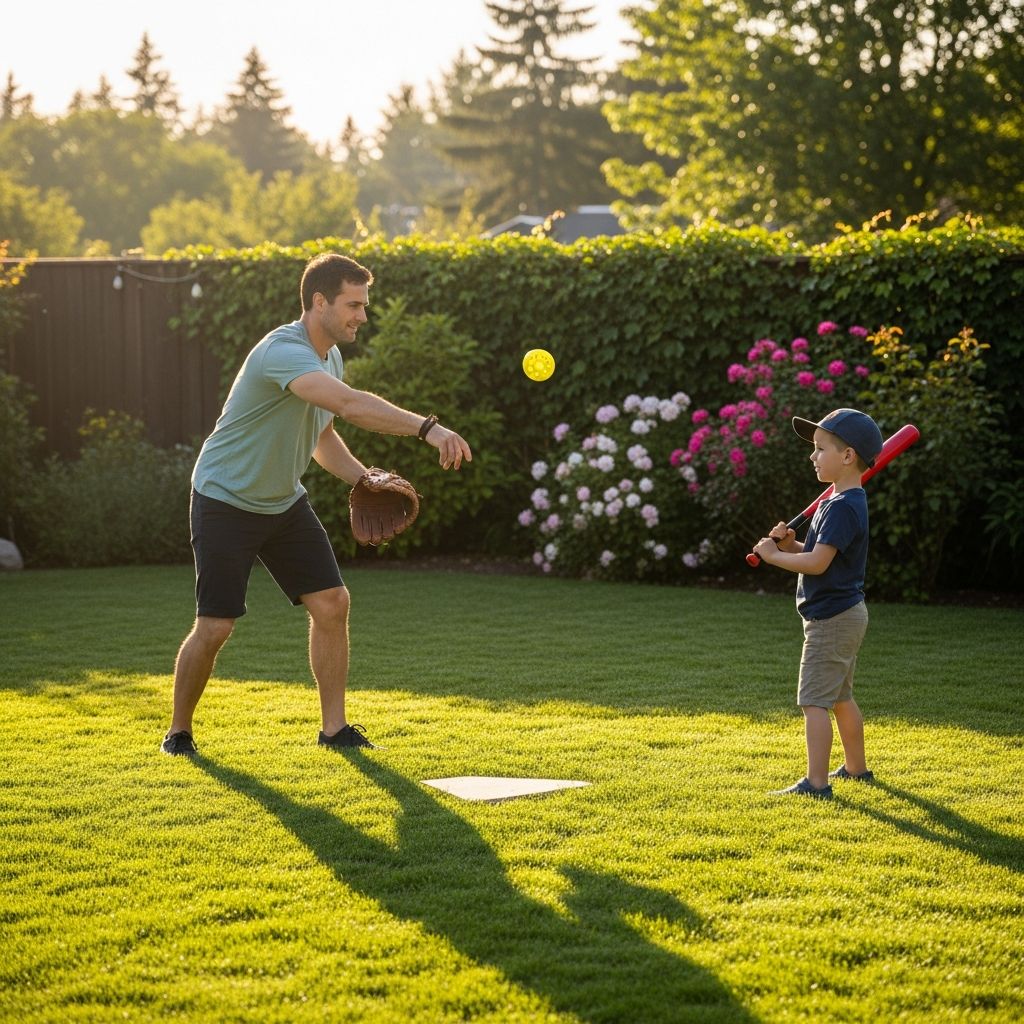
Wiffle ball turns any yard, driveway, or park into a miniature ballpark, and learning a few simple pitches can transform casual tosses into epic showdowns that kids talk about for days.
Why Wiffle Ball Is Perfect For Families
Wiffle ball is lighter and safer than a traditional baseball, which makes it ideal for small spaces, mixed age groups, and parents who do not want to worry about broken windows or bruised shins. The plastic ball’s holes create exaggerated movement, letting even beginners throw pitches that curve, rise, or drop dramatically and keep hitters laughing between swings.
Because the game is easy to modify with house rules, families can adjust distance, strike zones, and scoring so that younger kids stay engaged while older kids and adults still feel challenged. This flexibility turns pitching practice into a cooperative activity where everyone can learn together instead of a high-pressure performance.
Basic Wiffle Ball Setup And Safety
Before anyone starts experimenting with movement pitches, set up a safe and comfortable playing area with enough space behind the batter for a full swing and behind the pitcher for a natural follow-through. For most backyards, placing the mound around 30 to 40 feet from the strike zone keeps the game fun without making the ball impossible to hit.
- Use the classic, perforated plastic ball and a lightweight plastic bat.
- Avoid pitching directly toward windows, cars, or hard surfaces that might deflect the ball unpredictably.
- Agree on no headhunting: no intentional pitches aimed above the shoulders to keep the game relaxed.
Understanding How Wiffle Pitches Move
The secret behind wiffle ball magic is how air flows through and around the holes, which exaggerates the effect of spin compared with a solid baseball. When the pitcher releases the ball with different grips and wrist actions, the ball spins in unique ways that cause it to curve, rise, or dive as it approaches the plate.
For kids, it helps to think in three simple directions of movement: sideways (curves and sliders), upward (risers), and downward (drops and changeups). Each of the beginner-friendly pitches below focuses on one of these directions so young players can understand what they are trying to make the ball do before they worry about speed.
Four Kid-Friendly Wiffle Ball Pitches
The following four pitches are designed for beginners and families: one straight fastball and three movement pitches that build confidence without complicated mechanics. Parents can learn them quickly and then break them down into simple steps for younger children.
1. The Straight Control Pitch
This is the starter pitch that teaches kids to throw strikes consistently before they chase big movement. Focus on relaxed mechanics and accuracy rather than power so young arms stay healthy and players learn good habits early.
- Grip: Hold the ball gently across the widest part with the fingertips, not jammed into the palm.
- Arm path: Throw with a smooth, overhand motion like a regular toss, finishing with the throwing hand pointing at the target.
- Goal: Hit a large strike zone target (like a lawn chair or taped square) three times in a row before adding any spin.
2. The Gentle Curve
The gentle curve introduces sideways break with minimal extra stress on the arm, making it a natural next step after the straight control pitch. Kids love this pitch because it looks dramatic when it curls from one side of the plate to the other at the last moment.
- Grip: Turn the holes slightly to one side and place the pointer and middle finger together on the smooth plastic opposite the holes.
- Release: Keep the wrist firm and imagine “brushing” around the side of the ball as it leaves the fingers.
- Tip: Right-handed throwers aiming to curve the ball away from a right-handed hitter should start the ball near the inside corner of the plate.
3. The Backyard Riser
The riser looks like it is climbing a small invisible ramp as it nears the hitter, which feels almost like magic to kids seeing it for the first time. Because the ball is light, a combination of backspin and air catching the holes can make it jump upward instead of dropping like a normal pitch.
- Grip: Point most of the holes toward the ground and place two or three fingers across the top of the ball.
- Arm angle: Throw from a lower, sidearm slot, imagining that the ball is sliding off the fingertips while spinning backward.
- Target: Aim low in the strike zone or even just below it, trusting the spin and airflow to lift the ball up to the plate.
4. The Soft Drop Pitch
The drop pitch is the opposite of the riser, tumbling down late so hitters swing over the top of the ball and either miss or tap weak grounders. For young pitchers, it teaches the feel of topspin and pace control instead of pure speed.
- Grip: Hold the ball so the holes face the batter and keep the fingers mostly on the smooth side to allow air into the perforations.
- Release: As the hand moves forward, gently roll the wrist over so the fingers finish in front of the ball, creating topspin.
- Speed: Throw this pitch slightly slower than the straight control pitch to give gravity and spin more time to pull it down.
Pitch Comparison At A Glance
Once kids understand each pitch, a quick visual comparison helps them decide which one to use in different game situations.
| Pitch | Main Movement | Difficulty (1–5) | Best Use |
|---|---|---|---|
| Straight Control Pitch | Minimal, slight late sink | 1 (easiest) | Learning accuracy, getting ahead in the count |
| Gentle Curve | Sideways break | 2 | Surprising hitters who crowd the plate |
| Backyard Riser | Upward climb | 3 | Two-strike pitch to aggressive swingers |
| Soft Drop Pitch | Late downward tumble | 3 | Inducing grounders and weak contact |
Simple Drills To Build Confidence
Short, game-like drills help kids absorb new pitches faster than long, repetitive throwing sessions that can lead to fatigue or frustration. Parents can act as catchers, umpires, and cheering sections all at once, turning practice into another chance to connect.
Target Ladder Drill
- Set up a large target such as a folding chair or strike zone net.
- Have the pitcher throw five straight control pitches; every strike earns one point.
- Once the child reaches 10 total points over a few rounds, introduce the gentle curve with the same scoring system.
Riser And Drop Challenge
- Draw or tape a horizontal line through the middle of the strike zone.
- Ask the pitcher to throw three risers that start below the line and finish above it.
- Then have them throw three drop pitches that begin above the line and fall below it, focusing on movement rather than speed.
Encouraging Healthy Mechanics
Because wiffle balls are light, kids may be tempted to snap their wrists violently or twist their elbows to chase extra movement, which can create bad habits over time. Parents should remind young pitchers that smooth, repeatable motions are more important than extreme spin, especially while they are still growing.
- Warm up with gentle throws before attempting movement pitches.
- Stop if the child reports elbow or shoulder pain and switch roles or activities.
- Limit total pitches in a session, especially for younger kids, to keep arms fresh and enthusiasm high.
Making It Fun: Games And Variations
Turning practice into mini-games keeps kids engaged and reduces the pressure to “master” every pitch immediately. Parents can design short contests that reward creativity, accuracy, or even the funniest strikeout celebrations.
- Call Your Pitch: The pitcher announces the pitch type before each throw and earns extra points for correctly landing the movement.
- Three-Pitch Showdown: Each batter gets only three swings; the pitcher chooses any combination of the four pitches to try to record an out.
- Family Tournament: Create simple brackets and swap pitchers often so everyone gets a turn to try movement pitches.
Frequently Asked Questions About Wiffle Ball Pitches
What age is appropriate to start learning wiffle ball pitches?
Most kids can begin throwing basic wiffle pitches around ages six to eight, as long as the focus stays on fun and gentle mechanics rather than speed. The key is to introduce one pitch at a time and keep overall throwing volume modest so young arms can adapt gradually.
Do wiffle ball pitches hurt a child’s arm?
When thrown with relaxed mechanics and reasonable limits on pitch counts, wiffle ball usually places less stress on the arm than heavier balls because of its low weight. Problems tend to appear only when kids throw too hard, too often, or use extreme twisting motions to force extra movement.
Can practicing wiffle pitches help with real baseball or softball?
Practicing wiffle ball can improve hand-eye coordination, pitch recognition, and basic throwing rhythm, all of which transfer well to baseball and softball. However, the exaggerated movement of wiffle pitches means players still need separate practice with regulation balls to fine-tune timing and mechanics for organized leagues.
How far should kids pitch from in the backyard?
A distance of around 30 to 40 feet works for most backyards, with younger children starting closer and gradually stepping back as they gain strength and control. Families can experiment with different distances until pitches feel challenging but not discouraging for both pitchers and hitters.
What if my child only wants to throw trick pitches?
It is natural for kids to fall in love with the most dramatic pitches, but parents can frame the straight control pitch as the foundation that makes every other pitch more effective. One helpful rule is that for every movement pitch thrown in a drill, the child must also throw at least one or two simple strikes to reinforce accuracy.
With a light plastic ball, a simple strike zone, and a handful of creative pitches, families can turn any open space into a playful training ground where kids learn skills, confidence, and a lifelong love of the game.