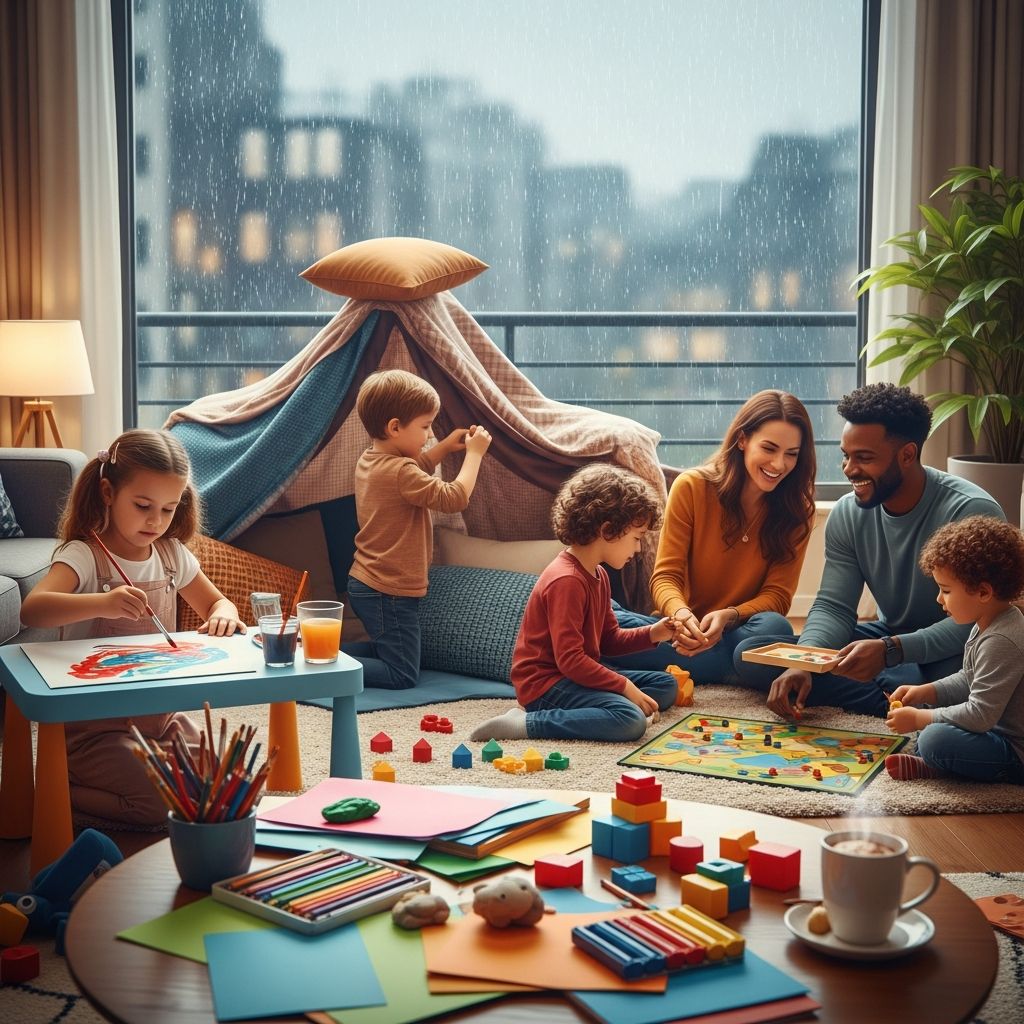
When the weather keeps your family indoors, you can still create a day that feels special, calm, and connected. With a bit of planning and a few household supplies, rainy days can become some of your children’s favorite memories.
Reframing Rainy Days as Family Time
Instead of viewing a rainy day as a ruined plan, treat it like an invitation to slow down and enjoy being together. Children often remember the simple rituals of home—blankets on the floor, warm snacks, and silly games—far more than perfectly planned outings.
Use these quiet hours to focus on connection rather than productivity. If expectations are clear and activities are varied, kids are less likely to spiral into boredom, while adults feel less overwhelmed by constant entertainment duties.
Setting the Scene: Cozy, Calm, and Play-Ready
Before you dive into specific activities, spend a few minutes creating a welcoming environment. A cozy, organized space makes it easier for kids to stay engaged and reduces the chaos that often builds up on long indoor days.
- Gather a few blankets, pillows, and cushions in one central area to create a “rainy day hub.”
- Place a small basket with basic supplies nearby: paper, crayons, tape, scissors (age-appropriate), and a deck of cards.
- Lower the overall noise level by turning off background TV and using soft music or nature sounds instead.
- Keep snacks simple and self-serve when possible so kids can refuel without constant interruptions.
Quick-Start Ideas by Age Group
Not every activity fits every age. Use this simple table as a starting point, then adapt based on your child’s personality and energy level.
| Age Range | Low-Energy Ideas | High-Energy Ideas |
|---|---|---|
| Toddlers (1–3) | Simple sensory bin, sticker play, board books in a blanket nest | Pillow obstacle course, balloon chase, tunnel made from chairs |
| Preschoolers (3–5) | Playdough bakery, toy wash station, storytime theater | Indoor scavenger hunt, dance freeze, mini relay races |
| Early Elementary (6–8) | Comic-making, simple card games, build-your-own puzzle | Spy training course, yoga challenge, cooperative board games |
| Tweens (9–12) | Writing a mini-book, basic coding or puzzles, simple baking project | Indoor sports skills practice, timed house challenges, group charades |
Imaginative Worlds: Story-Driven Play
Imagination-based activities help kids dive deep into play without needing elaborate supplies. You can guide the story at first, then step back as they take over.
1. Home Adventure Quest
Turn your living space into a series of themed “lands” that kids must travel through to complete a mission.
- Choose a simple storyline, such as rescuing a stuffed animal, finding a magic key, or delivering a secret message.
- Assign each room a role: jungle, ice cave, spaceship, or library of clues.
- Place one easy challenge in each area: hopping on cushions, decoding a picture clue, or stacking blocks to reach an object.
- End with a tiny “treasure,” like a homemade certificate, sticker, or small snack.
2. Indoor Puppet or Toy Theater
Create a simple “stage” with a table, sofa back, or cardboard box and let kids’ favorite toys become the actors.
- Use socks, paper bags, or existing figurines as characters.
- Encourage kids to invent a beginning, middle, and end to their story.
- Offer a phone or camera to record the performance if that motivates them, but keep screens as tools rather than the main event.
3. Time Travel Afternoon
Pretend your family has stepped into another time period—past or future—and adjust your behavior accordingly.
- Pick a theme: dinosaurs, knights, explorers, space travelers, or future inventors.
- Talk and move as if you are really there: tiptoe past “sleeping dragons” (pillows) or float like astronauts.
- Draw “artifacts” or design “future gadgets” on paper and explain them to each other.
STEM and Learning Fun in Disguise
Rainy days are a great chance to sneak in learning through hands-on play. Kids often stay engaged longer when activities feel like experiments rather than lessons.
4. Kitchen Science Lab
Use everyday ingredients to explore basic scientific ideas in a playful way.
- Create a simple “sink or float” test with a bowl of water and small household objects.
- Mix baking soda and vinegar in a tray to watch fizzing reactions, adding food coloring for extra excitement.
- Play with melting and freezing by comparing ice cubes in different containers around the house.
5. Build-It Workshop
Encourage kids to design and build structures using materials you already have.
- Offer blocks, cardboard tubes, plastic cups, or clean recyclables as building supplies.
- Challenge them to construct the tallest tower, a bridge that can hold a toy car, or a “storm-proof” house.
- Ask questions about what worked, what collapsed, and how they might try again differently.
6. Mini Makerspace on the Table
Set up a small zone where kids can invent gadgets, toys, or “machines” from mixed materials.
- Place out tape, string, paper, cardboard scraps, and a few safe fasteners or clips.
- Invite children to build something useful: a phone stand, bookmark, or tiny marble run.
- Encourage them to write or dictate a short “instruction manual” for their creation.
Movement and Energy-Burning Games
When kids are stuck inside, physical play helps release pent-up energy and supports better moods for everyone. You don’t need much space to get bodies moving.
7. Hallway Olympics
Use a hallway or cleared space as the venue for simple, silly events.
- Events can include crab walks, hopping on one foot, sock slides, or balancing an item on your head.
- Time each participant with a kitchen timer to add a sense of challenge without heavy competition.
- Create homemade “medals” or achievement cards for completing all events.
8. Color or Shape Chase
This simple game works well for young kids who need structure and fun at the same time.
- Call out a color or shape and have children run to touch an object that matches it.
- For older kids, add categories like “something that smells nice” or “something that makes noise.”
- Rotate who calls out the next challenge to keep everyone engaged.
9. Calm-Down Yoga and Stretch Breaks
Balance active play with moments of stillness so the day doesn’t become overstimulating.
- Teach a few simple poses like tree, cat-cow, or child’s pose.
- Invite kids to inhale like they are smelling a flower and exhale like they are blowing out candles.
- Use dimmer lights or soft music for a short relaxation at the end.
Creative Arts, Crafts, and DIY Projects
Art projects do not need to be elaborate to be meaningful. Focus on open-ended activities that let kids explore materials rather than follow complex instructions.
10. Story-Inspired Art Table
Combine reading and creativity by turning a picture book into an art prompt.
- Read a short story or a few pages from a favorite book.
- Ask kids to draw their favorite scene, invent a new character, or redesign the setting.
- Display the finished pieces on a temporary “gallery wall” with tape.
11. Recycled Craft Challenge
Give new life to clean recyclables by inviting children to transform them into something imaginative.
- Gather boxes, cardboard, egg cartons, and paper rolls.
- Suggest themes such as “create a vehicle,” “design a tiny city,” or “build a creature.”
- Encourage kids to name their creations and explain how they work.
12. Simple Keepsake Projects
Use a rainy day to create something you might want to keep for years.
- Trace handprints and turn them into animals or flowers with markers.
- Help older kids write a letter to their future self and tuck it away in a safe place.
- Create a small “rainy day journal” where family members can write or draw one memory from the day.
Cozy Kitchen Moments and Snack Rituals
Cooking or preparing snacks together gives kids a sense of responsibility and comfort. Even very young children can help in small ways, and the results are almost always appreciated.
13. Build-Your-Own Snack Bar
Instead of preparing everything yourself, set out components kids can assemble into their own creations.
- Offer simple options such as crackers, fruit slices, cheese, or yogurt with toppings.
- Provide small bowls and let each child design their own “snack plate” or “parfait.”
- Use this time to model conversation skills by sharing highlights of the day so far.
14. No-Bake Treat Session
Choose recipes that rely on mixing, spreading, or layering rather than cooking, especially with younger kids.
- Let children stir ingredients, sprinkle toppings, or press mixtures into pans.
- Talk about textures, smells, and tastes to build sensory awareness.
- Enjoy the finished treats during a movie, storytime, or quiet game later in the day.
Screen-Time with Intention
Completely avoiding screens may not be realistic, and that’s okay. The key is to use them intentionally so they support connection instead of replacing it.
- Plan a specific window for a family movie or educational show, and treat it like an event rather than a default activity.
- Co-watch when possible and talk about characters, choices, and feelings to deepen understanding.
- Balance screen segments with hands-on play before and after.
Simple Structure: Building a Rainy Day Rhythm
Kids thrive on predictable patterns, especially when outdoor time is limited. A loose structure can keep the day from drifting into boredom or conflict.
Instead of scheduling every minute, think of the day in short “blocks” that mix quiet, active, and creative time.
- Morning: Movement game + simple art activity.
- Midday: Snack prep together + independent play or reading.
- Afternoon: STEM or building challenge + cozy storytime or movie.
- Evening: Family game or reflection + tidy-up game before bed.
FAQs: Making the Most of Rainy Days with Kids
How do I keep kids from getting bored too quickly?
Offer a mix of short activities rather than one long project, and rotate between active and calm options. Giving kids choices within clear boundaries helps them feel in control while you still guide the flow of the day.
What if I have kids of different ages?
Choose activities with layers: younger kids can participate in simple ways while older children take on leadership roles. For example, during a scavenger hunt, older siblings can help read clues or design new ones for younger participants.
How can I involve kids who prefer screens?
Start with short, hands-on activities linked to their interests, such as drawing characters from a favorite show or building a set from a movie. Gradually extend the off-screen time by making these activities collaborative and fun for the whole family.
What if I feel too tired to organize elaborate games?
Focus on simple setups: a stack of books and a blanket, a basket of blocks on the rug, or a deck of cards at the table. Many of the best rainy day memories come from low-prep moments where the focus is on being together, not on perfection.
Turning Grey Skies into Bright Memories
Rainy days do not have to feel like lost time. With a few flexible ideas and a willingness to slow down, you can turn indoor hours into a mix of laughter, learning, and quiet connection.
Over time, these small rituals—shared snacks, blanket forts, homemade experiments, and silly games—become part of your family’s story, proving that special memories are not dependent on the weather outside.