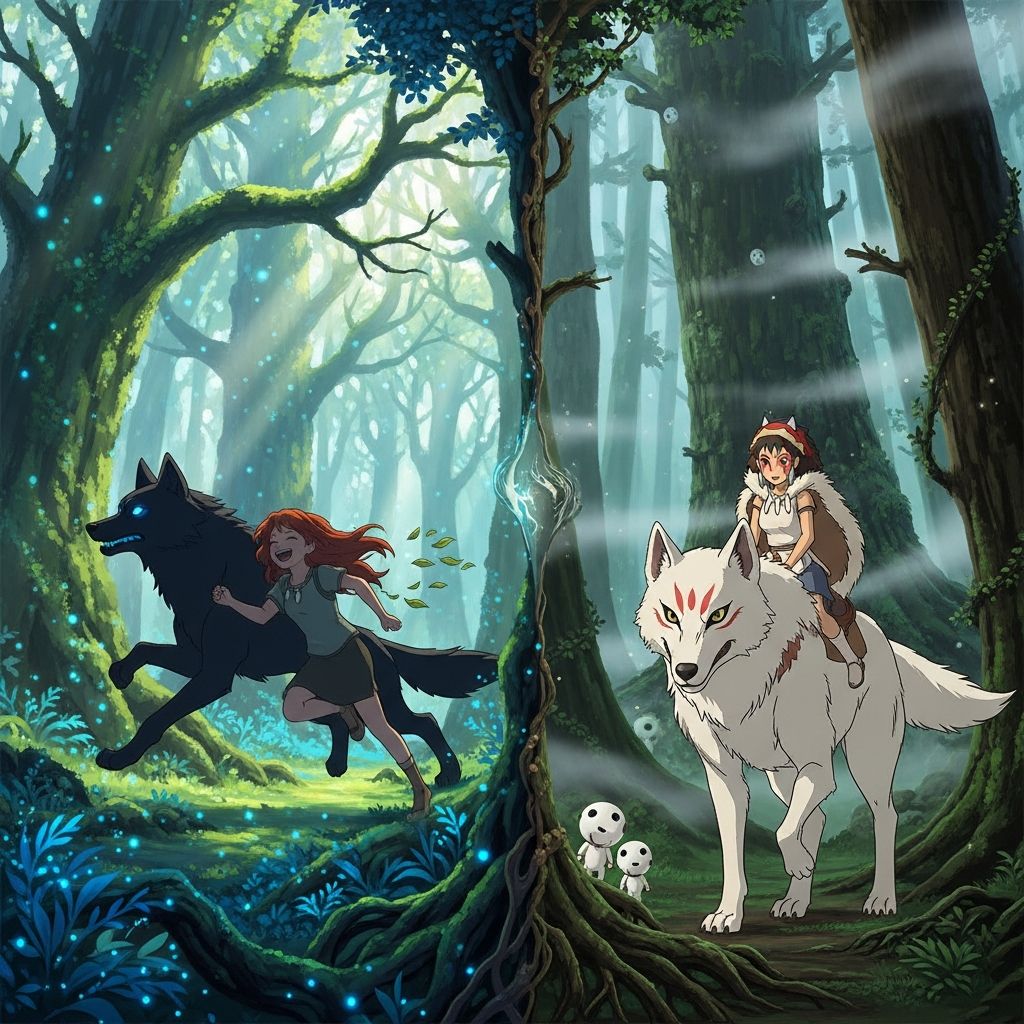
On the surface, Wolfwalkers and Princess Mononoke could not be more different: one is a hand-drawn Irish adventure about a hunter’s daughter, the other a sweeping Japanese epic filled with gods and curses. Yet both films place a wild girl and a haunted forest at the center of a struggle between human ambition and the living world.
Rather than treating these movies as competitors, it is far more useful to see them as companions. Together, they give families a powerful way to talk about nature, fear, friendship, and the complicated systems kids are growing up inside.
Two Stories, One Shared Howl
Both films follow a young outsider who befriends a wild girl deeply connected to wolves, then finds themselves pulled between loyalty to human society and responsibility to the forest. That shared setup gives kids something emotionally familiar to hold onto while each film explores very different tones, cultures, and ideas.
In both worlds, wolves are more than animals. They are guardians, symbols of resistance, and mirrors for how far humanity has drifted from the ecosystem it depends on. When a child aligns with the wolves, that child is choosing not just a side in a conflict, but a way of seeing the world.
Why Wolf Girls Resonate With Kids
The most striking shared element is the figure of the wolf girl: fierce, loyal, and uncompromising. Kids encounter a kind of courage in these characters that goes beyond polite bravery; it is the courage to reject unjust rules, even when doing so risks isolation or punishment.
These girls embody a freedom that many children sense but rarely see validated in media. They move through trees instead of streets, listen to wind instead of orders, and treat the forest as family rather than scenery. That wildness speaks to kids who are learning that obedience does not always equal goodness.
Nature Is Not Just a Backdrop
In both films, the forest is not a neutral setting. It is an active force that can nurture, frighten, or fight back. This portrayal helps kids unlearn the idea that nature is a passive resource waiting to be used. Instead, the forest becomes a character with boundaries and needs of its own.
When trees crash, rivers flood, or wolves converge, these events are not random disasters. They are responses to human choices. Kids watching learn, sometimes unconsciously, that ecosystems react to pressure the same way people do: they adapt, resist, or collapse.
Industry, Empire, and Everyday Rules
Although both movies show humans attacking the forest, the reasons behind that attack matter. Each film links environmental destruction to broader systems of control—whether that means political power, economic expansion, or religious certainty. Children see that bulldozers and muskets rarely arrive alone; they come with laws, uniforms, and justifying stories.
This connection helps kids understand that environmental issues are not only about litter or recycling. They are about who makes decisions, whose fears get amplified, and which lives are considered expendable. The wolf girl and the child protagonist stand at the fault line where those decisions become visible.
Fear As a Tool of Control
Adults in these films often rely on fear to keep order. Wolves are framed as monsters, the forest as chaos, and obedience as the only path to safety. For a young viewer, this looks uncomfortably similar to real-life messaging: stay inside, follow the rules, trust authority without question.
Crucially, both movies reveal how easily fear can be manipulated. The more frightened the townspeople become, the easier they are to steer toward violence. Kids watching learn that fear is not just a feeling; it can be used to build walls and justify harm.
How Children Learn to Question
The central human child in both stories starts out aligned with authority. They trust parents, leaders, and the social order they were born into. The turning point comes not through argument, but through friendship with someone the system has labeled dangerous or unworthy.
By making the heart of the story a relationship instead of a lecture, the films model a powerful idea: genuine contact with the “other” can transform how a child sees everything. Conversation around these films can help kids see that kindness across social lines is not just nice—it is politically meaningful.
Different Audiences, Different Temperatures
While the themes overlap, the emotional temperature of the two movies is very different. One leans toward a gentler, more family-friendly tone, even at its darkest moments. The other wades into bloody battles, moral ambiguity, and genuinely terrifying imagery.
This contrast makes the films complementary in a family’s media journey. Younger kids can start with the warmer, more straightforward story, then graduate to the harsher and more complex film when they are ready for shades of gray and open-ended questions.
Table: How the Two Films Speak to Kids
| Element | Wolfwalkers | Princess Mononoke |
|---|---|---|
| Tone | Gentler, storybook-like, more suitable for younger kids. | Darker, intense, better for older kids and teens. |
| Violence | Threat and action with limited graphic detail. | Severed limbs, blood, and war imagery that can be disturbing. |
| Morality | Clearer sense of who is in the wrong and who needs to change. | Multiple sides have valid motives, and no one is entirely innocent. |
| Cultural roots | Steeped in Irish history, folklore, and religious tension. | Grounded in Japanese myth, Shinto ideas, and historical echoes. |
| Wolf girl’s role | A bridge to acceptance, healing, and a new community. | A fierce defender who never fully submits to human rules. |
Culture Shapes How We See the Wild
Because the films grow out of different cultures, they imagine the forest and its spirits differently. One roots its magic in Celtic-inspired imagery and religious conflict; the other in Japanese spiritual traditions and industrial revolution anxieties. To kids, that means two distinct ways of picturing the sacredness of the non-human world.
Watching both broadens a child’s sense of what environmental care can look like. Protection of nature is no longer just a local or national concern. It becomes something people all over the globe wrestle with, filtered through language, myth, and history.
Friendship as Environmental Education
Neither film preaches directly about climate change or conservation. Instead, they attach the health of the forest to the fate of characters kids love. When the woods suffer, the wolf girl suffers. When smoke rises, friendships are put at risk. The emotional stakes do the teaching.
This approach aligns with what many parents instinctively know: children protect what they feel connected to. Stories that invite them to care about specific trees, animals, and rivers can be more impactful than abstract warnings about the future.
Rage, Grief, and Forgiveness
Both wolf girls carry anger that is not neat or polite. They rage against hunters, settlers, and the people who burned their homes. Seeing this fury onscreen is important for children who have been taught to keep intense emotions out of sight.
Yet neither story stops at rage. Each explores what happens when hatred hardens into a desire for revenge, and how difficult—but necessary—it can be to step back from total destruction. Families can use these moments to talk about justice, accountability, and the limits of forgiveness.
How Parents Can Use These Films
Parents who watch alongside their kids can turn these movies into the starting point for empathetic, age-appropriate conversations. It helps to focus less on plot details and more on how characters feel and why they make the choices they do.
- Pause after a tense scene and ask, “Who do you feel sorry for right now, and why?”
- Invite kids to imagine what the wolves might say if they could speak directly to the town or the village.
- Compare the forests to real places your family knows: a park, a hiking trail, even a single tree on the walk to school.
Choosing the Right Age and Order
Because one film is significantly more intense than the other, many families find it helpful to treat them as steps rather than interchangeable options. Starting with the lighter, more accessible story allows younger viewers to get used to the core ideas without being overwhelmed.
Later, when kids are ready for murkier morality and more disturbing images, the heavier film can deepen and complicate what they have already learned. Seen in this order, the two movies feel less like versions of the same tale and more like a growing conversation across childhood.
Beyond the Screen: Turning Stories Into Action
One of the most powerful follow-ups to either film is concrete engagement with the natural world. That does not require an ancient forest; a backyard, a balcony planter, or a city playground can all become sites of noticing and care. The key is to frame these spaces as living communities rather than just backdrops.
- Encourage kids to keep a “wolf girl journal” where they track birds, insects, and plants like a guardian of a small territory.
- Choose one small, manageable action—picking up trash, planting pollinator-friendly flowers, or reducing food waste—and connect it to the idea of defending the forest.
- Talk about local environmental issues in kid-friendly terms, linking them to the themes in the movies: Who is making decisions? Who is affected? What would the wolves think?
FAQs
Is it necessary to watch both films?
No, each film stands on its own, but watching both offers a richer exploration of similar themes through different cultural lenses. Together, they show kids that love for nature and skepticism toward blind authority are not tied to one country or storytelling style.
Which movie should younger kids start with?
Families with sensitive or younger children often begin with the gentler, more straightforward story that handles danger and conflict in a less graphic way. The darker and more complex film can then serve as a second step for older kids ready to grapple with moral ambiguity and challenging images.
Are the wolf girls good role models?
They are not perfect, and that is part of what makes them valuable. Both wolf girls model bravery, loyalty, and deep care for the natural world, while also showing anger, impulsiveness, and distrust. This complexity helps kids see that being “good” does not mean being quiet or conflict-free.
How can these films support conversations about climate change?
Although neither movie uses modern environmental language, they both show the consequences of treating nature as expendable. Parents can use specific scenes—smoke over the trees, animals fleeing, poisoned landscapes—to bridge into real-world discussions about pollution, deforestation, and climate, always keeping the focus on empathy rather than guilt.
Do kids need to understand the historical context?
Younger viewers can enjoy both stories without knowing the exact history they echo. Older kids, however, may benefit from simple explanations of colonization, industrial expansion, or religious and political conflict. This context can turn the films into gentle entry points for talking about how humans have treated one another and the planet over time.
Seen together, Wolfwalkers and Princess Mononoke invite families to imagine a world where courage means more than swinging a sword. It means listening to the forest, honoring the wild girl who refuses to bow, and asking who benefits when fear drowns out compassion. For children growing up amid climate anxiety and social upheaval, that is a lesson as vital as any textbook.