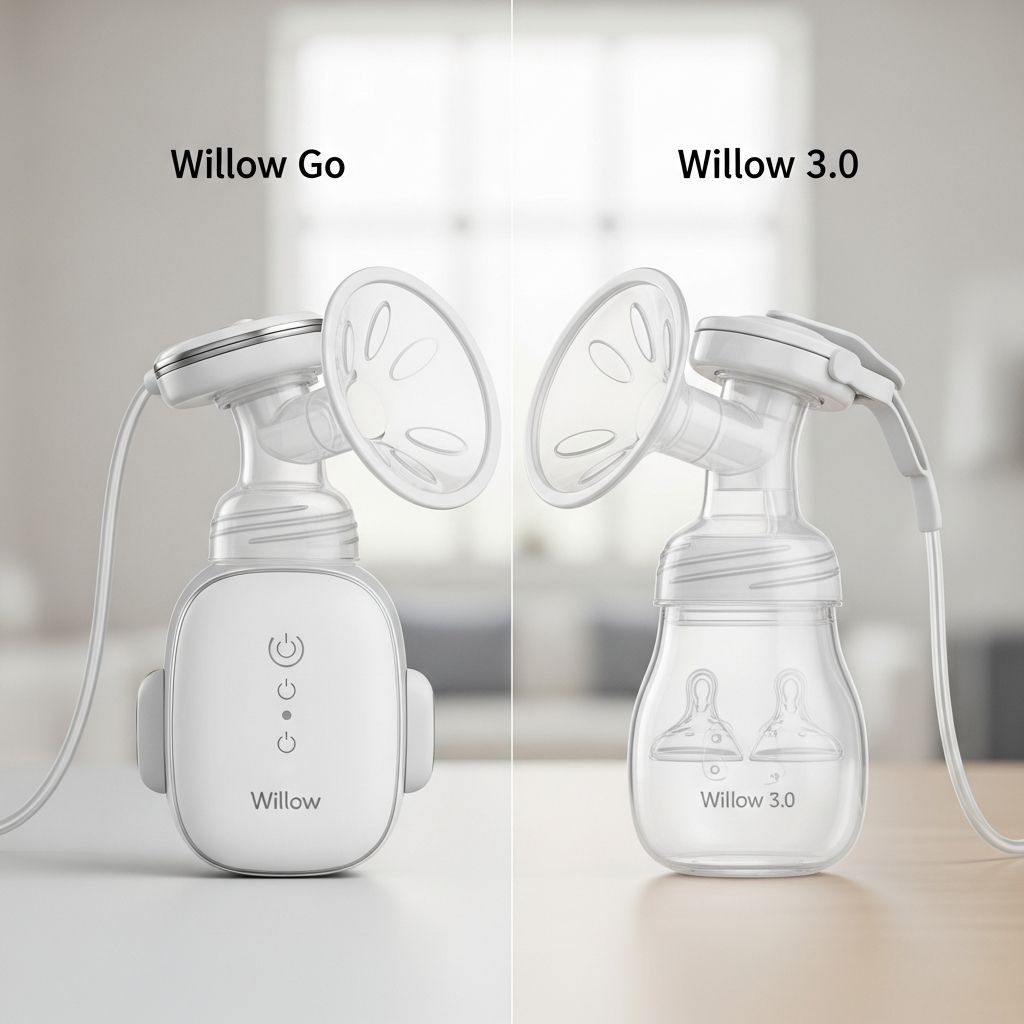
Wearable breast pumps have changed what feeding a baby can look like: you can sit in a meeting, ride in a car, or rock a toddler to sleep while quietly expressing milk inside your bra. Willow is one of the most recognizable names in this space, and many parents find themselves torn between the Willow Go and the Willow 3.0 (sometimes called Willow 360 in newer branding). Both are fully wearable, cordless pumps, but they are designed with slightly different priorities: one focuses on maximum mobility and spill-proofing, and the other on simplicity and value.
This guide breaks down the differences in plain language so you can match the right pump to your body, routine, and budget. All details are synthesized from high-quality comparisons and the manufacturer’s own documentation, with additional breastfeeding context from clinical and public health sources.
At a Glance: Key Differences Between Willow Go and Willow 3.0
| Feature | Willow Go | Willow 3.0 |
|---|---|---|
| Overall concept | Wearable pump focused on simplicity and lower price | Premium wearable pump engineered for leak-free movement |
| Mobility while pumping | Good for sitting, standing, light walking; must limit bending to reduce spills | Can bend over or recline when used with spill-proof bags |
| Spill-proof design | Not fully spill-proof; upright posture recommended | Marketed as leak-free when paired with proprietary bags |
| Milk collection options | Reusable containers only | Choice of disposable bags or reusable containers |
| Cup capacity | Typically 5 oz per side; higher-capacity cups available in some kits | About 4 oz per side whether using bags or containers |
| Pumping mechanism | Standard “tug and release” suction pattern | “Continuous latch” suction to support spill-proof pumping |
| App features | Core controls and basic session logging; no Apple Watch control | More advanced tracking, estimated milk volume, and Apple Watch control |
| Learning curve | Generally easier and more intuitive to assemble and use | More complex setup and troubleshooting, especially when optimizing for bags |
| Relative cost | Lower price point among Willow wearables | Premium price, plus potential ongoing cost of bags |
How Wearable Pumps Fit Into Evidence-Based Breastfeeding Care
The World Health Organization and major pediatric bodies encourage exclusive breastfeeding for about the first six months of life, then continued breastfeeding alongside complementary foods for up to two years or longer, as mutually desired. Many families rely on pumping—especially wearable pumps—to maintain milk supply while working, studying, or sharing feeding responsibilities.
Evidence from clinical and public health guidance highlights three priorities when choosing a pump:
- Comfort and correct fit to protect nipple and breast tissue and support effective milk removal.
- Consistency of pumping sessions to help maintain milk production, especially in the first few months postpartum.
- Practicality and ease of use, so the pump doesn’t become a barrier to continuing breastfeeding or expressing milk.
Both Willow Go and Willow 3.0 can align with these priorities when matched to the right user and used with proper flange sizing, which lactation professionals often recommend as a key factor in comfort and milk yield.
Mobility and Spill Protection: How Much Are You Moving While You Pump?
Willow 3.0: Designed for High-Mobility Pumping
The Willow 3.0 is built around spill-proof performance when used with proprietary milk collection bags. With this configuration, Willow markets the pump as allowing full freedom of movement—parents can bend over, reach down, or even recline without worrying that milk will pour out of the top of the cup.
- Ideal for: caregiving tasks that involve frequent bending (picking up toys, lifting older siblings), yoga or stretching, pumping in less predictable environments (commuting, travel).
- Trade-off: Using bags rather than containers adds an ongoing supply cost and creates extra waste.
When the Willow 3.0 is used with its reusable containers instead of bags, its leak protection is more in line with the Willow Go—still wearable and cordless, but not completely impervious to spills if you lean sharply or lie flat.
Willow Go: Wearable With Some Posture Limits
The Willow Go is also fully wearable and cordless, but it does not claim to be leak-free. The manufacturer and lactation professionals generally recommend staying more or less upright and avoiding fast, deep bending while pumping, since milk can escape from the top of the pump.
- Ideal for: pumping at a desk, on the couch, during quieter chores, or when you can stay mostly upright.
- Trade-off: If you need to chase a toddler, climb under desks, or do lots of floor work, you may feel limited.
If your daily life involves constant motion and many position changes, the 3.0’s leak-proof bag option can be worth the extra complexity. If your pumping happens mostly during predictable, relatively still moments, the Go’s posture limits may not be a problem.
Suction Style, Comfort, and Milk Yield
Different Pumping Mechanisms
Most electric breast pumps use a rhythmic pattern often described as “tug and release”—the pump pulls the nipple into the flange tunnel, compresses the ducts to draw out milk, then releases before repeating. The Willow Go follows this familiar pattern.
The Willow 3.0 instead uses a so-called continuous latch approach. The pump maintains more constant suction rather than fully releasing between cycles, which is essential for keeping the system sealed and spill-proof when using milk bags.
How That May Feel in Real Use
Comfort is highly individual, and there is no single pattern that works best for everyone. Some users find that standard tug-and-release suction feels more like a traditional pump and may draw milk slightly more efficiently for them. Others appreciate the more constant feel of continuous latch once they adapt.
- Willow Go: May be easier to tolerate for people already used to conventional pumps with a rhythmic pattern.
- Willow 3.0: May take a few sessions to get used to the continuous suction sensation, but it is integral to the spill-proof design.
Some comparison testers and lactation professionals note that individual users sometimes observe slightly better output with one model over the other, underscoring that anatomy, flange sizing, and schedule matter as much as pump brand. International lactation guidance also stresses that effective milk removal and adequate frequency (rather than brand alone) are what protect supply.
Capacity, Containers, and Managing Stored Milk
How Much Milk Can Each Pump Hold?
Capacity can matter if you produce larger volumes per session or if you want fewer interruptions while pumping.
- Willow 3.0: Holds about 4 oz (roughly 120 mL) per side whether you are using bags or reusable containers, for around 8 oz total before you must stop and swap.
- Willow Go: Common kits collect about 5 oz (roughly 150 mL) per side, and higher-capacity cups (up to around 7 oz) may be available, for a potential total of 10–14 oz in one session.
For parents who frequently pump large volumes, the Go’s larger cup options can reduce the chance of hitting maximum capacity mid-session. Those who typically produce smaller amounts may not notice a difference.
Bags vs Reusable Containers
The two models also differ in how they collect and store milk:
- Willow Go uses reusable containers only. You transfer milk to separate storage bags or bottles after pumping. This reduces single-use plastic but requires more pouring and washing.
- Willow 3.0 offers two options: proprietary disposable bags or reusable containers. The bags allow spill-proof mobility but add cost and waste; containers behave more like the Go’s setup and are reusable.
Health authorities emphasize safe milk storage—keeping expressed milk at appropriate temperatures and avoiding repeated warming and cooling cycles—to protect nutrients and reduce bacterial growth. Whether you choose bags or containers, plan a system for labeling dates, rotating your milk stash, and following evidence-based storage guidelines.
Apps, Data, and Smart Features
Willow 3.0: More Advanced Tracking
The Willow 3.0 is designed for parents who like data and remote control. According to detailed reviews and the manufacturer’s specs, the app can:
- Start and pause pumping sessions.
- Adjust suction levels.
- Estimate milk volume in real time while you pump.
- Log sessions with time stamps and approximate output.
- Connect with an Apple Watch for discreet in-shirt adjustments.
This can be helpful for those who want to closely track production over time, watch for dips in supply, or avoid overfilling bags.
Willow Go: Core Controls Without All the Extras
The Willow Go also connects to an app, which now allows in-app control of suction and mode. However, its tracking features are more limited. It generally focuses on:
- Starting and stopping the pump.
- Adjusting suction settings.
- Basic logging of session dates and times, with simpler output tracking.
If you like technology but do not need deep data analytics, the Go’s simpler app may be sufficient—and slightly less overwhelming when you are already juggling a newborn.
Cleaning, Parts, and Everyday Maintenance
Every pump requires regular cleaning of the parts that contact milk to reduce bacterial growth and protect your infant’s health. Public health agencies like the U.S. Centers for Disease Control and Prevention outline clear steps for washing breast pump parts—rinsing, washing in warm soapy water, and fully air-drying between uses, with occasional sanitizing for infants at higher risk.
Number of Parts
- Willow 3.0: When using bags, there are relatively few milk-contact parts, often reported as two main components to clean on each side. When using containers, assembly and disassembly are slightly more involved but still streamlined compared to some traditional pumps.
- Willow Go: Typically has more individual components to wash—often counted around five parts per side—although they are straightforward in shape and easier to see and reach inside.
Some experienced users find the Go mechanically simpler, while others appreciate the 3.0’s fewer parts when using bags. Think about which trade-off matters more to you: fewer pieces overall versus pieces that feel more intuitive to assemble and scrub.
Noise, Discretion, and Comfort in Public
Both Willow pumps are marketed as discreet, but there are nuance differences:
- Noise: Third-party tests report that Willow 3.0 can be a bit quieter in some conditions, whereas the Go is described as quiet but not silent. Some reviewers note a more mechanical clicking sound with the 3.0 and a smoother hum with the Go.
- Profile under clothing: Because both are self-contained cups, you can expect some visible fullness in your bra. Precise profile depends on your bra size and clothing.
- Comfort: Comfort feedback is mixed and individualized. Some lactation specialists report that users find the Go easier to fit correctly, while the 3.0 can be less forgiving of improper flange sizing.
Locking in the right flange size and suction level matters more for comfort than the model name. If possible, work with a lactation consultant to measure your nipple diameter and check fit—professional support has been shown to improve breastfeeding comfort and duration overall.
Budget, Warranty, and Long-Term Planning
Upfront and Ongoing Costs
- Willow 3.0: Positioned as a premium pump with a higher purchase price, plus recurring spending on proprietary milk bags if you rely on spill-proofing.
- Willow Go: Priced lower than the 3.0, with reusable containers that do not require special bags. Replacement parts (valves, flanges, containers) are still needed periodically, but ongoing costs may be lower.
Both pumps typically include a one-year warranty on the motor, which aligns with standard industry practice for electric breast pumps. Many families also explore whether insurance coverage or health savings accounts can offset costs, though details vary by plan and country.
Who Each Pump Is Best For: Quick Scenarios
- You might prefer Willow 3.0 if:
- You need to pump while moving vigorously, bending frequently, or reclining, and want maximum spill protection.
- You love detailed data, smart tracking, and the ability to control the pump from an Apple Watch.
- You are willing to pay more upfront and potentially buy bags regularly in exchange for flexibility.
- You might prefer Willow Go if:
- You usually pump sitting or standing relatively upright.
- You want a wearable pump that is more budget-conscious but still hands-free and portable.
- You prefer reusable containers and a setup that feels mechanically straightforward.
Either choice can be compatible with successful breastfeeding or exclusive pumping when paired with realistic expectations, support, and evidence-based pumping routines.
Frequently Asked Questions (FAQs)
Q: Is a wearable pump like Willow enough to maintain milk supply on its own?
A: For many parents, yes—if the pump is well-fitted and used often enough. International guidelines emphasize regular and effective milk removal, especially in the early weeks, to establish and maintain supply, whether at the breast, with a personal pump, or both. Some people still prefer a more traditional pump as a backup for certain situations.
Q: Which is better for exclusive pumpers, Willow Go or Willow 3.0?
A: Exclusive pumpers often value comfort, reliability, and cost efficiency because they pump many times per day. The 3.0 offers strong mobility and data-tracking advantages, while the Go has a lower price and simpler routine. The best choice depends on your budget, how much you move while pumping, and whether ongoing bag costs are acceptable.
Q: Can I share or buy a Willow pump secondhand?
A: Most wearable pumps are designed as single-user medical devices. Reputable health organizations note that used pumps can pose hygiene and safety concerns if milk or moisture reaches internal components that cannot be fully sanitized. Always check the manufacturer’s guidance and consider the potential risks before using secondhand equipment.
Q: How do I know if my flange size is correct?
A: An optimal fit usually means your nipple moves freely in the tunnel without excessive areola being pulled in, and there is no pinching, rubbing, or blanching. Lactation consultants and many hospital-based breastfeeding clinics can measure your nipples and recommend sizes. Correct sizing is associated with less pain and better milk removal.
Q: Is one of these pumps safer for my baby than the other?
A: Both Willow Go and Willow 3.0 are cleared as consumer breast pumps and, when used and cleaned according to manufacturer instructions and public health guidelines, are considered safe ways to express milk. The most important safety factors are proper hygiene, correct storage and handling of milk, and ensuring your baby is feeding enough overall.
References
- Go vs. 360 — Willow Pump. 2023. https://onewillow.com/pages/go-vs-gen-3
- Willow Breast Pumps: Product Comparison and Features — Willow Pump. 2023. https://onewillow.com/pages/willow-breast-pumps
- Willow 3.0 vs Willow Go — Exclusive Pumping. 2023. https://exclusivepumping.com/willow-30-willow-go/
- Willow Pump 3.0 and 360 vs Willow Go Pump — Genuine Lactation. 2023. https://www.genuinelactation.com/blog-for-breastfeeding-families/willow-pump-3-vs-willow-go-pump
- World Health Organization Recommendations on Breastfeeding — World Health Organization. 2023. https://www.who.int/health-topics/breastfeeding
- How to Keep Your Breast Pump Kit Clean — Centers for Disease Control and Prevention. 2022-10-19. https://www.cdc.gov/breastfeeding/recommendations/cleaning-pump.html