Word Party, the animated preschool series from The Jim Henson Company streaming on Netflix, is designed as an interactive vocabulary-building show for very young children, yet many adults find it oddly unsettling to watch. This contrast makes it an ideal case study for how modern toddler TV works—what it gets right for kids, and why it can feel so strange for grown-ups.
This article explores the show from a parent’s perspective: its educational goals, visual style, emotional tone, and the eerie elements that leave some caregivers creeped out, even while their toddlers are completely enthralled.
What Exactly Is ‘Word Party’?
Word Party is a short-form animated series where diaper-wearing baby animals—Bailey, Kip, Lulu, Franny, and later Tillie—play, argue, sing, and learn new words together. Episodes are about 12–15 minutes long, which fits common recommendations that toddler screen time, if used, be brief and structured.
| Feature | Details |
|---|---|
| Platform | Netflix streaming series |
| Target age | Babies and toddlers (roughly 1–4 years) |
| Main characters | Baby animal friends (panda, wallaby, cheetah, elephant, turtle) |
| Focus | Vocabulary, basic social skills, emotional awareness |
| Format | Interactive songs, direct address to viewers, repetition |
The show invites young viewers—referred to as the “big kids”—to help the animal babies learn new words, identify feelings, and solve tiny social problems. There are no on-screen adults, and the world is an almost featureless, brightly lit playspace, punctuated by toys, furniture, and a talking clock that cues the day’s activities.
Why Toddlers Love It: Design Choices That Work for Little Brains
From a developmental perspective, many of the show’s creative choices are surprisingly aligned with what experts know helps toddlers learn.
1. Repetition, Rhythm, and Simple Language
Repetitive songs, predictable phrases, and slow speech patterns can be powerful tools in early vocabulary development. Language researchers have found that children learn new words more effectively when they are heard repeatedly in meaningful, engaging contexts. Word Party centers each mini-story around a small set of target words, repeating them in songs, dialogues, and visual gags.
- Key words are emphasized several times in one episode.
- Characters label objects and actions out loud (“This is soft,” “That is loud”).
- Short, simple sentences mirror how adults typically speak to toddlers.
This heavy repetition may be excruciating to adults, but for a two-year-old, it can be exactly the level of redundancy that supports learning.
2. Emotional Literacy and Social Skills
Many episodes revolve around tiny conflicts—sharing toys, waiting for a turn, or apologizing when someone is hurt. The characters model:
- Recognizing and naming feelings (“sad,” “mad,” “frustrated”).
- Responding to a crying friend with comfort rather than ignoring them.
- Trying out phrases like “I’m sorry” and “Can I have a turn?”
Early childhood organizations emphasize that learning to label feelings and practice empathy is just as critical as learning letters or numbers. By slowing down conflicts and dramatizing repairs, the show gives young children examples of how to move from meltdown to resolution.
3. Low-Stimulation Visuals and Simple Plots
Compared to many fast-cut, high-noise children’s videos common on user-generated platforms, Word Party is relatively calm. The animation is bright but not chaotic, and scenes hold for longer than in many modern cartoons. That matters because rapid pacing and constant sensory overload can be overwhelming for toddlers who are still learning to filter input.
Parents frequently report that the show’s gentle pace holds their child’s attention without revving them up the way some more frenetic content does. That calm can be a genuine advantage if you are trying to avoid overstimulating your child close to nap or bedtime.
4. Encouraging Participation
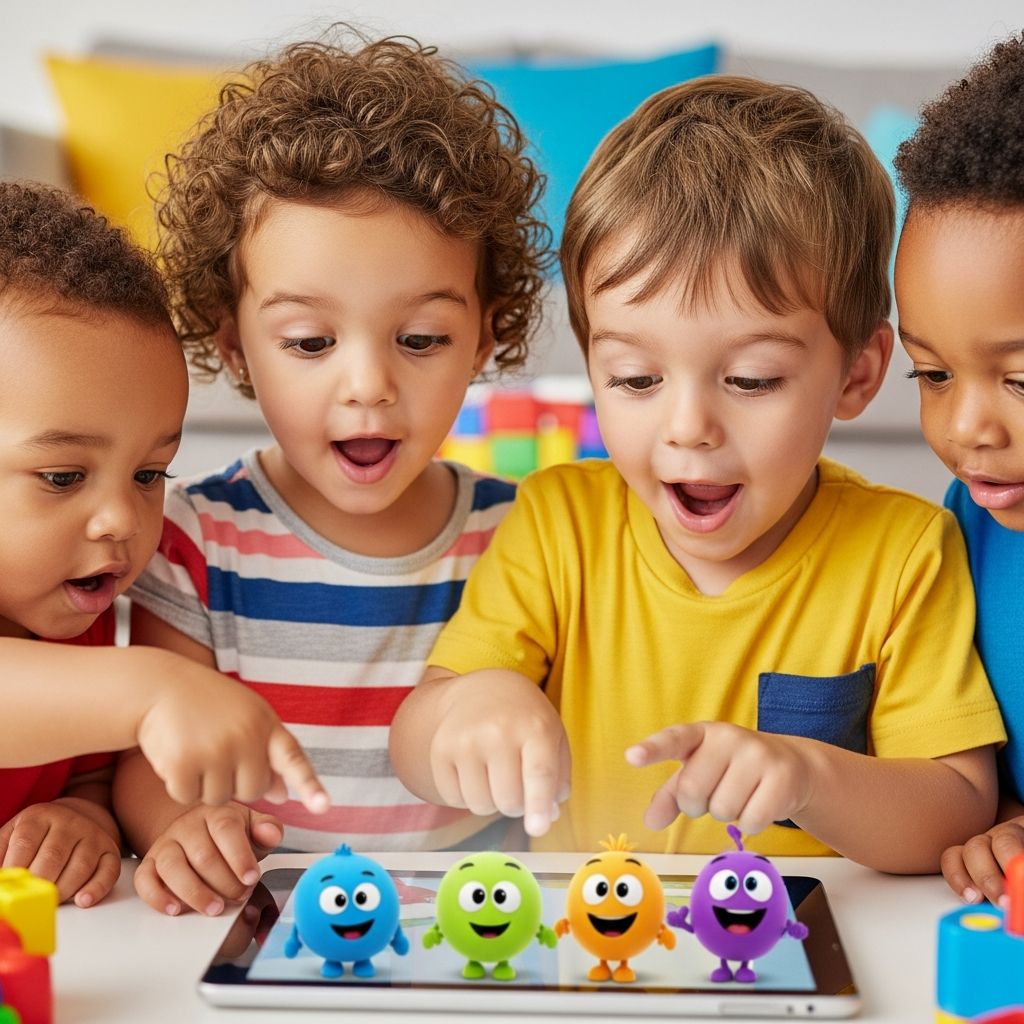
The characters often pause to ask the viewer to point, repeat a word, or demonstrate an action. Research suggests that interactive conversation—where adults and children take turns—is a key driver of language growth, even more than passive exposure to words. While TV can never fully mimic a real back-and-forth, shows that purposely build in response time may support more active engagement than non-interactive cartoons.
Why Adults Find It Creepy: The Uncanny Side of the Party
Many caregivers report that watching Word Party alongside their children gives them a vague sense of discomfort or even dread, despite the show’s cheerful tone. Several qualities often come up in these reactions.
1. The Uncanny Digital Puppetry
The show uses a digital puppetry technique where performers control the characters in real time, blending aspects of puppets and CGI animation. This can produce very expressive faces and eye movements—but for adults, those expressions sometimes fall into the “uncanny valley,” where something looks almost human but not quite, triggering discomfort.
- Extended eye contact with the viewer can feel intense or intrusive.
- Overly smooth movements combined with baby-like proportions look slightly off.
- The characters’ fixed smiles can read as forced rather than natural.
While toddlers may not notice any of this, adults are highly attuned to subtle social cues in faces, so near-human animation can easily feel eerie rather than endearing.
2. A World Without Adults in a White Void
There are essentially no visible adult caregivers in the show’s world. The babies are alone together in a bright, featureless environment—mostly white, with colorful objects dropped in almost like a laboratory setting. Occasionally, a disembodied adult voice addresses them from nowhere, guiding or narrating.
To a toddler, this is just the normal backdrop of the series. To an adult, it can feel like:
- A staged experiment where someone is watching from behind a one-way mirror.
- A surveillance scenario in which an unseen authority monitors the babies’ every move.
- An oddly sterile, context-free world with no family, home, or outside community.
The absence of concrete surroundings—no kitchen, backyard, or classroom—removes comforting details that usually signal safety and belonging in children’s stories.
3. The All-Seeing Clock and the Disembodied Voice
A central figure in the series is an animated clock that announces when it is time to play, snack, nap, or learn. A separate adult voice sometimes provides instructions or explanations. Because no adult body ever appears, it can feel as though all authority flows from these abstract, omnipresent forces.
For adults, this setup can evoke dystopian overtones: rules handed down from an invisible ruler, constant observation, and a cheerful insistence that everyone follow the schedule perfectly. Again, toddlers take it at face value: it is simply how they know when snack time starts.
4. Extreme Cheerfulness and Emotional Narrowness
Although the characters briefly experience negative emotions—sadness, frustration—the world of Word Party quickly resolves everything back to harmony and joy. For adults, that constant sweetness can feel emotionally thin or even suffocating. Real family life is messier and less scripted; seeing every conflict neatly wrapped in a musical bow can make the show feel more artificial than comforting.
The Educational Upside vs. the Psychological Weirdness
Parents often find themselves caught between two truths: their toddlers adore Word Party, and they themselves cannot stand watching it. That tension raises an important question—does parental discomfort matter if the show appears developmentally appropriate for kids?
| For Toddlers | For Adults |
|---|---|
| Simple vocabulary lessons and repetition support word learning. | Dialogue can feel painfully repetitive and over-explained. |
| Slow pacing and calm visuals reduce overstimulation. | The empty white world feels artificial, sterile, even experimental. |
| Emphasis on sharing and empathy promotes prosocial behavior. | Always-happy tone may come across as shallow or saccharine. |
| Interactive prompts invite participation rather than passive viewing. | Direct eye contact and address can feel uncomfortably intense. |
Major pediatric organizations emphasize that if screen time is used, it should be high-quality, age-appropriate, and ideally co-viewed with an adult who can talk about what is happening on the screen. In that sense, Word Party checks several important boxes: it is simple, educational, non-violent, and focused on cooperation.
The unease adults feel often stems not from overtly harmful content, but from stylistic choices—animation style, world-building, and mood—that speak more to grown-up sensibilities than to child development. As long as parents remain actively involved and screen time stays limited and intentional, that discomfort does not necessarily translate into harm for toddlers.
Practical Tips for Parents Considering ‘Word Party’
If your child has discovered—or is about to discover—this show, here are some strategies for using it thoughtfully.
1. Treat It as a Tool, Not a Babysitter
- Use episodes in short bursts (one or two at a time), aligned with guidance that screen time for children aged 2–5 be limited and planned.
- Reserve it for moments when you genuinely need a quick break, rather than leaving it on for hours.
2. Co-View When You Can—Even If It Creeps You Out
Watching with your child gives you a chance to translate on-screen moments into real-life learning:
- Pause when a character feels upset and ask, “How do you think they feel?”
- Repeat key words with your child and point to real objects that match.
- Later, reference the show: “Remember when they had to share the blocks?”
Shared viewing also lets you monitor how your child is reacting and decide whether the tone and style truly feel right for your family.
3. Balance It with Real-World Play and Conversation
Even the best-designed show cannot replace live interaction. Experts consistently note that real-life talk, reading, and play are more powerful drivers of development than screen exposure alone.
- Use new words from the show in daily routines (“Let’s find something soft to cuddle”).
- Encourage pretend play that echoes, then expands on, the characters’ adventures.
- Make sure screens are off during family meals and before bedtime.
4. Listen to Your Gut (and Your Child)
If the show genuinely unsettles you or your child seems agitated afterward, it is reasonable to switch to another series. There are many preschool shows that support language, kindness, and curiosity; your family does not have to click with every popular option.
On the other hand, if your toddler is calm, delighted, and starting to use new words, and you keep viewing within healthy limits, it is also reasonable to accept that Word Party might be one of those kids’ shows that is beneficial for them—even if it will never be your favorite background noise.
Sample Episode Experience Through a Parent’s Eyes
To illustrate what watching Word Party can feel like, imagine a typical viewing session:
- Your toddler spots the familiar intro music and runs to the screen, shouting the characters’ names.
- The babies discover a new object—say, a drum—and do not know the words “loud” and “quiet.”
- They turn to your child and ask for help, encouraging them to say the words out loud.
- Conflict arises when one character bangs too loudly, upsetting another; there are tears, apologies, and a lesson in taking turns.
- By the end, the words “loud” and “quiet” have been sung, chanted, and repeated a dozen times.
From your perspective, you may be hyper-aware of the long, unblinking gazes and the stark, empty background. From your child’s perspective, it is a bright, welcoming world where they are important, listened to, and invited to be the smart “big kid” who helps the babies learn.
Frequently Asked Questions (FAQs)
Is ‘Word Party’ appropriate for toddlers?
For most families, yes. It is gentle, age-targeted, and focused on vocabulary and social-emotional learning, aligning with expert recommendations that screen content for young children be simple, slow-paced, and prosocial.
Why does the show feel so creepy to me as an adult?
Many adults react to the uncanny animation style, the empty white environment, the lack of visible caregivers, and the intense direct address from baby characters. These design choices can trigger unease in grown-ups even though toddlers usually accept them without question.
Does watching ‘Word Party’ help my child learn real words?
It can contribute, especially when paired with real-life conversation. Research suggests children learn new vocabulary best through interactive talk and repetition; shows that repeatedly label words and encourage participation may support, but not replace, that process.
How much screen time is okay for a toddler watching this show?
Professional guidelines generally suggest avoiding screens (other than video chat) for children under 18 months, and keeping time for ages 2–5 to about an hour per day of high-quality content, ideally with adult co-viewing. Individual family needs and cultural contexts vary, so think in terms of balance and overall daily routines.
Are there better alternatives, or is ‘Word Party’ one of the good ones?
“Better” depends on your child and your values. Compared to fast-paced, ad-driven content, Word Party scores well on calm pacing, gentle themes, and educational focus. If it bothers you personally, you can look for other shows with similar educational aims but a style you find more comfortable.
References
- WORD PARTY Teaches Preschoolers Kindness, Empathy — Movieguide. 2021-03-02. https://www.movieguide.org/news-articles/word-party-teaches-preschoolers-kindness-empathy.html
- Word Party – TV Review — Plugged In / Focus on the Family. 2021-03-02. https://www.pluggedin.com/tv-reviews/word-party/
- ‘Word Party’ On Netflix Review: Good For Toddlers. Creepy For Adults — Fatherly. 2021-03-03. https://www.fatherly.com/play/word-party-review-toddler-show-netflix
- Media and Young Minds — Council on Communications and Media, American Academy of Pediatrics. Pediatrics, 138(5), e20162591. 2016-11-01. https://publications.aap.org/pediatrics/article/138/5/e20162591/60325/Media-and-Young-Minds
- Quality versus Quantity: The Role of Language Input in Vocabulary Development — Rowe ML. Child Development, 83(5):1762–1774. 2012-09-01. https://srcd.onlinelibrary.wiley.com/doi/10.1111/j.1467-8624.2012.01805.x
- Screen Time and Children — American Academy of Child & Adolescent Psychiatry. 2020-02-01. https://www.aacap.org/AACAP/Families_and_Youth/Facts_for_Families/FFF-Guide/Children-And-Watching-TV-054.aspx