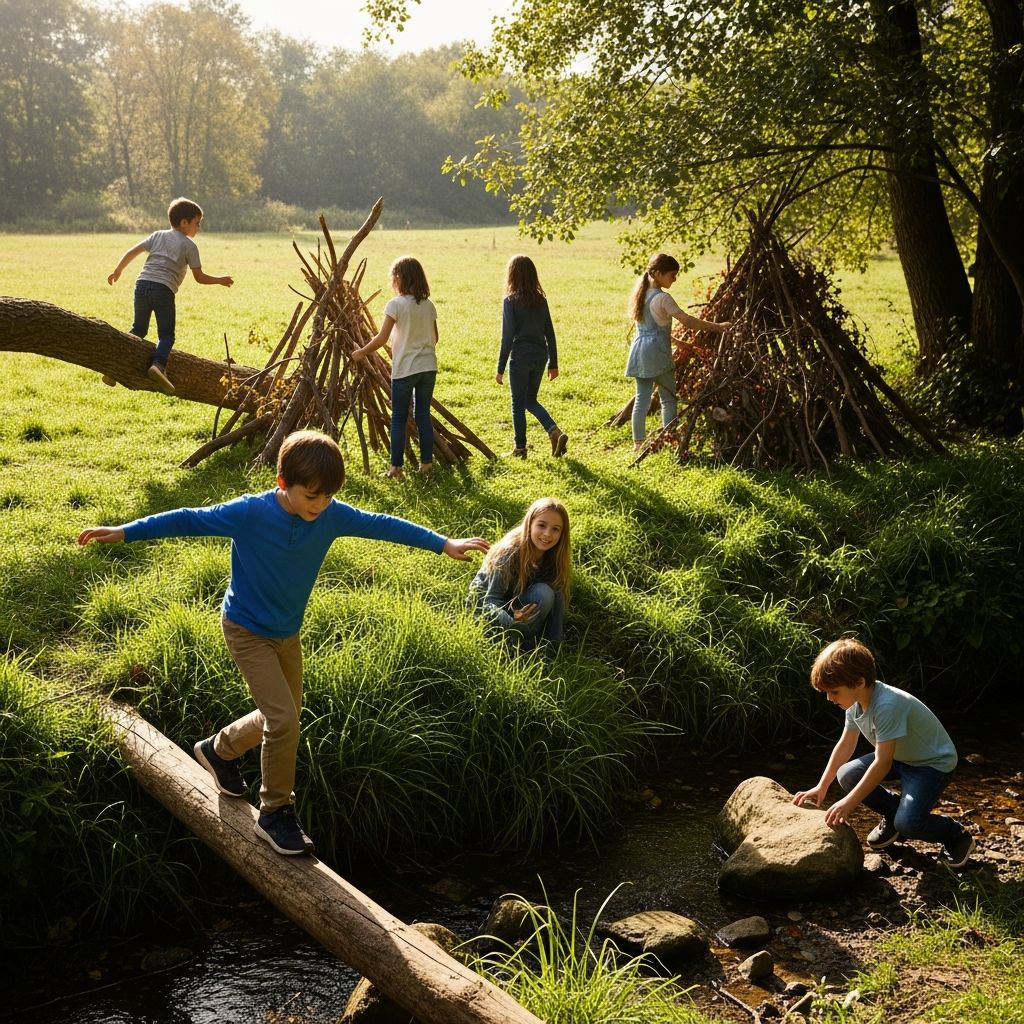
Allowing children to engage in unsupervised outdoor play is essential for their holistic development. This type of free exploration in natural settings builds physical prowess, emotional strength, social bonds, and cognitive sharpness, far beyond what structured activities offer.
Building Robust Physical Health Through Free Exploration
Free outdoor play naturally promotes vigorous activity that strengthens young bodies. Children running across fields, climbing trees, or balancing on logs develop superior motor skills, including agility, coordination, and endurance.
Such activities engage multiple muscle groups simultaneously. For instance, swinging from branches or jumping over streams enhances core strength and flexibility. Regular exposure to sunlight also triggers vitamin D production, crucial for bone health and immune function, reducing risks of obesity and chronic diseases like heart issues.
- Improved balance from uneven terrain navigation.
- Enhanced cardiovascular fitness via sustained movement.
- Stronger bones and muscles from weight-bearing play.
- Boosted immunity through natural microbe exposure.
Studies confirm that kids spending more time outdoors maintain healthier weights and exhibit lower incidences of lifestyle-related illnesses into adulthood.
Enhancing Mental Resilience and Emotional Well-Being
Unstructured outdoor time acts as a natural stress reliever. The calming influence of nature lowers anxiety levels and fosters emotional regulation. Children learn to manage frustrations independently, such as when a game doesn’t go as planned, building resilience.
Moreover, sunlight boosts serotonin production, improving mood and sleep quality. Active days lead to deeper rest at night, enhancing focus and emotional stability the following day.
| Indoor vs. Outdoor Play Impact on Mental Health | Indoor (Screen-Dominated) | Outdoor (Unsupervised) |
|---|---|---|
| Stress Levels | Higher anxiety from overstimulation | Reduced stress via nature immersion |
| Sleep Quality | Disrupted by blue light | Improved by physical exhaustion |
| Mood Regulation | Prone to irritability | Enhanced serotonin from sunlight |
Research links greater green space exposure in childhood to decreased risks of psychiatric disorders later in life.
Fostering Social Skills and Peer Connections
Without adult intervention, children negotiate rules, resolve conflicts, and form friendships organically. Outdoor settings encourage teamwork in games like tag or fort-building, teaching empathy and cooperation.
These interactions heighten self-awareness of others’ emotions, reducing bullying tendencies. Positive peer experiences build lasting social competence and respect for diversity.
- Learning turn-taking and sharing resources.
- Practicing conflict resolution without mediation.
- Developing leadership through group play.
- Gaining confidence in social settings.
Experts note that such play is key to healthy relationship-building and imaginative group entertainment.
Sparking Creativity, Independence, and Problem-Solving
Open environments ignite imagination as kids invent games from sticks, stones, and surroundings. This unstructured play hones decision-making and innovation without predefined rules.
Independence grows as children assess risks, like testing branch strength before climbing, fostering confidence and boundary awareness. Failures become learning opportunities, teaching perseverance.
Cognitive benefits include sharpened focus and sensory engagement. Nature’s varied stimuli—bird calls, wind textures, earthy scents—stimulate brain development, improving attention spans.
Practical Strategies for Encouraging Safe Outdoor Freedom
Parents can facilitate this by selecting safe yet challenging spaces like parks or wooded areas. Start with nearby supervision, gradually increasing distance to build trust.
- Choose age-appropriate locations with natural features.
- Set clear boundaries and check-in signals.
- Equip with simple tools like water bottles or first-aid basics.
- Discuss risks and safety rules beforehand.
- Debrief adventures to reinforce lessons learned.
Variety keeps engagement high: beaches for digging, forests for hiding, fields for running. Community playgrounds offer social opportunities while allowing autonomy.
Overcoming Modern Barriers to Outdoor Play
Today’s screen-heavy lifestyles and safety concerns limit free play. Counter this by scheduling device-free outdoor hours and educating on balanced risk-taking.
Weather shouldn’t deter; layered clothing enables year-round fun. Community advocacy for green spaces ensures accessible nature for all kids.
Frequently Asked Questions
What age is suitable for unsupervised outdoor play?
Starting around 5-7 years, depending on maturity and environment. Begin with short periods nearby, extending as confidence grows.
How much outdoor time do children need daily?
Aim for at least 60 minutes of unstructured play, per health guidelines, to reap full physical and mental benefits.
Is outdoor play safe in urban areas?
Yes, with proper site selection like fenced parks. Supervised introduction mitigates risks while preserving independence.
Does bad weather prevent outdoor benefits?
No, adapted play in rain or cold builds adaptability. Appropriate gear ensures safety and enjoyment.
Can indoor kids transition to outdoor play?
Absolutely. Gradual exposure with fun incentives sparks interest, leading to habitual engagement.
Long-Term Impacts on Lifelong Health and Habits
Early outdoor habits predict active adulthoods, lower disease risks, and robust mental health. Children internalize nature appreciation, promoting environmental stewardship.
Brain development accelerates through sensory-rich experiences, aiding academic success and creativity. Socially, they become adept communicators and collaborators.
In essence, prioritizing unsupervised outdoor play equips children with indispensable life skills, setting a foundation for thriving in a complex world.
References
- Benefits of Outdoor Play for Kids: Why It Matters — Miracle Recreation. 2023. https://www.miracle-recreation.com/blog/why-should-my-child-play-outside-benefits-of-outdoor-play-for-kids/
- Exploring Nature: The Benefits of Outdoor Play for Kids — Community Choice Pediatrics. 2024. https://communitychoicepeds.com/exploring-nature-the-benefits-of-outdoor-play-for-kids/
- Beyond the Screen: How Outdoor Play Boosts Kids’ Physical, Mental, and Social Growth — Discover IMUA. 2023. https://discoverimua.com/beyond-the-screen-how-outdoor-play-boosts-kids-physical-mental-and-social-growth/
- 7 Benefits of Outdoor Play and Less Screen Time — Big Life Journal. 2024. https://biglifejournal.com/blogs/blog/benefits-of-outdoor-play-less-screen-time
- The Benefits of Outdoor Play: Why It Matters — Children’s Hospital of Philadelphia (CHOP). 2023-01-17. https://www.chop.edu/news/health-tip/benefits-outdoor-play-why-it-matters
- Playing Outside: Why It’s Important for Kids — HealthyChildren.org (American Academy of Pediatrics). 2024. https://www.healthychildren.org/English/family-life/power-of-play/Pages/playing-outside-why-its-important-for-kids.aspx