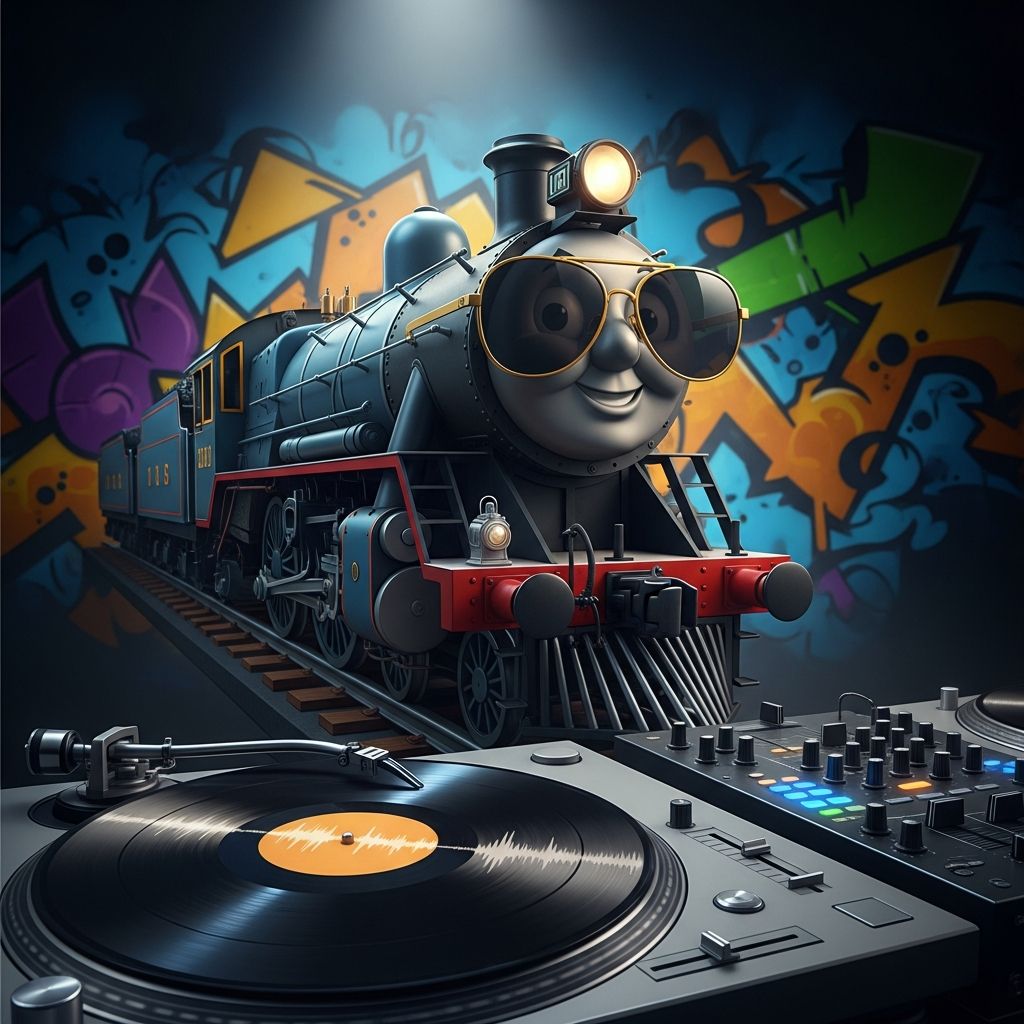
If you have ever stumbled across a video where a serious rap vocal is laid over the Thomas the Tank Engine theme, you already know the strange magic: it should not work, yet it absolutely does. The clash of a cheerful children’s tune and grimy bars somehow makes everything funnier, more shareable, and weirdly catchy.
This article explores why that combination works so well, how the structure of rap and the Thomas theme line up, and what this says about internet humor, nostalgia, and the way we listen to music in the meme era.
The Unlikely Chemistry Between a Kids’ Jingle and Hardcore Rap
On paper, the pairing makes no sense. A bright, bouncy melody written for a preschool TV show is the polar opposite of the gritty, adult themes typical in rap. Yet that contrast is precisely what gives these mashups their bite.
- Rap brings intricate rhythm, attitude, and lyrical intensity.
- The Thomas theme offers a relentlessly upbeat, almost toy-like instrumental bed.
- The result is a comic collision where everything feels both wrong and perfectly timed.
Psychologists studying humor often highlight the role of incongruity—the brain finds it funny when expectations are violated in a surprising but harmless way. When an aggressive rap verse rides over a tune you associate with childhood innocence, that incongruity hits instantly.
Why the Thomas Theme Works Musically With Rap
The Thomas theme is more than a nostalgic earworm; it is structured in a way that is surprisingly compatible with rap flows and standard hip-hop song forms.
Steady Tempo and Clear Pulse
Most rap songs sit in a tempo range that allows for clear, conversational delivery—often between roughly 80 and 110 beats per minute, sometimes double-time. The Thomas theme (in its most recognized TV version) uses a regular, march-like pulse that makes it easy to tap along, count beats, and drop vocal lines right on top.
- Strong downbeats help rappers emphasize punchlines or rhyme endings.
- Predictable rhythm patterns leave plenty of space for syncopated flows.
- Loop-friendly phrases make it easy for editors to repeat sections behind verses.
Compatibility With Rap Song Structure
Modern rap songs often use a combination of intros, verses, hooks/choruses, and sometimes bridges or outros. The Thomas theme has short, clear phrases that can be chopped into loops that mimic some of these basic sections. For instance:
| Typical Rap Element | Usual Role | How a Thomas Loop Can Substitute |
|---|---|---|
| Intro | Sets mood, prepares listener | Use the raw Thomas melody before the rap kicks in |
| Verse bed | Supports lyrics without overpowering | Loop a simpler section of the theme underneath the vocal |
| Hook/chorus foundation | Catchy, repeated centerpiece | Drop in the most recognizable phrase of the theme |
Because many rap tracks use 16-bar verses and 8-bar hooks, editors can line up looped fragments of the Thomas theme to repeat on those same cycles, even if the original TV theme was not written with bars in mind.
Simple Harmony, Big Effect
The harmony in a children’s TV theme is intentionally simple so it is easy to remember and sing. For mashup creators, that simplicity is a bonus:
- There are fewer dissonant chords that might clash with melodic rap hooks.
- A limited chord palette keeps the focus on the vocal.
- Repeating harmonies prevent the track from feeling too busy when vocals are layered on top.
In a sense, the Thomas theme behaves like a quirky, pre-built beat: repetitive, clear, and instantly recognizable.
Nostalgia: The Secret Ingredient Everyone Underestimates
Beyond tempo and structure, part of the appeal is emotional. Many adults encountering these mashups grew up watching Thomas or at least hearing the music in the background of childhood. That makes the theme a powerful trigger for nostalgia.
Research on nostalgia suggests it is often linked with warmth, social connection, and a sense of continuity in life. When you mix that comforting soundtrack with the confrontational energy of rap, you get a bizarre emotional cocktail: half childhood memory, half modern swagger.
- Shared reference point: Viewers across different countries recognize the tune.
- Social bonding: People tag friends who shared the same shows growing up.
- Reframing childhood: Adult humor layered over kid music lets people laugh at how far they have come.
Internet Culture and the Rise of Absurd Music Mashups
Thomas-and-rap edits sit comfortably in a broader wave of internet remix culture, where familiar media is endlessly re-cut, repurposed, and reframed for laughs.
Digital culture scholars often describe this as a “participatory” environment, where audiences are no longer just consumers but also creators, remixers, and commentators. Turning a beloved children’s show into the backing track for club anthems is exactly the kind of playful rule-breaking that thrives on social platforms.
Why Thomas Mashups Are So Shareable
- Instant hook: The first seconds are recognizable; you do not need context.
- Quick payoff: The joke lands as soon as the vocal enters, perfect for short-form video.
- Safe shock value: It is surprising but non-threatening; nobody is really harmed.
- Cross-generational appeal: Parents and younger audiences may both relate, but for different reasons.
On platforms built around brief, looping clips, a short, punchy joke like “Thomas but make it trap” is ideal. Users consume dozens of such micro-surprises in a single session, and the most effective ones lean on instantly recognizable audio.
What Makes a Rap Vocal Work Over the Thomas Theme?
Not every rap verse fits perfectly on top of the Thomas theme, but there are patterns in the ones that do. From the perspective of rap songwriting, several traits make a vocal especially mashup-friendly.
Clear, Consistent Flow
Rap flows with a steady rhythm and strong end-rhymes tend to lock into the Thomas groove better. Songwriting guides emphasize that rap structure relies heavily on bars and rhythmic consistency: verses are often built as 12–16 bar units that line up tightly with the beat.
- Predictable cadence lets the vocal naturally land on the same beats as the Thomas accents.
- Pauses and breaths often line up with the ends of melodic phrases.
- Strong rhythmic patterns stand out against the simple, repetitive backing.
Bold, Serious Subject Matter
The more self-serious the original track, the funnier it becomes when paired with toy-train music. Lyrics about status, danger, or luxury clash brilliantly with an image of animated engines chugging along a cheerful railway.
That contrast amplifies another key element of rap: performance. Guides to hip-hop songwriting point out that delivery, tone, and attitude are as crucial as the words themselves. When that hard-edged delivery is pushed against a bright children’s melody, the performance feels exaggerated, almost theatrical.
How Creators Build These Mashups
You do not need a professional studio to make a Thomas-and-rap mashup, but there is more craft involved than people may realize. At a basic level, creators need to align the two tracks in tempo, key, and structure.
Core Steps in a Simple Mashup
- Choose a vocal: Typically, an acapella or a track where the vocal can be isolated.
- Find the tempo: Determine the beats per minute (BPM) of both the rap and the Thomas theme.
- Sync the beats: Time-stretch or pitch-shift one of the tracks so the drum hits and syllables roughly align.
- Loop the Thomas theme: Select a 4–8 bar phrase to repeat under verses and hooks.
- Balance levels: Turn down the theme so it supports rather than drowns out the vocal.
These steps mirror the fundamentals of arranging a typical hip-hop track, where producers build intros, verses, and hooks from repeated samples and drum loops. In this case, instead of a dusty soul record, the sample just happens to be a jaunty engine rolling out of a station.
Why Parents Secretly Love These Mashups
There is another audience quietly fueling the popularity of Thomas-rap edits: parents. For caregivers who spend hours listening to the same cartoon theme songs, these mashups offer comic relief.
- They provide a way to reclaim children’s music as something adults can laugh at.
- They validate the experience of having a nursery tune stuck in your head all day long.
- They create a bridge between the parent’s musical tastes (hip-hop) and the child’s world (TV characters).
In some households, a Thomas-rap mashup is one of the few tracks that both a toddler and an exhausted adult find entertaining, albeit for completely different reasons.
What the Trend Reveals About How We Hear Rap
Beyond the joke, these edits highlight something important about the way listeners engage with rap as a genre.
Rap as Rhythm-First Storytelling
Because the Thomas theme is so harmonically simple, it strips away many of the musical distractions listeners are used to. That puts the spotlight squarely on the flow, rhyme schemes, and delivery of the rapper. Educational resources on hip-hop often emphasize that these rhythmic and lyrical dimensions are the core components of rap craft.
When a complex trap beat is replaced with a children’s jingle, you can suddenly hear just how carefully the rapper rides the beat, places syllables, and builds internal rhymes. In an odd way, the joke format becomes an accidental masterclass in flow.
De-mystifying “Serious” Music
Pairing heavyweight rap tracks with something as unserious as a cartoon theme also chips away at the idea that music must be consumed reverently. It suggests that even intense, emotionally charged tracks are still sounds that can be rearranged, recontextualized, and played with.
This lines up with a broader trend music scholars have identified: in the streaming era, listeners treat songs more like flexible building blocks than sacred, unchangeable artifacts, especially in online spaces where remixing is normalized.
Frequently Asked Questions (FAQs)
Why does the Thomas the Tank Engine theme fit rap flow so well?
The Thomas theme has a steady tempo, a clear beat, and repeating phrases that can be looped into 4–8 bar segments. Those features line up nicely with common rap structures like 12–16 bar verses and 8-bar hooks, making it easier for editors to sync vocals on top.
Are these mashups legal to post online?
Legality depends on copyright, licensing, and platform rules. Many mashups use copyrighted TV themes and commercially released rap vocals without permission, which can lead to content being muted, blocked, or taken down. Some platforms allow certain uses under limited conditions, but that does not necessarily make them fully legal.
Do artists or rights holders ever embrace these edits?
Sometimes rights holders tolerate or even share fan-made edits when they boost visibility or introduce music to new audiences. However, others enforce copyright more strictly. Reactions vary, and creators who post mashups have to accept the risk that their content might be removed.
Could any kids’ TV theme work this well with rap?
Not every children’s song has the same effect. The Thomas theme benefits from a strong marching beat, simple chords, and huge cultural recognition. Other themes can work, but they may not strike the same balance between rhythmic clarity, nostalgia, and instant recognizability.
What does this trend say about rap as an art form?
It highlights how robust rap vocals are: even when you swap out the original beat for something ridiculous, the flow, wordplay, and delivery remain compelling. The joke format unintentionally underscores the technical skill involved in writing and performing rap verses.
References
- Rap Song Structure: Complete Guide with Examples — eMastered. 2023-05-10. https://emastered.com/blog/rap-song-structure
- What Is The Best Hip-Hop & Rap Song Structure? (2025 Guide) — Luke Mounthill Beats. 2025-01-15. https://lukemounthillbeats.com/music-production/hip-hop-rap-song-structure/
- Write Your Own Rhymes — Flocabulary. 2022-09-01. https://www.flocabulary.com/warp/hip-hop-songwriting/
- How To Rap: Song Structure — ColeMizeStudios. 2022-03-18. https://colemizestudios.com/how-to-rap-song-structure/
- How To Write A Rap Song From Start To Finish — 99Beats. 2023-07-21. https://99beats.com/how-to-write-a-rap-song-from-start-to-finish/
- The Strange Power of Nostalgia — American Psychological Association. 2019-11-01. https://www.apa.org/monitor/2019/11/nostalgia
- Writing Rap and Hip-Hop Songs — My Song Coach (Robin Frederick). 2018-06-05. https://mysongcoach.com/writing-rap-and-hip-hop-songs/
- Spreadable Media: Creating Value and Meaning in a Networked Culture — Jenkins, Ford & Green. New York University Press. 2013-01-21. https://nyupress.org/9780814743508/spreadable-media/