From the moment your baby enters the world, their ears are tuned to the sound of your voice. Engaging in regular, meaningful conversations isn’t just heartwarming—it’s a cornerstone of cognitive and emotional growth. Parents who chat, narrate, and respond to their little ones foster advanced language skills that set the foundation for reading, social interaction, and academic success later in life. This guide dives deep into why talking matters, what developmental stages to expect, and actionable strategies to make every day a language lesson.
Why Conversations with Infants Build Brains
Infants are wired for language acquisition. Newborns distinguish their caregiver’s voice amid background noise, calming to familiar tones and startling at loud ones. This innate responsiveness evolves into active participation when parents provide rich verbal input. Research shows that babies exposed to varied vocabulary and back-and-forth exchanges develop larger vocabularies by toddlerhood, outperforming peers in comprehension and expression.
The mechanism is simple yet profound: Talking stimulates neural pathways in the brain’s language centers. Each coo responded to with enthusiasm teaches turn-taking, a fundamental communication skill. Over time, this builds synaptic connections, enhancing memory, attention, and problem-solving. Moreover, responsive dialogue strengthens emotional bonds, reducing stress hormones and promoting secure attachment.
- Brain boost: Frequent talk increases gray matter in areas linked to speech processing.
- Vocabulary explosion: Babies hearing 30 million words by age 3 show 50% larger lexicons.
- Social gains: Early chit-chat predicts better peer interactions in preschool.
Month-by-Month Milestones: Tracking Your Baby’s Verbal Journey
Understanding typical progress helps parents celebrate wins and spot needs early. Here’s a breakdown of speech and language benchmarks from trusted pediatric sources, organized by age for easy reference.
Newborn to 3 Months: The Listening Phase
Your newborn’s world is auditory chaos turning to symphony. They quiet to your voice, differentiate cries by need, and coo in pleasure. Eyes track sounds, and gurgles emerge during play. Respond with exaggerated tones to encourage reciprocity.
| Milestone | What It Looks Like |
|---|---|
| Recognizes voice | Quiets crying, smiles when spoken to |
| Sound response | Startles at loud noises, turns toward rattles |
| Vocalizations | Cooing, laughing, distinct cries |
4 to 6 Months: Babbling Begins
Now the fun ramps up. Babies turn toward new sounds, mimic intonation, and babble ‘ba-ba’ or ‘ooh-aah.’ They respond to ‘no’ with behavioral shifts and delight in toys that chime.
- Repeats sounds in conversation.
- Enjoys music and voice changes.
- Uses voice for joy or frustration.
7 to 12 Months: Pre-Word Wonders
Babies comprehend their name, follow simple directions like ‘come here,’ and babble strings like ‘ma-ma-da-da.’ Gestures pair with sounds—waving at ‘bye-bye’ or pointing at objects.
By 12 months, expect a few words like ‘mama’ or ‘dada,’ alongside imitation of everyday phrases.
12 to 24 Months: Words Take Shape
The vocabulary surge hits: 4-6 words at 12-17 months grow to 50 by 18-23 months. Phrases like ‘more milk’ emerge, with understanding of actions (‘jump’) and basic questions.
| Age Range | Key Skills | Word Count |
|---|---|---|
| 12-17 months | Follows 1-step directions, labels objects | 4-6+ |
| 18-23 months | 2-3 word phrases, animal sounds | 50 |
| 24 months | Simple questions, 50% understandable speech | 50-200 |
Practical Strategies: Turn Everyday Moments into Language Lessons
You don’t need fancy toys—just your voice. Narrate routines: ‘Now we’re washing your tiny toes!’ Exaggerate pitch, pause for responses, and repeat their babbles. Reading books daily introduces new words; point and describe pictures.
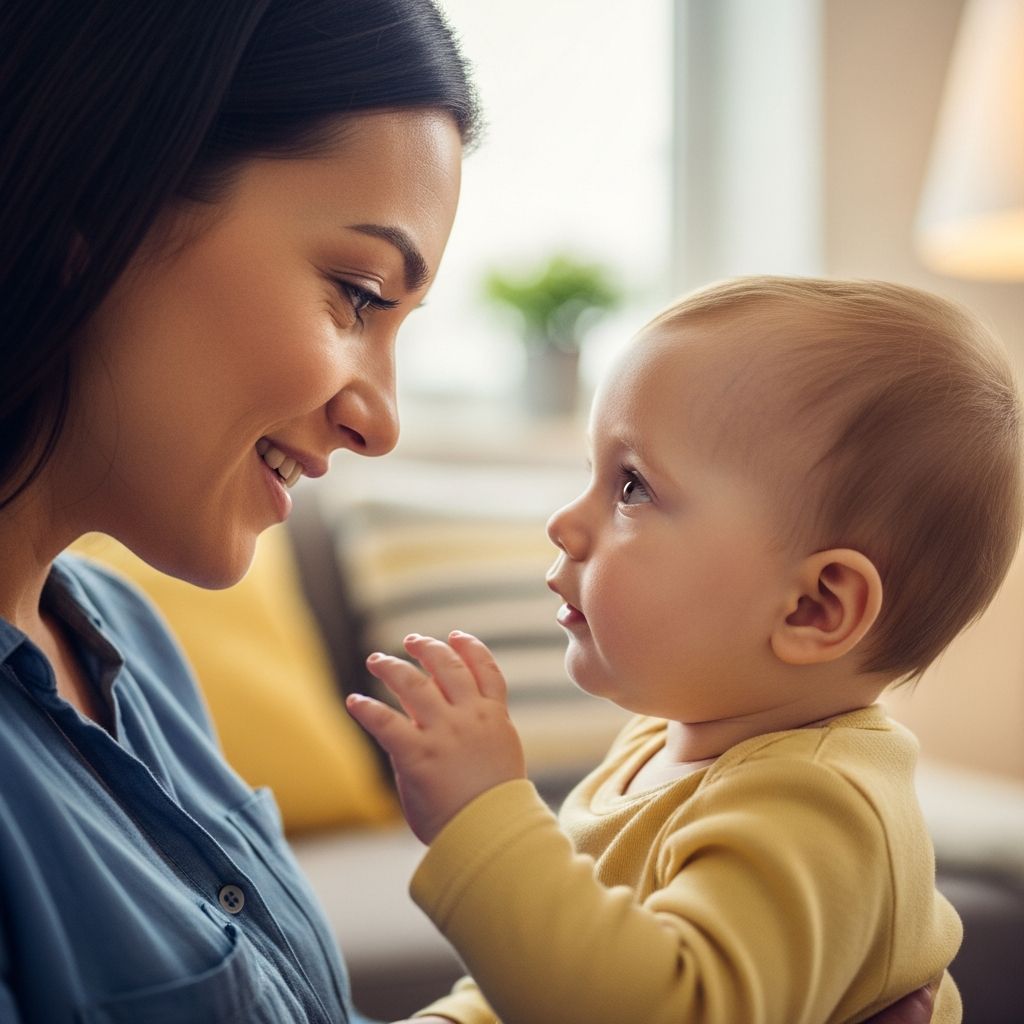
- Face-to-face talks: Get eye-level, mimic expressions for engagement.
- Sing and rhyme: Songs like ‘Itsy Bitsy Spider’ teach rhythm and prediction.
- Describe emotions: ‘You look happy splashing water!’ builds emotional vocabulary.
- Expand utterances: If they say ‘ball,’ reply ‘Big red ball rolling fast!’
- Limit screens: Prioritize human interaction over passive media.
Incorporate play: Peek-a-boo hones object permanence and turn-taking. During meals, name foods and textures: ‘Crunchy carrot, yum!’ These habits yield measurable gains—children talked to more score higher on language assessments.
Real-Life Inspiration: Parents Who Chat and Their Thriving Kids
Modern parents share viral stories of non-stop baby talk yielding precocious talkers. One mom recounts her 10-month-old saying full sentences after months of descriptive monologues during walks and baths. These anecdotes align with science: Consistent input accelerates milestones. Even skeptics convert when seeing siblings differ— the ‘talker’ parent raises the chatterbox.
Dads play a huge role too. Varied voices and styles enrich phonetic exposure, preventing monotony. Couples alternating narration styles model diverse communication.
Red Flags: When to Consult a Professional
Most babies hit milestones variably, but persistent delays warrant checks. By 12 months, no babbling or gestures? Limited eye contact or response to name? Pediatricians screen routinely; early intervention like speech therapy transforms outcomes.
- No cooing by 4 months.
- No single words by 16 months.
- Loss of previously gained skills.
Multilingual homes? Relax—bilingual kids may speak slightly later but excel cognitively long-term.
Long-Term Payoffs: From Babble to Brilliance
Investing in baby talk reaps dividends. Preschoolers with robust early language navigate school better, with stronger reading readiness and fewer behavioral issues. Teens from talk-rich homes show superior verbal reasoning. It’s not about prodigy status—it’s equipping kids for confident expression.
Frequently Asked Questions About Baby Language Development
At what age should my baby say their first word?
Typically between 10-14 months, though some precocious ones start at 8 months. Focus on comprehension first—many understand far more than they say.
Does TV count as talking to my baby?
No—passive screens lack interaction. Opt for live conversations; the American Academy of Pediatrics advises no screens under 18 months.
How much should I talk daily?
Aim for constant narration during awake hours. Quality beats quantity: Responsive, varied talk trumps rote repetition.
What if my baby is bilingual?
They’ll mix languages initially but catch up by 3-4 years. Consistent exposure to both works best.
Can I overstimulate with too much talk?
Rarely—babies thrive on input. Watch for fatigue cues like fussing, then switch to quiet cuddles.
References
- Age-Appropriate Speech and Language Milestones — Children’s Hospital of Philadelphia (CHOP). Accessed 2026. https://www.chop.edu/health-resources/age-appropriate-speech-and-language-milestones
- Speech and Language Development from Birth to 12 Months — Great Ormond Street Hospital (GOSH). Accessed 2026. https://www.gosh.nhs.uk/conditions-and-treatments/procedures-and-treatments/speech-and-language-development-birth-12-months/
- Language Development: Speech Milestones for Babies — Mayo Clinic. Accessed 2026. https://www.mayoclinic.org/healthy-lifestyle/infant-and-toddler-health/in-depth/language-development/art-20045163
- Speech Milestones — First 5 California. Accessed 2026. https://www.first5california.com/en-us/articles/speech-milestones-baby/
- Speech and Language Developmental Milestones — National Institute on Deafness and Other Communication Disorders (NIDCD), NIH. Accessed 2026. https://www.nidcd.nih.gov/health/speech-and-language
- Communication Milestones: Birth to 1 Year — American Speech-Language-Hearing Association (ASHA). Accessed 2026. https://www.asha.org/public/developmental-milestones/communication-milestones-birth-to-1-year/
- CDC’s Developmental Milestones — Centers for Disease Control and Prevention (CDC). Accessed 2026. https://www.cdc.gov/act-early/milestones/index.html