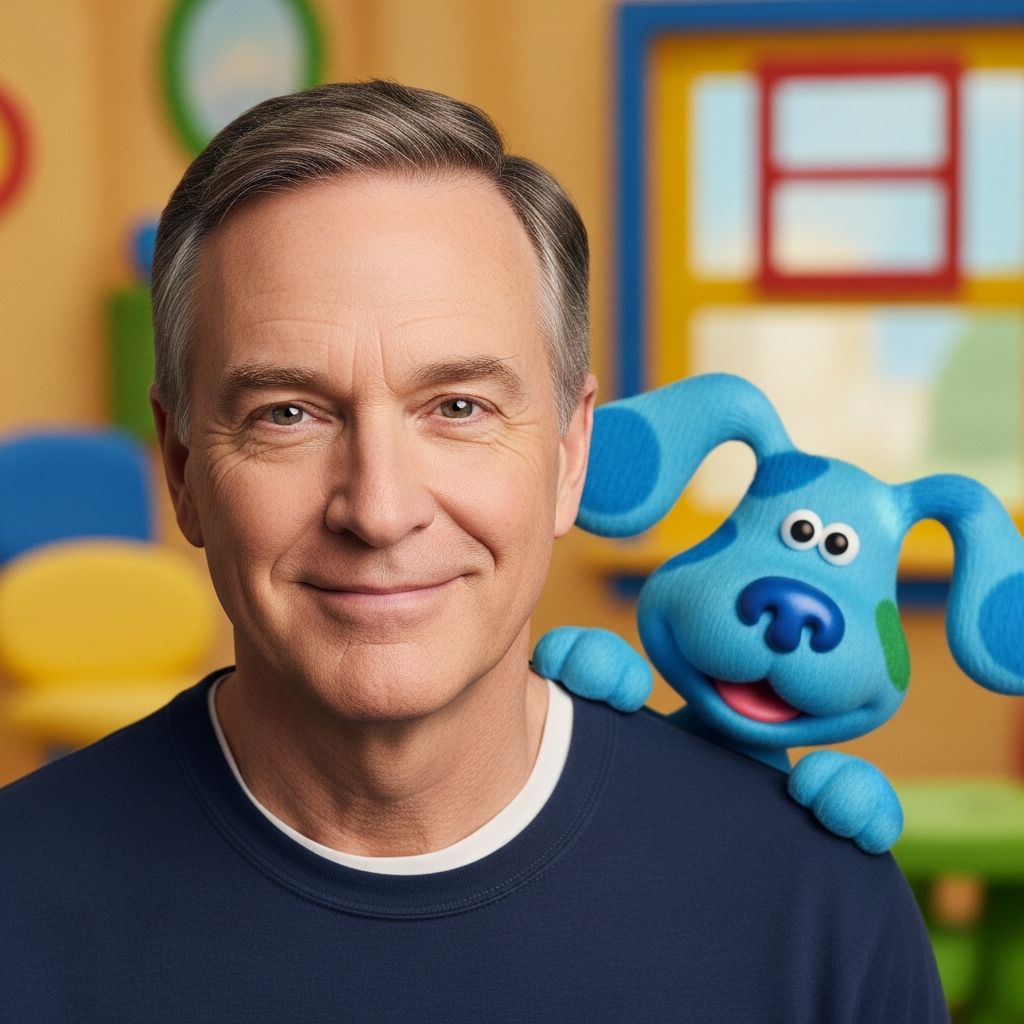
For many millennial parents, the first adult who looked straight into their eyes on a screen, waited for an answer, and took them seriously was a young man in a green striped shirt. Steve Burns, the original host of Blue’s Clues, did more than guide kids through puzzles; he modeled patience, curiosity, and emotional safety at a time when brain science was just beginning to reshape children’s television.
Now, the children who once shouted at the TV to help him find paw prints are raising kids of their own. Their relationship with Steve—and what he represented—has quietly followed them into adulthood, informing how they think about empathy, learning, and how to talk to their own children.
From Basement Actor to Unlikely Preschool Icon
Before he entered millions of living rooms, Steve Burns was a struggling actor and musician, living in a small New York apartment and working voice-over jobs while trying to break into television drama. He had played bit roles on shows like Homicide: Life on the Street and Law & Order, far removed from the brightly colored world of preschool TV.
When he auditioned for Blue’s Clues in 1995, he assumed it would be another voice-heavy gig, not a six-year commitment to talking directly with toddlers about shapes, clues, and big feelings. Nickelodeon executives initially doubted whether this slightly scruffy, offbeat performer could anchor a children’s show; they reportedly envisioned someone more conventionally polished. But test audiences—especially kids—responded to the way he listened: leaning into the camera, waiting just long enough to make a child feel heard.
That style became the emotional backbone of the series, and it’s part of why so many viewers now recall Steve as less of a host and more of a kind, slightly awkward older friend.
| Steve Burns Before Blue’s Clues | Steve Burns On Blue’s Clues |
|---|---|
| Acting student on scholarship at DeSales University, left before graduating | Original host of Blue’s Clues from 1996–2002 |
| Played in indie bands and pursued music | “Micro-celebrity” known intensely by kids, anonymous to most adults |
| Auditioned with long hair, earring, and skater style | Soft-spoken, friendly guide in a striped shirt and khakis |
Why His Style Mattered for Young Brains
Blue’s Clues came along as research in child development was increasingly informing kids’ programming. The show used repetition, direct address, and pause-filled questions that asked preschoolers to think, not just watch. Educational psychologists working with Nickelodeon drew on cognitive science to design episodes that supported memory and problem-solving.
Steve’s performance sat right at the intersection of that science and real emotion. His manner checked several boxes that developmental experts say help young children learn:
- Consistent, calm voice that reduced overstimulation.
- Predictable routines (the notebook, the mail, the thinking chair) that supported memory and made kids feel secure.
- Open questions with real pauses, which encouraged children to answer out loud and practice language and reasoning.
- Respectful tone, treating preschoolers as capable problem-solvers rather than passive audience members.
Developmental science backs up why this worked. Research from the American Academy of Pediatrics has found that when media directly engages young children and invites interaction, it can support language and cognitive skills—particularly when combined with parental involvement. The slow pacing and repetition that some adults found tedious were actually a feature, not a bug, for three- and four-year-olds learning to connect ideas.
Acting in a Blank World: The Hidden Difficulty
From the couch, everything in Steve’s world looked vivid and full. In reality, he spent much of his time performing alone in front of a blue or green screen, with animation added later. He later described the work as “maddening,” comparing it to acting at the bottom of a swimming pool—relying on imagination and memory to maintain eye lines, timing, and emotional continuity from scene to scene.
For adults now, that behind-the-scenes challenge highlights just how much craft went into something that felt so effortless. Every moment of listening—to a child’s invisible response, to a cartoon dog, to a clue drawn on an imaginary wall—had to be created from scratch, over and over, with the same genuine warmth.
In a sense, Steve was practicing a kind of radical adult attention that many people still crave: full focus, zero distraction, patient waiting for you to find the answer. It’s no surprise that, years later, those kids remember less about any specific episode and more about the feeling of being accompanied.
The Exit That Sparked Rumors—and Real Feelings
After almost 100 episodes and six years as the show’s anchor, Steve Burns left Blue’s Clues in 2002, passing the job to his on-screen younger brother, Joe (played by Donovan Patton). The transition was written into the story: Steve headed off to college, and Joe took over the household and the clue-hunting.
Off-screen, though, his departure became the subject of persistent urban legends—claims that he had died, been arrested, or abruptly quit for a music career. Burns eventually appeared on talk shows with co-creator Angela Santomero to reassure worried parents and debunk the rumors.
In later interviews, he explained his decision in straightforward terms: he was aging out of the boyish role, wanted to explore other creative work, and felt it was time to move on. He has emphasized that it was not a dramatic blow-up, but a professional turning point.
For kids at the time, though, the explanation “Steve went to college” landed like a first real experience of loss. Many never saw the talk-show clarifications. They just knew that the person who had spoken to them almost every day was suddenly gone, replaced by someone new.
How Children Processed His Disappearance
From an adult perspective, a cast change may seem minor. But for preschoolers building early attachments to familiar characters, it can feel like a genuine separation. Child psychologists note that media figures can function as “parasocial” companions—one-sided relationships that still feel real to young viewers.
That helps explain why, decades later, so many now-adults vividly recall the episode where Steve leaves, or the moment they realized he was no longer there. For some, it sits alongside other childhood milestones: the first day of school, a move, or a grandparent’s death. Steve’s departure became a small emotional rehearsal for change.
Life After the Thinking Chair: Music, Movies, and Creative Detours
Freed from the demands of daily children’s television, Burns turned toward music and independent film. He collaborated with members of The Flaming Lips on his debut album Songs for Dustmites in 2003, followed by a second album with his band, Steve Burns and the Struggle, titled Deep Sea Recovery Efforts in 2009.
His music often leaned introspective and experimental—far from the simple melodies of a preschool show. One track, “Mighty Little Man,” later found new life as the opening theme for the CBS series Young Sheldon, quietly reintroducing his work to a prime-time audience.
On screen, he took roles in offbeat films like the horror-comedy Netherbeast Incorporated and the science-fiction feature Christmas on Mars, expanding his range far beyond the earnest host persona. For many former Blue’s Clues kids, discovering these projects years later created a striking contrast: the gentle friend from childhood now playing vampires or astronauts in surreal, adult-targeted stories.
Reunion and Renewal: Steve’s Emotional Return
In the 2010s and beyond, nostalgia for 1990s children’s media intensified. Blue’s Clues was revived as Blue’s Clues & You!, with a new host, Joshua Dela Cruz, and with Steve returning as a consulting producer and guest star. Seeing him back in the striped shirt—now older, with his trademark bald head and glasses—had an unexpectedly powerful effect on the generation that grew up with him.
The most widely shared moment came when Burns addressed his now-adult former audience directly in a heartfelt video, acknowledging his long-ago departure, sharing how his own life had changed, and thanking viewers for how far they had come. The message resonated deeply, speaking to people navigating careers, burnout, parenting, and the unresolved feelings of an abrupt childhood goodbye.
For many, that video functioned as emotional closure. It reframed his disappearance not as abandonment, but as a transition into another stage of life—something his viewers were now experiencing themselves.
What Steve Means to Millennial Parents Today
The children who once sat cross-legged in front of the TV are now the people deciding what their own kids watch. Steve’s legacy shows up in subtle ways in how they parent:
- Patience with questions: Many remember how Steve would wait quietly for answers, and now try to offer that same space to their children’s curiosity.
- Respectful tone: His habit of addressing kids as capable thinkers influences parents who want to avoid talking down to their toddlers.
- Media boundaries: Having seen both the benefits and drawbacks of heavy TV exposure, some parents carefully choose slower-paced, more educational content—often including Blue’s Clues itself.
- Honest transitions: Steve’s departure—and later explanation—gives adults a template for how to talk about change and goodbyes with young children.
At the same time, today’s parents are navigating a far more complex media landscape. The American Academy of Pediatrics now recommends limited screen time for preschoolers and emphasizes co-viewing—parents watching alongside children and discussing what they see. For those who grew up with Steve, this can feel like a natural extension of how they experienced his show: not as digital babysitting, but as an interactive learning tool that adults occasionally joined.
Lessons for Talking to Kids—On and Off Screen
Steve Burns’ time with Blue’s Clues offers several practical takeaways for any adult trying to connect with young children, whether or not a camera is involved.
1. Slow Down More Than You Think You Need To
Watching old episodes today, the pauses can feel surprisingly long. Yet those extra beats are exactly what many kids need to process a question and formulate an answer. Neuroscience research on early childhood shows that young brains require more time to integrate information and organize language.
In real life, that might mean:
- Leaving silence after asking a toddler a question.
- Resisting the urge to “fill in the blank” when they search for words.
- Repeating key phrases or instructions without frustration.
2. Treat Small Feelings as Big Work
On Blue’s Clues, even simple frustrations—like not finding a clue right away—were treated as worth acknowledging. That aligns with modern understandings of emotional regulation: small moments of struggle are practice for bigger life challenges later on.
Parents can mirror this by naming emotions (“You’re feeling disappointed we can’t watch more”) and offering tools (“Let’s think of something else fun we can do”). The gentleness Steve modeled becomes a concrete parenting strategy.
3. Make Learning a Shared Adventure
One of the enduring charms of the show is that Steve rarely acted as the all-knowing teacher. He was a co-investigator, genuinely puzzled and excited by new clues. That stance—learning alongside a child rather than always instructing—fosters curiosity and resilience.
Research on parent–child interactions suggests that collaborative problem-solving, where adults frame themselves as partners rather than judges, supports children’s motivation and persistence.
Frequently Asked Questions (FAQs)
Why did Steve Burns really leave Blue’s Clues?
Steve Burns has explained in multiple interviews that he left Blue’s Clues after nearly six years because he felt he was aging out of the role and wanted to pursue other creative projects, including music and acting. He has said it was simply time to move on, not the result of scandal or a dramatic conflict.
Did Steve have any say in how the show was made?
Yes. Burns was described as being very involved with the production from early on, helping shape the pacing and tone of the show and working closely with creators and producers as the series evolved.
What did Steve Burns do after Blue’s Clues?
After leaving, Burns released music albums such as Songs for Dustmites and Deep Sea Recovery Efforts, collaborating with members of The Flaming Lips. He also acted in films like Netherbeast Incorporated and Christmas on Mars, and later returned to the franchise as a consulting producer and guest on Blue’s Clues & You!
Was Blue’s Clues really educational, or just entertaining?
Blue’s Clues was intentionally designed with input from child development experts to support preschoolers’ problem-solving, memory, and language skills, using repetition, direct questions, and interactive pauses. Its approach aligned with research showing that well-designed educational media can aid early learning, especially when adults watch and talk with children about what they see.
Why do so many adults get emotional seeing Steve again?
For many millennials, Steve was part of daily routines during a highly sensitive period of development. His sudden departure felt like an early experience of loss, and his later return—speaking directly to them as adults—offers a form of closure and recognition of how far they have come.
References
- Steve Burns — Simple English Wikipedia, summarizing biographical details and career history. 2024-01-10. https://simple.wikipedia.org/wiki/Steve_Burns
- Steve Burns – IMDb — IMDb, filmography and production roles. 2024-05-01 (last updated). https://www.imdb.com/name/nm0122886/
- The origin story of Steve from “Blue’s Clues” is even more wholesome than you think — WQLN / NPR. 2024-05-13. https://www.wqln.org/culture/2024-05-13/the-origin-story-of-steve-from-blues-clues-is-even-more-wholesome-than-you-think
- Steve Burns | Blue’s Clues Wiki — Fandom, production and role details. 2023-11-02. https://bluesclues.fandom.com/wiki/Steve_Burns
- Media and Young Minds — American Academy of Pediatrics Policy Statement. Pediatrics, Vol. 138, No. 5. 2016-11-01. https://publications.aap.org/pediatrics/article/138/5/e20162591/60336/Media-and-Young-Minds
- Blue’s Clues & You! — Paramount / Nickelodeon official information page. 2022-09-15. https://paramount.fandom.com/wiki/Steve_Burns