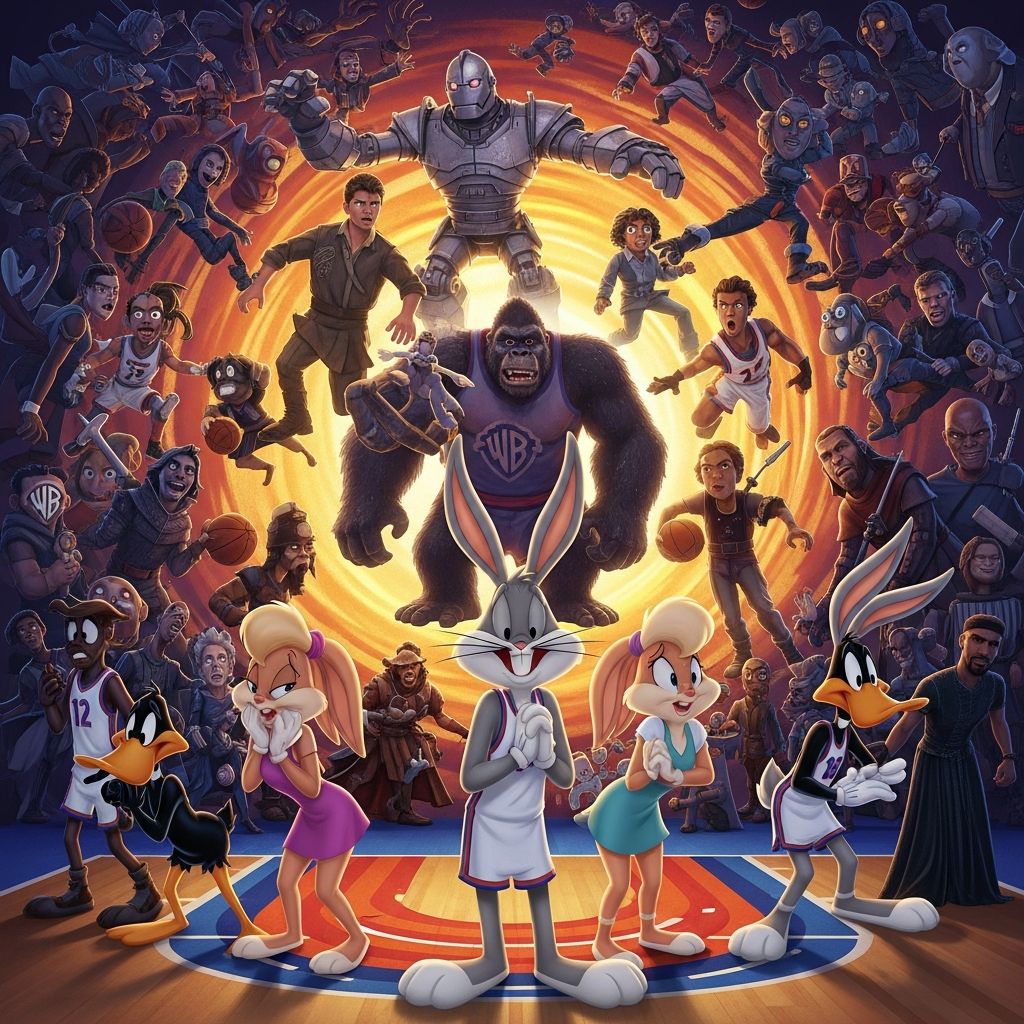
Space Jam: A New Legacy is technically a sequel about basketball, Looney Tunes, and family, but visually it often plays like a crowded studio tour. Instead of just Bugs Bunny, Daffy Duck, and LeBron James, the movie floods the screen with characters from decades of Warner Bros. film and TV history. Some of these background gags are playful nods for parents; others raise a real question: how did that character end up in a supposed kids’ movie?
This article unpacks how cameos work in general, how studios use them as branding tools, and why Space Jam: A New Legacy’s cameo strategy feels especially chaotic, even compared with other cameo-heavy blockbusters.
What Is a Cameo, Really?
In film studies, a cameo usually means a brief appearance by a well-known person or recognizable character in a small role that is not central to the plot. Directors like Alfred Hitchcock famously turned the cameo into a recurring signature; in modern blockbusters, cameos have evolved into a way to reward fans, set up jokes, or tease future projects.
Cameos tend to fall into a few recognizable types:
- Self-referential celebrity – an actor or athlete playing themselves for comedic or promotional effect.
- Legacy character – a familiar role returning briefly, often to trigger nostalgia or validate a sequel.
- Deep-cut background gag – a minor visual reference or figure in the background, mainly for attentive fans.
- Meta-industry joke – a cameo that comments on the studio, the genre, or Hollywood itself.
Most of the characters swarming around the basketball court in Space Jam: A New Legacy fall into the last two categories: IP as wallpaper, constantly reminding you of the company that owns the playground.
From Easter Egg to Advertising Strategy
Early movie cameos were often playful surprises with no commercial agenda. Over time, studios recognized that recognizable faces and characters could keep audiences talking and encourage repeat viewings. In shared universes like the Marvel Cinematic Universe, cameos have become integral to brand-building: characters from one film pop up in another to create a sense of continuity and scale.
That shift reflects a broader move toward what media scholars describe as synergy—the coordinated use of intellectual property (IP) across multiple platforms to reinforce brand recognition. In practice, synergy means that a superhero might appear not only in their own film but in team movies, animated shows, video games, and toy lines. Space Jam: A New Legacy takes that logic to an extreme by throwing nearly the entire Warner Bros. catalog into a single climactic game.
Why Space Jam: A New Legacy Feels So Different
The original 1996 Space Jam certainly contained product placement and celebrity appearances, but its focus remained on Michael Jordan and the Looney Tunes. The sequel flips that balance. A New Legacy turns the story’s central arena into what feels like a corporate fan convention where every Warner-owned character is invited.
For adults familiar with the studio’s back catalog, this produces a constant stream of recognition flashes: classic superheroes, vintage cartoon icons, cult-favorite villains, and even characters from R-rated films hover around the court. Children, meanwhile, may process most of these figures as indistinct costumed extras. The result is a family film that is oddly more legible to nostalgic adults than to its supposed core audience of kids.
Brand Parade: How Warner Bros. Uses Its IP in the Film
Warner Bros., like other major studios, has spent decades accumulating film and television franchises. Space Jam: A New Legacy uses the basketball game as a literal stage on which those properties can appear at once. The movie’s crowd scenes function almost like a moving catalog.
Some key franchise clusters visible (or alluded to) around the court include:
- Superhero worlds – figures evoking DC heroes and villains show up in the stands, offering quick hits of comic-book recognition.
- Classic cartoons – beyond the Looney Tunes themselves, stylized versions of other animated icons pop up as visual callbacks.
- Monster and sci-fi properties – large creatures and robots resembling famous giant beasts and robots loom near the action.
- Retro TV and film characters – live-action figures dressed like characters from older sitcoms and cult films appear briefly.
While some of these appearances are affectionate nods, the density of references can feel less like storytelling and more like a rolling advertisement reel for the studio’s library.
When a Kids’ Movie Borrows from Adult Cinema
What truly separates A New Legacy from other cameo-filled family films is not just the quantity of references, but the tone of some of them. The crowd includes visual echoes of characters from films rated R for graphic violence, sexual content, or disturbing themes. These original works were aimed very clearly at adults, not children.
A few broad categories of these more adult-oriented references include:
- Violent dystopias – figures dressed like characters from ultra-violent or sexually explicit future-set films appear cheering courtside.
- Found footage horror – robed or masked entities resembling figures from modern horror series can be spotted amid the crowd.
- Serial killer and crime films – stylized versions of criminals and antiheroes from crime-heavy dramas stand only a few feet from cartoon animals.
These references are staged as visual jokes for attentive adults, but they create strange juxtapositions: icons originally associated with brutal violence or exploitation now clap politely at a digital basketball game featuring child audiences and family-friendly mascots.
Juxtaposition in Action: Family Fun vs. Disturbing Icons
To see why some of these cameos feel off, it helps to compare them with other famous movie crossovers. When family films have borrowed from adult cinema in the past, they usually do so in limited, carefully contextualized ways—often parodying genre tropes rather than spotlighting specific, controversial characters.
| Aspect | Typical Family-Film Cameo | Space Jam: A New Legacy Approach |
|---|---|---|
| Source material | Mostly PG or PG-13 titles with broad appeal | Mix of G-rated cartoons, PG franchises, and R-rated cult films |
| Screen time | Single gag or quick punchline | Extended visibility during the entire climactic game |
| Context | Joke is clearly aimed at adults but not foregrounded for kids | Adult-oriented figures placed prominently courtside, continuously visible |
| Emotional tone | Light parody or affectionate homage | Jarring mix of slapstick cartoon action and icons from disturbing stories |
This contrast explains why viewers and critics have singled out certain Space Jam references as especially “WTF” compared with typical cameo-heavy blockbusters.
Does This Help the Story—or Distract from It?
In theory, cameos can support storytelling by quickly conveying information, providing emotional payoff, or underscoring a theme. For example, when a legendary athlete appears to endorse a younger player, that can serve as a metaphor for passing the torch. In Space Jam: A New Legacy, however, many of the cameos are not integrated into the narrative; they function as commentary tracks that only some viewers can hear.
Potential consequences of this overstuffed approach include:
- Fragmented attention – instead of following the emotional arc between LeBron and his son, adult viewers may spend the game scanning the stands for recognizable faces.
- Uneven tone – the presence of characters from grim or violent stories can undercut the film’s attempts at sincere family bonding.
- Missed emotional payoffs – with so many visual distractions, smaller character beats risk getting lost.
The film’s core story about tension between parental expectations and a child’s own interests is clear enough on the page, but the on-screen execution constantly pulls the eye away from that emotional center.
The Logic Behind Including Problematic References
Why would a studio allow characters originally associated with explicit violence or assault to appear in a movie marketed heavily to children and families? Several overlapping incentives help explain the choice:
- IP maximization – from a corporate perspective, every recognizable property is a potential asset to be reused, reintroduced, or rebranded.
- Adult engagement – modern family movies often assume that parents will watch alongside their children; adult-oriented references aim to keep those parents entertained.
- Social media buzz – surprising, even controversial cameos can generate online conversation, think-pieces, and free publicity.
Research on media franchising notes that conglomerates often treat older, niche, or controversial titles as part of a flexible IP portfolio that can be reshaped or recontextualized for new audiences. Space Jam: A New Legacy offers one concrete example of that strategy—albeit one that many viewers found confusing or unsettling in practice.
How This Compares to Other Cameo-Heavy Movies
Space Jam: A New Legacy is not the only modern film to pack itself with cameos, but the way it does so is distinct. Other movies and series use surprise appearances to punctuate the story rather than to dominate the frame.
Common patterns in successful cameo use include:
- Limited quantity – only a handful of cameos, each carefully set up and paid off.
- Clear joke or function – the cameo either delivers a major laugh, a plot twist, or key information.
- Audience alignment – the reference matches the rating and target demographic of the film.
By contrast, A New Legacy leans into quantity over clarity. Instead of one or two well-placed surprises, the movie opts for dozens of simultaneous visual references—some charming, some baffling, and some arguably incompatible with the film’s family-friendly label.
What Kids See vs. What Adults See
One reason the film’s cameos feel so strange is that they effectively create two different films playing at once:
- For children, the movie is about a kid, his dad, and the Looney Tunes winning a surreal basketball game. Most background characters register simply as colorful extras.
- For adults familiar with Warner Bros. history, the same game is a collage of references to crime epics, horror movies, erotic thrillers, and classic genre cinema.
Media scholars note that family films increasingly rely on this kind of dual-address structure—simple plots for children, layered references for adults—especially in an era where parents are major decision-makers for streaming subscriptions and movie tickets. Space Jam: A New Legacy amplifies this duality, sometimes to disorienting effect.
Tips for Parents Watching Cameo-Heavy Movies with Kids
If you are a parent or caregiver watching A New Legacy with children, you may wonder how to handle the more intense or odd background figures. While each family’s approach will differ, some general strategies can help make sense of cameo-heavy movies:
- Focus on the main story – steer conversation toward the central relationship, the choices characters make, and the lessons about teamwork or creativity.
- Answer questions selectively – young children may not notice or care about specific background characters; if they do ask, simple, age-appropriate answers are usually enough.
- Use curiosity as a teaching moment – older kids who notice references can be introduced gradually to media literacy ideas: branding, crossovers, and how companies reuse characters.
- Preview unfamiliar titles – if a child becomes curious about a referenced property you know is adult-oriented, preview it first or look up age-appropriate guidance through reputable rating and advisory organizations.
Frequently Asked Questions (FAQs)
Why are there so many random characters in the big game?
The movie’s climax is staged inside a digital world controlled by a studio-like algorithm, which allows Warner Bros. to justify pulling in characters from across its film and TV catalog. On a practical level, these cameos showcase the company’s intellectual property and encourage viewers to recognize older franchises.
Are all the crowd characters really from Warner Bros. movies?
Not every background extra is a one-to-one recreation, but many are designed to closely resemble or evoke characters from various Warner-owned films, TV shows, and cartoons. Costuming, color schemes, and makeup are used to make the homages instantly recognizable to adult fans while remaining legally and visually consistent with the film’s style.
Is it normal for a kids’ movie to reference R-rated films?
Family movies have long included subtle jokes aimed at adults, but directly incorporating recognizable figures from R-rated or extremely violent titles is less common. Those choices reflect a modern emphasis on brand synergy and adult nostalgia. Whether this is appropriate is largely a matter of individual family preference and cultural norms.
Do these cameos affect the movie’s rating?
Ratings boards such as the Motion Picture Association focus on the explicit content of the film itself—what is shown or heard on screen—rather than the histories of referenced characters. As long as the cameos do not depict graphic violence, sexual content, or strong language, they typically do not change the rating, even if the original works were intended for adults.
What can I talk about with my kids after watching?
Useful discussion topics include how the movie portrays pressure from parents, the value of creativity over rigid expectations, and the difference between characters designed for children and those meant for adults. You can also talk about why companies like to reuse popular characters and how that shapes what ends up on screen.
References
- Johnson, Derek. Media Franchising: Creative License and Collaboration in the Culture Industries. — New York University Press. 2013-01-01. https://nyupress.org/9780814743478/media-franchising/
- Classification and Rating Rules — Motion Picture Association. 2019-11-04. https://www.motionpictures.org/wp-content/uploads/2019/11/Film-Rating-System_Rules.pdf
- Covington, Paul & Adams, Jay & Sargin, Emre. Deep Neural Networks for YouTube Recommendations. — Proceedings of the 10th ACM Conference on Recommender Systems. 2016-09-15. https://dl.acm.org/doi/10.1145/2959100.2959190
- Children’s Viewing of Violent Content on Streaming Platforms. — Common Sense Media. 2022-03-01. https://www.commonsensemedia.org/sites/default/files/research/report/2022-03/csm_violence_in_television_and_online_video.pdf
- Huesmann, L. Rowell. NIMH Report on Television and Behavior: Ten Years Later. — National Institute of Mental Health. 1986-01-01. https://files.eric.ed.gov/fulltext/ED327080.pdf