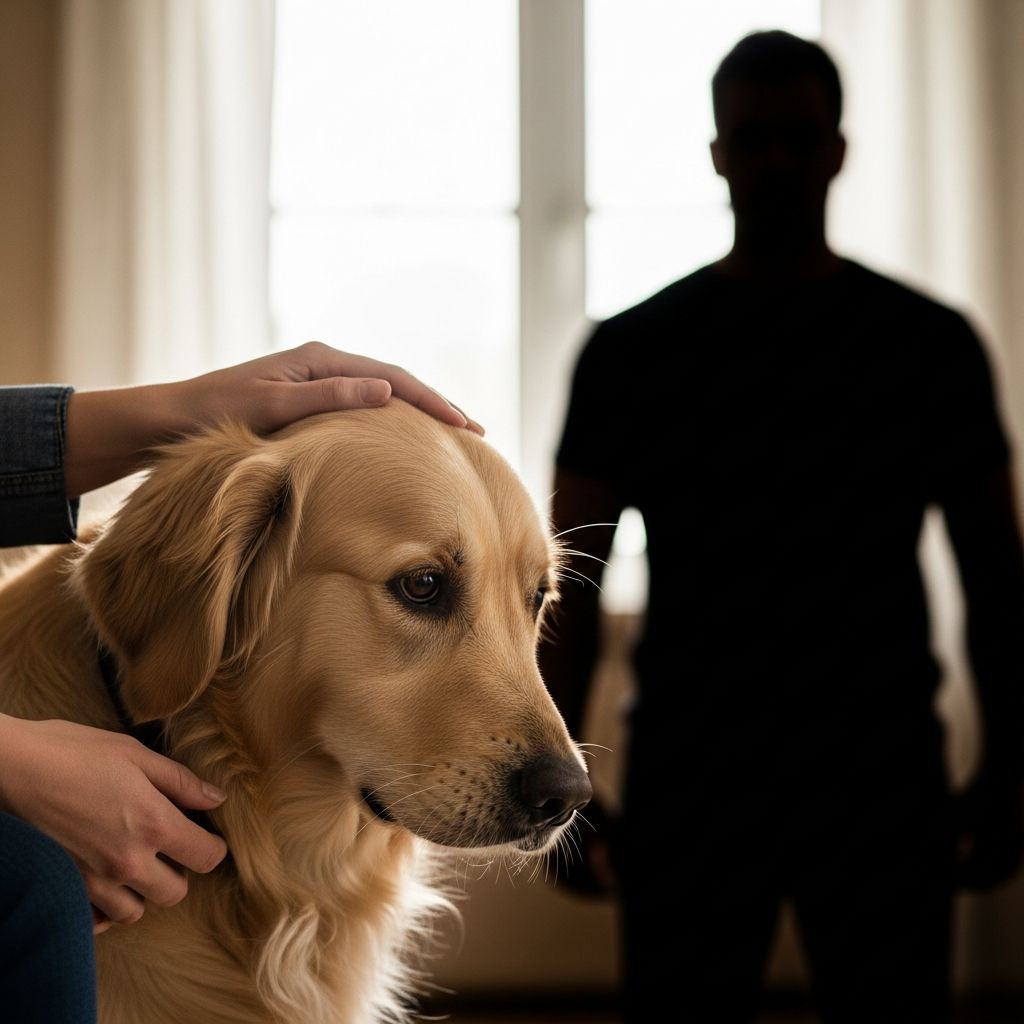
Many families notice a puzzling pattern: their dog is relaxed around women and children but becomes tense, avoidant, or even defensive around men. This reaction can be embarrassing, confusing, and sometimes risky if it escalates into snapping or biting. Understanding why this happens is the first step toward helping a fearful dog feel safe with everyone in the household.
How Fear of Men Shows Up in Dogs
Fear toward men rarely appears out of nowhere; it usually shows in clear body language and behavior. Recognizing these signs early allows adults to step in before the dog feels pushed to use teeth.
Common warning signs
Dogs afraid of men may show a mix of the following behaviors when a man approaches or enters the room:
- Lowering the body, tucking the tail, or crouching
- Avoiding eye contact and turning the head or whole body away
- Licking lips, yawning, or panting when not hot
- Backing up or trying to hide behind furniture or a familiar person
- Freezing briefly, then bolting away if the man reaches toward them
- Barking or growling while staying out of reach
- Showing teeth, lunging, or snapping if cornered or touched
Researchers describe this spectrum from mild fear (avoidance, cowering) to more serious stranger-directed aggression, such as lunging or attempting to bite. When the scary person is consistently a man rather than a woman, we are usually looking at a fear pattern shaped by experience and perception, not simple “bad behavior.”
Why Dogs Often React Differently to Men and Women
There is no single cause, but several overlapping factors can make men more likely to trigger a fearful response.
1. Physical differences: size, voice, and movement
To a dog, men and women can look and move like different species:
- Body size and posture: Men tend to be taller, with broader shoulders and more direct, looming postures, which dogs may interpret as threatening.
- Voice pitch: Deeper voices and louder speech patterns can sound more intense or alarming to noise-sensitive dogs.
- Movement style: Fast, heavy footfalls, abrupt gestures, and confident strides can seem more intimidating than smaller, softer approaches.
Because dogs rely heavily on visual and auditory cues, these physical contrasts alone can be enough to make a nervous dog treat men as a separate, scarier category of person.
2. Learning history and past experiences
Fear is often learned. A dog that has been roughly handled, yelled at, or punished by a man in the past may start to generalize that fear to all men, even gentle ones. Animal behavior research shows that fear of strangers strongly increases the odds of hostility toward strangers overall. Once a dog associates a particular type of person with danger, it can take many calm, positive experiences to undo that learning.
Common experience-based contributors include:
- Previous rough handling or punishment by a male caregiver
- Intimidating encounters with male strangers (e.g., loud shouting, chasing, grabbing)
- Being adopted after a history of neglect or abuse in a home where men were present
- Single frightening events, such as a painful veterinary procedure performed by a man
3. Gaps in early socialization
Puppies have a sensitive period (roughly 3–14 weeks) when positive exposure to many types of people strongly shapes how confidently they navigate the world later in life. Veterinary and behavioral guidelines emphasize that carefully supervised introductions during this window help prevent fear of unfamiliar people.
If, during that period, a puppy meets mostly women and children but few men, the dog may reach adulthood with men filed mentally under “unfamiliar and potentially unsafe.” This effect was magnified for many “pandemic puppies” that grew up without normal contact with visitors and strangers.
4. Biological and genetic influences
Some dogs are simply more prone to fear or stranger-directed aggression than others. Large-scale studies using behavioral questionnaires have found:
- Fear of strangers is strongly associated with aggression toward strangers in general.
- Certain breeds or breed groups (for example, some herding or mixed breeds) show higher odds of stranger-directed aggression, while many sporting breeds show lower odds.
- Neutering status and age at neutering can modestly influence aggression toward strangers, although effects are small and complex.
These findings do not mean any specific dog is destined to fear men, but they highlight that temperament and genetics can create a more sensitive baseline. In a sensitive dog, one or two bad experiences with men can have a bigger emotional impact.
5. Subtle reinforcement of fearful behavior
Family routines sometimes, unintentionally, teach the dog that fear of men “works.” For example:
- The dog barks and growls at a male visitor; the visitor quickly leaves or backs away.
- The dog hides whenever Dad walks in; Dad says, “He hates me,” and stops approaching at all.
From the dog’s perspective, fearful or defensive behavior successfully drives the scary person away, reinforcing that strategy. Over time, the dog may escalate more quickly in an attempt to keep men at a distance.
Fear vs. Aggression: What’s Really Going On?
Families often label a dog “aggressive” when they see growling or lunging at men, but in many cases the underlying emotion is fear. Understanding this distinction helps guide humane and effective responses.
| Feature | Primarily Fearful Dog | Primarily Offensive Aggression |
|---|---|---|
| Body posture | Low, crouched, weight shifted back | Tall, forward-leaning, chest out |
| Facial expression | Wide eyes, ears back, tight mouth | Hard stare, ears forward, tight jaw |
| Goal of behavior | Increase distance from the person | Control or challenge the person |
| Trigger situations | Sudden approach, cornering, reaching in | Resource guarding, territorial intrusions |
In many households, dogs that react badly to men fit the “fearful” profile: they try to avoid contact, escalate only when pressured, and calm down when given space. For safety, however, families should treat any growl, snap, or bite as serious and consult a qualified behavior professional.
Helping a Dog Feel Safer Around Men
Change will not happen overnight, but with patience and structure, many dogs can learn that men predict good things rather than danger. The core principles are safety, choice, and gradual positive exposure.
1. Start with management and safety
Before working on training, reduce the dog’s opportunities to practice fearful or aggressive behavior.
- Use barriers: Baby gates, crates, or leashes can prevent sudden close contact between the dog and men in the home or visiting.
- Control entrances: When male visitors arrive, have the dog in another room or behind a gate until everyone is settled.
- Set rules for guests: Ask men not to stare, reach toward, or speak loudly to the dog, and to ignore the dog unless guided otherwise.
- Consider a muzzle: A basket muzzle, introduced gently with treats, can be a humane added safety layer for close-quarters training.
2. Use counter-conditioning: changing the dog’s emotional response
Counter-conditioning means pairing the presence of the scary thing (men) with something the dog loves (usually high-value food) until the dog’s emotional response shifts from fear to anticipation of good things. Modern veterinary behavior guidelines see this as a cornerstone of treatment for fear and aggression problems.
Basic steps:
- Have the man appear at a distance where the dog notices him but is not panicking or barking.
- Every time the dog looks at the man, a handler delivers special treats (chicken, cheese, etc.).
- When the man leaves or moves out of view, treats stop.
- Over multiple short sessions, gradually decrease the distance while keeping the dog under their fear threshold.
The goal is that the dog starts to think, “Man appears = snacks rain from the sky,” changing their underlying emotional expectation.
3. Let the dog control the pace
Respecting the dog’s choice builds trust:
- Never drag or push the dog toward a man, even if the man is friendly.
- Allow the dog to approach, sniff, and retreat on their own timeline.
- Encourage men to stay sideways, avoid bending over the dog, and toss treats rather than hand them directly at first.
When the dog learns that they can move away without being chased or grabbed, they are less likely to feel forced into defensive aggression.
4. Adjust the man’s behavior
For the man in the household (or regular visitors), simple changes can be powerful:
- Softer body language: Sit down, turn slightly sideways, avoid looming.
- Quieter voice: Use calm, gentle tones; avoid shouting across the room.
- Predictable routines: Move more slowly around the dog, especially in narrow spaces like hallways.
- Hands-off rule: Let the dog “ask to be petted” by approaching and leaning in, rather than initiating contact.
Over time, the man can gradually take on more positive roles: feeding meals, tossing toys, or cueing simple tricks for treats once the dog is ready.
5. Involve a qualified professional
Because fear of men can escalate into bites—especially when strangers visit—many families benefit from guidance. Look for:
- Veterinary behaviorists or veterinarians with advanced behavior training
- Certified behavior consultants who use reward-based methods
Peer-reviewed research emphasizes that aggression and fear have multiple contributing factors, and individualized plans are more effective than generic advice. A professional can tailor distance, pace, and safety protocols to your dog and household.
Supporting Dogs That Are Also Fearful of Male Strangers
Some dogs are wary not only of men at home but also of male strangers on walks or in public spaces. Large population studies show that dogs who fear strangers are far more likely to show stranger-directed aggression, including barking, growling, lunging, and biting. For these dogs, public-space strategies are essential.
- Increase distance: Cross the street or step off the path to give your dog room when a man approaches.
- Avoid tight spaces: Skip narrow hallways, crowded elevators, or busy sidewalks during training.
- Use treat-based exercises: When the dog spots a man at a safe distance, feed a stream of treats until the person passes, then stop.
- Choose quiet times: Walk during less crowded hours so you can control exposure.
Consistent practice of these routines teaches the dog that the presence of male strangers predicts calm, predictable handling from their guardian and access to rewards, not surprise confrontations.
Frequently Asked Questions (FAQs)
Did a man definitely abuse my dog if she’s scared of men?
Not necessarily. While past mistreatment by a man can cause a dog to fear men, many dogs develop this fear simply from a lack of positive exposure or from one or two frightening but unintentional events, such as loud shouting or rough play. Genetics and general fearfulness also play a role.
Can my dog grow out of being afraid of men?
Dogs rarely “grow out” of fear without help. In fact, fear often gets stronger if the dog keeps having scary experiences. Gentle management and structured, reward-based training are usually needed to change how the dog feels when men are around.
Is it safe for my kids to have male friends over if our dog is fearful?
It can be managed safely, but you must plan ahead. Keep the dog behind a gate or in another room when boys or men arrive, supervise all interactions closely, and do not let guests approach or touch the dog without guidance. For dogs that bark, lunge, or growl, work with a behavior professional and use barriers or a muzzle for added safety.
Will neutering my male dog stop his aggression toward men?
Neutering alone is unlikely to solve fear-based aggression. Large studies suggest that neutering has a complex and often small effect on aggression toward strangers, and in some cases neutered males may even show slightly more stranger-directed aggression than intact dogs. Behavior modification and careful management remain essential.
When should I seek professional help?
Get help as soon as you see growling, snapping, lunging, or any attempt to bite, or if your dog cannot relax around men despite time and management. These are signs that your dog is beyond their coping level, and guidance from a veterinary behaviorist or certified behavior consultant can prevent the problem from worsening and keep everyone safe.
References
- Dog Aggression And Strangers: The Risk Factors — Faunalytics (summary of Applied Animal Behaviour Science study). 2019-08-01. https://faunalytics.org/dog-aggression-strangers-risk-factors/
- Aggression toward Familiar People, Strangers, and Conspecifics in Gonadectomized and Intact Dogs — Farhoody et al., Frontiers in Veterinary Science. 2018-02-13. https://www.ncbi.nlm.nih.gov/pmc/articles/PMC5834763/
- Guidelines for the Diagnosis, Treatment, and Prevention of Dog Aggression — Journal of Veterinary Behavior (summary of consensus approaches to fear and aggression). 2018-01-01. https://www.ncbi.nlm.nih.gov/pmc/articles/PMC5834763/