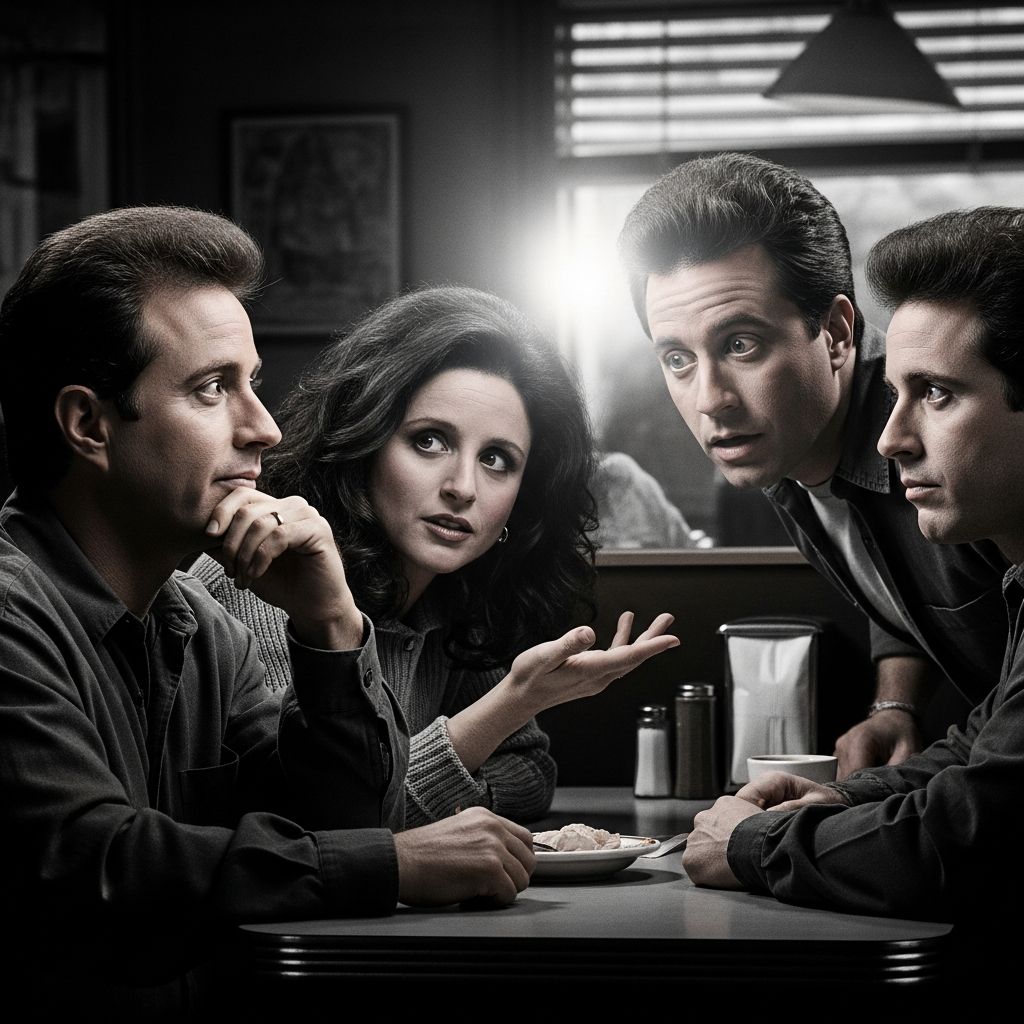
When people talk about television that “changed everything,” they often mention gritty dramas or prestige cable shows. Yet one half-hour network sitcom episode about four neurotic New Yorkers making a secret bet over self-control did as much to shift TV comedy as any serious drama. Without ever saying the word at the center of its story, Seinfeld’s “The Contest” pushed broadcast standards, deepened character comedy, and proved that mainstream audiences were ready for sharper, more honest adult humor.
Setting the Stage: Seinfeld Before the Shockwave
By the early 1990s, Seinfeld was still evolving from a quirky, low-rated experiment into NBC’s flagship comedy. The series was known as a “show about nothing,” but underneath that tagline was a clear formula:
- Obsessive focus on small, everyday frustrations
- Four flawed leads who rarely learned lessons
- Plots that wove together into a single comic payoff
- Clean, network-safe language despite edgy subtext
Television standards on American broadcast networks in the early ’90s were still relatively strict. Sexual content, especially anything involving explicit language or solo sexuality, was heavily policed by network censors and watchdog groups. The default approach for sitcoms was either to avoid the topic entirely or to treat it as a one-note gag.
The Premise That Almost Didn’t Air
At the center of “The Contest” is a simple question: who can go the longest without masturbating? The brilliance lies not just in the premise itself, but in how it is handled:
- Nothing explicit is ever said. The episode avoids the actual word, using euphemisms and phrases like “master of your domain” instead.
- The story is framed as a bet. This turns an intimate subject into a structured game with clear stakes.
- Temptation is visual and situational. A neighbor across the street, a hospital visit, a romantic encounter — all raise the pressure without graphic detail.
Historically, American TV networks had long shied away from even indirect depictions of masturbation, treating it as off-limits content. The episode’s writer, Larry David, reportedly expected it to be rejected by the network, yet it was eventually approved with careful language constraints. Critics and scholars often point to this episode as a turning point in how television could handle adult themes without resorting to either prurience or moral panic.
Character Study in the Form of a Wager
On the surface, “The Contest” is one of the most talked-about episodes of Seinfeld because of its subject. Underneath, it is a tightly structured character piece. Each main character’s struggle in the bet highlights a different core flaw:
| Character | Key Weakness Exposed | Source of Temptation |
|---|---|---|
| Jerry | Comfort-seeker, easily distracted by desire | Proximity to temptation in his own apartment and dating life |
| George | Emotional dependency and anxiety about his mother | Hospital visits and repressed frustration around family expectations |
| Kramer | Impulsiveness and total lack of self-discipline | The neighbor across the street; he gives in almost instantly |
| Elaine | Romantic idealism and attraction to an unavailable man | The possibility of meeting John F. Kennedy Jr. |
By tying each character’s breaking point to their established traits, the episode avoids cheap shock value. Instead, it becomes a case study in how desire intersects with personality, neuroses, and social pressure. This is one reason writing instructors still cite the episode as a model of character-driven comedy.
Elaine, Desire, and Quiet Gender Progress
One of the most culturally significant aspects of “The Contest” is the way it includes Elaine as an equal participant. Many sitcoms of the era kept female characters at a slight remove from explicitly sexual plots, or made them the target of the joke rather than full agents within it.
In this episode, however:
- Elaine joins the bet under the same rules as the men, with slightly altered financial terms.
- Her temptation is framed not as a moral failing, but as a fully human response to attraction.
- The narrative never treats her inclusion in the contest as bizarre; it is accepted by the group and the story moves on.
Julia Louis-Dreyfus has later commented on how the episode acknowledges the “equity of sexual desire” — the idea that women’s sexual impulses are as real and as funny as men’s, without turning them into a punchline. Media scholars often note that presenting a female character as sexually self-motivated, without judgment or punishment, helped normalize a more honest portrayal of women on television comedies.
Writing Around the Unsayable
Part of what makes “The Contest” a favorite among screenwriters is the way it turns censorship into a creative engine. Rather than being hampered by what they could not say, the writers:
- Invented memorable euphemisms (like “master of your domain”) that entered pop culture as in-jokes.
- Used silence, reaction shots, and audience laughter to fill in the blanks.
- Relied on clear visual storytelling — like characters tossing money on the table — to signal who has lost the bet.
According to television criticism in outlets like The A.V. Club, the episode’s mix of maturity and immaturity is central to its appeal: it treats the subject frankly in terms of human behavior while still reveling in the juvenile silliness of the situation. This balance allowed network TV to move slightly closer to reality without losing the sense of fun that audiences expected from a primetime sitcom.
The Audience Reaction and Critical Legacy
Upon airing in November 1992, “The Contest” drew strong ratings and a mixture of surprise and praise from critics. Over the decades, it has consistently appeared in rankings of the greatest TV episodes of all time and is often singled out as the defining episode of Seinfeld itself.
Its reputation rests on several key achievements:
- Pushing standards without alienating viewers. The episode proved that audiences could handle more frank topics if they were treated with wit rather than crudity.
- Elevating sitcom stakes. By making the characters’ inner battles the central conflict, it showed that personal restraint could feel as urgent as any external plot.
- Launching catchphrases into everyday language. Phrases from the episode became shorthand for self-control and private behavior among fans.
Television historians and critics often place “The Contest” in the lineage of shows that broadened what mainstream TV could talk about, alongside earlier milestones in dealing with topics like pregnancy, race, or divorce.
How “The Contest” Influenced Later TV Comedy
The long-term influence of the episode shows up in how later series, including on cable and streaming platforms, approach sexual topics. While the exact subject matter has become far more explicit in shows that are not bound by broadcast rules, the approach pioneered here remains important:
- Focus on characters’ emotional and psychological responses, not just the act itself
- Let taboo subjects be the engine for situational, not purely shock-based, humor
- Write women as full participants in stories about desire and self-control
Scholars of television and media note that as standards shifted, especially with the growth of cable in the late 1990s and later streaming, earlier boundary-pushing episodes on broadcast networks helped normalize talking about such themes at all. “The Contest” is frequently cited as a key reference point in that evolution.
Why the Episode Still Resonates
Decades after it first aired, the episode continues to feel oddly modern. That staying power comes from elements that go beyond its initial controversy:
- Universality of self-control struggles. Almost everyone has faced some version of wanting to resist a temptation and failing.
- Economy of storytelling. The episode is largely confined to a few locations and a single, clear premise, making it timeless and easy to revisit.
- Refusal to moralize. No character is punished with a grand lesson; they simply live with their choices and keep moving, in classic Seinfeld fashion.
Rather than serving as an after-school special about restraint or a cautionary tale about excess, “The Contest” chooses to observe its characters with wry detachment. That attitude — neither condemning nor celebrating them — helped pave the way for modern “hangout” comedies where flawed behavior is simply part of the texture of life.
Key Takeaways at a Glance
- “The Contest” transformed a forbidden topic into mainstream network comedy without using explicit language.
- Its structure reveals character traits through personal temptation, serving as a model for character-driven writing.
- Elaine’s inclusion in the bet marked a subtle but important step forward for the depiction of female desire in sitcoms.
- The episode influenced later TV by showing that adult subjects could be handled smartly, not just shockingly.
- It remains a reference point in both popular culture and media studies as one of the most important sitcom episodes ever produced.
Frequently Asked Questions About “The Contest”
Why is Seinfeld’s “The Contest” considered groundbreaking?
It tackled masturbation — a topic traditionally off-limits on American broadcast TV — without ever naming it directly, using implication, character behavior, and clever euphemisms. This let the show explore adult themes within network standards while still reaching a mass audience.
Did the episode face censorship from the network?
Yes. Network standards were strict at the time, so the writers were not allowed to use explicit terms. They navigated these restrictions by writing around the forbidden word and focusing on reactions and situational comedy instead.
How did “The Contest” affect Seinfeld’s reputation?
The episode cemented the show’s status as a bold, culturally relevant sitcom rather than just a quirky ensemble comedy. Critics and fans frequently rank it among the greatest episodes in television history, and it helped define the series’ identity as a boundary-pusher.
What makes Elaine’s role in the episode important?
Elaine is treated as an equal participant in the bet, with her own desires and weaknesses, rather than as an outsider or moral counterpoint. Commentators and cast members have pointed out that this normalized female sexual desire in a way that was rare for sitcoms of that era.
Does the episode still feel relevant today?
Yes. Even though modern TV can be far more explicit, the episode’s focus on character, subtext, and human weakness still resonates. Its humor comes from behavior and personality rather than shock value, which helps it hold up decades later.
References
- This Is ‘Seinfeld’s Most Groundbreaking Episode, According to Julia Louis-Dreyfus — Collider. 2023-10-11. https://collider.com/seinfeld-the-contest-episode/
- Remembering the Edgy ‘Seinfeld’ Episode ‘The Contest,’ 30 Years Later — TV Insider. 2022-11-18. https://www.tvinsider.com/1069843/seinfeld-the-contest-30th-anniversary/
- The Contest — Wikipedia (plot and production details; corroborated against primary reporting). Last updated 2024. https://en.wikipedia.org/wiki/The_Contest
- Seinfeld: “The Contest” — YouTube video essay on screenwriting (What Makes This Episode So Great?). 2020. https://www.youtube.com/watch?v=8_7jLcEG13c
- Seinfeld, Season Four, Episode Ten, “The Contest” — The Avocado (critical analysis). 2024-09-01. https://the-avocado.org/2024/09/01/seinfeld-season-four-episode-ten-the-contest-2/
- Seinfeld: “The Contest”/”The Airport”/”The Pick” — The A.V. Club. 2009-07-09. https://www.avclub.com/seinfeld-the-contest-the-airport-the-pick-1798166885