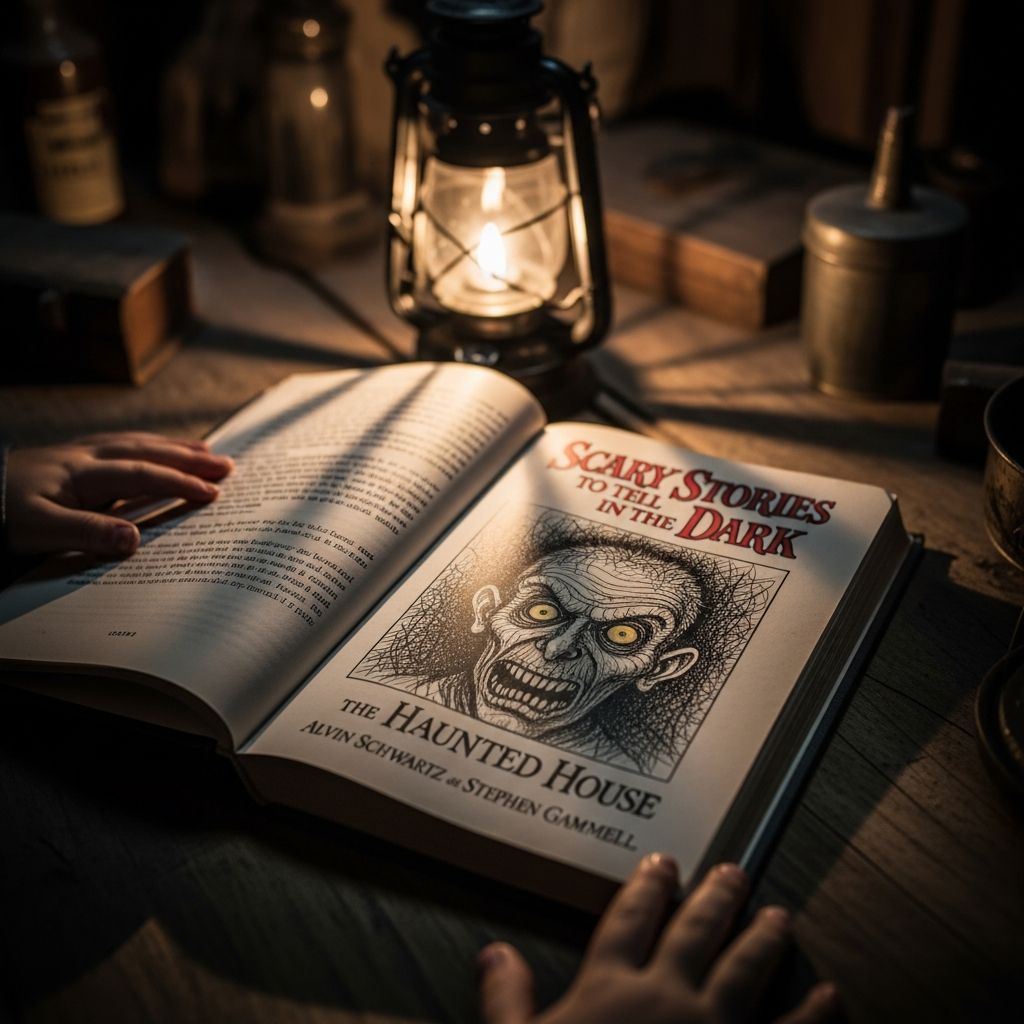
For many adults, seeing the cover of Scary Stories to Tell in the Dark instantly transports them back to a school library aisle or a dimly lit sleepover, clutching a thin paperback that felt far more dangerous than it looked.
That sense of danger did not come only from the tales themselves, but from the grotesque, dreamy artwork that made the book feel less like a children’s collection and more like a forbidden artifact that somehow slipped onto the kids’ shelf.
The Book That Looked Like a Dare
Before a child read a single word, the original cover of Scary Stories to Tell in the Dark delivered a warning in ink: this was not a gentle bedtime storybook.
The images were all jagged lines, blurred faces, and impossible bodies, tapping into the way children half-remember nightmares and giving visual form to anxieties they could not yet name.
- The colors were washed-out and sickly rather than bright and inviting.
- Characters seemed to dissolve into the page, as if they were rotting or evaporating in front of you.
- Backgrounds were unfinished and foggy, echoing the way fears feel more intense when details are missing.
For many young readers, simply picking the book up felt like breaking a rule—an act of courage and curiosity that was part of the appeal.
Why Kids Love Being Safely Terrified
Children’s horror that actually frightens kids is controversial, but it also serves a developmental purpose: it lets them practice feeling fear in a controlled, reversible way.
In the case of Scary Stories to Tell in the Dark, the short length of each tale, the familiar campfire structure, and the often exaggerated endings meant kids could dip into terror and then quickly step back out again.
Emotional rehearsal through horror
When a child leans into a frightening story, they are not only seeking thrills; they are also testing how it feels to be confronted with danger, uncertainty, and the feeling of being small in a big, unpredictable world.
The book’s mix of quick shocks, grotesque imagery, and dark humor allowed children to experiment with different reactions—screaming, laughing, bragging afterward—without any real-world risk.
- Fear is time-limited: the story ends, the lights come on, and ordinary life returns.
- Kids tell the same story repeatedly to reduce its power and prove they can handle it.
- Retelling a tale to friends shifts them from passive audience to active storyteller and “fear manager.”
The Power of Urban Legends in a Kid-Sized World
Many of the stories in the collection are rather simple retellings of urban legends and folktales: ghost hitchhikers, hooks on car doors, babysitters in danger, and things that thump in the night.
These tales thrived in playground culture long before the book appeared, but collecting them between two covers gave children a sense that their whispered lore mattered enough to be written down.
Folklore as shared language
Urban legends function almost like a shared emotional language for kids, encoding lessons and anxieties in memorable, easy-to-retell narratives.
By formalizing these hallway and campfire tales, the book turned kids into carriers of a living folklore tradition, helping them feel part of something that stretched beyond their immediate circle of friends.
| Theme | Typical Setting | Underlying Fear |
|---|---|---|
| Threat at the window or door | Suburban house or cabin at night | Vulnerability at home when adults are absent or distracted |
| Dangerous stranger or hitchhiker | Lonely road or small town | Fear of the unknown and of adults who cannot be trusted |
| Body horror (spiders, boils, decay) | Bedroom, bathroom, or hospital | Anxiety about bodily changes and loss of control |
| Ghost seeking justice | Old house, cemetery, church | Worry that adults hide terrible secrets and that wrongs go unpunished |
The Artwork Adults Feared More Than the Stories
While parents often focused on plot content—murders, ghosts, monsters—the most unsettling element for many children was actually the distorted, dreamlike illustrations.
Adults sometimes underestimated how much those images lingered in kids’ minds, popping back into focus when they turned off the lights or stared too long at a dark corner of the bedroom.
Why those drawings felt so wrong
- The figures rarely looked fully human, yet they also avoided the comforting exaggeration of cartoons, landing in an uncanny valley that made them hard to dismiss as “just pictures.”
- The use of smudges, drips, and broken lines mirrored how fear muddies perception, making everything feel slightly distorted and unreliable.
- Many scenes lacked clear context, which forced children to imagine what came before and after—a gap their minds eagerly filled with worst-case scenarios.
This combination of ambiguity and intensity made the book’s visuals feel more like glimpses into dreams than straightforward illustrations, leaving emotional impressions long after specific story details faded.
The Banned Book on the Kids’ Shelf
Over time, the series rose to the top of challenged and banned book lists in schools and libraries, with critics arguing that its grisly content, gruesome art, and references to death were inappropriate for children.
This backlash ironically cemented the series’ reputation, transforming it from a popular kids’ horror collection into a symbol of the ongoing tug-of-war between adult gatekeeping and children’s curiosity.
| Adult Concern | Child Perspective |
|---|---|
| Graphic depictions of death and decay | Proof that the book was “for real” and not babyish |
| Nightmare-inducing images and scenarios | An exciting challenge: “Can I handle this without freaking out?” |
| Association with occult or “dark” themes | Playful fascination with ghosts and monsters already circulating among peers |
| Fear of desensitization to violence | Sense of power in safely retelling shocking stories to others |
For many now-adults, the knowledge that the book had been banned or challenged only enhances its aura of danger and authenticity in memory, even if they originally found it in a perfectly ordinary school library.
Raising Kids in a World With Bigger, Louder Scares
Today’s children have access to horror far more intense than any school-library paperback, from algorithm-driven video feeds to ultra-realistic games and movies available on demand.
Against that backdrop, a slim volume of brief folk tales and black-and-white drawings might seem almost quaint, yet it still carries emotional weight because of how directly it speaks to common childhood fears.
Paperback fear vs. algorithmic fear
- Books offer natural stopping points—chapters, page turns—that let kids regulate their exposure and step away when overwhelmed.
- Digital platforms often blur those boundaries, autoloading the next video or suggested clip, which can escalate intensity before a child has time to process.
- Reading scary stories typically happens in shared spaces (bedrooms, classrooms, living rooms), while digital horror is often consumed alone on personal devices.
From a parenting standpoint, this means that older horror books can be surprisingly useful tools: they allow families to discuss fear, boundaries, and media literacy in a lower-stakes format than high-definition video.
How to Tell If Your Child Is Ready
There is no single “right age” for Scary Stories to Tell in the Dark, because children differ widely in sensitivity, previous exposure to frightening material, and how much they ruminate afterward.
Instead of focusing on a number, it helps to watch for signs that your child can tolerate and process mild fear without it spilling over into daily anxiety or sleep disruption.
Practical readiness checkpoints
- Your child already enjoys gentle spooky content—like slightly eerie cartoons or Halloween specials—and recovers quickly after jumpy moments.
- They can distinguish clearly between fiction and reality and talk about the difference without becoming visibly distressed.
- They show curiosity about ghost stories or creepy folklore but also know how to say “that’s too scary” and change the subject.
- They do not struggle with recurring nightmares or bedtime anxiety that could be amplified by graphic imagery.
If you decide to introduce the book, consider reading alongside them or pre-reading selected stories to gauge tone and intensity before turning it into a ritual or sleepover activity.
Turning Scary Reading Into Connection
One overlooked benefit of shared horror reading is how it can become a surprising bonding experience, especially when parents treat the stories as conversation starters rather than tests of toughness.
Reading aloud, pausing to react together, and even laughing at over-the-top endings can help children feel that their fears are taken seriously and also survivable.
Ideas for a family-friendly spooky session
- Create a “spooky but safe” environment with dim lamps instead of total darkness, blankets, and a clear plan for switching to something lighter afterward.
- Let the child choose which stories to hear and when to stop, reinforcing their sense of control over the experience.
- After a particularly tense tale, ask open questions like, “What part would be the scariest for you if it were real?” and “How would you get out of that situation?”
- Share age-appropriate stories from your own childhood fears to normalize the idea that being scared sometimes is a universal experience.
Why the Book Still Haunts Adult Memory
For many grown readers, the details of specific plots have blurred, but the feeling of first encountering the book—the smell of the library, the weight of the pages, the shock of seeing that art—remains oddly sharp.
This emotional clarity suggests that the book functioned less as a collection of stories and more as a kind of rite of passage, a shared test that kids administered to themselves and each other.
- Seeing the cover as an adult can trigger a rush of sensory memory: the way friends huddled together, the hush before a loud scream in the story, the nervous giggles afterward.
- Those memories often carry a mix of fear and pride—fear at the images, pride at having faced them and lived to brag about it at school the next day.
- Parents who grew up with the book now face the strange question of whether to hand that same experience to their own children, knowing both its intensity and its impact.
FAQs About Kids and Scary Story Books
Is Scary Stories to Tell in the Dark appropriate for my child?
The answer depends less on age and more on temperament: some upper-elementary kids eagerly devour creepy stories and sleep fine afterward, while others find the images or endings too disturbing.
Consider your child’s history with nightmares, their interest in spooky topics, and whether they tend to replay frightening material in their minds long after the story ends.
Should I worry about the illustrations causing nightmares?
The artwork is notorious for lingering in memory, and sensitive children may find certain images hard to shake, especially at bedtime.
If you are concerned, you can preview the artwork yourself and either cover specific pictures, limit exposure to a small number of stories at a time, or postpone the book until your child is older and more resilient.
Does reading scary stories make kids more anxious overall?
For many children, controlled exposure to fictional fear—where they can close the book or walk away—actually helps them feel more capable of handling scary feelings when they arise in real life.
However, if a child already experiences high anxiety, intrusive thoughts, or frequent nightmares, intense horror content can amplify those struggles, so it is wise to proceed cautiously and check in often.
What if my child discovers the book at school before I am ready?
Instead of responding with shame or panic, treat it as an opening for conversation: ask what they liked or disliked, which parts felt most intense, and how their body felt while reading or listening.
You can then set clear family guidelines about when, where, and how often they engage with that kind of material, making it part of a broader pattern of discussing media choices openly.