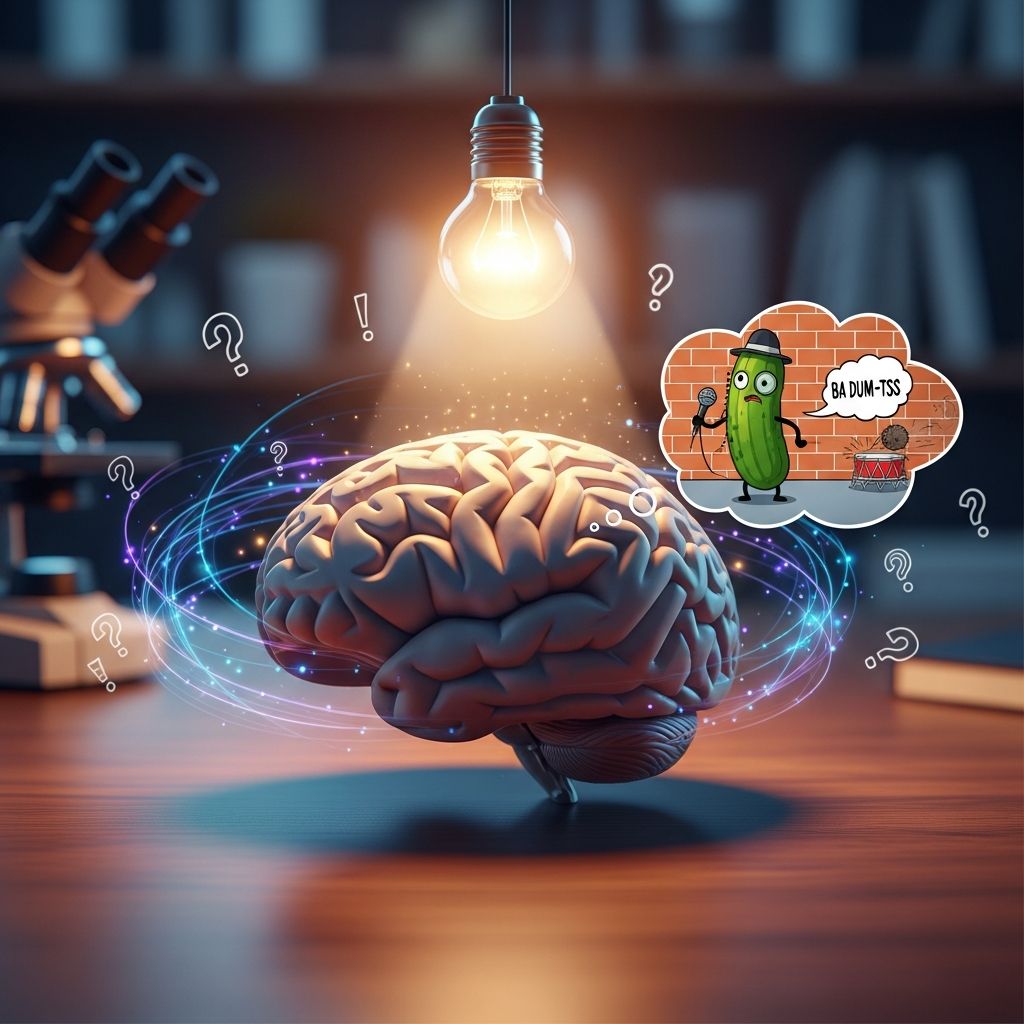
Terrible puns and dad jokes might sound simple, but they sit at the crossroads of language, memory, emotion, and social connection, making them far more powerful than most people realize.
What Makes a Pun a Pun?
A pun is a form of wordplay that relies on a word or phrase having more than one possible meaning, or on two different words sounding very similar. At its core, a pun surprises the brain by suddenly shifting from one interpretation to another.
This twist forces a rapid mental reframe: the brain has to abandon its first, serious interpretation and swap in a playful one, which creates the familiar mix of amusement, groaning, or second-hand embarrassment that puns are famous for.
Types of puns you hear every day
- Sound-alike puns: Two words sound the same or nearly the same, but mean different things.
- Double-meaning puns: A single word or phrase can be legitimately read in two ways, and the joke jumps between them.
- Context-flip puns: A familiar saying is used in an unexpected situation, creating a playful mismatch.
These basic patterns are simple enough for kids to grasp, yet complex enough that the brain has to shift gears quickly to “get” the joke.
How Puns Travel Through the Brain
Even the shortest pun calls on surprisingly large portions of the brain, especially regions that handle language, attention, and conflict resolution between competing meanings.
Researchers who study the neuroscience of humor have repeatedly found that puns activate both “left-brain” and “right-brain” processes, challenging the old myth that language lives entirely on one side of the brain.
Step-by-step: what happens when you hear a pun
- Literal meaning is processed first: As you listen, the brain initially tries to build a straightforward, logical interpretation of what is being said.
- A conflicting meaning appears: The punchline introduces a second interpretation that clashes with the first one.
- The brain resolves the conflict: Control networks step in to choose which meaning fits the joke, and this mental “flip” creates the feeling of surprise.
- Reward systems react: If the flip feels clever rather than confusing, reward circuits signal a small hit of amusement or satisfaction.
Language and humor: a quick comparison table
| Aspect | Straightforward sentence | Pun or wordplay |
|---|---|---|
| Main goal | Convey one clear meaning as efficiently as possible. | Juggle multiple meanings to create surprise or playfulness. |
| Brain effort | Minimal: one interpretation fits easily. | Higher: the brain must detect and resolve ambiguity. |
| Emotional reaction | Neutral or mildly informative. | Amusement, groaning, or shared eye-rolling. |
| Social function | Transfer information or instructions. | Signal cleverness, create inside jokes, and build bonds. |
Why Puns Can Signal Mental Agility
Being able to produce and understand puns at high speed demands a rare mix of skills: rich vocabulary, fast retrieval of word meanings, sensitivity to sound patterns, and the cognitive flexibility to switch tracks mid-sentence.
This does not mean that everyone who loves puns is a genius, but it does suggest that strong punning ability often overlaps with verbal intelligence and mental agility in everyday life.
Skills that pun-makers practice without realizing it
- Rapid word retrieval: Pulling up similar-sounding or related words in split seconds.
- Pattern recognition: Detecting overlaps between sounds, spellings, and meanings.
- Perspective shifting: Jumping fluidly between literal and playful interpretations.
- Compact communication: Packing extra meaning into fewer words by layering interpretations.
These are the same abilities that support persuasive speaking, creative problem-solving, and learning new languages later in life.
When Puns Hint at Something Deeper
Most puns are harmless signs of curiosity and creativity, but in rare medical situations, relentless punning can be a symptom of certain neurological conditions that alter impulse control and social judgment.
In those cases, the issue is not the presence of puns themselves, but the inability to stop or adapt them even when they are clearly unwanted or disruptive.
Healthy punning vs. unhealthy compulsive joking
| Feature | Everyday punning | Compulsive joking |
|---|---|---|
| Frequency | Occasional, usually in playful contexts. | Persistent, often in inappropriate settings. |
| Control | Easy to stop when others are uncomfortable. | Very difficult to stop, even after complaints. |
| Social impact | Strengthens relationships when used thoughtfully. | Can strain relationships and cause distress. |
| Underlying cause | Playfulness and habit. | Possible neurological or psychiatric changes. |
For the vast majority of families, though, the worst outcome of a pun streak is a chorus of sighs and a child muttering, “You’ve got to stop.”
Dad Jokes, Embarrassment, and Emotional Resilience
Dad jokes—those famously corny puns that parents repeat with suspicious enthusiasm—do more than fill awkward silences; they also expose kids to safe doses of mild social discomfort and embarrassment.
When a parent intentionally tells a joke so bad that everyone groans, the real message is that it is okay to look silly, to misjudge a joke, and to survive a moment of awkwardness without falling apart.
How repeated groan-worthy jokes help kids
- Normalizing awkwardness: Kids see a trusted adult willingly being a little ridiculous and surviving just fine.
- Modeling emotional flexibility: Children learn that blushing or cringing is a feeling that passes, not a disaster.
- Reducing fear of judgment: Over time, kids become slightly more desensitized to embarrassment in a safe, warm environment.
This gentle exposure acts almost like emotional training, helping children tolerate future social bumps such as public speaking, classroom mistakes, or trying new skills in front of others.
Wordplay as a Family Bonding Tool
Shared puns and running jokes can become a kind of family language, turning everyday situations—car rides, grocery trips, bedtime routines—into moments of connection and laughter.
When kids start contributing their own puns to the mix, they are not only joining in the humor but also signaling that they understand the subtle rules and rhythms of the family’s communication style.
Ways puns strengthen relationships
- Creating shared history: Recycled jokes and catchphrases form inside references that make kids feel like part of an in-group.
- Softening tense moments: Playful wordplay can help reset the emotional tone after a disagreement or stressful day.
- Encouraging conversation: Children are often more willing to talk when the atmosphere is light and humorous.
Over years of repetition, these tiny moments of shared amusement add up, weaving humor into the emotional fabric of the household.
Puns as Brain Workouts for Kids
For children, learning to understand puns is a clear sign that their language system is becoming more flexible, able to recognize that the same word can be bent to mean different things in different situations.
This linguistic flexibility supports reading comprehension, vocabulary growth, and even problem-solving skills, because children must hold multiple possibilities in mind and then choose the one that makes the joke work.
Everyday benefits of playful word confusion
- Better awareness of ambiguity: Kids notice when a sentence can be taken in more than one way, which helps them read more critically.
- Improved listening skills: To catch a pun, children have to pay attention to both sound and context.
- Stronger memory: Jokes that twist familiar words and phrases are easier to remember and retell, which practices recall.
Over time, this practice makes kids more comfortable with the idea that language is not always literal or straightforward, an important lesson for understanding sarcasm, figurative speech, and even complex instructions.
How to Use Puns Wisely at Home
Like any kind of humor, puns are most helpful when they are used with sensitivity to who is listening, how they feel, and whether they are included in the joke rather than made into the target.
Thoughtful use of wordplay can turn puns into a powerful tool for learning, bonding, and emotional regulation instead of a source of irritation or exclusion.
Practical tips for parents and caregivers
- Match the joke to the age: Use simpler, sound-based puns with younger children and more complex wordplay as they grow.
- Invite participation: Ask kids if they can come up with their own twist on a word or phrase, and celebrate the effort, not just the outcome.
- Read the room: Save the relentless pun streak for relaxed moments, not for times when someone is upset or overwhelmed.
- Keep it kind: Focus on wordplay that does not insult or target anyone, especially in front of children who are still learning boundaries.
Used this way, puns become part of a supportive environment where humor is a shared resource, not a weapon or a distraction from real feelings.
Adults, Puns, and Lifelong Brain Health
For adults, engaging in regular wordplay can help keep language pathways active, especially as natural age-related changes in memory, speed, and attention begin to appear.
Challenging the brain to search for multiple meanings, retrieve unusual associations, and adapt quickly to new jokes can act as a gentle cognitive workout woven into everyday life.
Simple ways adults can train their brains with puns
- Play word games: Try crossword puzzles, word association challenges, or pun-based games with friends or family.
- Collect running jokes: Keep a mental or physical list of recurring puns that you and your loved ones enjoy.
- Experiment with language: When you encounter a new word, see if you can spot sound-alikes or double meanings, even if you never say them out loud.
These small habits may not replace more intensive cognitive training, but they add an enjoyable, low-pressure layer of mental stimulation to daily routines.
Balancing Humor and Respect
Not everyone enjoys puns, and some people find constant wordplay draining or frustrating, especially when it interrupts serious conversations or sensitive topics.
Respecting those boundaries is essential: good humor should feel inclusive and flexible, able to pause when someone clearly needs to be heard without distraction.
Signs your puns may be crossing a line
- People repeatedly tell you they feel ignored or dismissed when you joke.
- Children seem anxious or withdrawn rather than amused during playful teasing.
- Jokes continue even after someone directly asks for a change of topic.
When in doubt, it is better to err on the side of listening first and joking later, using humor to support connection instead of replacing genuine conversation.
Frequently Asked Questions About Puns and the Brain
Are people who love puns automatically smarter?
Liking puns does not automatically mean someone is more intelligent, but being good at crafting them often reflects strong verbal skills and flexible thinking. Many people with average or above-average intelligence enjoy puns simply because they appreciate the playful side of language.
Can kids be too young to understand puns?
Very young children may laugh at the funny sound of a joke without truly understanding the double meaning, and that is perfectly normal. As their vocabulary and grasp of ambiguity grow, they slowly move from enjoying the rhythm of the joke to actually appreciating the twist in meaning.
Is it possible to overdo dad jokes?
Yes, even the most good-natured humor can become overwhelming if it ignores context, timing, or the feelings of others. A healthy balance mixes playful teasing with plenty of serious listening, empathy, and moments where children can express themselves without being turned into a punchline.
Do puns have any real mental health benefits?
Puns alone will not cure anxiety or depression, but they can contribute to a more relaxed, connected atmosphere at home or in friendships. When people feel free to laugh together, they often find it easier to share worries and seek support when they need it.
Can adults still improve their pun skills later in life?
Absolutely: wordplay is a skill that can be practiced at any age by reading widely, noticing sound patterns, and gently pushing yourself to think of alternative meanings. Over time, the brain gets faster at making these connections, turning hesitant attempts into smoother, more confident jokes.
Puns may look trivial on the surface, but they reveal how flexible, social, and curious the human brain can be. Whether you groan, laugh, or do both at once, each eye-rolling joke is a tiny demonstration of just how much work your mind is doing in the background.