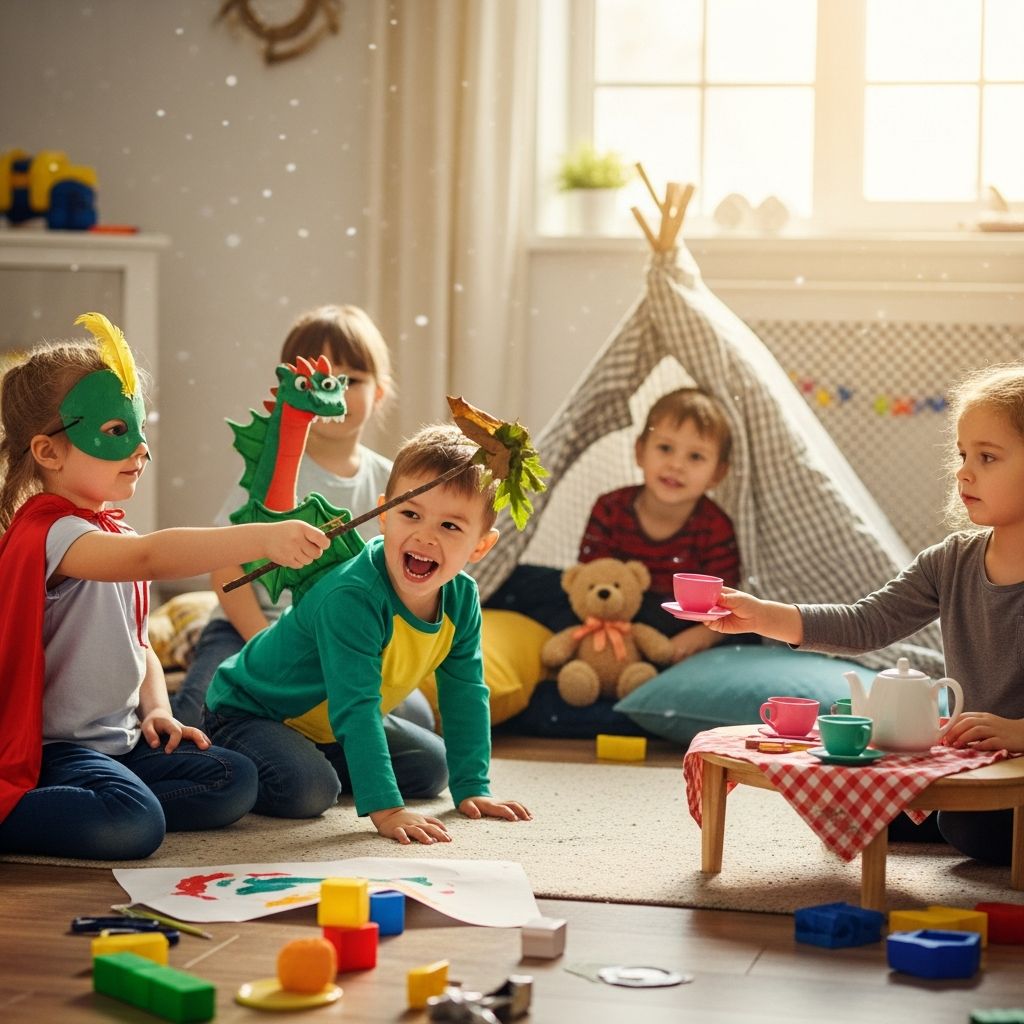
Imaginative pretend play stands as a cornerstone of early childhood development, enabling children to explore worlds beyond reality while honing vital skills. Through role-playing as doctors, chefs, or explorers, kids transform everyday objects into tools of adventure, fostering growth across multiple domains.
The Cognitive Boost from Imaginative Adventures
Pretend play significantly enhances cognitive abilities by promoting abstract thinking and mental representation. Children learn to symbolize objects—a stick becomes a sword or a block a phone—building foundational skills for later academic success.
Research highlights how such play facilitates perspective-taking and higher-level cognition. For instance, engaging in fantasy scenarios helps children understand diverse viewpoints, crucial for abstract thought development.
- Problem-Solving Mastery: In play, children navigate challenges like building a fort or resolving a ‘crisis’ in their story, practicing divergent thinking and improvisation.
- Executive Function Gains: Pretend scenarios demand planning, flexibility, and self-regulation, strengthening the brain’s prefrontal cortex activities.
- Mathematical and Literacy Foundations: Activities like ‘grocery store’ play integrate sorting, counting, and narrative creation, blending skills seamlessly.
Studies from early research link pretend play to improved impulse control, representational competence, and narrative recall, underscoring its role in cognitive readiness for school.
Social and Emotional Foundations Built Through Role-Play
One of pretend play’s greatest strengths lies in its ability to cultivate social competence and emotional intelligence. By assuming roles and interacting with peers or adults, children practice cooperation, negotiation, and empathy.
During play, kids take turns, share resources, and resolve conflicts, mirroring real-world social dynamics in a safe space. This builds teamwork foundations and helps them step into others’ shoes, enhancing perspective-taking.
| Skill | How Pretend Play Develops It | Long-Term Benefit |
|---|---|---|
| Empathy | Acting out emotions in roles | Better relationships |
| Communication | Dialogues in scenarios | Stronger verbal skills |
| Conflict Resolution | Negotiating play rules | Reduced aggression |
Emotionally, pretend play allows rehearsal of real-life situations, boosting confidence and independence. Children explore identities, likes, and dislikes, feeling more prepared for future challenges.
Language and Communication Explosion
Pretend play accelerates language development by encouraging expressive and receptive skills. Children narrate stories, describe actions, and engage in dialogues, expanding vocabulary and syntax.
As they improvise scripts and negotiate roles, linguistic competence grows. Private speech during play, as theorized by Vygotsky, aids self-regulation and transforms into internalized thought processes.
- Rich narratives from play enhance recall and storytelling abilities.
- Symbolic language use in play supports literacy emergence.
This interactive dialogue strengthens social bonds and cognitive-linguistic links, vital for academic progress.
Physical Development Hidden in Fun
Beyond mental gains, pretend play promotes physical health through active movement. Children run, climb, manipulate toys, and gesture dramatically, developing motor skills without structured exercise.
Gross motor activities like chasing ‘monsters’ build strength and coordination, while fine motor tasks such as dressing dolls refine dexterity and hand-eye alignment.
Bilateral coordination improves as kids use both sides of the body in play, preparing them for sports, writing, and daily tasks.
Why Modern Childhood Needs More Pretend Play
In an era dominated by screens, unstructured pretend play is diminishing, yet its benefits are irreplaceable. High-quality play supports brain plasticity during the extended childhood phase, refining psychological skills.
Evolutionary perspectives suggest prolonged playfulness adapted human minds for complex social environments. Depriving children of this could limit metacognition, problem-solving, and social sophistication.
Parents and educators must prioritize child-led play over rigid activities to maximize developmental outcomes.
Practical Strategies to Spark Imaginative Play
Encouraging pretend play requires minimal resources but intentional support. Provide open-ended props like scarves, boxes, and old clothes to ignite creativity.
- Set the Scene: Suggest starting themes but let children lead.
- Join In: Participate as a co-player to model skills without dominating.
- Limit Screens: Reserve tech-free zones and times for pure imagination.
- Diverse Roles: Expose to varied scenarios for broad skill-building.
Observe your child’s interests—dinosaurs, superheroes, or baking—and build from there for engagement.
Evidence from Research: Play’s Lasting Impact
Peer-reviewed studies confirm pretend play’s reciprocal ties to cognition. Training in thematic play boosts semantic problem-solving, while cooperative play enhances general divergence.
Longitudinal insights show associations with executive function, language, and perspective-taking, persisting into education. Even neuroscience hints at dense synaptic connections from multifaceted play.
Frequently Asked Questions (FAQs)
What age is best for pretend play?
Pretend play emerges around 18-24 months, peaking in preschool years until age 7, aligning with peak neural plasticity.
Can solo play be as beneficial as group play?
Yes, solitary pretend play builds independence and internal dialogue, while group play adds social layers—both are essential.
How much pretend play do children need daily?
Aim for 30-60 minutes of unstructured play daily, integrated naturally without forcing it.
What if my child prefers screens over play?
Gradually introduce props and co-play to transition; consistency reduces screen reliance over time.
Does pretend play help with ADHD or emotional issues?
It supports self-regulation and emotional processing, potentially aiding focus and resilience, per cognitive studies.
Integrating pretend play into daily routines yields profound, multifaceted growth. From cognitive leaps to emotional resilience, this timeless activity equips children for a complex world. Prioritize it alongside academics for holistic development.
References
- Pretend Play: Ways Children Can Exercise Their Imagination — American Academy of Pediatrics. 2023-05-15. https://www.healthychildren.org/English/family-life/power-of-play/Pages/pretend-play-ways-children-can-exercise-their-imagination.aspx
- The Role of Pretend Play in Children’s Cognitive Development — Early Childhood Research & Practice, University of Illinois. 2002-01-01. https://ecrp.illinois.edu/v4n1/bergen.html
- Play it Forward: Lasting Effects of Pretend Play in Early Childhood — Florida Atlantic University News. 2023-10-10. https://www.fau.edu/newsdesk/articles/pretend-play-early-childhood
- Why is pretend play important? — Bright Horizons. 2024-02-20. https://www.brighthorizons.com/article/parenting/why-is-pretend-play-important
- The Physical Benefits of Pretend Play — Maileg USA. 2023-08-12. https://www.mailegusa.com/blogs/press/the-gift-of-pretend-play-physical