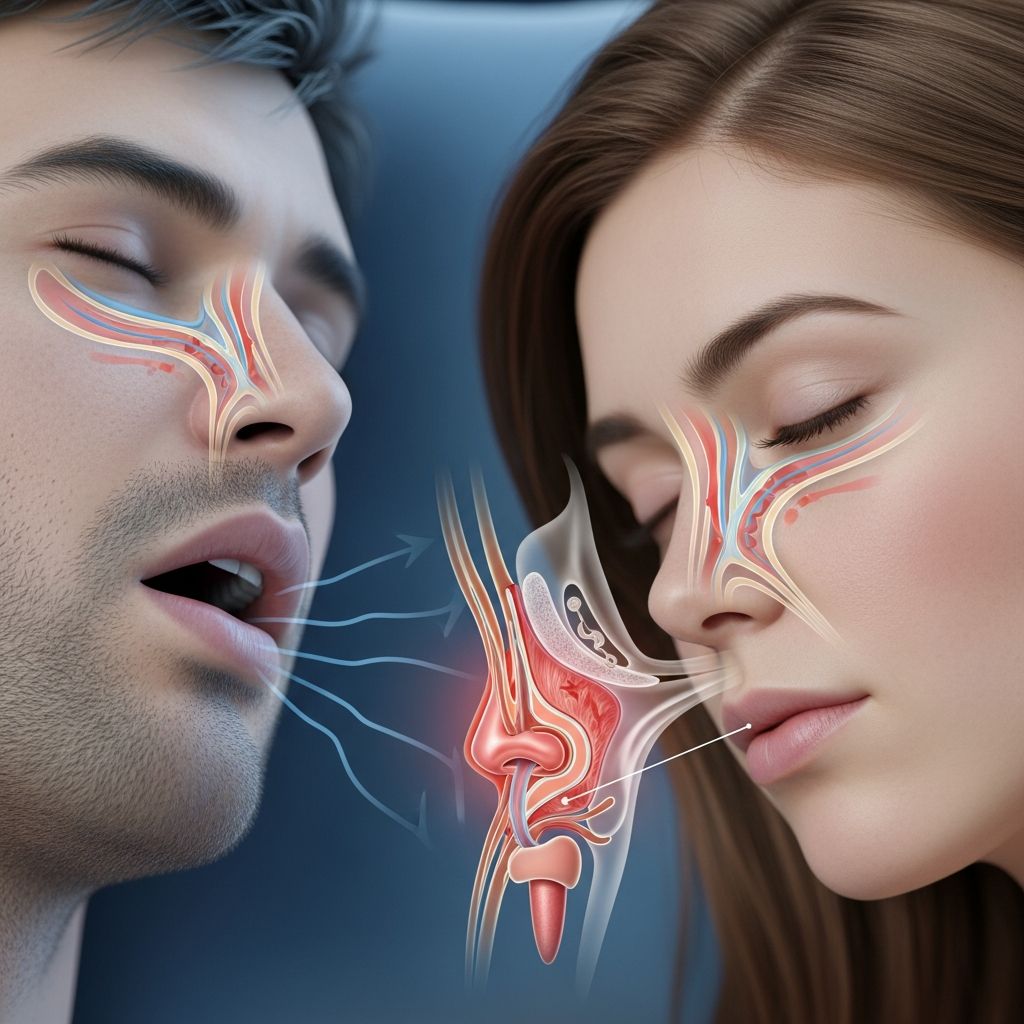
Men experience snoring at roughly double the rate of women, with about 40% of men affected compared to 20% of women, according to multiple studies analyzing self-reports and objective measurements. This disparity stems from a combination of anatomical, physiological, and hormonal factors that make men’s upper airways more prone to vibration and partial collapse during sleep.
Anatomical Factors Driving Snoring Disparities
The structure of the upper airway plays a central role in why men snore more. Men’s soft palates, which are key tissues involved in producing snoring vibrations, have a larger cross-sectional area, providing more material that can flap and generate noise during relaxed breathing. Additionally, the region between the hard palate and epiglottis—the oropharynx—is longer and more collapsible in men due to increased unsupported soft tissue, heightening obstruction risk when muscles slacken at night.
Men’s necks tend to be thicker, contributing to greater pharyngeal compliance, meaning the airway walls are more flexible and susceptible to narrowing under pressure. This passive collapsibility arises from surrounding structures rather than intrinsic muscle differences. Research using polysomnography confirms higher snoring indices across all sleep stages in men without obstructive sleep apnea compared to women.
- Larger soft palate area in men: Increases tissue vibration potential.
- Extended pharyngeal length: Creates more space for collapse.
- Higher neck circumference: Boosts overall airway compliance.
Hormonal Influences on Airway Stability
Sex hormones significantly modulate breathing and airway tone. Testosterone, more abundant in men, correlates with greater airway collapsibility and respiratory instability during sleep. Elevated testosterone levels in women, such as those with polycystic ovarian syndrome, elevate sleep-disordered breathing risks, underscoring its role.
In contrast, female hormones offer protection. Progesterone, elevated during pregnancy and the luteal phase, stabilizes ventilation by minimizing airflow drops and bolstering upper airway muscle tone, particularly the genioglossus muscle in the tongue that prevents backward fall and blockage. Estrogen complements this by enhancing muscle contractility. These effects explain lower snoring prevalence in premenopausal women.
| Hormone | Primary Gender | Effect on Snoring |
|---|---|---|
| Testosterone | Male | Increases collapsibility, promotes instability |
| Progesterone | Female | Stabilizes ventilation, strengthens muscles |
| Estrogen | Female | Enhances airway dilator activity |
Sleep Stage Patterns in Snoring
Snoring predominantly occurs during non-REM sleep stages, especially slow-wave sleep (N3) and light sleep (N2), rather than REM, in both adults and children with mild obstructive sleep apnea. Men show elevated snoring across stages, but intriguing age-specific patterns emerge: among adults under 40 with mild OSA, women exhibit a higher percentage of snoring time in N3 sleep compared to men.
This may relate to sex differences in upper airway collapsibility, measured by critical closing pressure, which is higher (more collapsible) in men even after adjusting for BMI and age. Men also display greater pharyngeal resistance increases during non-REM inspiratory challenges. Central chemoreflex sensitivity, stronger in males, heightens ventilatory responses to CO2 and hypoxia. In younger women, progesterone-driven muscle tonicity reduces resistance, favoring isolated snoring over apneas.
The Myth of Women’s Silent Nights
Despite lower self-reported rates, women snore as loudly as men when objectively measured. A study of nearly 2,000 patients found women's mean maximal snoring at 50 decibels, nearly matching men's 51.7 decibels. Shockingly, 40% of women claiming no snoring produced severe or very severe sounds, and 28% self-reporting none actually had minimal quiet nights (only 9%).
Women underreport snoring frequency and intensity, potentially delaying diagnosis of sleep disorders. This perception gap hinders clinic referrals, as questionnaires precede objective tests like sound metering. Cultural stereotypes portraying snoring as a "man's issue" exacerbate underrecognition in women.
Age and Menopause: Shifting Dynamics
Snoring prevalence rises with age for both sexes, peaking around 50-59 years, then declining—more sharply in men. Gender gaps narrow post-50, partly due to menopause. Women over 50 with menopausal syndrome show significantly higher snoring odds (OR=1.629) after adjustments for age, BMI, and comorbidities.
Estrogen and progesterone declines reduce respiratory control via carotid body and brainstem receptors, diminishing pharyngeal dilator activity. This hormonal shift increases vulnerability, aligning women's rates closer to men's in older cohorts. Population data confirm lower female snoring overall, but menopause erodes this advantage.
Snoring Trends by Age and Gender
| Age Group | Men Snoring % | Women Snoring % | Gap Notes |
|---|---|---|---|
| <40 | High | Lower | Largest disparity |
| 50-59 | Peak | Peak | Narrowing begins |
| >59 | Declines sharply | Declines gradually | Minimal difference |
Health Implications and Beyond
While isolated snoring is often benign, frequent episodes signal risks like obstructive sleep apnea (OSA), more prevalent in men due to anatomical factors. Chronic snoring fragments sleep, causing daytime fatigue, hypertension links (noted in menopausal women), and cardiovascular strain. Women's underreporting delays interventions like CPAP or oral appliances.
Positional therapy reduces snoring in non-supine sleep, and studies show treatment shifts patterns. Lifestyle factors—weight management, alcohol avoidance—benefit both genders. Awareness of these science-backed differences empowers better sleep hygiene.
Frequently Asked Questions (FAQs)
Do women really snore as loudly as men?
Yes, objective measurements show women's snoring reaches similar decibel levels (around 50 dB) as men's (51.7 dB), despite self-underreporting.
Why does snoring decrease after age 60?
Prevalence drops post-59, steeper in men, possibly due to lifestyle changes, muscle tone shifts, or survivor bias in studies.
Can hormones explain snoring in pregnancy?
Progesterone surges protect against collapse, often reducing snoring despite weight gain.
Is snoring always a sign of sleep apnea?
No, but higher indices, especially in men, warrant screening via polysomnography.
How can I reduce snoring?
Sleep on your side, maintain healthy weight, avoid sedatives, and consult for persistent issues.
References
- Exploring the dynamics of snoring in relation to sleep stages — PLOS ONE. 2024. https://journals.plos.org/plosone/article?id=10.1371/journal.pone.0295232
- Men vs. Women – Who Snores More? — SnoreGym. 2023. https://snoregym.com/blog/men-vs-women—who-snores-more
- New Research Proves Women Snore Just As Much As Men And Just As Loudly — London Nose Clinic. 2019-04-30. https://londonnoseclinic.com/2019/04/30/new-research-proves-women-snore-just-as-men-and-just-as-loudly/
- The gender difference of snore distribution and increased tendency… — PMC (PMC5399062). 2017. https://pmc.ncbi.nlm.nih.gov/articles/PMC5399062/
- Gender Differences in Sleep Apnea — Respiratory Therapy. 2023. https://respiratory-therapy.com/department-management/clinical/gender-differences-in-sleep-apnea/
- Women underreport prevalence and intensity of their own snoring — AASM. 2018. https://aasm.org/women-underreport-snoring/