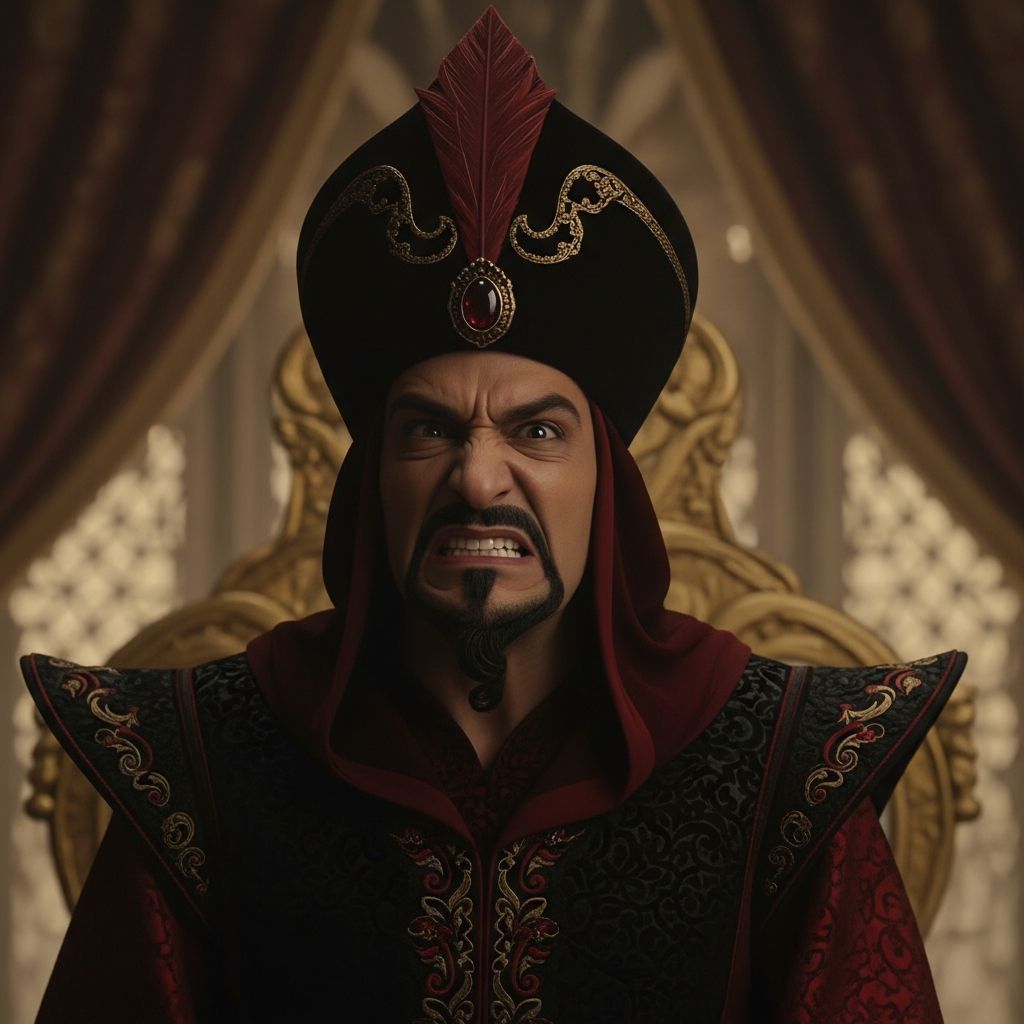
Disney’s live-action Aladdin set out to refresh a beloved classic with new songs, brighter visuals, and deeper backstories. Yet for many viewers, the biggest disappointment is clear: Jafar is no longer a truly frightening Disney villain. Instead of a commanding sorcerer whose presence shapes every scene, the remake offers a villain who rarely feels dangerous, mysterious, or even particularly interesting.
This article explores why live-action Jafar feels so underwhelming, how that weakens the story as a whole, and what it reveals about the challenge of translating animated villains into live-action.
From Iconic Menace to Mild Nuisance
In the 1992 animated film, Jafar quickly earned a place among Disney’s most memorable antagonists. His towering design, serpent staff, and silky yet menacing voice gave him an instantly recognizable identity. He was the embodiment of unchecked ambition, manipulating the Sultan, scheming for the lamp, and weaponizing dark magic in ways that felt genuinely threatening.
By contrast, the 2019 version presents a villain who often feels like an irritated bureaucrat rather than a towering force of evil.
- Less physical presence: The animated Jafar is tall, angular, and visually dominant; the live-action counterpart appears comparatively ordinary and far less imposing.
- Reduced vocal menace: The deep, rumbling delivery that once dripped with contempt and manipulation is replaced by a higher, more petulant tone, which undercuts his intimidation factor.
- Unfocused characterization: The remake adds hints of a street-rat past and insecurity, but never fully commits to exploring them, leaving him feeling flatter instead of richer.
On paper, giving Jafar more backstory and psychological nuance could have strengthened the character. In practice, the film gestures toward complexity without building it into the script in a meaningful way.
Why Strong Villains Matter in Family Films
Children’s media often lives or dies by the strength of its antagonist. Research in developmental psychology indicates that stories with clearly defined moral opposites help children understand concepts like justice, courage, and consequences. Villains embody what the hero must overcome—externally and internally—so their presence shapes the emotional stakes of the narrative.
When the villain is compelling:
- The hero’s courage feels earned.
- The plot gains urgency and momentum.
- Scenes of conflict linger in memory long after the credits roll.
In the animated Aladdin, Jafar fulfills this role almost perfectly. He is the dark mirror of Aladdin: manipulative where Aladdin is resourceful, power-hungry where Aladdin is yearning for belonging. That contrast deepens their final confrontation and gives the film a clear emotional throughline.
By diminishing Jafar’s menace, the live-action remake blurs this mirror effect. Aladdin’s journey still functions, but the danger he faces never feels overwhelming, and the story loses some of its narrative snap.
Performance vs. Writing: Where Does Jafar Falter?
Critiques of live-action Jafar often focus on the actor’s performance, but that tells only part of the story. To understand why the character misses the mark, it helps to separate performance choices from what is on the page.
| Element | Animated Jafar (1992) | Live-Action Jafar (2019) |
|---|---|---|
| Vocal style | Deep, theatrical, dripping with menace and sarcasm. | Higher-pitched, more petulant than imposing. |
| Visual design | Tall, angular, exaggerated costume and beard signal danger. | More grounded, less stylized; blends in visually with other characters. |
| Magic & sorcery | Feels tied to dark forces, hypnotic and eerie. | Looks like flashy visual effects with little sense of occult weight. |
| Motivation | Pure lust for power and domination; revels in cruelty. | Mix of ambition and insecurity, but not deeply explored. |
| Impact on stakes | Raises tension whenever he appears; feels genuinely dangerous. | Often feels like an obstacle rather than an overwhelming threat. |
Some of these issues clearly stem from performance—voice and physicality matter a great deal in villain roles. However, the script also softens Jafar’s edges. Scenes that might showcase his cunning or cruelty are abbreviated or reworked, and his rise to power lacks the slow-burn dread that made the original third act so memorable.
The Problem of Scale: A Villain Who Never Feels Big Enough
Live-action adaptations face a fundamental challenge: how to translate inherently exaggerated animated designs into a more realistic visual world without losing their symbolic power. Scholars of animation and adaptation note that animated villains often rely on stylization—sharp angles, dramatic colors, elongated silhouettes—to communicate evil instantly and viscerally.
The remake pulls Jafar closer to naturalism, but in doing so, it shrinks his sense of scale.
- Physical stature: A physically imposing villain automatically alters the composition of every frame they’re in. The animated Jafar’s height and angular form achieve this; the live-action version rarely dominates a shot.
- Costuming: Where the original leans into intense reds and strong shapes, the new design opts for more grounded attire that feels less symbolically charged.
- Setpiece presence: Key confrontations—such as the final palace battle—lack the operatic intensity of the original because Jafar never visually or emotionally overwhelms the heroes for long.
As a result, the climax feels less like a titanic showdown with dark forces and more like an extended scuffle powered by CGI.
Rewriting Jafar’s Backstory: Missed Opportunities
The live-action film adds new elements to Jafar’s past: he once was a thief like Aladdin, and his obsession with power is rooted in his fear of weakness and humiliation. In theory, this could deepen the story by framing Jafar and Aladdin as two men who started from similar circumstances but made radically different moral choices.
However, several problems keep that idea from fully landing:
- Shallow exploration: The film mentions Jafar’s background but rarely pauses to explore how it shapes his worldview or tactics.
- Limited contrast: Without giving Jafar moments of genuine cunning, discipline, or charisma, the movie fails to highlight how his path diverged from Aladdin’s beyond simple greed.
- Lack of emotional payoff: The final confrontation doesn’t explicitly resolve their shared origins in a thematic way—Jafar’s defeat is physical and magical, not moral or psychological.
Other films have shown that complex villains can work powerfully in family media when their motives are deeply interwoven with the hero’s arc—consider antagonists whose personal histories mirror the protagonist’s, forcing the hero to confront who they might become under different choices. Live-action Jafar gestures toward this model, but never fully commits.
How a Weak Jafar Undercuts the Story’s Stakes
When the villain lacks weight, the entire story feels lighter—sometimes in ways that clash with the film’s own ambitions. Analysts have pointed out that Aladdin relies heavily on Jafar to energize both the first and third acts.
Jafar is supposed to:
- Tempt and manipulate Aladdin into the Cave of Wonders.
- Block Aladdin’s path to Jasmine and the throne.
- Escalate the danger through magic and political takeover.
- Provide the final test of Aladdin’s growth and integrity.
In the animated version, each of these beats carries genuine dramatic charge because Jafar feels like someone Aladdin might not outsmart. The audience senses that the hero is always a step away from catastrophe.
In the remake, that sense of risk rarely materializes.
- Aladdin’s victories feel relatively assured; Jafar seldom appears to be more than one move ahead.
- Jasmine’s expanded agency, while welcome, further diminishes Jafar’s aura of control.
- The final battle, despite larger visual effects, does not significantly raise the emotional temperature because the villain never felt overwhelming to begin with.
As a result, the film’s strongest moments come not from its central conflict but from music, romance, and comedy—areas where the remake shines more consistently.
What Makes an Effective Disney Villain in Live Action?
Jafar’s shortcomings point toward broader lessons for adapting animated villains into live-action. To retain their impact, certain core elements need careful translation rather than simple replication.
Key ingredients for a compelling live-action villain include:
- Clear, dramatized motivation: The audience should understand not only what the villain wants but why that desire burns so fiercely.
- Sustained sense of threat: Scenes must regularly remind viewers of the stakes through the villain’s actions, not just their reputation.
- Memorable visual or behavioral signature: Distinct costumes, gestures, or vocal patterns help anchor the character in viewers’ minds.
- Thematic link to the hero: The best villains challenge the hero’s core belief or temptation, forcing an internal as well as external victory.
Live-action Jafar only partially meets these criteria. His ambition is clear, but its origin and emotional force remain sketchy. His actions are evil in content—he is willing to kill, overthrow rulers, and control Jasmine’s will—but often lack the framing, pacing, and performance choices that would make that evil feel viscerally dangerous on screen.
How Jafar Could Have Been Strengthened
Looking at both the animated original and critical responses to the remake, several adjustments could have made live-action Jafar more satisfying without abandoning the film’s broader creative choices.
- Lean into the mirror-of-Aladdin concept
Spend more time juxtaposing their similar origins and different responses to hardship, and let their final confrontation explicitly resolve that thematic conflict. - Restore a sense of dark sorcery
Frame Jafar’s magic with more eerie buildup—sound, lighting, and performance—so his spells feel like tapping into something dangerous, not just wielding colorful energy. - Sharpen the performance choices
Encourage a slower, more controlled vocal delivery and physical stillness that exudes cold calculation rather than petulant frustration. - Give him one unforgettable setpiece
Dedicate a substantial, tightly directed sequence purely to showcasing his cruelty and power, so viewers carry a lingering memory of what he can do. - Clarify the personal cost of his ambition
Show what he has sacrificed—alliances, humanity, sanity—to pursue power, reinforcing the cautionary dimension of his role.
None of these changes would require making the film darker than its intended audience can handle. Classic Disney films have long balanced frightening villains with humor and heart, using stylization, pacing, and suggestion rather than graphic content.
Frequently Asked Questions (FAQs)
Why do many viewers see live-action Jafar as underwhelming?
Many viewers feel that live-action Jafar lacks the menace, charisma, and visual presence that defined the animated version. His performance, design, and writing make him seem more like a frustrated official than a terrifying sorcerer, which lowers the story’s sense of danger.
Is the actor playing Jafar the main problem?
The performance contributes—particularly the higher-pitched voice and less imposing physicality—but the script and direction also soften the character. Key scenes that might highlight his cunning, ruthlessness, or magical power are either shortened or staged in ways that fail to convey real threat.
Did the new backstory for Jafar improve the character?
The idea of Jafar as a former thief who shares a rough background with Aladdin has potential, but the film only hints at this rather than exploring it deeply. Without meaningful character development or payoffs tied to that history, the added backstory feels like an underused idea rather than a true improvement.
How does a weak villain affect the overall movie?
Because Jafar drives much of the plot—especially the opening temptation and final conflict—a weaker version reduces the film’s tension. Viewers rarely doubt that Aladdin and Jasmine will outmaneuver him, which makes the climax feel more like a visual spectacle than an emotionally high-stakes showdown.
Can live-action Disney villains ever be as effective as their animated versions?
Yes, but they require careful adaptation. Successful live-action villains preserve the clear motivations, symbolic visual cues, and strong thematic ties to the hero while adjusting designs and performances for realism. When these elements align, a live-action villain can feel just as iconic, even without the exaggerated style of animation.
References
- Aladdin and Jafar: Two Sides of the Same Coin — Ficttobeuncovered. 2019-05-28. https://ficttobeuncovered.wordpress.com/2019/05/28/aladdin-and-jafar-two-sides-of-the-same-coin/
- Disney’s Aladdin Film Review – Success or Failure? — The Disney Classics Blog. 2019-06-03. https://www.thedisneyclassics.com/blog/aladdinreview
- Jafar Is The Biggest Problem With The Aladdin Remake — Screen Rant. 2019-05-26. https://screenrant.com/aladdin-movie-2019-jafar-bad-problem/
- Movie Review: “Aladdin” — Literary Analysis. 2019-05-26. https://literaryanalysis.net/2019/05/26/movie-review-aladdin/
- About Last Night: My Honest Take on Live Action Aladdin — The Castle Run. 2019-05-25. https://thecastlerun.com/about-last-night-my-honest-take-on-live-action-aladdin/