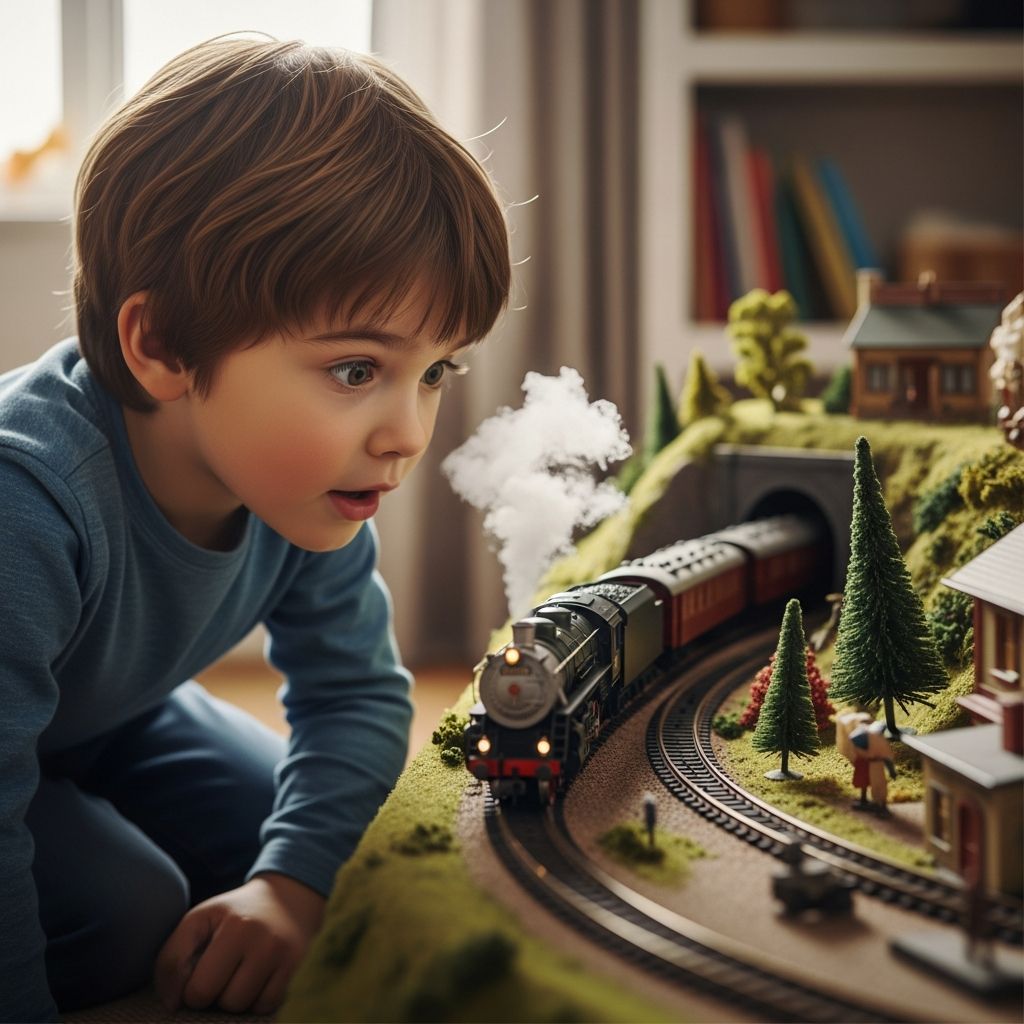
Across playgrounds and living rooms, countless children become utterly absorbed in trains. They memorize engine names, insist on watching the same railway videos, and carry a favorite locomotive everywhere. For many parents, this raises a question: is this just a harmless phase, or a sign of something deeper?
This article explores what lies behind kids’ train fascinations, how intense interests can support development, when an obsession might signal a problem, and practical ways parents can respond.
Why Trains Are So Magnetic for Young Minds
Children develop strong preferences as their brains learn to organize the world. Trains sit at a perfect crossroads of predictability, movement, and story, which makes them especially compelling for young kids.
Order, Predictability, and Control
Early childhood can feel chaotic. Trains offer a world that follows clear rules, which many children find deeply reassuring.
- Clear paths: Trains follow tracks. There is a visual, obvious route from one point to another.
- Consistent sequences: Stations, signals, and schedules follow routines that rarely change.
- Visible cause and effect: Press a button, the engine moves; move a lever, the switch changes direction.
Psychologists note that routines and predictable patterns help children feel safe and lower anxiety during developmentally intense periods. Stable, rule-based systems like railways can function as a comforting mental anchor.
Movement, Sound, and Sensory Appeal
Trains engage multiple senses at once:
- The rhythm of wheels on tracks
- Repetitive sounds like whistles and crossing bells
- Strong visual patterns: rows of cars, lines of tracks, signals turning from red to green
For some kids, especially those with sensory processing differences, this steady, predictable sensory input can be soothing or deeply satisfying.
Simple Stories With Big Feelings
Children’s train media often wraps big themes—friendship, fairness, mistakes, and repair—into simple, repeatable stories. That makes trains an ideal stage for learning about emotions and relationships in a format kids can follow.
Intense Interests: Normal Phase or Red Flag?
Psychologists sometimes call these deep fixations intense interests. Many children go through a phase of diving fully into a single topic—trucks, dinosaurs, space, sharks, or trains.
What Typical Intense Interest Looks Like
In many children without underlying conditions, an intense interest will show several of these features:
- High enthusiasm: They love to talk about trains, read about them, and play with train sets.
- Flexible engagement: They can still enjoy other toys and activities, especially with a little encouragement.
- Social sharing: They want to show trains to others, give running commentaries, or include peers in play.
- Gradual shift over time: The focus slowly widens (e.g., to other vehicles) or transitions to a new topic altogether.
Research suggests that focused interests can support knowledge, persistence, and even later academic skills, as kids practice paying attention, classifying, and recalling detailed information.
When Intense Becomes Restrictive
By contrast, clinicians pay attention when an interest becomes so rigid or extreme that it disrupts daily life or social development. For example:
- Meltdowns if trains are not available at all times
- Refusal to talk about or play with anything else
- Interests used mostly for self-soothing, with little social sharing
- Sleep, eating, or schoolwork consistently derailed by the obsession
In these situations, professionals look at the function of the behavior: is the child exploring and learning, or mainly using trains to escape overwhelming emotions or anxiety?
How Train Obsessions Connect to Child Development
To understand a train fascination, it helps to see how it fits into broader domains of development: cognitive, social, emotional, and sensory.
| Domain | How Train Play Helps | What Parents May Notice |
|---|---|---|
| Cognitive | Supports categorizing, sequencing, problem-solving, and early STEM thinking. | Child sorts engines by color or type, builds complex track systems, or invents routes. |
| Language | Encourages new vocabulary (stations, couplings, signals), narrative skills, and description. | Child narrates stories about trains, memorizes names, or imitates phrases from train shows. |
| Social | Provides a shared topic to talk about with peers and adults. | Child explains how trains work, invites others into play, or negotiates roles (engineer, conductor). |
| Emotional | Offers a reliable world to process big feelings and practice coping. | Child reenacts conflicts (crashes, delays) and resolves them in play. |
| Sensory | Delivers predictable sights, sounds, and motions that may be calming. | Child watches wheels spin, lines up trains, or repeats the same motion. |
Trains, Routines, and Anxiety
For some children, an intense focus on trains connects to anxiety or a strong need for control. Psychologists have long observed that repetitive behaviors can temporarily reduce distress by creating a sense of predictability. In mild forms, this might look like:
- Needing to watch the same train episode before bed
- Always arranging engines in a specific order
- Repeating particular train facts to feel calm
In more severe forms—especially when combined with intrusive worries and compulsive rituals—these patterns may overlap with symptoms of obsessive-compulsive disorder (OCD). Children with OCD can become trapped in cycles where trying to control distressing thoughts through rituals actually reinforces anxiety over time.
Important Distinctions from OCD
Most train fascinations are not OCD. Key differences include:
- Pleasure vs. relief: With typical interests, kids feel joy and curiosity; with OCD, rituals bring brief relief from intense fear or discomfort.
- Content of thoughts: OCD often involves fears of contamination, harm, or bad things happening, not just trains or vehicles.
- Flexibility: Children with a healthy interest can usually tolerate small changes with reassurance; OCD rituals are much harder to interrupt.
If you notice your child’s train routines are driven by fear (for example, they believe something terrible will happen if they do not line up trains perfectly), it is worth discussing this with a pediatrician or mental health professional.
Neurodiversity, Special Interests, and Trains
Trains also show up frequently as a special interest for children on the autism spectrum or with sensory processing differences. Autistic individuals often develop very focused topics of interest that they explore in great depth. These can be highly positive when understood and supported.
Why Trains Fit Many Autistic Kids’ Strengths
- Systemic thinking: Railways are logical systems with clear rules, which can align well with strengths in pattern recognition.
- Predictable motion: Watching wheels turn or trains loop around tracks offers rhythmic, repetitive sensory input.
- Opportunities to excel: Kids may become genuine experts on routes, models, or train history.
Parents sometimes worry that such focus is automatically a negative sign, but research and community experience suggest that, when balanced, special interests can support motivation, communication, and even future careers.
Practical Ways to Support a Healthy Train Passion
Parents do not have to either encourage the obsession blindly or shut it down completely. A middle path—where trains become a tool for connection and learning—often works best.
Use Trains as a Bridge to New Skills
- Reading and writing: Read train-themed books together; help your child write tickets, signs, or simple stories.
- Math and problem-solving: Count train cars, compare lengths, or time how long a route takes.
- Geography and science: Look at maps of railway lines, talk about how engines work, or explore the history of trains.
Long-term studies show that children’s ability to manage attention and behavior is linked to education, health, and financial outcomes in adulthood. Channeling a train interest into skills like planning, persistence, and flexible thinking can strengthen these capacities.
Set Gentle, Clear Boundaries
Protecting other areas of life—sleep, school, relationships—sometimes requires limits around the obsession, especially for media use.
- Define specific times for train shows or games (e.g., after homework).
- Agree on screen-free times, such as meals and the last hour before bed.
- Prepare transitions using visual timers or countdowns to reduce conflict.
Research indicates that when parents set consistent boundaries around media, children tend to sleep better, show less aggression, and perform better in school.
Encourage Variety Without Shaming
The goal is not to extinguish the passion but to gently widen the circle around it.
- Offer activities that are train-adjacent, like building bridges, exploring other vehicles, or visiting transportation museums.
- Suggest play scenarios that mix trains with other themes (animals riding trains, space trains, rescue missions).
- Use phrases like “Let’s add something new” instead of “You talk about trains too much.”
Watch Your Own Emotional Signals
Children often take cues from caregivers’ reactions. If parents respond with irritation or worry every time trains come up, kids can absorb shame about something that brings them joy.
- Notice when you feel overwhelmed by hearing about trains again and take a brief break instead of snapping.
- Invite short, focused “train talk” sessions—5–10 minutes where you show full interest—then transition to another topic.
- Share your own interests, modeling how passions can coexist with everyday responsibilities.
When to Seek Professional Advice
Most train obsessions are healthy phases or long-term interests. Still, some patterns suggest it is time to consult a professional—usually starting with your pediatrician, who can refer you to a psychologist, occupational therapist, or developmental specialist if needed.
Signs That Warrant a Closer Look
- Severe distress if separated from trains, far beyond typical protest
- Persistent social withdrawal or inability to engage in any other play
- Rigid rituals around trains tied to specific fears or “bad things” happening
- Developmental concerns in other areas (language delay, very limited eye contact, or repetitive movements that interfere with daily life)
Clinicians assessing for OCD, autism, or other conditions look at the whole picture: communication, play, daily functioning, and emotional patterns—not just the presence of a strong interest.
Frequently Asked Questions (FAQs)
Is a strong interest in trains a sign of autism?
Not by itself. Many neurotypical children also love trains. Professionals consider the broader pattern of communication, social interaction, flexibility, and daily functioning before diagnosing autism.
How long do train obsessions usually last?
It varies widely. For some kids, trains are a six-month phase; for others, the interest lasts for years but gradually becomes one of several hobbies rather than the only focus.
Should I limit train videos even if my child learns from them?
Moderate, age-appropriate viewing is fine, especially when it leads to off-screen play. However, setting reasonable limits around screens and encouraging varied activities supports better sleep, behavior, and health overall.
Could my child’s train rituals be OCD?
Rituals that are mainly fun or comforting are usually not OCD. If your child feels compelled to perform certain train-related behaviors to prevent something bad from happening, or if anxiety spikes when these rituals are interrupted, talk with a pediatrician or child psychologist.
How can I talk to teachers about my child’s train interest?
Share that trains are a powerful motivator and suggest ways to use them in learning: counting train cars in math, reading train stories, or allowing train drawings as part of writing assignments. Also discuss any concerns about distraction so you can create a joint plan.
References
- Obsessive-Compulsive Disorder in Children and Adolescents — G. Walitza et al., Dtsch Arztebl Int. 2011-05-01. https://pmc.ncbi.nlm.nih.gov/articles/PMC3071953/
- Children with attention, behavior problems earn less money, have poorer health as adults — American Psychological Association press release summarizing Koepp et al., Developmental Psychology. 2023-06-15. https://www.apa.org/news/press/releases/2023/06/children-behavior-problems-poorer-health
- Obsession or Addiction? Screen Media and Children — Children and Screens: Institute of Digital Media and Child Development. 2023-01-01 (approx.). https://www.childrenandscreens.org/learn-explore/research/obsession-or-addiction/
- Compulsive exercise: links, risks and challenges faced — G. Bratland-Sanda et al., Psychology Research and Behavior Management. 2017-03-30. https://pmc.ncbi.nlm.nih.gov/articles/PMC5386595/
- My Son’s Train Obsession – A Parent Perspective on Sensory Processing Disorder — STAR Institute for Sensory Processing. 2015-01-01 (approx.). https://sensoryhealth.org/node/981