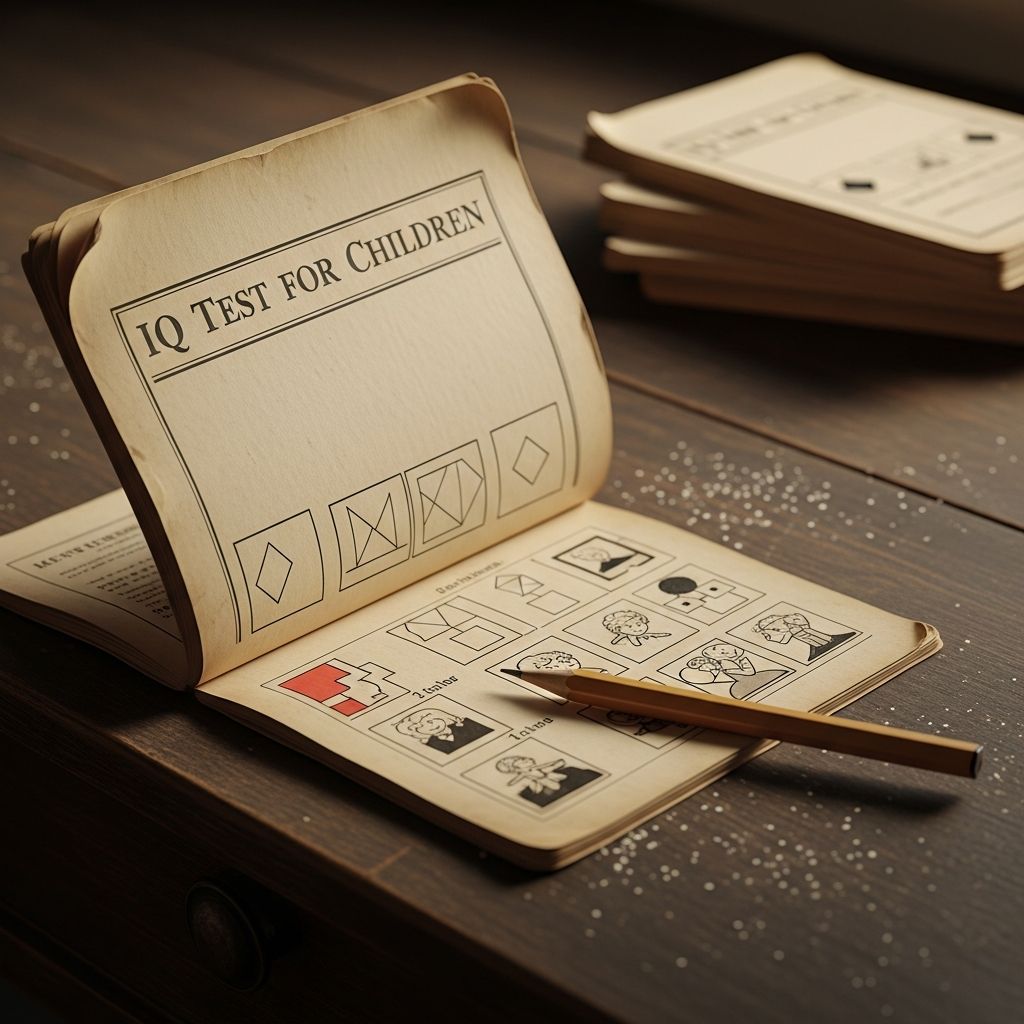
Intelligence Quotient (IQ) tests promised a scientific window into a child’s cognitive potential but never achieved widespread adoption for routine use among kids. Despite early enthusiasm in the early 20th century, persistent issues like score instability, cultural biases, and narrow focus sidelined them from everyday parenting and schooling.
The Origins and Early Promise of Childhood IQ Testing
IQ testing emerged in the early 1900s as a groundbreaking tool to quantify human intelligence. French psychologist Alfred Binet developed the first practical test in 1905 to identify schoolchildren needing extra help, not to rank innate ability. American psychologist Lewis Terman later adapted it into the Stanford-Binet test, popularizing the IQ score as a fixed measure of smarts.
By the mid-20th century, these tests gained traction for spotting gifted children or those with learning challenges. Schools used them for placements, and parents hoped for validation of their child’s brilliance. Proponents argued IQ scores could predict academic success and guide tailored education, fueling dreams of a merit-based system.
However, the vision of universal IQ screening for all kids fizzled. What began as a targeted diagnostic tool morphed into a controversial metric, criticized for oversimplifying human potential and embedding societal prejudices.
Key Benefits: When IQ Tests Deliver Real Value
Despite criticisms, IQ tests offer concrete advantages in specific scenarios. They excel at mapping cognitive profiles, revealing strengths in areas like verbal reasoning, spatial skills, or memory while flagging weaknesses.
- Guiding Educational Interventions: Scores inform Individualized Education Programs (IEPs) or gifted placements, helping schools provide appropriate challenges or support.
- Early Detection of Challenges: Identifying discrepancies between verbal and performance IQ can signal conditions like dyslexia or ADHD, enabling timely help.
- Objective Benchmarking: Standardized administration allows comparisons across populations, useful for research and policy.
For instance, high scores on tests like the Wechsler Intelligence Scale for Children (WISC) can qualify kids for advanced programs, fostering growth in logic and processing speed.
The Critical Flaws That Doomed Widespread Adoption
IQ tests’ popularity waned as flaws became undeniable. Scores for young children under age 6 are notoriously unstable, often fluctuating dramatically by 10-20 points upon retesting due to rapid brain development.
| Age Group | Score Stability | Common Issues |
|---|---|---|
| Under 5 | Low (changes up to 20+ points) | Precociousness mistaken for giftedness; environmental factors dominate |
| 6-10 | Moderate | Influenced by anxiety, fatigue, or test familiarity |
| Over 10 | High | More reliable but still affected by biases |
Moreover, tests measure only narrow cognitive domains—logic puzzles, vocabulary, pattern recognition—ignoring creativity, emotional intelligence, motivation, and social skills, which are vital for real-world success.
Cultural and Socioeconomic Biases Undermining Fairness
A major barrier was inherent biases. Early tests favored Western, middle-class experiences, disadvantaging children from diverse backgrounds. Vocabulary items or analogies often reflected privileged exposures, skewing results.
Research highlights how low scores block diverse students from gifted services while funneling others into special education unjustly. This echoes eugenics-era misuse, where tests justified discrimination.
Performance anxiety exacerbates issues: A child’s true ability can plummet under pressure, misrepresenting potential. Poor instructions or unfamiliar formats compound errors, especially in non-native language speakers.
Economic and Practical Hurdles to Mainstream Use
Beyond science, logistics blocked adoption. Professional administration costs $500-$2000 per test, unaffordable for routine screening. Schools balked at scaling for millions of kids.
Questionable motives often drive parental requests—curiosity or bragging rights—rather than child needs. Experts advise testing only when actionable, like for specific placements.
Modern Shifts: Moving Beyond IQ Scores
Today, educators favor holistic assessments. Multiple criteria, including portfolios, teacher observations, and dynamic testing (which adapts to the child), better capture potential.
States increasingly de-emphasize IQ in special education, prioritizing achievement and behavior data. For gifted identification, portfolios and nominations replace rigid cutoffs.
Parents can nurture intelligence through enriched environments: reading, puzzles, and open-ended play outperform any single score.
Case Studies: Real-World Lessons from IQ Testing
Consider a 4-year-old acing early reading tests, scoring 140 IQ. Retested at 10, the score drops to 120—still bright, but no longer ‘gifted’ by strict thresholds. Such volatility confuses families and schools.
Conversely, a bilingual child scores low due to language barriers but thrives in visual-spatial tasks, missed by verbal-heavy tests.
Expert Recommendations for Parents Today
- Delay testing until at least age 6-7 for stability.
- Seek comprehensive evaluations including emotional and creative assessments.
- Use results as one data point, not the definitive measure.
- Focus on growth mindset: Effort trumps fixed scores.
Frequently Asked Questions About IQ Tests for Kids
Are IQ tests accurate for young children?
No, scores under age 6 are highly unstable due to developmental spurts and external factors like anxiety.
Can IQ tests detect giftedness reliably?
They indicate high cognitive potential but miss creativity and leadership, key gifted traits.
Do biases still affect modern IQ tests?
Yes, despite updates, cultural and socioeconomic influences persist, affecting fairness.
Should parents test their child for curiosity?
Experts say no—test only if results lead to specific educational actions.
What are better alternatives to IQ testing?
Dynamic assessments, achievement tests, teacher observations, and portfolios provide a fuller picture.
Conclusion: Embracing a Broader View of Intelligence
IQ tests revolutionized understanding cognition but faltered as a universal child metric due to instability, biases, and incompleteness. Prioritizing multifaceted development over numbers empowers kids to flourish.
References
- The Pros and Cons of IQ Testing on Children — Compassionate Solutions. Accessed 2026. https://compassionatesolutionsscv.com/pros-cons-iq-testing/
- 6 Reasons Not to Give IQ Tests to Young Children — Gifted Guru. Accessed 2026. https://giftedguru.com/6-reasons-not-to-give-iq-tests-to-young-children/
- IQ Tests: Advantages and Limitations in Evaluating Giftedness — Philippe Vivier. Accessed 2026. https://www.philippevivier.com/en/iq-tests-advantages-and-limitations-in-evaluating-giftedness.html
- Pros and Cons of IQ Testing — IQ Metrics. Accessed 2026. https://iqmetrics.org/pros-and-cons-of-iq-testing/
- How Flawed IQ Tests Prevent Kids from Getting Help in School — The Hechinger Report. 2023. https://hechingerreport.org/how-flawed-iq-tests-prevent-kids-from-getting-help-in-school/