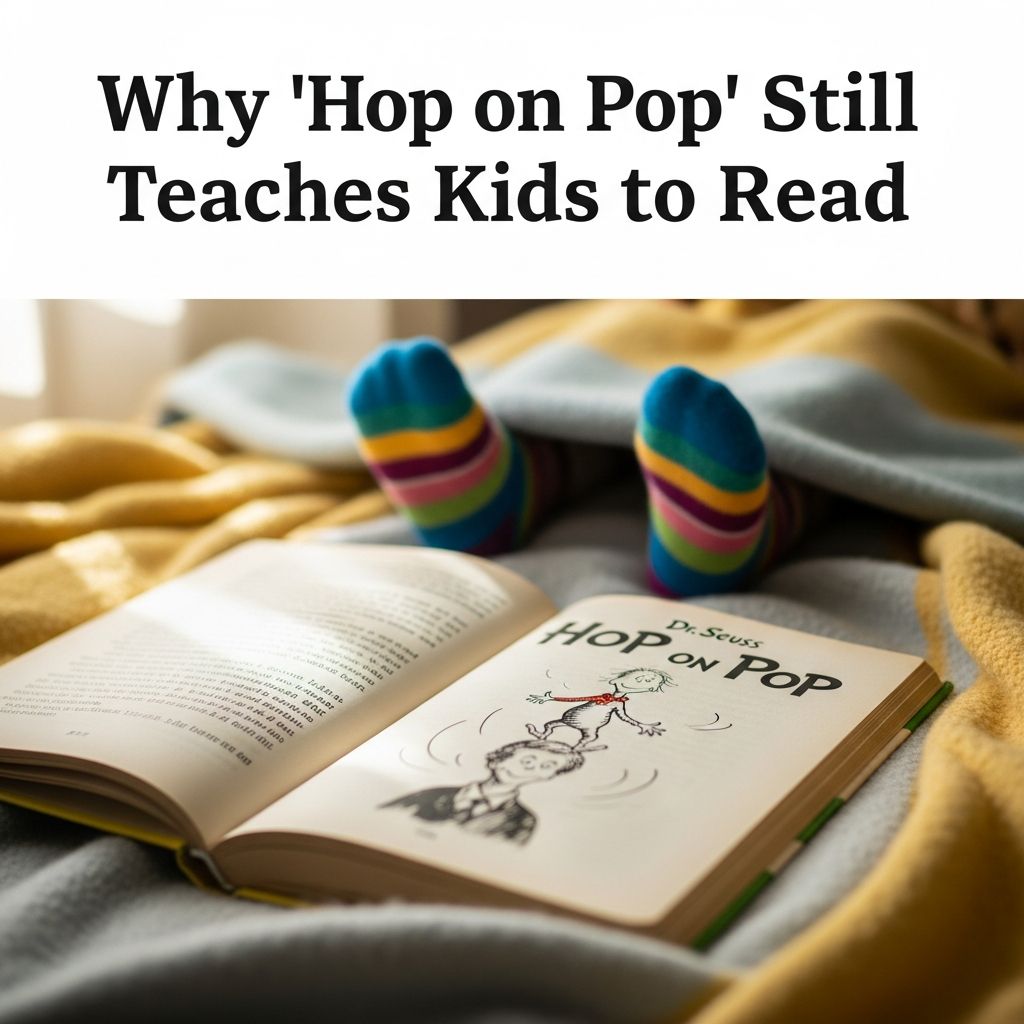
At first glance, Hop on Pop looks like the simplest of picture books: short rhymes, big images, and almost no plot. Yet this slim volume has quietly shaped how generations of children learned to connect letters, sounds, and meaning, becoming one of the most enduring early readers ever published.
The World Before “Hop on Pop”
To understand why “Hop on Pop” matters, it helps to see what early reading looked like before it arrived in 1963.
- Classrooms relied heavily on repetitive, formulaic primers like the Dick and Jane series.
- These books emphasized recognizing whole words by sight rather than connecting letters to sounds.
- Stories were deliberately plain and uneventful, with controlled vocabulary but minimal humor or surprise.
In the 1950s, concerns about children’s reading levels and boredom with schoolbooks were widely reported in mainstream media, prompting educators and publishers to look for more engaging approaches. Dr. Seuss, already successful with The Cat in the Hat, became a central figure in this shift.
From Cartoonist to Architect of Beginner Books
Theodor Seuss Geisel, better known as Dr. Seuss, moved from advertising and magazine cartoons into children’s literature long before Hop on Pop appeared.
Key steps on the road to Hop on Pop included:
- Publishing early children’s books that mixed rhyme, fantasy, and visual comedy.
- Collaborating with publishers to address complaints that school readers were “too boring” for kids.
- Helping launch the Random House Beginner Books line, aimed specifically at new readers, starting in the late 1950s.
These Beginner Books were designed around a simple promise: very limited vocabularies, heavy visual support, and stories children would actually want to finish.
What Makes “Hop on Pop” Different?
Published in 1963, Hop on Pop is subtitled “The Simplest Seuss for Youngest Use,” and that tagline is accurate.
Compared with other Dr. Seuss classics, it stands out in three ways:
- Extremely short, decodable words (mostly consonant-vowel-consonant patterns).
- Micro-stories that last only a line or two before moving to new rhymes.
- Direct visual mapping of each printed word to a clear, absurd illustration.
| Feature | Typical Primers (Mid-20th Century) | Hop on Pop |
|---|---|---|
| Main method | Memorize whole words by sight | Sound out parts of words (phonics) |
| Story style | Everyday, realistic scenes | Playful, surreal, and silly |
| Sentence length | Longer, repetitive patterns | Mostly two- or three-word phrases |
| Visual role | Illustrations decorate text | Illustrations teach meaning and support decoding |
| Target reader | Early elementary school | Preschoolers and brand-new readers |
How the Book Uses Phonics Without Feeling Like Homework
Modern literacy research strongly supports combining phonics instruction—explicit teaching of letter–sound relationships—with other reading activities. Hop on Pop anticipates this by naturally embedding phonics into its structure.
1. Rhyme Families and Word Patterns
The book cycles through rhyming word clusters to highlight patterns children can hear and see:
- Short vowel sound repetition (e.g., the same middle vowel linking multiple words).
- Shared endings that differ only by the initial consonant.
- Immediate variation: once one pattern is introduced, it’s followed quickly by a twist or new pair.
This mirrors phonics strategies that emphasize word families, such as teaching several words with the same rime so children can generalize more easily.
2. Tight Link Between Sound, Print, and Picture
Each tiny scene in the book creates a triangle between:
- Printed word on the page
- Spoken sound the adult or child produces
- Illustration that enacts the meaning
Because the art is exaggerated and humorous, children are more likely to pay attention and to request repeated readings, which is known to support word recognition and comprehension in early readers.
3. Simple Grammar, Big Cognitive Payoff
Though sentences are short, the book quietly exposes children to:
- Different parts of speech (nouns, verbs, adjectives) in isolation and in tiny phrases.
- Basic syntax patterns, such as subject–verb, while keeping word count extremely low.
- Repetition with variation, which supports memory and prediction.
This simplicity lines up with typical expectations for texts written for children in the earliest stages of reading, where controlled vocabulary and sentence structure are key.
Why Children Respond So Strongly to the Book
Parents and librarians often report that Hop on Pop is requested again and again. Several factors help explain that staying power.
- Physical comedy: The concept of literally hopping on a parent feels mischievous but safe.
- Rhythmic language: The cadence makes it fun to chant aloud.
- Predictability: Kids can guess the next rhyme, giving them a sense of mastery.
- Very short “episodes”: Each page feels like a punchline, so there’s constant payoff.
Because early positive experiences with books are associated with later reading engagement and achievement, playful texts like this can matter long after a child has outgrown them.
Controversies and Misreadings Over the Years
Despite its gentle tone, Hop on Pop has occasionally been challenged. One well-publicized case involved a complaint to a Canadian public library claiming that the book encouraged violence toward fathers.
The library reviewed the text and declined to remove it, noting that the book specifically includes a line discouraging children from hopping on their father and framing the action as something to avoid. The incident illustrates how literal readings can misinterpret a book that uses exaggeration and slapstick as humor rather than as behavioral instructions.
Dr. Seuss himself sometimes admitted to sneaking social ideas and values into his work, but in this case the agenda is remarkably straightforward: make phonics practice so engaging that children forget they are practicing at all.
How “Hop on Pop” Fits into Seuss’s Bigger Early-Reading Project
Hop on Pop is not an isolated experiment. It sits inside a larger effort to overhaul early reading through the Beginner Books series.
Common traits across these titles include:
- Restricted vocabularies designed for specific reading stages.
- High picture support, with illustrations that clarify text meaning.
- Humor and absurdity used as motivation instead of moral lectures.
- Short, punchy sentences that favor readability over literary complexity.
Where some Beginner Books focus on slightly older or more fluent readers, Hop on Pop deliberately aims lower on the age and skill spectrum. Its brevity and simplicity have kept it in print for decades and made it a common choice in libraries and early childhood settings.
Practical Ways Parents Can Use “Hop on Pop” Today
Although reading research has advanced significantly since the 1960s, the core design of Hop on Pop still aligns with many current recommendations for supporting early literacy.
1. Turn Rhymes into Sound Games
Instead of simply reading through from start to finish, parents can pause and play with the sounds:
- Ask children to predict the last word in a rhyme.
- Cover part of a word and reveal it slowly so the child can blend the sounds.
- Make up silly new rhymes that follow the same pattern.
Activities like these support phonological awareness, which studies identify as a strong predictor of later reading success.
2. Connect the Story to Movement
Under supervision and with care for safety, families can act out the more physical scenes in symbolic ways:
- Hop on a pillow when a character hops.
- Use toy figures to re-enact what’s happening on the page.
- Tap or clap to the rhythm of the words.
Linking movement to language can be especially helpful for very young children, who often learn best when multiple senses are engaged.
3. Encourage Kids to “Read” Back to You
Because the text is short and repetitive, children often memorize large chunks quickly. Parents can:
- Invite the child to “read” the pages they remember.
- Point to each word as it is spoken to reinforce print–sound connections.
- Gradually hand over more of the reading as the child gains confidence.
Even when the child is mostly reciting from memory, this ritual helps them understand that printed words map onto spoken language in predictable ways.
Why the Book Still Feels Current Decades Later
Many children’s books from the early 1960s feel dated in language, setting, or tone. Hop on Pop, by contrast, remains widely used in homes and libraries.
Several design choices help explain this longevity:
- Minimal cultural references keep it from aging in obvious ways.
- Universal family dynamics—parents, kids, playful mischief—remain relatable.
- Focus on sound and pattern rather than character psychology or plot keeps the book tightly aligned with its teaching goal.
- Short length suits modern attention spans and busy family schedules.
Combined with its status in a well-known series and the enduring popularity of Dr. Seuss, these features help the book stay in active circulation more than sixty years after its debut.
FAQ: Parents’ Common Questions About “Hop on Pop”
What age is “Hop on Pop” best for?
The book is typically recommended for children around ages 3 to 7, covering the span from pre-readers who enjoy listening to early readers decoding simple words on their own.
Does the book really help kids learn to read, or is it just fun?
While it is playful, its heavy use of rhyming word families, simple phonetic patterns, and consistent picture support lines up with principles used in structured early-reading materials.
Should I worry that it encourages kids to jump on their parents?
The book uses exaggerated slapstick and even includes language discouraging the behavior; libraries that have reviewed challenges to the book have declined to classify it as promoting harm.
How is it different from other Dr. Seuss books like “The Cat in the Hat”?
Compared with longer titles, Hop on Pop features shorter sentences, a smaller vocabulary, and less plot, making it more accessible to children who are just beginning to connect letters and sounds.
Is it still worth buying in the era of digital learning apps?
Research continues to support the value of shared print reading between adults and children, particularly for building vocabulary, phonological awareness, and positive attitudes toward books. A short, engaging text like Hop on Pop can complement, not replace, digital tools.
References
- 60 Years Ago, One Simple Book Changed The Way Kids Read — Fatherly. 2023-03-02. https://www.fatherly.com/entertainment/hop-on-pop-retrospective
- Hop on Pop Facts for Kids — Kiddle Encyclopedia. 2024-01-10. https://kids.kiddle.co/Hop_on_Pop
- National Reading Panel: Teaching Children to Read — National Institute of Child Health and Human Development (NIH). 2000-04-13. https://www.nichd.nih.gov/publications/pubs/nrp
- Hop on Pop | work by Dr. Seuss — Encyclopaedia Britannica. 2024-05-01. https://www.britannica.com/topic/Hop-on-Pop
- Hop on Pop – Favorite Early Readers — Kids’ Books Without Borders. 2016-02-29. https://kidsbookswithoutborders.wordpress.com/2016/02/29/hop-on-pop/
- Hop on Pop – Labyrinth Books Catalog Entry — Labyrinth Books. 2023-09-01. https://www.labyrinthbooks.com/hop-on-pop/
- Kids – Hop on Pop — Kern County Library / OverDrive. 2022-06-15. https://kern.overdrive.com/library/kids/media/2056289