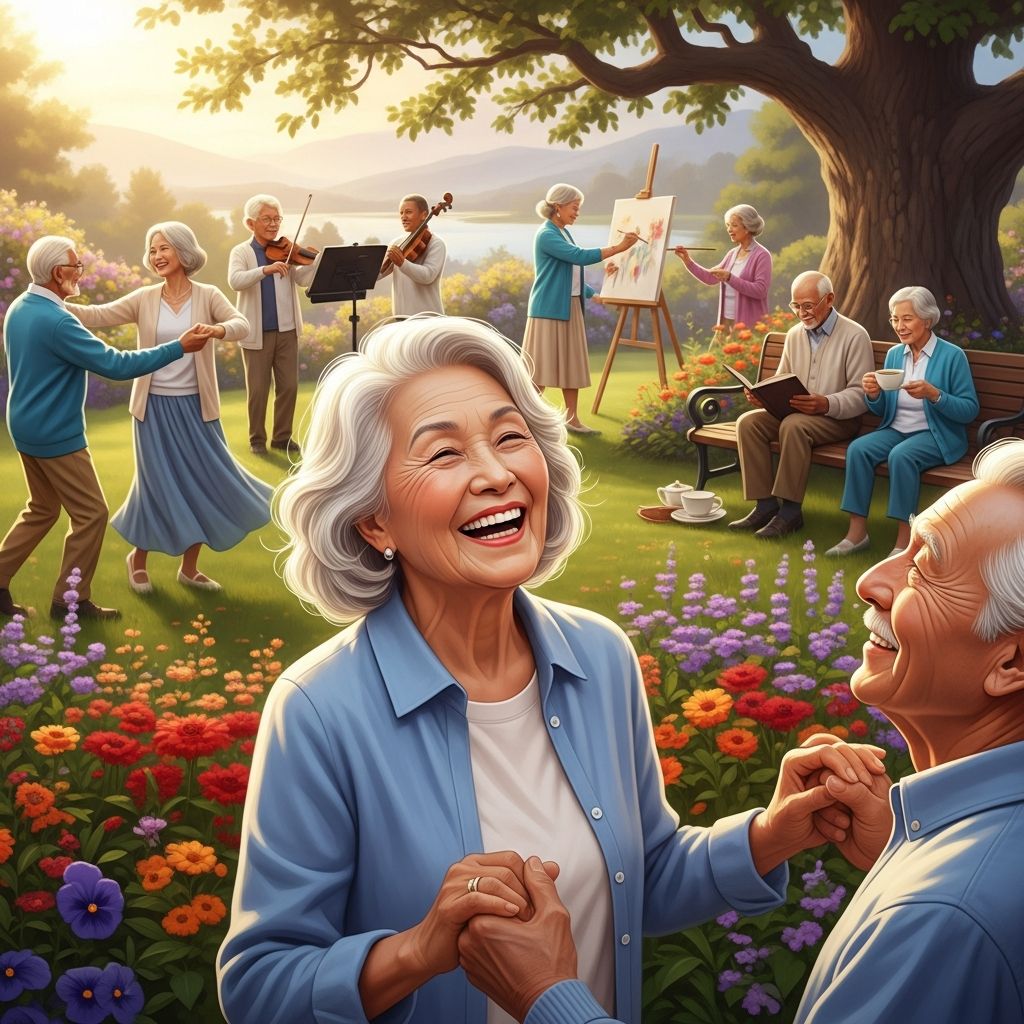
Contrary to popular belief that youth holds the key to maximum joy, extensive research reveals a **U-shaped curve** in happiness, where well-being dips during midlife and rebounds strongly in later years. This pattern, observed across multiple countries, suggests that people in their 60s, 70s, and beyond often report higher life satisfaction than those in their 40s or even younger adulthood.
Understanding the U-Shaped Happiness Trajectory
The **U-shaped curve** describes how happiness declines from early adulthood, bottoms out around age 40-50, and then climbs again, often surpassing youthful levels by late life. This phenomenon holds globally but with notable variations. For instance, in the United States, flourishing scores rise markedly from 6.36 among 18-29-year-olds to 7.68 for those aged 60-69.
Longitudinal and cross-sectional data confirm this trend. Analyses from the German Socio-Economic Panel and U.S. Health and Retirement Survey show life satisfaction increasing steadily post-50, with happiness continuing to rise even after 70. Economists and psychologists attribute this to adaptive coping mechanisms, shifting priorities, and reduced stress from career pressures.
Regional Variations in Age and Well-Being
While the U-shape is common, its shape and timing differ by region. In high-income nations like the U.S., UK, Germany, and Australia, older adults frequently outscore younger ones in flourishing metrics. A University of Michigan study of over 93,000 participants across nine countries found North Americans, particularly the oldest old (85+), reporting higher happiness and lower depression than global peers.
In contrast, Asian countries like Korea and India show declines in happiness among the very old, with elevated depression rates. Southern Europe mirrors this with higher loneliness in the oldest groups. Mexico bucks some trends, aligning more with North America despite lower income levels.
| Region/Country | Happiness Trend with Age | Key Observation |
|---|---|---|
| United States | Increases (esp. 85+) | Lowest depression among oldest old |
| Europe (Northern) | Stable to increasing | Higher baseline happiness |
| Southern Europe | Declines in oldest old | Higher depression/loneliness |
| Korea/India | Declines sharply | Less happiness in 85+ |
| Mexico | Increases | Outperforms income expectations |
This table summarizes patterns from 2018 Health and Retirement Study data, highlighting how economic, social, and health factors influence outcomes.
Why Older Age Brings Unexpected Joy
Several factors explain elevated well-being in later life. First, **emotional regulation** improves with age; older adults prioritize positive emotions and let go of negativity more effectively. Second, life experience fosters perspective: challenges like career peaks and family demands fade, allowing focus on meaningful pursuits.
The “well-being paradox” captures this—despite health declines, subjective happiness holds or rises. In the U.S., the oldest old excel due to preserved daily living abilities, education, and marital status. Generational effects, such as Baby Boomers avoiding Great Recession lows at retirement, may also play a role.
- Reduced aspirations gap: Midlife stress stems from unmet expectations; later, realistic goals align better with reality.
- Social shifts: Stronger friend ties boost happiness more in older groups.
- Purpose clarity: Youth struggle with mental health and purpose, dragging scores down.
Critical Role of Relationships Across Lifespan
Quality relationships predict health and happiness better than cholesterol levels at age 50, per the Harvard Grant Study. As people age, friendships gain relative importance: contact with friends contributes 7.35% to happiness in young adults but 11% in those 60+, per Shapley value analysis.
Family ties matter too, rising from 4.70% to 8.09% importance with age, while neighbors add steady value. Spouse support curbs negative emotions, but friends enhance positive affect most. For the elderly, friend quality trumps family for morale and satisfaction.
In declining youth happiness trends, like North America’s 15-24 drop below older groups, relationships offer a buffer. Building them early pays lifelong dividends.
Factors Protecting Well-Being in the Oldest Old
U.S. data pinpoint protectors against depression: higher education, marriage, and functional independence. These enable social engagement and autonomy amid bereavement or illness. Globally, income correlates loosely—Europe/North America lead, but Mexico’s high scores defy pure economics.
Challenges persist: widowhood, disability, and discrimination threaten all regions differently. Yet, cross-sectional rises don’t guarantee personal trajectories; individual health and support networks dictate outcomes.
Practical Strategies to Maximize Lifelong Happiness
To harness later-life gains:
- Cultivate friendships deliberately; their value compounds.
- Maintain physical function via exercise and preventive care.
- Foster purpose through volunteering or hobbies.
- Prioritize stable partnerships early.
- Manage midlife stressors like finances to enter later years resilient.
These evidence-based steps align with U-shape insights, turning age into an asset.
Frequently Asked Questions
Does happiness really increase after midlife?
Yes, numerous studies confirm a U-shaped curve, with rises post-50 in many countries, driven by better emotional regulation and priorities.
Why are oldest Americans happier than global peers?
Lower depression ties to daily living ability, education, and marriage; they defy trends seen in Asia and Southern Europe.
Can I expect personal happiness gains with age?
Cross-sectional data suggests yes, but individual health, relationships, and adaptations determine it—not age alone.
How do relationships change in importance over time?
Friendships rise most (to 11% of happiness variance in 60+), followed by family; they buffer age-related declines.
What drags down youth well-being compared to elders?
Mental health issues and unclear life purpose lower scores in young adults across high-income nations.
References
- Defying global trends: U-M study finds high happiness, low depression among oldest Americans — University of Michigan News. 2024-10-15. https://news.umich.edu/defying-global-trends-u-m-study-finds-high-happiness-low-depression-among-oldest-americans/
- Happiness and age—resolving the debate — Cambridge University Press (National Institute Economic Review). 2023-01-01. https://www.cambridge.org/core/journals/national-institute-economic-review/article/happiness-and-ageresolving-the-debate/7E765E7E32A488E1FF5EE735039DD6C0
- Global Study Reveals Complex Patterns in Age and Wellbeing — Gallup. 2024-05-20. https://news.gallup.com/opinion/gallup/660341/global-study-reveals-complex-patterns-age-wellbeing.aspx
- The relative importance of friendship to happiness increases with age — PMC/NCBI (Peer-reviewed). 2023-07-12. https://pmc.ncbi.nlm.nih.gov/articles/PMC10343095/
- This Happiness & Age Chart Will Leave You With a Smile (Literally) — Brookings Institution. 2017-04-10. https://www.brookings.edu/articles/this-happiness-age-chart-will-leave-you-with-a-smile-literally/
- Over nearly 80 years, Harvard study has been showing how to live a healthy and happy life — Harvard Gazette. 2017-04-11. https://news.harvard.edu/gazette/story/2017/04/over-nearly-80-years-harvard-study-has-been-showing-how-to-live-a-healthy-and-happy-life/
- Happiness and Age: Summary — World Happiness Report. 2024-03-20. https://www.worldhappiness.report/ed/2024/happiness-and-age-summary/