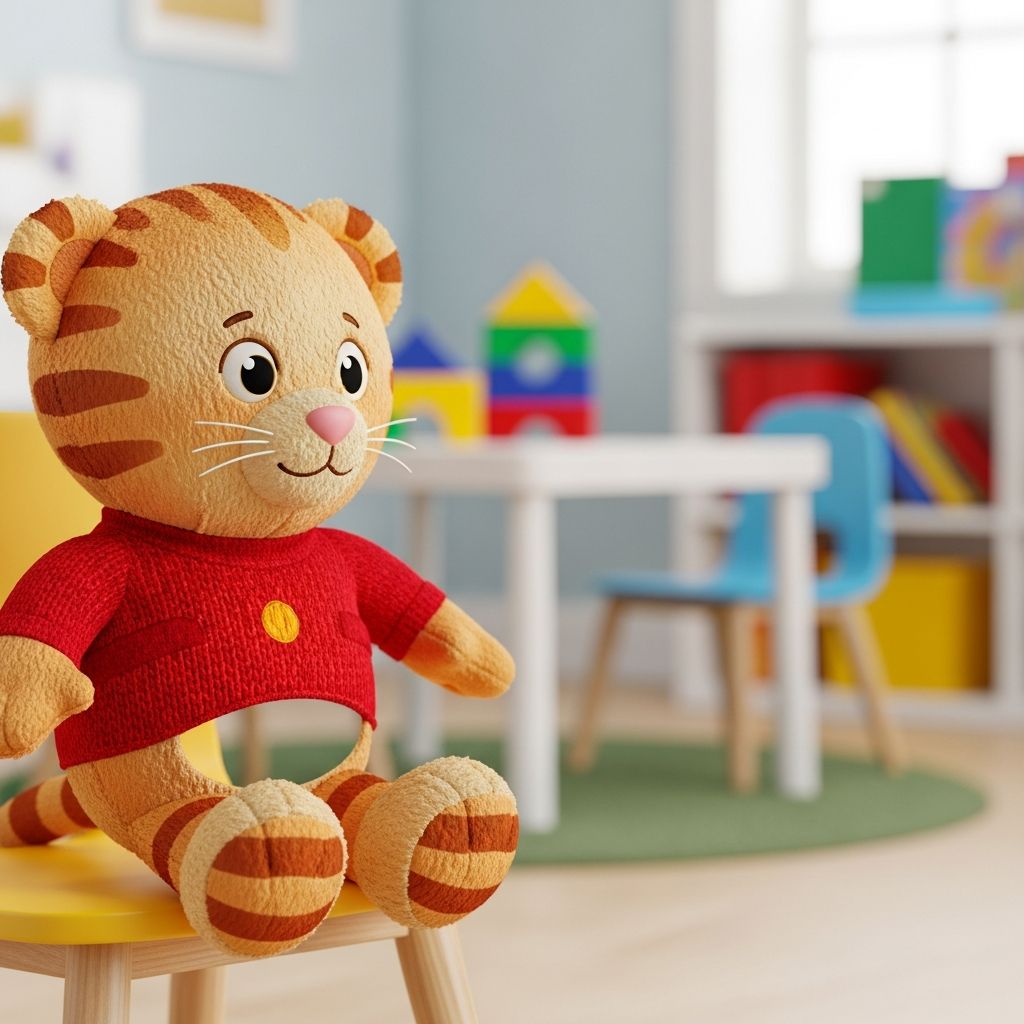
Daniel Tiger, star of the animated preschool series Daniel Tiger’s Neighborhood, is instantly recognizable in his bright red zip-up hoodie, sneakers, and visible fur legs. Parents notice something kids rarely question: Daniel doesn’t wear pants. Far from being a random or lazy design choice, his outfit reflects decades of thinking about how young children relate to characters, carried forward from Fred Rogers’ original Neighborhood of Make-Believe.
This article explores why Daniel’s look makes sense for preschoolers, how it connects to Mister Rogers’ Neighborhood, and what it reveals about modern children’s TV: comfort, consistency, emotional safety, and the power of simple visual design.
The Roots of Daniel Tiger: From Puppet to Preschool Hero
To understand Daniel’s hoodie-without-pants wardrobe, it helps to start where he began: as a shy puppet on Fred Rogers’ original show. Daniel Striped Tiger lived in a clock in the Neighborhood of Make-Believe and was the character Rogers most closely identified with emotionally.
- Daniel Striped Tiger first appeared in 1954 on The Children’s Corner, before becoming a staple of Mister Rogers’ Neighborhood.
- He lived in a clock with no hands, symbolizing a “timeless” space where feelings could be explored slowly and safely.
- Rogers used Daniel to talk openly about fear, shyness, and self-doubt—famously voicing lines like, “Sometimes I wonder if I’m a mistake.”
Fred Rogers’ vision shaped what would eventually become Daniel Tiger’s Neighborhood, an animated series launched in 2012 as a direct successor for preschool audiences. The new Daniel is portrayed as the child of the original puppet Daniel, now living in a fully realized animated Neighborhood of Make-Believe.
From Puppet Fur to Animated Fur
Puppets on the original show were essentially furry bodies with minimal clothing. Daniel Striped Tiger himself was a plush puppet whose fur served as his primary “outfit.” That tradition—animals as soft, huggable, not-quite-dressed beings—carried over when the character was reimagined for animation.
Animated Daniel needed an outfit that did two things simultaneously:
- Honor the look and feel of the original puppet.
- Make him visually clear, iconic, and appealing to a new generation of preschoolers.
The solution was simple: keep his fuzzy legs visible, but add a few strongly humanizing pieces of clothing—most notably the hoodie and sneakers.
Why Pants Are Missing: Practical and Psychological Reasons
From an adult perspective, Daniel’s lack of pants can feel odd because we apply human clothing rules to a cartoon tiger. For preschoolers, however, the logic is different. Children’s media researchers and producers design characters to be visually simple, easily readable, and emotionally safe for very young viewers.
1. He’s an Animal First, Kid Second
Daniel is a tiger who behaves like a preschool child. In kids’ animation, anthropomorphic animals often blend animal features with selective human clothing: think of ducks in sailor shirts or mice in shorts but no shirts.
- Showing his fur legs reminds kids that he is not a human child, which softens expectations and makes him feel like a plush toy come to life.
- His hoodie, shoes, and backpack signal that he lives in a familiar preschool world with school, family, and routines.
This hybrid design helps preserve the gentle fantasy of the Neighborhood of Make-Believe: it looks like children’s real lives, but with soft, friendly animal characters at the center.
2. Simplicity Helps Preschoolers Focus
Preschool television is intentionally visually simple so that children can focus on social-emotional lessons rather than costume details. Education research behind the show emphasizes that each episode is built around a single, clear theme—such as anger, disappointment, sharing, or gratitude—supported by repeating “strategy songs” that kids can remember and sing.
| Design Element | Primary Purpose for Preschoolers |
|---|---|
| Red hoodie | Instant visual recognition; emotional comfort; continuity across episodes. |
| Sneakers | Signals play, movement, and the energy of young children. |
| Visible fur legs | Reinforces his identity as an animal; reduces visual clutter. |
Adding more layers of clothing—especially pants with seams, pockets, and patterns—would increase visual complexity without adding educational value.
3. Continuity with the Mister Rogers Legacy
Daniel’s hoodie is a deliberate visual echo of Fred Rogers’ iconic cardigan and sneakers, which he changed into at the start of every episode of Mister Rogers’ Neighborhood.
- Fred’s cardigan signaled a transition into a safe, calm, child-centered space.
- Daniel’s hoodie serves a similar role: when you see it, you know you are entering a caring, predictable Neighborhood.
By keeping the bottom half of Daniel’s body closer to the original puppet—furry, simple, soft—the show visually bridges the worlds of live-action puppetry and modern animation while preserving the emotional DNA of the franchise.
Comfort, Clothing, and Preschool Identity
Clothing is deeply symbolic in stories for young children. It conveys not only style, but safety, identity, and routine. For preschoolers, comfort and familiarity are more important than realism.
Why the Hoodie Matters So Much
The red hoodie does more than keep Daniel “warm” in the fictional Neighborhood. It visually carries core values of the show:
- Consistency: Daniel wears essentially the same outfit in every episode, giving children a stable visual anchor as they encounter new situations like doctor visits, baby siblings, or first sleepovers.
- Co-regulation: When Daniel faces a big feeling, kids see him in the same comforting outfit, helping them associate his calm-down strategies with emotional safety.
- Relatability: Hoodies are common in real children’s wardrobes, making Daniel feel like a peer—even as his lack of pants quietly reminds us he is a tiger, not a human.
Clothing and Emotional Learning
The show’s curriculum emphasizes feelings, empathy, and self-regulation over academic content. Daniel talks frequently about being scared, shy, jealous, or excited, modeling language and coping strategies that help young viewers name and manage their own emotions.
Because clothing is part of how children express selfhood, Daniel’s steady outfit sends a subtle message: you are still you, even when your feelings change. The outer appearance stays the same while inner emotions fluctuate—and that’s okay.
How Kids See Daniel vs. How Adults See Him
Adults tend to project grown-up social rules onto media. For many parents, the first thought is: “Why no pants?” Young children rarely ask that question. For them, Daniel is simply “Daniel”: a friendly tiger in red.
Children’s Perspective
- They accept Daniel’s look as normal within the logic of the show’s world.
- They pay more attention to his songs, feelings, and interactions with friends like Katerina, O the Owl, Miss Elaina, and Prince Wednesday.
- They connect his outfit to specific routines: going to school, visiting Grandpere, riding Trolley.
Adults’ Perspective
- Adults notice mismatches with real-world dress codes, particularly when other characters wear more complete outfits.
- Parents often interpret wardrobe as a sign of production values or intentional messaging.
- Some see it as a quirky tradition in the lineage of animated animals that are half-dressed.
In effect, Daniel’s design is optimized for his primary audience: preschoolers. Adult questions about formality or modesty are simply not part of the design brief.
Designing a Character Who Feels Like a Friend
Modern research on screen media and young children highlights how parasocial relationships—one-sided “friendships” with media characters—can support learning when characters are nurturing, predictable, and trustworthy. Daniel is built to function as that kind of friend.
Key Design Goals Behind Daniel Tiger
- Softness: Rounded shapes, warm colors, and visible fur help him feel like a stuffed animal, not a sharp or threatening tiger.
- Approachability: His slightly oversized head, big eyes, and small body proportions mirror real toddlers’ features, which young children naturally respond to.
- Predictability: Emotional patterns (like singing a strategy song when upset) are supported by visual patterns (same outfit, same home, same Neighborhood landmarks).
The missing pants are part of this soft, toy-like feel. He looks more like a plush friend than a miniature adult, which lowers social pressure and makes his mistakes and learning experiences easier for kids to identify with.
Frequently Asked Questions (FAQs)
Is there an in-universe explanation for why Daniel doesn’t wear pants?
No explicit story within Daniel Tiger’s Neighborhood explains his lack of pants. The choice is primarily a design and legacy decision, blending the look of the original puppet with modern animation conventions for animal characters.
Do other characters in the show also have partial outfits?Yes. Many of Daniel’s friends are animals or fantasy figures who wear selective clothing—such as dresses, shirts, or accessories—while still showing fur, feathers, or scales. This mix keeps the Neighborhood whimsical and consistent with long-standing children’s television traditions.
Q: Is it appropriate for preschoolers that Daniel isn’t fully dressed?
In the context of animation, media researchers and broadcasters consider this design age-appropriate because Daniel is clearly an animal character and is shown in non-sexual, everyday situations. Preschoolers interpret his appearance as normal within a cartoon world and focus on his feelings and relationships rather than his clothing.
How does Daniel Tiger’s outfit connect to Mister Rogers’ red cardigan?Daniel’s red hoodie visually echoes Fred Rogers’ signature cardigan and sneakers, symbolizing a transition into a safe, caring space for children. It is a respectful, updated nod to the original show, helping parents recognize the lineage while giving kids a modern character to follow.
Q: Does Daniel ever change clothes in special episodes?
On rare occasions, Daniel may wear accessories or themed outfits for events like costumes, dress-up, or weather changes. However, his core look—the red hoodie and visible fur legs—remains the default to maintain consistency and recognizability across episodes.
References
- Daniel Striped Tiger – Mister Rogers’ Neighborhood — Fred Rogers Productions. 2024-01-15. https://www.misterrogers.org/articles/daniel-tiger/
- Daniel Tiger’s Neighborhood — PBS KIDS / Fred Rogers Productions (series overview and curriculum description). 2023-09-01. https://pbskids.org/daniel
- Daniel Tiger’s Neighborhood — American Academy of Pediatrics Council on Communications and Media (discussion of prosocial media for young children, in policy statements on educational television). 2016-10-01. https://publications.aap.org/pediatrics/article/138/5/e20162591/60316/Media-and-Young-Minds
- Daniel Tiger’s Neighborhood – Series Entry — The Paley Center for Media. 2014-02-10. https://www.paleycenter.org/collection/item/?q=daniel%20tiger&p=1&item=B84.03.01