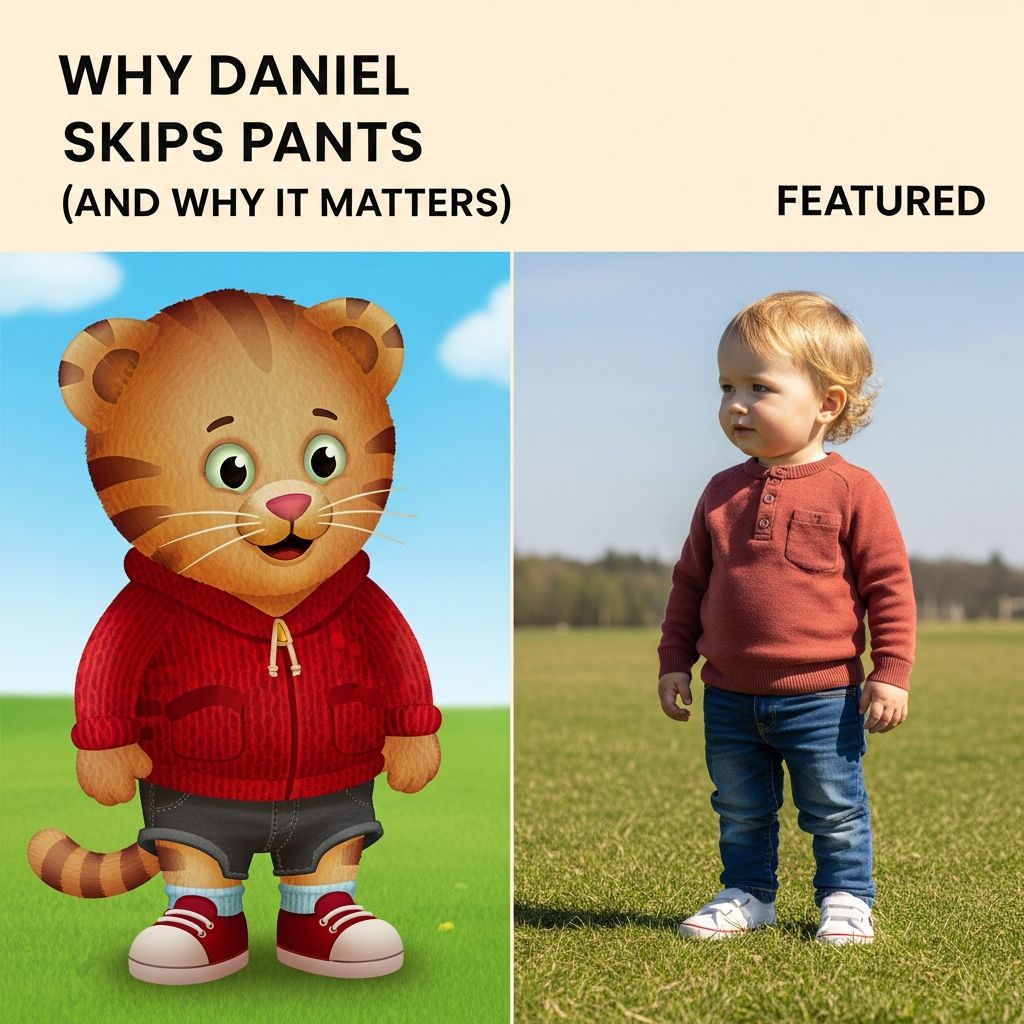
Daniel Tiger, the friendly four-year-old tiger from Daniel Tiger’s Neighborhood, wears bright red sneakers, a cozy red hoodie – and no pants. For many parents, his half-dressed look sparks a double-take: is that really intentional, and why would a preschool show make that choice?
Behind this design is a thoughtful mix of nostalgia, animation tradition, child psychology, and practical storytelling decisions shaped by Fred Rogers’ legacy and modern educational research.
Meet Daniel Tiger: A Preschooler With a Purpose
Daniel Tiger’s Neighborhood is an animated preschool series inspired by Mister Rogers’ Neighborhood, produced by Fred Rogers Productions. The show follows Daniel, a four-year-old tiger, and his friends as they navigate everyday challenges like sharing, waiting, feeling angry, or welcoming a new sibling.
The series is designed from the ground up as an educational tool that helps children practice:
- Recognizing and naming emotions
- Managing big feelings like anger, jealousy, or disappointment
- Developing empathy and kindness toward others
- Using simple, repeatable coping strategies through “strategy songs”
Every aspect of the show—from pacing to music to character design—is informed by early childhood research and specialists in child development. Daniel’s clothing (or lack of it) is part of that careful design.
From Puppet to Preschooler: The Legacy of Mister Rogers
The roots of Daniel’s look stretch back to the original Daniel Striped Tiger puppet created by Fred Rogers. On Mister Rogers’ Neighborhood, Daniel Striped Tiger was a shy puppet who lived in a clock in the Neighborhood of Make-Believe. Like most puppet characters on that show, he was not fully dressed like a human; he was simply a small tiger with a simple outfit or no detailed clothing at all.
When Fred Rogers Productions and their creative partners developed Daniel Tiger’s Neighborhood, they decided to imagine the puppet’s child as a modern preschooler. The new Daniel would:
- Live in the Neighborhood of Make-Believe, just like the original characters
- Be the “son” of Daniel Striped Tiger, connecting old and new generations
- Carry visual echoes of Mister Rogers himself
This is where the red hoodie and sneakers come in. Fred Rogers famously opened his show by changing into a red sweater and comfortable sneakers. Giving Daniel a red zip-up hoodie and red shoes creates an immediate visual bridge between Mister Rogers and this animated tiger, making Daniel feel like the emotional and educational heir to Fred Rogers.
Why the Hoodie but No Pants? The Core Reasons
Daniel’s pants-free look can seem odd at first, but it rests on several overlapping ideas that are common in children’s animation and grounded in design logic.
1. Animation Tradition: Animal Characters Rarely Fully Dress
In many classic children’s cartoons, anthropomorphic animals wear partial clothing:
- Mickey Mouse in shorts but no shirt
- Winnie the Pooh in a shirt but no pants
- Donald Duck in a sailor shirt and hat but no pants
This tradition helps audiences read these characters as animals first, while still using clothing to express personality, status, or mood. It is an instantly familiar visual language to children and adults alike.
By giving Daniel a hoodie and sneakers while leaving his legs as striped fur, the designers keep him situated clearly as a tiger, not a miniature human in a costume. That matters because he lives in a world where animals and humans mix, and the show depends on children understanding him as a friendly animal neighbor, not just a child in a tiger suit.
2. Visual Clarity for Preschoolers
Young children process visual information differently from adults. Research in early childhood development suggests that simple, clear shapes and consistent colors help young viewers follow characters and stories more easily. Cluttered or overly detailed designs can distract from emotional cues and narrative content.
Daniel’s design uses:
- A limited color palette: mainly red, orange, and yellow
- Simple shapes: round head, big eyes, clear stripes
- Consistent silhouette: hoodie top, furry legs, sneakers
Adding pants would introduce extra lines, patterns, and animation work. Leaving his legs as clean, striped forms keeps his silhouette readable and his movements easy for preschoolers to follow.
3. A Friendly Hybrid: Human Routines, Animal Body
Daniel’s world is a blend of animal bodies and human routines. He goes to preschool, rides a trolley, visits the doctor, and has a baby sister—very human-like experiences—but he and his friends are animals like tigers, owls, and cats.
The clothing design supports that hybrid idea:
- The hoodie and sneakers connect Daniel to human habits and to Mister Rogers.
- The exposed fur and tail reinforce that he is a tiger cub with animal traits.
This balance lets the show teach human social-emotional skills without losing the playful magic of talking animal characters.
4. Nostalgia and Iconic Branding
Children’s characters are often designed around one or two high-impact visual anchors that become instantly recognizable. For Daniel, these anchors are:
- The red hoodie (evoking Mister Rogers’ sweater)
- The prominent stripes on his face and legs
- The red sneakers, echoing Fred Rogers’ shoes
The combination is strong enough that you can recognize Daniel even in a simple silhouette. That level of recognizability is important for branding, toys, books, and educational materials that extend the show’s impact beyond the screen.
How Daniel’s Design Supports Emotional Learning
Daniel Tiger’s Neighborhood is intentionally structured to help young viewers handle everyday emotions and challenges. Each episode revolves around a social-emotional theme (like frustration, sharing, or jealousy), and teaches a short, memorable song—called a “strategy song”—that children can sing in real life to regulate their feelings.
Daniel’s character design is a crucial part of making these lessons stick:
- Big expressive eyes help children easily read how he feels—sad, worried, excited, proud.
- Simplified body language emphasizes major emotional cues like slumped shoulders, bouncing jumps, or slow walks.
- Consistent outfit means that changes in his facial expressions and posture stand out more, instead of being overshadowed by changing clothes.
Because his outfit never really changes, children can focus on the emotional changes. They learn, for example, what Daniel’s face looks like when he is nervous about visiting the doctor, or how his body moves when he is proud of trying something new.
Parents’ Reactions: Amusement, Confusion, and Conversation
Many parents notice Daniel’s wardrobe quickly, partly because adults are used to thinking about modesty and clothing norms in a way preschoolers are not. Children who are used to classic cartoons may not find anything unusual about an animal character in partial clothing.
For parents, though, the pants question sometimes becomes a springboard to bigger conversations, such as:
- How kids’ TV has changed since Mister Rogers’ era
- Why animated animals often look “half-dressed”
- How intentional design choices can support learning
In that sense, Daniel’s missing pants are doing a bit of extra work: they signal the show’s connection to cartoon tradition while also inviting adults to look more closely at how carefully designed this world really is.
Comparing Daniel’s Look to Other Children’s Characters
The design of Daniel Tiger fits into a long lineage of animal characters that balance human traits and animal features. The table below shows a simplified comparison of a few well-known preschool figures.
| Character | Species | Clothing Style | Intended Age Group | Design Purpose |
|---|---|---|---|---|
| Daniel Tiger | Tiger | Hoodie + sneakers, no pants | Preschool (around 2–5) | Blend of Mister Rogers nostalgia and clear emotional cues |
| Mickey Mouse | Mouse | Shorts + shoes, no shirt | Broad kids’ audience | Iconic silhouette; simple, bold shapes |
| Winnie the Pooh | Bear | Red shirt, no pants | Young children | Soft, cuddly design; minimal clothing to keep him toy-like |
| Peppa Pig | Pig | Simple dress, no visible pants | Preschool | Bold, flat shapes; clear colors for quick recognition |
Daniel fits comfortably into this pattern, but with a unique twist: his hoodie and sneakers directly reference a real person—Fred Rogers—making his appearance part of a multigenerational storytelling legacy.
Educational Philosophy Behind the Neighborhood
The people behind Daniel Tiger’s Neighborhood emphasize that the show is grounded in decades of experience with children’s media and early learning. Fred Rogers’ original work drew on child development theories from experts like Erik Erikson and Benjamin Spock, and the new series continues that tradition using modern research.
According to Fred Rogers Productions, every story is created with input from early learning specialists and formative research with children. That includes considerations such as:
- How long a preschooler can comfortably focus on a storyline
- Which words and sentence structures are easiest to understand
- What kinds of visuals support, rather than distract from, emotional learning
The show’s use of “strategy songs”—short, catchy phrases set to music—reflects research showing that rhythm and repetition help children remember information and apply it later. When kids sing lines like “When you feel so mad that you want to roar, take a deep breath and count to four,” they are rehearsing self-regulation skills in a playful way.
Hidden in Plain Sight: Small Design Choices, Big Impact
Daniel’s missing pants are just one example of how small visual decisions shape kids’ experience of a show. Other subtle details support the same educational goals:
- Slow pacing: Episodes unfold at a gentle, real-time pace that matches how preschoolers experience daily life.
- Direct address: Daniel often talks directly to viewers, asking questions and inviting them to respond, which encourages active engagement rather than passive watching.
- Repetition: Key messages and songs repeat across episodes, reinforcing concepts like sharing, empathy, and patience.
- Live-action segments: Short live-action clips feature real children and families mirroring the episode’s theme, helping kids connect Daniel’s lessons to their own world.
In that context, it makes sense that his outfit remains constant: changing clothes every episode would add complexity without much educational payoff, whereas keeping him visually stable lets emotional and narrative changes stand out.
Frequently Asked Questions About Daniel Tiger’s Outfit
Q: Why does Daniel Tiger wear a hoodie like Mister Rogers?
Fred Rogers was known for putting on a sweater and sneakers at the start of each episode of Mister Rogers’ Neighborhood. Daniel’s red hoodie and sneakers are a visual homage to that ritual, signaling that he carries on Mister Rogers’ gentle, educational approach for a new generation.
Q: Is there a specific rule about Daniel not wearing pants?
There is no public rulebook that bans pants for Daniel, but his design follows a long-standing cartoon tradition where animal characters wear partial clothing. Keeping him pants-free emphasizes his identity as a tiger, simplifies his design for young viewers, and maintains continuity with other animated animals children already recognize.
Q: Do young children notice that Daniel doesn’t wear pants?
Most preschoolers accept Daniel’s appearance without concern, especially since many popular animated animals have similarly partial outfits. Adults tend to notice the wardrobe issue more than children, who focus on the stories, songs, and emotions.
Q: Does Daniel’s design really affect how kids learn from the show?
Yes. Research and practice in children’s media show that simple, consistent character designs help young viewers track emotions and storylines more easily. Daniel’s stable, uncluttered appearance supports the show’s focus on naming feelings and practicing social-emotional strategies.
Q: How is Daniel related to the original Mister Rogers’ characters?
Daniel is presented as the child of Daniel Striped Tiger, a puppet from the original Mister Rogers’ Neighborhood. Many of his friends are also children or relatives of classic characters, creating a new generation in the Neighborhood of Make-Believe while honoring the original show’s world.
References
- Daniel Tiger’s Neighborhood — Wikipedia (overview of series, characters, and premise). 2024-01-15. https://en.wikipedia.org/wiki/Daniel_Tiger%27s_Neighborhood
- Daniel Tiger’s Neighborhood — Fred Rogers Productions (official series description and educational approach). 2023-06-01. https://www.fredrogers.org/production/daniel-tigers-neighborhood/
- Daniel Tiger’s Neighborhood — PBS KIDS (official show portal for children and parents). 2023-09-10. https://pbskids.org/daniel
- Daniel Tiger’s Neighborhood Characters — Neighborhood Archive (character relationships and lineage). 2022-03-05. https://www.neighborhoodarchive.com/dtn/characters/