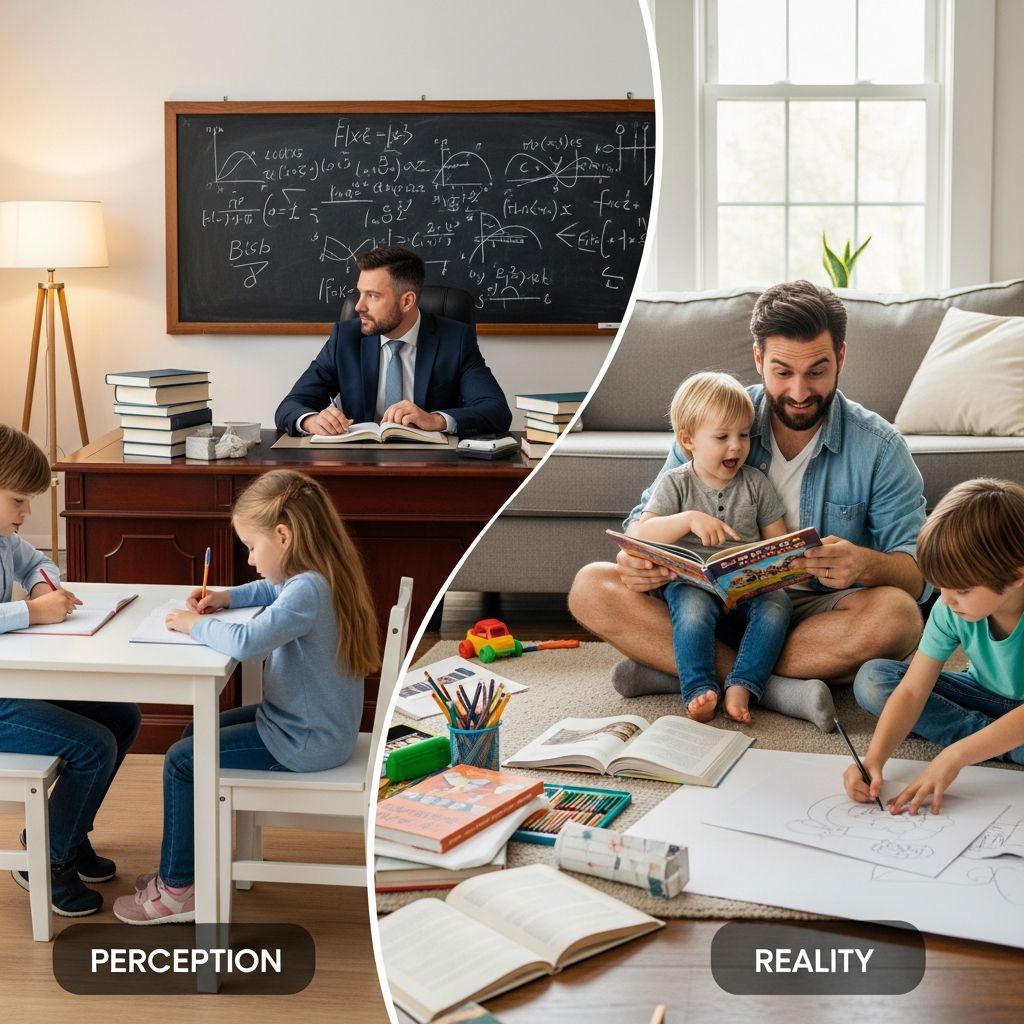
In the evolving landscape of family life, homeschooling has become a prominent choice for many parents, particularly since the pandemic shifted educational norms. A striking survey finding reveals that nearly half of fathers with young children believe they are shouldering the majority of homeschooling responsibilities, a view not widely shared by mothers. This article examines the data, underlying factors, and implications for modern parenting.
The Rise of Homeschooling and Parental Involvement
Homeschooling in the United States has seen significant growth, with families opting for personalized education amid school closures and dissatisfaction with traditional systems. Parents have had to balance work, household duties, and teaching, leading to new dynamics in role distribution. Recent analyses show that while both parents contribute, perceptions of effort differ markedly by gender.
Stay-at-home parenting provides context: In 2021, 18% of U.S. parents were not employed for pay, stable from 2016, with dads comprising 18% of this group. Among mothers, 26% were stay-at-home compared to 7% of fathers, indicating women still bear more unpaid care burdens overall. Yet, homeschooling introduces a specific layer where active teaching time is scrutinized.
Survey Insights: What Fathers and Mothers Report
A Morning Consult poll for The New York Times surveyed over 2,200 Americans living with partners or children, focusing on those with kids under 12. Key results highlight a perception gap:
- Almost 50% of men claimed they spend more time homeschooling than their spouse.
- Only 3% of women agreed their spouse does more homeschooling.
- 80% of mothers reported handling most homeschooling themselves.
- 20% of men acknowledged their spouse manages most housework and childcare, while another 20% believed they do.
These discrepancies echo prior studies where men overestimate their domestic contributions. Women often multitask professional and home roles, amplifying the load.
| Perception | Fathers (%) | Mothers (%) |
|---|---|---|
| Father does most homeschooling | ~50 | 3 |
| Mother does most homeschooling | 20 | 80 |
| Shared equally | ~30 | ~15 |
This table summarizes the divide, underscoring mismatched views on labor division.
Why the Perception Gap Exists
Several factors contribute to fathers viewing their involvement as primary. Cognitive biases play a role: Individuals often inflate their contributions in shared tasks, a phenomenon termed ‘optimism bias’ in household labor studies. Fathers may focus on visible activities like leading lessons, while overlooking mothers’ planning and emotional support.
Work schedules influence this too. Many fathers hold full-time jobs, engaging in homeschooling during evenings or weekends, perceiving it as intensive. Mothers, more likely in flexible or part-time roles, handle daytime routines, leading to fatigue without recognition.
Cultural shifts matter: Progressive ideals promote equal parenting, yet traditional expectations linger. Dads embracing homeschooling feel pioneering, heightening their sense of primacy. Videos and discussions, like those on YouTube, explore why dads aren’t more involved, suggesting societal barriers persist.
Broader Trends in Stay-at-Home Parenting
Stay-at-home dads have increased from 4% in 1989 to 7% in 2021, reflecting economic and social changes. High unemployment periods boost this share, as seen historically. However, the overall stay-at-home parent rate remains steady at 18%, with women predominant.
This context frames homeschooling: Not all stay-at-home dads homeschool exclusively, but the role appeals to those prioritizing family education. Programs and communities support paternal involvement, yet data shows uneven participation.
Benefits of Father-Led Homeschooling
When fathers take lead roles, children gain from diverse teaching styles. Dads often emphasize STEM, outdoor activities, and problem-solving, complementing maternal approaches focused on literacy and social skills. Studies link paternal engagement to better child outcomes in confidence and resilience.
Families report stronger bonds when dads homeschool. It challenges stereotypes, modeling shared responsibility. Success stories include dads crafting custom curricula, integrating hobbies like coding or sports into lessons.
Challenges Faced by Homeschooling Fathers
Despite positives, barriers exist. Workplace stigma views male caregivers as less committed, impacting careers. Social isolation hits harder for dads, with fewer peer networks than moms. Skill gaps in early education topics require self-teaching.
Balancing this with income provision strains families. Partners must communicate openly to align efforts, avoiding resentment from mismatched perceptions.
Strategies for Balanced Homeschooling Partnerships
To bridge gaps, couples can:
- Track contributions: Use apps logging time on tasks for objective views.
- Divide clearly: Assign subjects by strength—dad for math, mom for reading.
- Schedule joint planning: Weekly meetings ensure coordination.
- Seek communities: Join dad homeschool groups for support.
- Celebrate efforts: Acknowledge mutual roles to foster appreciation.
These steps promote equity, enhancing family harmony and child education.
Future of Family Education Dynamics
As remote work normalizes, more fathers may engage in homeschooling. Policy support like paid leave could equalize roles. Surveys suggest growing awareness of disparities, pushing cultural change.
Educational resources tailored for dads, online platforms, and co-op models will aid involvement. Ultimately, collaborative parenting benefits all, transcending gender perceptions.
Frequently Asked Questions
Why do fathers think they do more homeschooling?
Fathers may focus on high-visibility tasks and suffer from optimism bias, overestimating contributions compared to mothers’ comprehensive roles.
Has the number of stay-at-home dads increased?
Yes, from 4% in 1989 to 7% in 2021, though mothers remain the majority at 26%.
How can couples improve homeschooling teamwork?
Implement time-tracking tools, clear task divisions, and regular check-ins to align perceptions and efforts.
Are there benefits to dad-led homeschooling?
Yes, it introduces unique teaching styles, strengthens bonds, and models equality for children.
What surveys back these homeschooling perceptions?
The New York Times/Morning Consult poll of 2,200 parents revealed the 50% father claim vs. 3% mother agreement.
References
- Almost 1 in 5 stay-at-home parents in the U.S. are dads — Pew Research Center. 2023-08-03. https://www.pewresearch.org/short-reads/2023/08/03/almost-1-in-5-stay-at-home-parents-in-the-us-are-dads/
- Why Dads Are Not More Involved With Homeschooling — An American Homestead (YouTube). Accessed 2026. https://www.youtube.com/watch?v=q82_H418ZMo
- New Survey Shows Men Think They Do Most of the Homeschooling — The Bump. 2020. https://www.thebump.com/news/men-women-homeschooling-new-york-times-survey
- Almost 50% of dads think they’re doing most of the homeschooling — Mother.ly. Accessed 2026. https://www.mother.ly/life/nearly-half-of-fathers-homeschool/