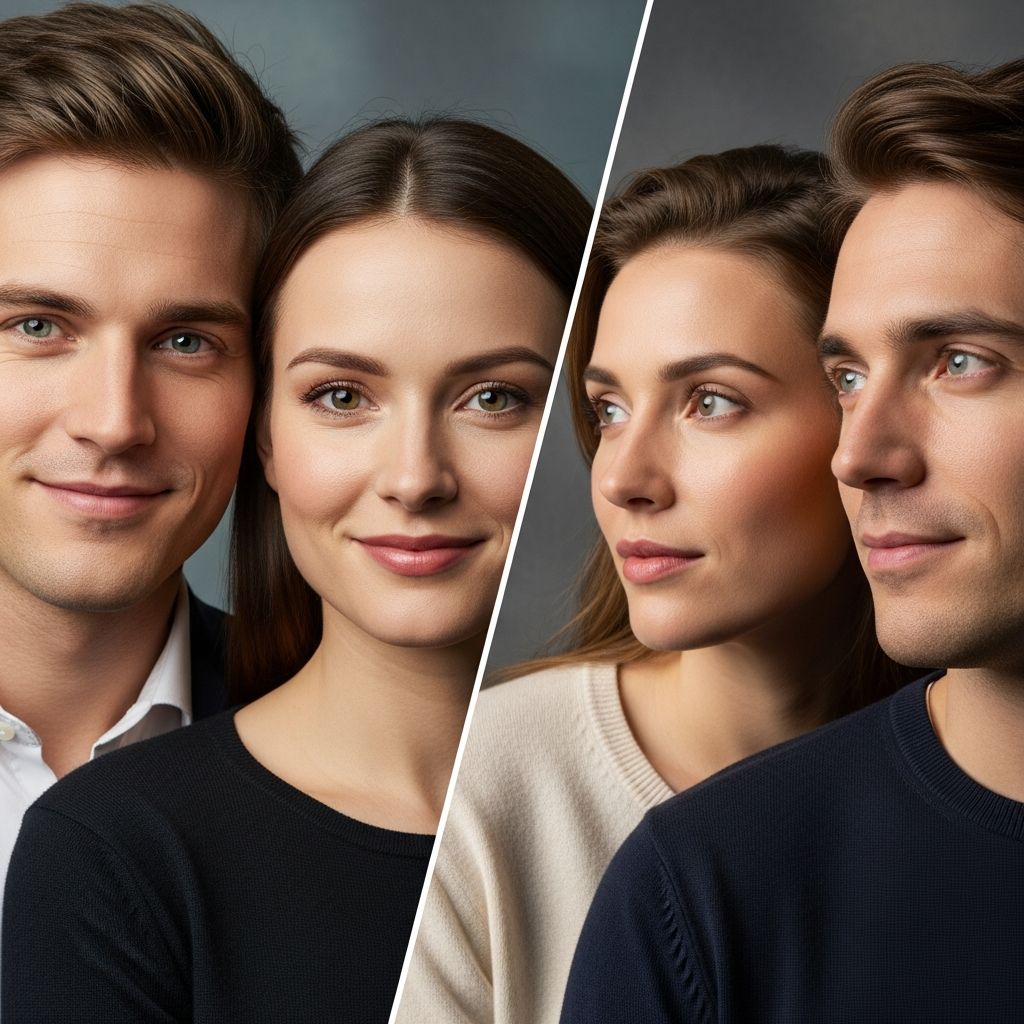
Scroll through social media, flip through wedding photos, or glance at longtime partners at a restaurant and you may notice something curious: many couples seem to resemble one another. Their faces, builds, or even their expressions look oddly similar. Is this just our imagination, or is there real science behind lookalike couples?
Researchers in psychology, genetics, and sociology have been asking this question for decades. Their findings reveal that while couples often start out similar, they do not necessarily grow more alike over the years. Instead, a mix of genetic similarity, shared environments, and psychological biases explains why so many romantic partners look as if they could be related.
The Myth: Do Couples Grow to Look More Alike Over Time?
One of the most persistent beliefs is that couples slowly converge in appearance as they share a life, meals, and emotions. The classic story goes: decades of laughing, crying, and dealing with stress together carve matching wrinkles and expressions into their faces.
However, modern research paints a different picture. A 2020 study in Scientific Reports analyzed photos of 517 married heterosexual couples taken at the start of their marriages and again 20–69 years later. Using both human judges and facial recognition algorithms, the researchers found:
- Partners’ faces were more similar than random pairs at the beginning of marriage.
- No evidence that spouses’ faces became more similar over time.
- Facial similarity remained stable rather than converging.
Across other traits like personality, attitudes, intelligence, and well-being, couples also tend to be similar from the outset but do not systematically grow more alike over time. This suggests that the impression of increasing resemblance is largely a visual illusion shaped by familiarity and memory rather than physical change.
Homogamy: Why People Pair With Similar Partners
The fact that couples start out similar is not an accident. Scientists use the term homogamy to describe the tendency for people to choose partners who are like themselves. This similarity can appear in many forms:
- Physical traits such as height, body size, or facial structure
- Education level and career paths
- Values, beliefs, and interests
- Health and lifestyle patterns, such as diet or exercise
Homogamy emerges through several overlapping processes:
- Preference for similar others: Many people consciously or unconsciously feel more at ease with partners who share their background, culture, or appearance.
- Social homogamy: Individuals are more likely to meet potential partners in similar environments—schools, workplaces, neighborhoods, clubs—where people tend to share traits and experiences.
- Market dynamics: People often match with partners of similar attractiveness or socioeconomic status due to how dating markets function.
Because appearance and social background are often linked with genetics, homogamy naturally increases the chances that partners will share both visible features and underlying genetic similarities.
The Pull of Familiarity: Why Your Own Face Feels Attractive
Another powerful force behind lookalike couples is the human preference for what feels familiar. Psychologists call this the mere exposure effect: people tend to like things more simply because they have seen them often. Familiarity can apply to faces, voices, and even names.
In one experiment, researchers showed people photos of their romantic partner’s face that had been digitally blended with another face—sometimes their own. Both men and women usually rated the version that included their own facial features as the most attractive, even though they did not realize what had been changed.
Other studies have found that participants judge faces as more attractive when they are subtly primed with images of a familiar parental face just before seeing them. This does not imply romantic attraction to parents; rather, it shows that the brain tags highly familiar faces as safe and pleasant, which spills over into judgments of attractiveness.
In daily life, this means:
- Your own face is extremely familiar to you.
- Faces that share some of your features feel warm, safe, or comfortingly recognizable.
- This sense of familiarity can boost attraction, even if you are unaware of it.
In short, when people say someone “looks like their type,” part of what they may be describing is that the person looks a bit like them or like other familiar individuals in their life.
Genes and Ancestry: Hidden Similarities Beneath the Surface
Beyond familiarity, genetics also play a meaningful role in why couples often resemble one another. Numerous studies show that spouses are more genetically similar than random strangers, especially regarding traits such as height, education, and body characteristics.
Researchers at Stanford University have examined genetic similarity between spouses and friends, suggesting that people with shared genetic predispositions often end up in similar environments—such as the same universities, neighborhoods, or interests—where they then meet and form relationships.
When two people come from similar ancestry or population backgrounds, they may share:
- Characteristic facial bone structures
- Similar skin, hair, and eye color
- Parallels in height and build
These ancestral and genetic overlaps subtly raise the odds that partners will look alike. However, it is important to note that much of the available research has focused on white heterosexual couples in Western countries, so more diverse studies are needed for a fuller global picture.
Lifestyle, Culture, and the Illusion of Increasing Resemblance
If couples do not truly grow more alike in their facial structure over time, why do some older pairs appear almost uncanny in their resemblance?
Researchers suggest that what may change most over time are not the bones of the face, but the expressions, grooming habits, and lifestyle markers a couple shares. These factors can create a strong visual impression of similarity without altering underlying anatomy.
Shared routines and environments
- Diet and exercise: Partners often eat similar meals and adopt shared habits, affecting weight, muscle tone, and overall health appearance.
- Sun exposure and sleep patterns: Similar daily routines shape skin quality, dark circles, or wrinkles.
- Stress and coping styles: Shared stressors and ways of handling them may subtly influence posture, expressions, and visible aging.
Grooming and style choices
- Couples may gravitate toward matching clothing styles, colors, or formality.
- They may influence each other’s haircuts, glasses, facial hair, and even skincare choices.
- Similar fashion identities can make partners look more aligned than their natural facial features alone would suggest.
Emotional mimicry and expressions
Partners often unconsciously mirror each other’s expressions—smiling, frowning, or reacting in sync. Over time, this can emphasize similar expression lines around the eyes or mouth. While research indicates this does not substantially change facial similarity overall, it likely contributes to the everyday perception that certain couples “share the same face.”
Opposites Attract? How This Fits With Lookalike Couples
The idea that “opposites attract” is popular in culture, but empirical evidence paints a more nuanced picture. Studies generally find that long-term partners are more alike than different in many traits. Nonetheless, some areas of difference can support a healthy relationship.
| Domain | Where Similarity Is Common | Where Differences May Help |
|---|---|---|
| Appearance | Facial features, height range, body type | Style, fashion sense, grooming choices |
| Values & Beliefs | Religion, politics, life priorities | Hobbies, niche interests, perspectives |
| Personality | Broad traits like conscientiousness or openness | Complementary roles (e.g., planner vs. spontaneous) |
| Behavior in Relationships | Communication style, conflict approach | Dominance–submissiveness balance, task preferences |
In other words, couples often look and think similar in big-picture ways, while still balancing each other through differences in roles, habits, and emotional style.
Why We Notice Lookalike Couples More Than Others
Not every couple looks alike, but those who do are especially striking. Several cognitive biases shape how we notice and remember these pairs:
- Salience bias: Unusual or extreme examples (such as almost “twin” couples) are more memorable than ordinary ones.
- Confirmation bias: When we believe that couples grow alike over time, we pay extra attention to pairs that seem to confirm the myth.
- Pattern detection: Human brains are wired to see patterns and similarities, sometimes even where none exist.
Social media amplifies striking lookalike examples—sometimes in playful formats asking viewers to guess whether two people are siblings or dating. These viral images reinforce the idea that partners often resemble each other, even if they represent a small, visually dramatic subset.
Is It Good or Bad If You Look Like Your Partner?
From a scientific standpoint, resemblance between partners is largely neutral—it is a side effect of how people meet, choose partners, and navigate shared environments. There is no evidence that looking similar makes a relationship stronger or weaker by itself.
What does matter for relationship quality, according to extensive research by scholars like John Gottman and others, are factors such as:
- Mutual respect and effective communication
- Constructive conflict resolution
- Shared values and goals
- Emotional support and responsiveness
None of these depend on partners looking alike. A couple can share no visible resemblance and still build a deeply connected, stable relationship.
Key Takeaways About Why Couples Look Alike
- Couples often look more similar than random pairs of people, but this is mostly because they start that way rather than growing more alike.
- People tend to choose partners who share their background, environment, and appearance—a pattern known as homogamy.
- Familiarity with one’s own face and family faces can subtly boost attraction to people with similar features.
- Shared lifestyle, grooming, and expressions can create a strong visual impression of similarity over time, without major anatomical changes.
- Looking like your partner is neither a requirement nor a guarantee of relationship success; it is simply one fascinating outcome of how humans choose each other.
Frequently Asked Questions (FAQs)
Q: Do couples scientifically grow to look more alike over time?
A: Evidence from large-scale studies using both human ratings and facial recognition algorithms shows that while spouses’ faces are somewhat similar early in marriage, they do not become more similar over time.
Q: Why do I find people who look like me attractive?
A: Psychological research suggests that people tend to feel more positively toward familiar faces. Because your own face is highly familiar, seeing similar traits in others can increase comfort and attraction, often without your awareness.
Q: Is it normal to date someone who could be mistaken for a sibling?
A: It is not uncommon. Shared ancestry, similar environments, and homogamy can all make partners resemble one another. This resemblance reflects how people meet and choose partners, not anything inherently problematic.
Q: Do genetics play a role in why couples look alike?
A: Yes. Studies indicate that spouses tend to be more genetically similar than random individuals, especially regarding traits like height and education. When partners come from similar ancestral backgrounds, visible similarities in facial features and body type are more likely.
Q: Does looking similar make a relationship stronger?
A: There is no solid evidence that physical resemblance itself predicts relationship satisfaction or longevity. Factors like communication, shared values, and emotional support are far more important to relationship health.
References
- Why Do So Many Couples Look Alike? Here’s the Psychology Behind the Phenomenon — Time Magazine. 2019-03-15. https://time.com/5553817/couples-who-look-alike/
- Spouses’ faces are similar but do not become more similar with time — Tea Sandstrom & Michal Kosinski, Scientific Reports, Nature Publishing Group. 2020-10-12. https://www.nature.com/articles/s41598-020-73971-8
- Genetic and educational assortative mating among US adults — Benjamin W. Domingue et al., Proceedings of the National Academy of Sciences (PNAS). 2014-09-02. https://www.pnas.org/doi/10.1073/pnas.1321426111
- Attractiveness and mate selection: Familiarity and similarity — Various authors, summarized in peer-reviewed social psychology literature. 2013 and later. https://pubmed.ncbi.nlm.nih.gov/
- Assortative mating and couple similarity in personality and other traits — Review of assortative mating research, American Psychological Association. 2016-05-01. https://psycnet.apa.org/record/2016-25402-001