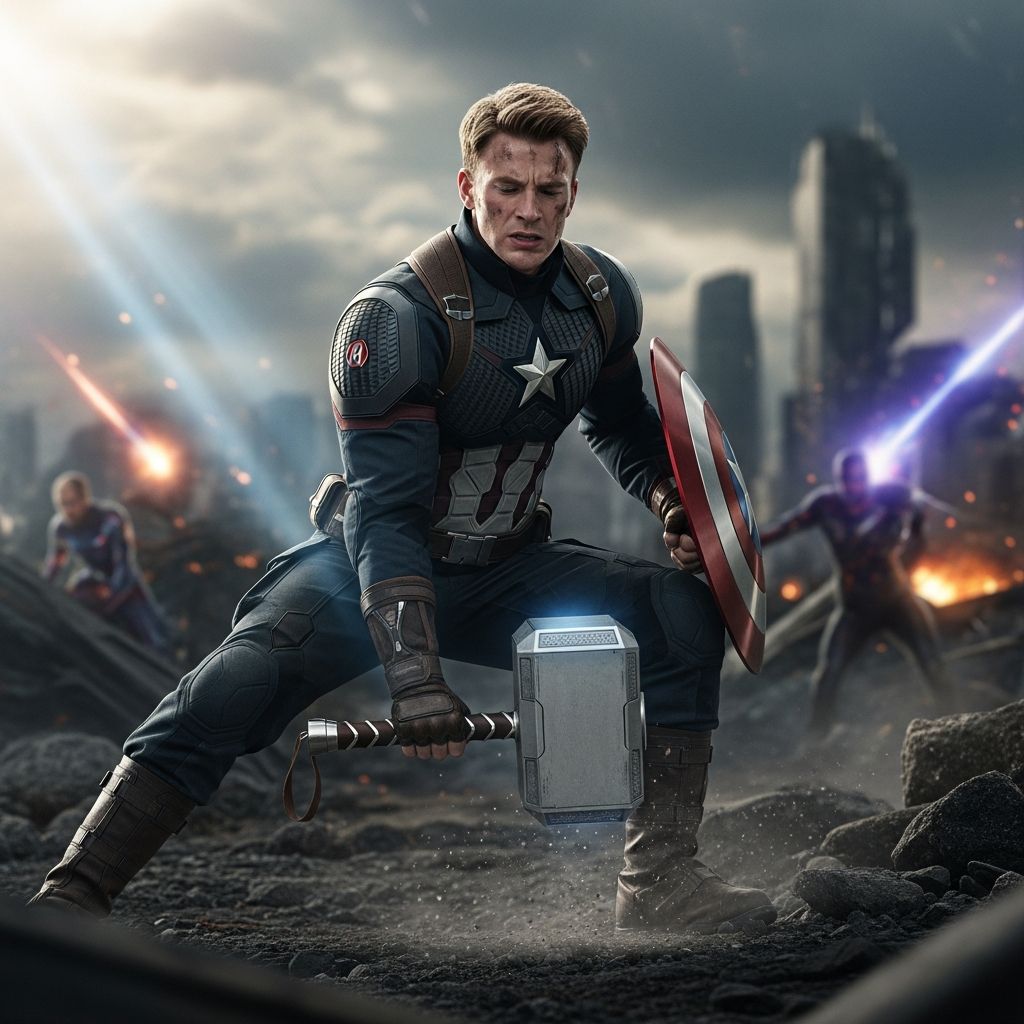
In the Marvel Cinematic Universe, few images landed with as much force as Captain America wielding Thor’s hammer in Avengers: Endgame. For many fans, it was the heroic payoff of a tease that began years earlier in Avengers: Age of Ultron. But when the directors later clarified what really happened during that original hammer-lifting scene, the meaning of both moments subtly changed. This article explores how Endgame reshaped that twist, what it reveals about Marvel’s evolving rules of “worthiness,” and why this seemingly small detail became so significant to audiences.
The Long Road to Cap Lifting Mjolnir
Marvel Studios carefully planted seeds for Captain America’s big hammer moment long before the climactic battle with Thanos. To understand how Endgame rewrote the twist, it helps to trace how Mjolnir, and the idea of worthiness, has been built up across the films.
- Thor’s hammer is established as an enchanted weapon only those who are worthy can lift.
- In Thor and Thor: The Dark World, no one besides Thor can even budge it, reinforcing its magical exclusivity.
- In Age of Ultron, the Avengers try to lift Mjolnir at a party, and Steve Rogers makes it move just slightly before stopping.
- In Endgame, Steve finally wields Mjolnir in battle, paying off years of teasing and speculation.
That seemingly playful party game in Age of Ultron turned into one of the MCU’s most dissected scenes, because it hinted that Steve might already be worthy years before the final showdown with Thanos.
Revisiting the Age of Ultron Party Scene
The party sequence in Age of Ultron became a cornerstone of fan theories. In it, each Avenger takes a turn trying to lift Mjolnir, and all fail in comic fashion—until Steve gives it a try. The hammer moves a fraction of an inch, Thor’s face briefly drops, and then Steve casually gives up. At the time, audiences were left with three main interpretations:
- Not yet worthy: Steve is close to worthy, but not there yet.
- Partially worthy: Something about his moral character lets him nudge the hammer, but not fully wield it.
- Fully worthy but polite: Steve realizes he can lift it but chooses not to, to spare Thor’s feelings.
Years later, comments from the filmmakers leaned heavily toward that third interpretation, suggesting that Steve may have held back on purpose to avoid humiliating his friend. That retroactive explanation turned what was originally a clever gag into an early act of quiet compassion—and it changed how the Endgame moment is perceived.
What Endgame Adds: From Tease to Triumph
When Mjolnir flies into Steve’s hand during the final battle in Endgame, the film does more than deliver a crowd-pleasing spectacle. It reframes the earlier party scene and redefines how the MCU treats worthiness.
Key differences between the two moments include:
- Context: The party scene is light and comedic; the Endgame scene is life-or-death and mythic.
- Stakes: In Ultron, nothing is at risk except Thor’s pride. In Endgame, the fate of the universe hangs in the balance.
- Intent: At the party, Steve seems to downplay his potential. In Endgame, he has no reason to hold back.
- Reaction: Thor’s brief panic in Ultron becomes full-blown joy in Endgame, confirming that Steve’s worthiness is now fully acknowledged.
By the time Steve lifts the hammer against Thanos, the audience is primed to see it as the culmination of his entire moral journey, not just a fun callback.
Timeline Logic: How Does Cap Use Mjolnir Again?
From a story-logic perspective, Endgame complicates Mjolnir’s history by involving time travel. Thor retrieves his hammer from an earlier point in time during the mission to Asgard, even though in the original timeline it would later be destroyed. This raises questions about how the film’s rules of time travel and causality apply to the hammer and its enchantment.
| Question | Answer in Endgame’s Logic |
|---|---|
| Does removing Mjolnir from the past change history? | No. Endgame treats any change to the past as creating a branch timeline, not overwriting the original. |
| How is the timeline repaired? | Steve is sent back to return the Infinity Stones and Mjolnir to their original places, closing off the branches. |
| Does Steve’s use of Mjolnir break continuity? | Not within Marvel’s own multiverse rules. The hammer is borrowed from one point in time, used, then returned. |
Marvel’s time-travel framework, as described within the film and in follow-up explanations, explicitly avoids the classic “change the past, erase the future” model. Instead, it adopts a branching multiverse structure in which alterations create new timelines rather than rewriting the original.
Worthiness Explained: Why Can Steve Lift the Hammer?
The enchantment on Mjolnir—”whosoever holds this hammer, if he be worthy, shall possess the power of Thor”—has always implied a moral test rather than a physical one. Over multiple films, Marvel ties worthiness to traits that Steve consistently demonstrates:
- Self-sacrifice: Steve routinely puts himself in harm’s way for others, from crashing the Valkyrie in The First Avenger to facing Thanos with shattered gear in Endgame.
- Integrity: He resists political pressure in Captain America: The Winter Soldier and Civil War, prioritizing individual rights and accountability over blind obedience.
- Humility: He never seeks power for its own sake; he treats leadership as duty, not status.
- Empathy: Whether opposing HYDRA or protecting Bucky, Steve acts from a place of compassion rather than vengeance.
If Steve could already lift the hammer during the Ultron party, that choice becomes an expression of the same humility and empathy that makes him worthy in the first place. He is strong enough to claim a symbolic victory, but kind enough to leave it on the table.
Did Endgame Undercut the Original Twist?
Some fans argue that retroactively declaring Steve fully worthy in Age of Ultron weakens the impact of his Endgame moment. From that perspective, the “twist” at the party loses its ambiguity and becomes a deliberate fake-out. However, viewed another way, the filmmakers’ later explanation deepens Steve’s character arc.
Two main readings now coexist:
- Payoff diminished? If Steve was always worthy, the Endgame moment becomes less about growth and more about circumstance. He lifts the hammer now because he must, not because he has finally become worthy.
- Character enriched? The retcon highlights Steve’s emotional intelligence. The earlier scene becomes a quiet act of friendship; the later scene becomes the moment necessity overrules his instinct to stand back.
In both readings, Endgame doesn’t erase the earlier twist so much as reinterpret it. The ambiguity shifts from “Can he?” to “Why didn’t he?” That focus on motivation—on Steve choosing not to take a symbolic victory earlier—fits well with Marvel’s broader portrayal of him as a hero who avoids ego whenever possible.
Thor’s Arc and Emotional Payoff
Any discussion of Mjolnir and worthiness must also account for Thor’s journey. In Endgame, Thor is haunted, grieving, and burdened by guilt after failing to prevent Thanos’ snap. His weight gain, depression, and self-doubt are played partly for humor but also treated as a serious emotional breakdown.
- When Thor summons Mjolnir from the past and it comes to him, he breaks down, whispering, “I’m still worthy.”
- Later, when Steve wields Mjolnir, Thor does not respond with jealousy, but with unfiltered joy, shouting that he “knew it.”
- That reaction affirms that worthiness is not a zero-sum trait. Steve’s worthiness does not diminish Thor’s; it validates Thor’s choice of allies and his faith in Steve’s heart.
By allowing both men to wield the hammer in different ways, Endgame reframes the enchantment as a recognition of shared values rather than an exclusive badge of divine favor.
Canon, Commentary, and the Role of Filmmaker Explanations
Modern franchises like the MCU are shaped not only by what appears on screen, but also by director commentaries, interviews, and behind-the-scenes insights that emerge afterward. Viewers are often left to decide how much weight to give these retroactive explanations compared to what is shown in the films themselves.
In the case of Steve and Mjolnir:
- The text (what is on screen) shows the hammer budging in Ultron, then Steve fully lifting it in Endgame.
- The paratext (director commentary) leans toward Steve already being worthy, but choosing not to show it.
- Fans weigh these layers differently. Some prioritize strict on-screen evidence; others embrace the creators’ explicit intent.
This tension highlights a broader trend in contemporary storytelling: complex franchises increasingly encourage active interpretation, with official commentary functioning more like extended footnotes than fixed law. That dynamic is especially visible in Endgame, whose time-travel rules and character arcs have sparked extensive debate and clarification in interviews and editorials.
Broader Implications for the MCU
Steve’s use of Mjolnir in Endgame has ripple effects across the Marvel universe, both within the story and in terms of future storytelling possibilities.
- Expanded definition of worthiness: The hammer is no longer uniquely tied to Thor’s Asgardian lineage. It becomes a symbol of shared heroic ideals.
- Precedent for others: Later MCU projects, including stories involving Jane Foster as Mighty Thor in the comics and films, reinforce the idea that Mjolnir’s enchantment can recognize multiple worthy bearers over time.
- Legacy and succession: Steve’s handing of the shield to Sam Wilson at the end of Endgame parallels his temporary wielding of Mjolnir. Both moments underline that symbols of power can be passed on while remaining true to their original spirit.
- Multiverse storytelling: With Endgame firmly introducing branching timelines, Marvel has narrative room for alternate versions of heroes who may or may not be worthy in different universes.
In this way, a single shot of Steve swinging Mjolnir does double duty: it pays off a long-running tease and subtly opens the door to new permutations of heroism and legacy within a multiverse framework.
Key Takeaways in Bullet Form
- Captain America’s brief movement of Mjolnir in Age of Ultron set up a multi-year mystery around his worthiness.
- Endgame delivers the full payoff by letting Steve wield Mjolnir against Thanos in a moment designed as an emotional and thematic climax.
- Filmmaker commentary suggests Steve may have been able to lift the hammer earlier but chose not to, reframing the party scene as a moment of kindness rather than inadequacy.
- Marvel’s time-travel rules, based on branching timelines rather than overwriting history, allow Mjolnir to be borrowed from the past without breaking continuity.
- Thor’s personal arc, including his affirmation that he is “still worthy,” turns Mjolnir into a symbol of resilience and shared values rather than exclusive divine privilege.
Frequently Asked Questions (FAQs)
Was Captain America already worthy of Mjolnir in Age of Ultron?
On-screen, the hammer moves slightly when Steve tries to lift it, signaling that he is at least close to worthy. Later explanations from the filmmakers lean toward the idea that Steve could have fully lifted it but held back out of respect for Thor. While this interpretation is not explicitly stated in the film, it aligns with Steve’s established humility and empathy.
Does Endgame’s time travel break the rules about Mjolnir and the timeline?
Within Endgame’s own framework, it does not. The movie adopts a branching-timeline model—changes to the past create new universes rather than altering the original history, and then the heroes return the Stones and Mjolnir to their proper places. This structure is meant to preserve continuity while still allowing dramatic detours.
Why is Thor happy, not jealous, when Steve lifts the hammer in Endgame?
Thor’s joy underscores how far he has come from the more arrogant warrior of his early films. Having struggled with guilt and self-doubt, he no longer treats Mjolnir as his personal trophy. Instead, he sees Steve’s worthiness as confirmation of his trust in his friend and as proof that the qualities the hammer rewards—courage, selflessness, and honor—exist in more than one hero.
Does Steve lifting Mjolnir diminish Thor’s uniqueness?
Not necessarily. While Thor is closely associated with Mjolnir, the enchantment has always implied that the hammer recognizes character, not bloodline alone. Allowing Steve to wield it expands the symbol’s meaning from “Thor’s exclusive weapon” to “a divine tool that chooses the truly heroic,” enriching both characters rather than reducing either.
How does this affect Captain America’s legacy in the MCU?
Steve’s use of Mjolnir cements his standing as one of the MCU’s moral centers. Together with his decision to pass the shield to Sam Wilson, it frames his legacy as one of stewardship: he is entrusted with incredible power, proves himself worthy of it, and then deliberately hands that power to others he believes can carry the mantle forward.
References
- AVENGERS: ENDGAME – The Movie Spoiler — TheMovieSpoiler.com. 2019-04-26. https://themoviespoiler.com/movies/avengers-endgame/
- Breaking Down the Complicated Time Travel in “Avengers: Endgame” — Eliana Dockterman, Time. 2019-04-26. https://time.com/5576656/avengers-endgame-time-travel/
- Avengers: Endgame Ending Explained — Mike Cecchini, Den of Geek. 2019-04-26. https://www.denofgeek.com/movies/avengers-endgame-ending-explained/
- 10 ‘Avengers: Endgame’ Plot Holes — ScreenCrush. 2019-04-30. https://screencrush.com/avengers-endgame-plot-holes/
- Marvel Studios’ Avengers: Endgame Production Notes — Marvel / Disney Press Materials. 2019-04-22. https://www.marvel.com/movies/avengers-endgame