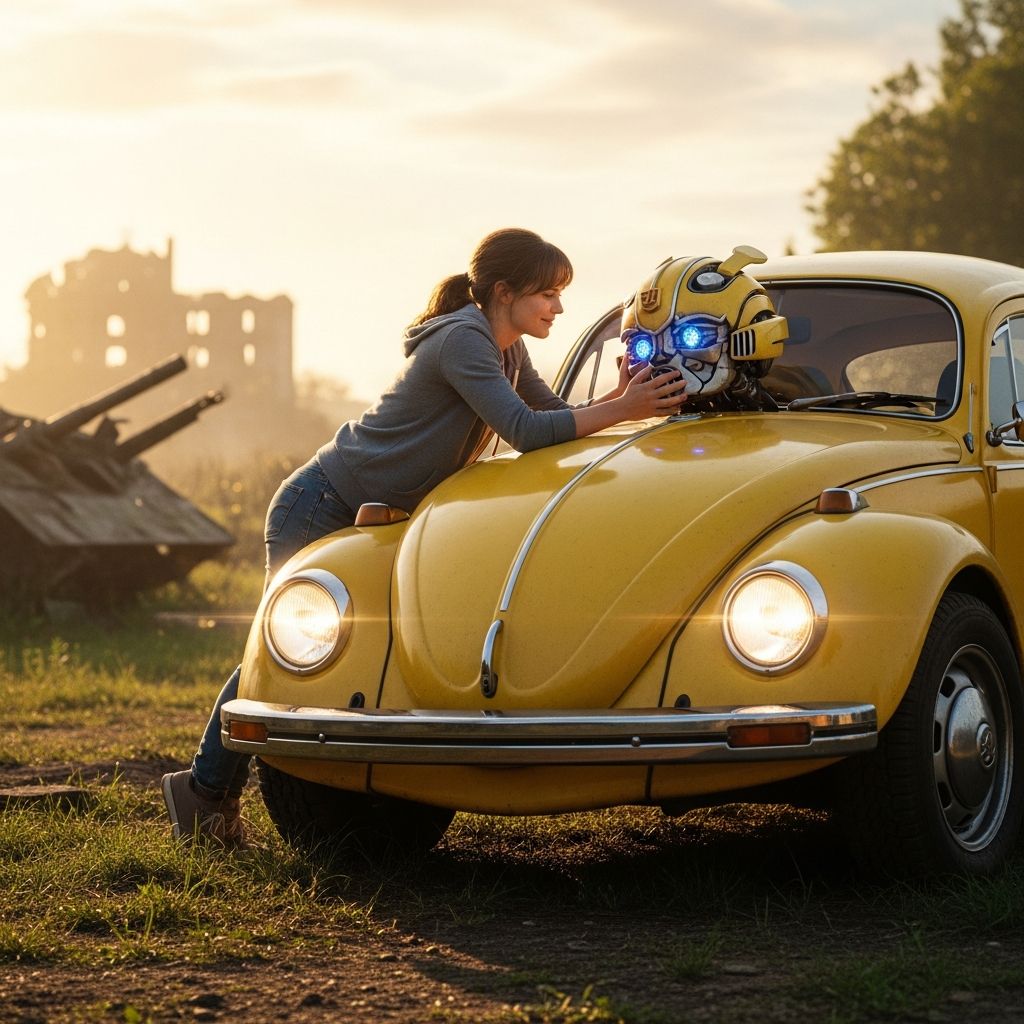
On the surface, Bumblebee is a prequel in the long-running Transformers franchise, packed with alien robots, military hardware, and explosive showdowns. Look closer, though, and the movie plays much more like a tender, awkward, and surprisingly funny romantic comedy about a lonely teen and the broken alien robot who crashes into her life.
By shrinking the scale of the conflict and centering on one girl, one car, and one very specific emotional journey, the film quietly transforms the Transformers formula into something warmer, more intimate, and much more human. This is less a story of intergalactic war and more a story about grief, first love, and learning to trust again — with car chases and robot battles as emotional punctuation instead of the main event.
The Setup: A Meet-Cute With Metal
Romantic comedies live and die on the meet-cute — that first encounter where two leads collide, misunderstand each other, and reluctantly start to connect. In Bumblebee, that moment happens in a dusty corner of a California junkyard, when Charlie Watson discovers a beat-up yellow Volkswagen Beetle and drags it home, not knowing it’s a traumatized Autobot soldier in hiding.
- Charlie is grieving her father, stuck in a new family dynamic she doesn’t like, and aching for independence.
- Bumblebee (B-127) has lost his memory, his voice, and his place in the Autobot army, reduced to a panicked amnesiac who barely understands his own body.
- Both of them feel broken, stranded between who they used to be and who they might become.
Instead of fireworks and instant chemistry, their early scenes are built on fear, clumsiness, and miscommunication. Bumblebee trashes Charlie’s garage out of panic; she screams, he cowers; they slowly figure out each other’s limits. It’s the DNA of a classic odd-couple romcom, just with more sheet metal.
Why the Movie Feels Like a Romcom, Not a War Epic
Compared to the louder, more chaotic Transformers entries, Bumblebee deliberately narrows its focus to the emotional lives of its leads. Several choices push it toward romantic comedy territory:
- Small stakes, big feelings: The fate of the universe matters, but the movie keeps returning to whether Charlie can heal after losing her father and whether Bumblebee can learn to trust humans again.
- Relationship-first structure: Major action beats are timed around key emotional milestones — betrayal, reconciliation, sacrifice — much like classic romcoms where fights and reconciliations chart the arc of a relationship.
- Humor over spectacle: Many of the standout moments are comedic: Bumblebee fumbling with human objects, misunderstanding pop culture, or using the radio to express himself.
- Emotional climax, not just physical: The most memorable resolution is not just a Decepticon’s defeat, but Charlie’s decision about who she wants to be and how she wants to say goodbye.
Charlie Watson: The Beating Heart of the Story
None of the romantic-comedy framing would work without a central character who feels real. Hailee Steinfeld’s Charlie Watson is written and performed with an emotional specificity more typical of a coming-of-age dramedy than a toy-branded blockbuster.
| Romcom Trope | Charlie’s Version |
|---|---|
| The relatable, slightly messy lead | Grieving, sarcastic, into old cars and alt music, out of sync with her family. |
| Emotional obstacle | Unresolved guilt and sadness over her father’s death; fear of moving on. |
| Supportive-but-flawed family | They care, but don’t fully grasp why she’s stuck — a source of both friction and reluctant warmth. |
| Awkward would-be love interest | Memo, the shy neighbor who likes her but is never allowed to hijack the story. |
By centering Charlie’s perspective, the film lets her relationship with Bumblebee resemble a healing partnership more than a generic human-hero/alien-sidekick dynamic. Her arc — from shut-down and bitter to protective, open, and finally able to let go — mirrors the emotional trajectory of someone stumbling through a first intense love that changes who they are.
Bumblebee as the Perfect Romcom Partner
Bumblebee is written less like a hardened soldier and more like a bashful, emotionally transparent partner who wears his heart on his metal sleeve.
- He can’t speak, so he communicates through body language, radio snippets, and small gestures — much like a shy romcom lead who struggles to say how they feel.
- He is physically imposing but emotionally gentle, generating the protective, soft-giant dynamic that a lot of romantic stories rely on.
- He learns from Charlie — about boundaries, about trust, about what she needs from him — which places them on equal emotional footing instead of making her just his “human handler.”
Importantly, the relationship is intimate without being sexual. It taps into the same emotional energy as many first-love narratives — exclusivity, loyalty, sacrifice — but frames it as a deep, cross-species friendship. That choice keeps the story accessible to families while still feeling like a genuine love story.
How the 80s Setting Supercharges the Romance
Set in the late 1980s, Bumblebee leans hard into its period backdrop: mixtapes, VHS tapes, mall culture, and an aggressively catchy soundtrack. This isn’t just nostalgia for its own sake — the era amplifies the film’s emotional tone in several ways.
- Mixtape intimacy: In the pre-streaming age, a carefully curated tape was a love letter. Charlie’s musical obsession and Bumblebee’s radio-voice gimmick turn songs into emotional dialogue between them.
- Analog isolation: Without smartphones or social media, Charlie’s world feels smaller and lonelier, making her bond with Bumblebee feel larger and more necessary.
- Warm visual palette: The film’s color and production design evoke a softer, less sterile world, mirroring the story’s emphasis on sincerity over cynicism.
Critics noted that the movie is nostalgic but not lazily retro — it uses the 80s flavor to reinforce emotion and character rather than as a checklist of references. The result is a setting that feels like a time capsule of teenage longing, not just a backdrop for robots.
Comedy Rooted in Character, Not Chaos
Romantic comedies depend on humor that exposes vulnerability: misunderstandings, overreactions, social disasters. Bumblebee quietly follows that rule.
- Bumblebee’s physical comedy — squeezing into Charlie’s house, breaking things he doesn’t understand, trying to hide in plain sight — comes from his earnest attempts to fit into her world.
- Charlie’s social awkwardness around Memo and her peers feeds into gentle, cringe-adjacent humor that feels closer to teen comedies than macho action cinema.
- Even the military character Jack Burns, played by John Cena, gets knowingly exaggerated moments that undercut his toughness with a wink rather than turning him into a cartoon villain.
This style of comedy is miles away from the crude jokes and constant noise of earlier Transformers films. Reviewers highlighted Bumblebee as funnier, more relaxed, and more character-driven, which is exactly what you’d expect from a romcom disguised as a robot movie.
The Action Serves the Relationship
Where previous franchise entries often let action overwhelm character, Bumblebee flips the equation. The fights are clear, visually readable, and relatively contained; their purpose is to crystallize emotional turning points.
| Type of Scene | Function in the Story |
|---|---|
| Quiet garage moments | Build trust, reveal backstories, and deepen their emotional connection. |
| Early skirmishes | Underline Bumblebee’s fear and confusion; show why Charlie’s trust matters. |
| Climactic battles | Force both characters to risk themselves for each other, confirming the strength of their bond. |
Critics repeatedly called Bumblebee the most coherent and emotionally motivated of the live-action Transformers films, praising how the action is easy to follow and always anchored to what the characters want and fear. That clarity lets the final confrontations feel less like noise and more like payoffs.
Subverting the Usual Boy-Meets-Girl Ending
A classic romcom often closes on a kiss, a grand gesture, or a promise of happily-ever-after. Bumblebee deliberately chooses a different route. Without spoiling specifics, the ending:
- Honors the intensity of Charlie and Bumblebee’s relationship.
- Respects Charlie’s autonomy and emerging sense of self.
- Avoids turning her into a prize or accessory in someone else’s story.
Critics singled out this conclusion as refreshingly anti–”guy gets the girl”, noting that Charlie behaves like a fully realized person with her own path rather than a reward for heroism. It is, in effect, a romcom ending that prioritizes growth over possession.
Why Families Responded So Strongly
The emotional clarity and gentle humor made Bumblebee especially appealing to parents and kids who were turned off by the more aggressive tone of the earlier movies.
- Simpler, cleaner plot: Easier for kids to follow and for adults to care about, with fewer subplots and more focus on the central duo.
- Less objectification, more empathy: Reviewers noted that the film dials back on leering camerawork and instead foregrounds character emotion and respect.
- Emotionally healthy message: It quietly encourages grieving, talking about loss, and building supportive relationships, all inside a story about a giant transforming robot.
For many viewers, that shift in tone was enough to crown Bumblebee the best live-action Transformers movie to date, precisely because it behaves less like a toy commercial and more like a heartfelt teen movie that just happens to feature alien mechs.
What Bumblebee Teaches Other Blockbusters
Bumblebee offers a quiet lesson to other big-budget franchises: even the loudest concepts can benefit from romcom-level attention to character.
- Start with a specific emotional wound (Charlie’s grief, Bumblebee’s trauma) and design the plot to confront it.
- Treat the central relationship as the core engine of the story, not a side dish next to spectacle.
- Use action to externalize emotional stakes rather than to distract from a thin narrative.
- Let your ending reflect growth, not ownership — especially for young female leads.
By doing all this, Bumblebee doesn’t just rehabilitate a weary franchise. It quietly argues that even a story about alien robot warfare can function beautifully as a romantic comedy about trust, healing, and choosing who you want to be.
Frequently Asked Questions (FAQs)
Q: Is Bumblebee really a romantic comedy?
A: It is not marketed as one, but structurally it borrows heavily from romantic comedies and coming-of-age dramas: a meet-cute, emotional obstacles, comedic misunderstandings, a crisis that tests the relationship, and a bittersweet, growth-focused ending. The key difference is that the core bond is a deep friendship rather than a traditional romance.
Q: Do I need to watch the previous Transformers movies first?
A: No. Critics consistently describe Bumblebee as accessible even to viewers who have never seen a Transformers film, thanks to its smaller cast, simpler plot, and focus on Charlie and Bumblebee’s relationship rather than on franchise lore.
Q: Is Bumblebee appropriate for kids?
A: While the film includes sci-fi violence and some intense action, reviewers note that it is gentler, less graphic, and less cynical than earlier entries, with a stronger emphasis on empathy, humor, and emotional growth, which many families have found more suitable and enjoyable.
Q: What makes Bumblebee stand out from other Transformers films?
A: Reviewers highlight its coherent action, 80s charm, character-driven story, and the standout performance of Hailee Steinfeld. The central bond between Charlie and Bumblebee gives the movie a warmth and specificity that earlier, more bombastic installments often lacked.
Q: Why do critics say it is the best Transformers movie?
A: Many critics and fans point to its emotional focus, clear storytelling, nostalgic yet grounded setting, and the balance between humor and heart. These elements combine to create a film that works not just as a franchise entry, but as a satisfying story in its own right.
References
- Bumblebee movie review & film summary (2018) — Matt Zoller Seitz, RogerEbert.com. 2018-12-20. https://www.rogerebert.com/reviews/bumblebee-2018
- Bumblebee (2018) – More Than Meets The Eye — Moviemeister Reviews. 2018-12-14. https://moviemeisterreviews.com/2018/12/14/bumblebee/
- Bumblebee movie review: floats like a butterfly… — MaryAnn Johanson, FlickFilosopher.com. 2018-12-17. https://www.flickfilosopher.com/2018/12/bumblebee-movie-review-floats-like-a-butterfly.html
- Bumblebee (2018) – IMDb User Reviews — IMDb. 2018. https://www.imdb.com/title/tt4701182/
- Bumblebee (movie) – Review — Phenixx Gaming. 2019-03-27. https://web.phenixxgaming.com/2019/03/27/bumblebee-movie-review/
- Bumblebee — Rotten Tomatoes. 2018. https://www.rottentomatoes.com/m/bumblebee
- Bumblebee Review (2018) — World of Geek Stuff. 2018-12-21. https://www.worldofgeekstuff.com/bumblebee-2018-2018-a-quick-review/