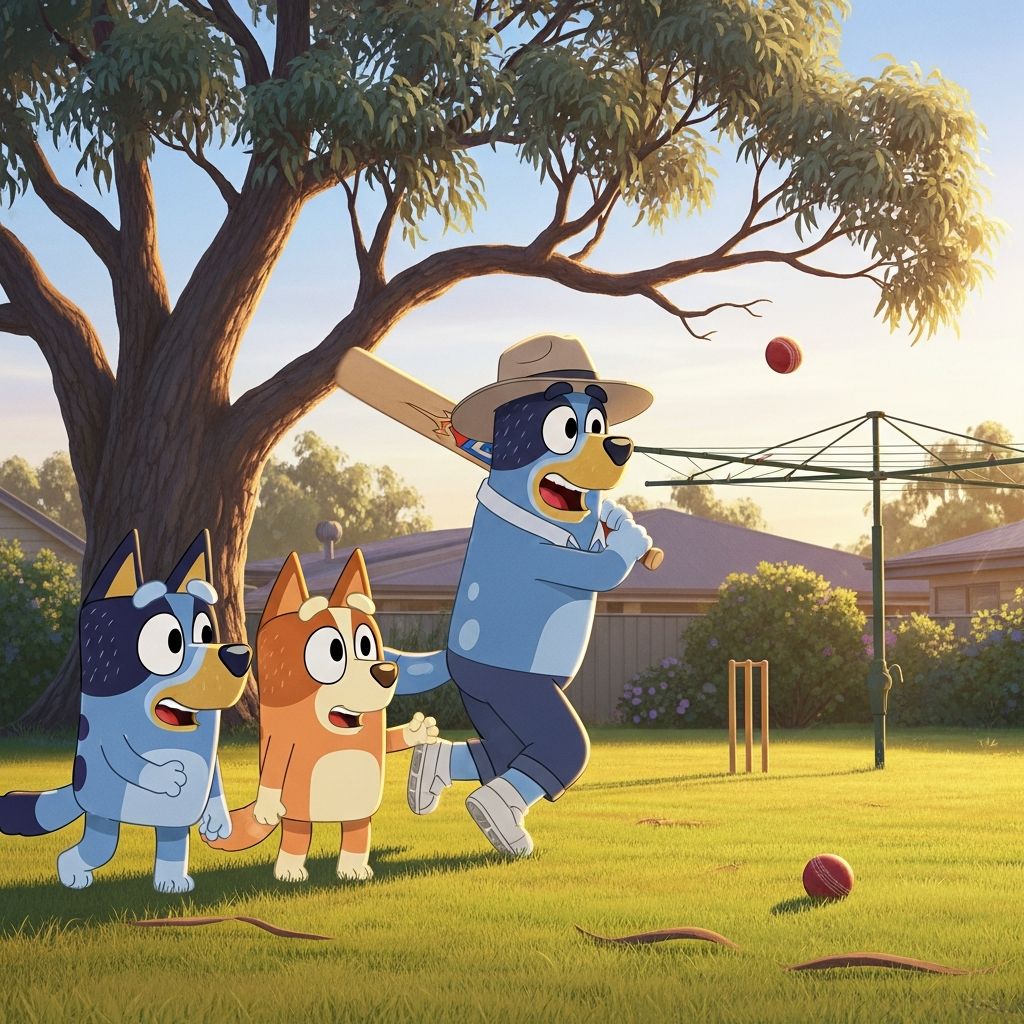
Among the many beloved stories in Bluey, the Australian animated series about a blue heeler puppy and her family, one stands out as a modern classic: the episode often referred to simply as “Cricket”. What appears to be a simple backyard game becomes a layered story about resilience, community, and the bittersweet feeling of watching children grow up.
This article explores why that episode has been so widely praised, what it reveals about Bluey as a whole, and how it bridges the worlds of childhood play, parenting, and Australian culture.
Bluey in Brief: Why This Show Matters
Bluey is an Australian animated TV series created by Joe Brumm and produced by Ludo Studio. It follows Bluey, a six-year-old (later seven-year-old) blue heeler puppy, her younger sister Bingo, and their parents Bandit and Chilli. Each seven-minute episode turns everyday family life into rich imaginative play, often reflecting real developmental and emotional milestones in young children.
- Audience: Aimed at preschoolers, but written as a co-viewing show for children and adults.
- Core themes: Imaginative play, emotional regulation, family relationships, and modern parenting.
- Setting: A stylized version of Brisbane, full of recognizably Australian homes, vegetation, and weather.
Critics frequently praise the series for its emotional authenticity and its nuanced portrayal of contemporary family life.
Why ‘Cricket’ Feels Different From Other Bluey Episodes
Many Bluey episodes are small stories about household routines: grocery trips, bath time, or playground games. “Cricket” adds another layer by centering on a treasured national sport and the way it connects generations.
What sets this episode apart?
- Sport as story engine: The cricket game provides all the tension, conflict, and payoff instead of a typical “lesson of the day.”
- Minimal dialogue from adults: Much of the emotion comes from looks, body language, and the slow rhythm of the game.
- Time and memory: It hints at years of neighborhood friendship and practice, giving the story an unusually epic feel for seven minutes.
- Universal yet specific: It is deeply Australian, yet any viewer who has ever played or watched a childhood sport can understand it.
Cricket as a Cultural Heartbeat in Bluey
Cricket is not just a backdrop; it is a cultural symbol. In Australia, cricket has long been a summer ritual – from backyard matches with improvised rules to major international games watched by millions.
In the episode, the game reflects:
- Community bonds: Kids of different ages, neighbors, and parents coming together informally in a shared activity.
- Generational continuity: The way parents pass down skills, stories, and traditions associated with the sport.
- National identity: For Australian viewers, the sounds, field set-up, and even the attitudes toward winning and losing tap into a shared cultural memory.
International audiences, even those unfamiliar with cricket, can read the sport visually: bat, ball, bowler, batter, catching, cheering. The rules aren’t fully explained, but the emotions behind each moment are crystal clear.
The Emotional Core: Resilience, Loss, and Small Triumphs
At its heart, “Cricket” is about learning to stick with something hard. The story lingers on a younger child struggling at the crease, repeatedly missing the ball, wobbling between frustration and determination.
Three intertwined emotional threads run through the episode:
- Resilience: Children experience failure in real time and are gently encouraged to keep trying without being pressured.
- Letting go: Older kids begin to outgrow certain games and roles, and adults watch those transitions with pride and nostalgia.
- Shared victory: The “win” at the end is less about the scoreboard and more about a child finally connecting bat to ball in front of a cheering crowd.
Because this is Bluey, the episode does not spell out its moral. The lesson lives in the rhythm of the game, in the long pauses between deliveries, and in the tiny smile of an older child who realizes they are no longer the smallest in the yard.
How ‘Cricket’ Fits Within the Wider Bluey Universe
The series as a whole often focuses on imaginative games, like “Taxi,” “The Doctor,” and other episodes where Bluey, Bingo, and friends transform ordinary objects into elaborate play scenarios. “Cricket” is unusual because the game itself already exists in the real world. Instead of inventing rules from scratch, the characters use a sport with its own long-established culture.
| Typical Bluey Episode | ‘Cricket’ Episode |
|---|---|
| Focus on imaginative make-believe (e.g., markets, hospitals, taxis). | Focus on a real sport with minimal rule explanation. |
| Conflict often arises from rule disagreements, sharing, or turn-taking. | Conflict centers on skill gap, confidence, and persistence. |
| Parents are usually active co-players, dramatically in character. | Adults are more like facilitators and spectators, letting kids lead the action. |
| Lesson is often about empathy, fairness, or imagination. | Lesson is about resilience, practice, and growing into your abilities. |
Why Parents Connect So Deeply With This Episode
Parents already appreciated Bluey for its honest portrayal of everyday parenting wins and failures. “Cricket” amplifies that connection in several ways.
Seeing Children as They Are – and Who They’re Becoming
The episode captures the precise moment when a child stops being a “little kid” and starts to look, move, and think like a big kid. For many adults, that shift is bittersweet: exciting to witness, painful to realize it means a phase of life is ending.
- Parents see the time and patience it took to reach that one good shot.
- They recognize the sacrifices – early mornings, countless retries, gentle encouragement instead of stepping in.
- They watch older kids hand over the spotlight to younger siblings or neighbors.
Modeling Supportive, Non-Overbearing Parenting
The parenting style in Bluey has been widely commended for showing engaged, playful, yet imperfect parents who model emotional literacy. In “Cricket,” the adults:
- Offer tips without micromanaging every play.
- Let children experience frustration so the eventual success feels real.
- Celebrate effort and growth rather than obsessing about who “wins.”
For many viewers, this becomes a subtle guide to sideline behavior in kids’ sports: be present, be encouraging, but do not hijack the game.
Teaching Kids About Losing, Winning, and Everything Between
Developmental psychologists emphasize that sport and free play help children learn to manage emotion, deal with setbacks, and develop perseverance. “Cricket” compresses that journey into a single, high-stakes-at-least-to-the-kids match.
Key Takeaways for Young Viewers
- Missing is normal: Failure is part of learning any skill, from sport to reading.
- Practice matters: Improvement comes from many small, repetitive attempts, not just natural talent.
- Team support: Teammates, siblings, and older friends can cheer you on rather than tease you.
- Emotional regulation: It shows children can feel upset and keep trying, rather than quitting immediately.
Subtle Messages About Fairness
The episode also hints at the idea of older kids “going easy” on younger ones without being condescending. A bowler may choose to slow down a little, but the younger batter still has to do the work. That balance reflects real debates around how to keep games challenging but not discouraging for mixed-age groups.
The Power of Quiet Storytelling in Children’s TV
In an era of fast-paced, hyper-stimulating children’s media, “Cricket” stands out for how unhurried it is. There are pauses between balls. Characters walk to reset the field. The camera lingers on faces instead of constant jokes or slapstick.
This slower rhythm matters because:
- It mimics the pace of real cricket, known for its long stretches of anticipation between action.
- It gives kids space to anticipate and predict what might happen next, building narrative comprehension.
- It invites adults to sink into the nostalgia of long summer days and endless backyard games.
How ‘Cricket’ Showcases Australian Life to the World
Bluey has been praised for portraying Australian humor, landscapes, and everyday life without resorting to caricature. “Cricket” continues that trend by showing a familiar suburban backyard world that still feels specific to Brisbane and Australian summers.
- Visual cues: The bright light, greenery, and design of houses and fences mirror real urban landscapes in Queensland.
- Social dynamics: Neighbors casually dropping in, parents mixing socializing with child-wrangling, and kids moving fluidly between yards reflect common community patterns.
- Sport as language: For Australians, cricket terms and body language are instantly readable; for others, they quickly become familiar through context.
International distribution through platforms like Disney+ has helped turn this very local-feeling story into a global phenomenon, introducing many young viewers to cricket for the first time.
What Makes ‘Cricket’ One of Bluey’s Best Episodes?
Ranking Bluey episodes is always subjective, but several widely-cited strengths of the series appear in their purest form in “Cricket.”
- Emotional resonance for all ages: Kids see a sports story; parents see a coming-of-age moment.
- Complex themes in a short runtime: It tackles resilience, identity, and cultural tradition in about seven minutes.
- Elegant visual storytelling: Much of the narrative is carried by framing, music, and facial expression instead of exposition.
- Rewatch value: Each viewing reveals new details – a background reaction, a small gesture, a side conversation.
How Families Can Use This Episode as a Conversation Starter
Because “Cricket” is rich in emotion and meaning, many families use it as a way to open gentle discussions about effort, disappointment, and courage.
Questions to Ask Younger Kids
- “How do you think the batter felt at the beginning of the game?”
- “Have you ever felt like you keep trying something and it doesn’t work yet?”
- “What helped the characters keep going instead of giving up?”
Questions to Ask Older Kids
- “Have you ever been the ‘big kid’ helping someone younger learn?”
- “What do you think the adults were feeling when they watched the game?”
- “Do you think it’s okay to ‘go easy’ on younger players sometimes? Why or why not?”
These conversations can reinforce what child psychologists and educators often highlight: that discussing emotions and experiences after the fact helps children integrate lessons from play into their everyday lives.
Frequently Asked Questions (FAQs)
Q: Do kids need to understand cricket rules to enjoy this episode?
No. The episode is designed so that even viewers unfamiliar with cricket can follow the emotional stakes just by watching who is batting, who is bowling, and how the crowd reacts.
Q: Is ‘Cricket’ appropriate for preschoolers, or is it aimed more at older kids?
It is still suitable for preschoolers, like the rest of Bluey, but older children and adults may pick up more of the nuance about growth, time, and community.
Q: How does this episode compare to more “silly” Bluey episodes?
While some episodes lean heavily on slapstick and exaggerated games, “Cricket” has a calmer, more reflective tone, though it still includes humor and joy.
Q: Can watching ‘Cricket’ help my child cope with losing in real sports?
It can help children see that struggle and temporary failure are normal, and that perseverance and support from others can make eventual success feel meaningful.
Q: Why do so many adults get emotional watching this Bluey episode?
For many adults, it evokes memories of their own childhood games, the effort behind their achievements, and the realization that their children are gradually growing up and away from them.
References
- Bluey (TV series) — Australian Broadcasting Corporation / BBC Studios via Wikipedia references and official materials. 2018–2024. https://www.bluey.tv
- List of Bluey episodes — ABC Kids / Ludo Studio episode guides. 2018–2024. https://en.wikipedia.org/wiki/List_of_Bluey_episodes
- Bluey (TV Series 2018– ) — IMDb editorial overview and aggregated user reviews. 2018–2024. https://www.imdb.com/title/tt7678620/
- Bluey — Plugged In review (Focus on the Family) discussing themes, content, and family dynamics in the series. 2023-03-15. https://www.pluggedin.com/tv-reviews/bluey/
- Cricket in Australia — Cricket Australia historical overview of the sport’s cultural importance. 2023-11-01. https://www.cricketaustralia.com.au/about/history