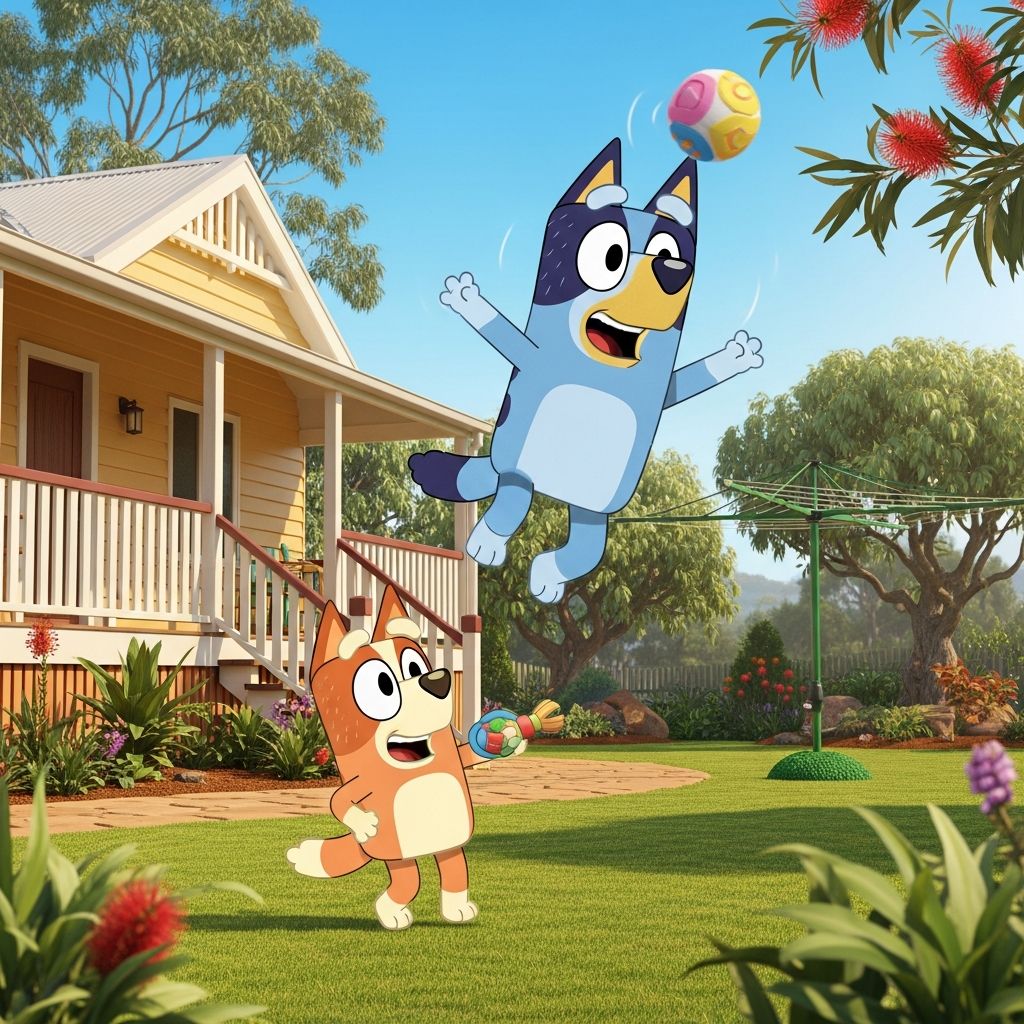
‘Bluey’ is a preschool animated series from Australia that follows a six-year-old Blue Heeler puppy whose boundless imagination turns ordinary family moments into elaborate games with her parents and younger sister, Bingo.[web:1][web:2] The show has become a global phenomenon because it treats play as serious emotional work and portrays parents as flawed, funny guides rather than perfect authorities.[web:1][web:4]
The Show That Made Play Feel Important
The basic premise of ‘Bluey’ is deceptively simple: a dog family living in a Brisbane-inspired suburb does school runs, visits the park, and manages bedtime, but nearly every situation turns into a game.[web:1][web:3] These playful setups turn day-to-day routines into small emotional adventures, allowing kids in the audience to see problem-solving, frustration, and joy played out in real time.[web:1][web:4]
- Episodes are short slices of family life, usually centered on a single game or imaginative scenario.[web:1]
- Bluey and Bingo lead the play, while their parents, Bandit and Chilli, frequently join in and adapt the rules.[web:1][web:2]
- Everyday activities like shopping, visiting the doctor, or riding in a taxi are reimagined as high-stakes adventures.[web:1][web:3]
Meet the Heeler Family
The heart of the series is the Heeler family: Bluey, Bingo, Bandit, and Chilli.[web:1][web:2] Their personalities are carefully designed to create playful friction and emotional learning without ever feeling preachy.
| Character | Role in Family | Key Traits |
|---|---|---|
| Bluey | Older sibling, six-then-seven-year-old Blue Heeler pup.[web:1][web:3] | Energetic, curious, assertive, often the “director” of games.[web:1] |
| Bingo | Younger sister, four-then-five-year-old.[web:1][web:3] | Gentler, imaginative, sometimes anxious, often negotiates rules rather than sets them.[web:1] |
| Bandit | Dad, an archaeologist.[web:1] | Goofy, patient, physically playful, often the target of roughhousing but also a thoughtful listener.[web:1][web:4] |
| Chilli | Mum, works part-time in airport security.[web:1] | Emotionally attuned, quietly funny, balances work, self-doubt, and caregiving.[web:1] |
Why Kids Connect So Deeply With ‘Bluey’
Children see their own inner world reflected in Bluey and Bingo’s games, which often start with a simple premise and spiral into complex make-believe rules.[web:1][web:2] The stories show kids dealing with losing, waiting, sharing, and facing disappointment through the low-stakes arena of pretend play.[web:1][web:4]
- Games act as emotional laboratories where siblings practice negotiation and resilience.
- Conflicts—such as wanting different rules, feeling left out, or struggling with patience—are resolved through play rather than lectures.[web:1]
- The short runtime keeps the focus tight, allowing one emotional concept per episode to land clearly for young viewers.[web:1][web:3]
How ‘Bluey’ Redefined TV Parents
One of the show’s most radical choices is its honest portrayal of parents who are loving but imperfect.[web:1][web:4] Bandit and Chilli get tired, misjudge situations, and sometimes need time to themselves, yet they consistently circle back with empathy and humor.[web:1][web:6]
- Bandit is frequently shown doing housework and caregiving, not as a joke but as an ordinary part of his role.[web:1]
- Chilli’s experiences of work-life balance and early motherhood anxieties appear in flashbacks that normalize parental vulnerability.[web:1]
- Both parents validate feelings; they name emotions and give space for sadness, frustration, or fear.[web:1][web:4]
Imaginative Games as Emotional Training
The creators designed ‘Bluey’ around the belief that play is essential for cognitive and emotional development, not just a way to pass time.[web:1] Many episodes show the girls inventing complex, evolving games that demand planning, compromise, and self-regulation.[web:1][web:3]
- Games routinely incorporate physical challenges, role reversals, and rule changes that require flexible thinking.
- Make-believe transforms mundane spaces—a trampoline, living room, or supermarket—into dynamic problem-solving arenas.[web:1]
- Children see that learning to wait, share, or lose gracefully happens through repetition, not single “teachable moments”.[web:1]
The Australian Spirit Behind the Stories
The series is distinctly Australian in tone and backdrop, drawing heavily on Brisbane’s climate, architecture, and natural surroundings.[web:1] Families encounter local wildlife such as fruit bats, wallabies, and native birds, and episodes nod to Australian sports like rugby league without leaning on stereotypes.[web:1][web:3]
- Bright, leafy streets and Queenslander-style homes ground the fantastical games in a strong sense of place.[web:1]
- Dry, understated humor gives adults a parallel track of enjoyment while children follow the main story.[web:1][web:4]
- Local cultural details are woven subtly into background gags, dialogue, and settings rather than explained overtly.[web:1]
A Show Designed for Co-Viewing
‘Bluey’ was built as a co-viewing experience, meaning it aims to engage both kids and their caregivers at the same time.[web:1] The writers treat each seven-minute episode like a tiny film, with emotional arcs and jokes that land differently depending on the viewer’s age.[web:1][web:4]
- Parents recognize their own daily struggles in scenes about bedtime, screen time, or trying to get out the door on schedule.
- Subtle adult humor, nostalgic references, and visual in-jokes keep grown-ups invested without alienating children.[web:4]
- This dual-layer approach encourages families to watch together, then re-enact or remix games in their own homes.
What Makes ‘Bluey’ Critically Acclaimed
The show has earned major awards, including national television prizes in Australia and international recognition such as an International Emmy Kids Award and a Peabody Award, reflecting its critical and cultural impact.[web:1] Reviewers praise its warm portrayal of family dynamics, deft balance of humor and heart, and its ability to speak to both preschoolers and adults.[web:1][web:4]
| Aspect | Why It Stands Out |
|---|---|
| Storytelling | Compact, emotionally resonant plots that center one clear theme per episode.[web:1] |
| Characterization | Parents and kids are written with complexity, humor, and vulnerability.[web:1][web:4] |
| Visual Style | Colorful, expressive animation with a distinct sense of place in Brisbane.[web:1] |
| Music & Sound | Playful scoring and sound design that amplify both comedy and emotional beats.[web:4] |
The Hidden Workload of Playful Parenting
Many parents watching ‘Bluey’ notice that saying “yes” to play often means postponing chores or stretching personal energy.[web:1][web:6] The series subtly acknowledges this cost; Bandit and Chilli are occasionally exhausted, distracted, or late, yet they keep returning to games because they see how much their kids thrive on connection.[web:1]
- The show offers parents a kind of permission slip: playful engagement matters more than spotless floors.
- By depicting small moments of frustration and repair, ‘Bluey’ normalizes the idea that good parenting is about effort and reconnection, not perfection.[web:1][web:4]
- Episodes show that even a few minutes of focused, silly play can reset a tense afternoon.
How Families Can Bring ‘Bluey-Style’ Play Home
Parents do not need elaborate toys or scripted dialogue to adapt the spirit of ‘Bluey’ into their own homes.[web:1][web:2] The key ingredients are attention, willingness to look a bit ridiculous, and openness to following the child’s lead.
- Start with the mundane: Turn tasks like laundry sorting, grocery unpacking, or tidying toys into simple games of pretend roles or timed challenges.
- Use house rules lightly: Let kids suggest “what happens next” and adjust the game’s rules as a way to practice flexibility.
- Lean into physical silliness: Safe rough-and-tumble play—like gentle wrestling or “climbing parent mountain”—can help kids burn energy and learn body boundaries.
- End with a beat: When time is up, close the game with a clear ritual (a high-five, a silly song, or a “to be continued”) so kids know it can return later.
The Global Ripple Effect of a Local Show
From its debut in 2018 on Australian television to its international rollout on channels and streaming platforms, ‘Bluey’ has grown from a local production to a worldwide franchise.[web:1][web:2] The brand now extends into merchandise, live experiences, and an announced feature film project planned for the later 2020s, reflecting enduring audience enthusiasm.[web:1]
- Families across different cultures see their own routines echoed in the Heeler family’s everyday adventures, even when local details differ.[web:1][web:4]
- Its success has sparked broader discussion about the value of emotionally intelligent children’s TV and the visibility of engaged father figures on screen.[web:1][web:6]
- As new content and live shows appear, the core appeal remains the same: simple games that reveal complex feelings.[web:1][web:7]
Frequently Asked Questions About ‘Bluey’
Is ‘Bluey’ really for adults too?
Yes. While ‘Bluey’ targets preschoolers, its humor, emotional nuance, and honest portrayal of parenting are intentionally designed to keep adults engaged as co-viewers.[web:1][web:4] Many parents report watching episodes alone for comfort, reflection, or a quick laugh.
What age group is ‘Bluey’ best for?
The intended audience is primarily children in the preschool range, roughly ages two to six, though older siblings and adults often enjoy it as well.[web:1][web:2] The short runtime and clear storylines make it especially accessible to younger viewers with limited attention spans.
Is the show educational?
‘Educational’ in this context does not mean direct instruction in letters or numbers, but emotional, social, and imaginative learning.[web:1][web:4] Episodes model skills like sharing, empathy, patience, coping with disappointment, and creative problem-solving through play.
Why do critics talk so much about Bandit?
Bandit is often highlighted because he breaks from older media stereotypes of distant or bumbling fathers by being actively involved, affectionate, and playful while still making mistakes.[web:1][web:4] His character has prompted conversations about modern fatherhood, domestic labor, and the value of dads engaging fully with their kids.
Will there be more ‘Bluey’ in the future?
The series has continued to release new episodes and specials, and a feature film is in development with a target release later in the decade, indicating that the franchise is far from finished.[web:1] Additional live experiences and adaptations, including theme park entertainment, are also expanding its presence in family culture.[web:7]
Why ‘Bluey’ Matters Right Now
In an era when parents juggle work, digital distractions, and rising anxiety about “doing it right,” ‘Bluey’ offers a small but powerful reframe: daily connection often looks like getting down on the floor and being a bit silly.[web:1][web:4] The show’s success suggests that what families crave most from media is not perfection or instruction, but recognition—of messiness, of love, and of the magic hidden in ordinary afternoons.