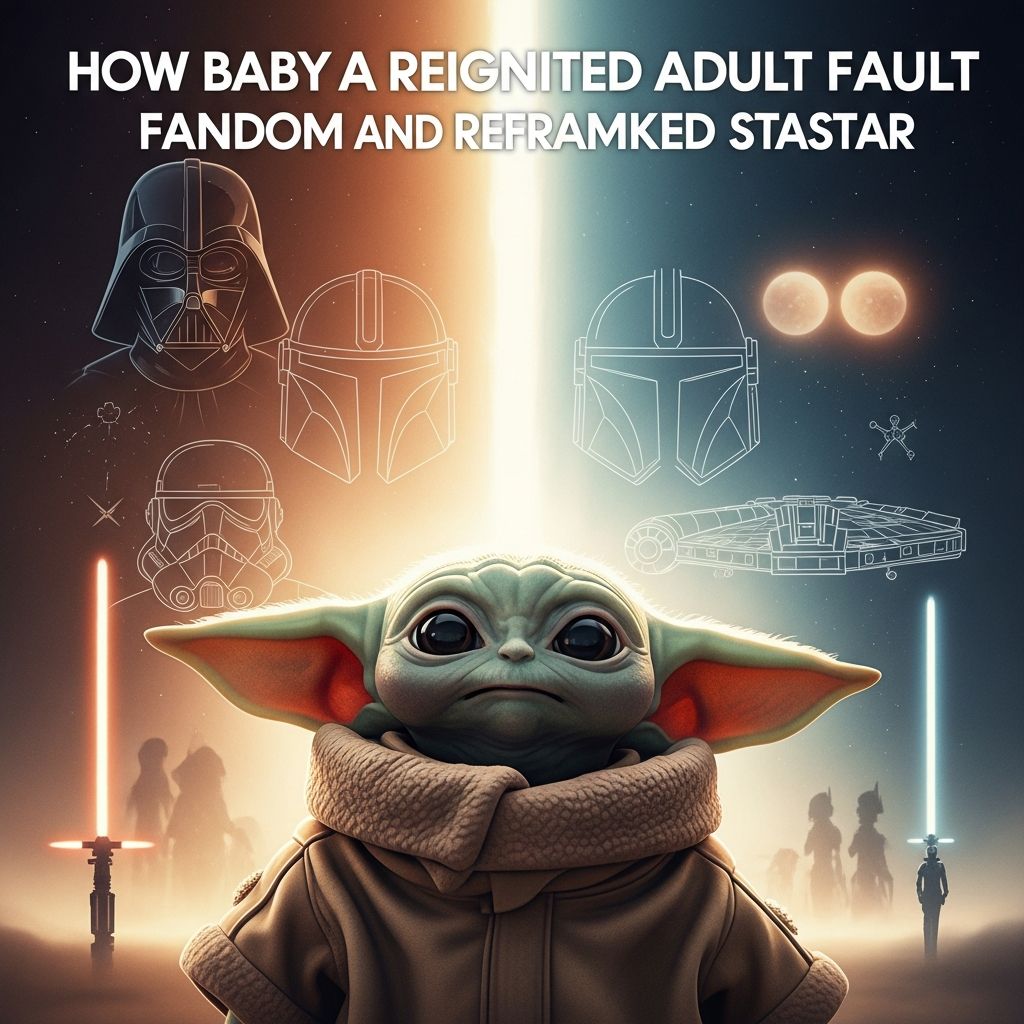
When The Mandalorian debuted, no one expected a tiny green child to become the emotional center of modern Star Wars, yet Baby Yoda — later named Grogu — did exactly that for millions of adults. More than a cute character, he became a mirror for grown-up responsibilities, vulnerabilities, and hopes inside a galaxy far, far away.
For adults juggling work, family, and the weight of an uncertain world, Baby Yoda offered a rare combination of comfort, moral clarity, and imaginative escape. He reenergized a forty-year-old franchise not by being powerful, but by being small, dependent, and deeply loved.
The Unexpected Appeal of a Tiny Alien
On the surface, Baby Yoda’s appeal seems simple: big eyes, oversized ears, and a wobbling walk designed to trigger every protective instinct. Beneath that surface, though, adults responded to something more profound — a character that needs care in a universe better known for war and rebellion.
- He slows the pace of a traditionally action-driven saga, forcing hardened characters to stop and protect rather than attack.
- He reintroduces wonder into a franchise that had increasingly focused on politics, legacy, and lore.
- He embodies vulnerability, a trait many adults suppress in everyday life but secretly crave to acknowledge.
How Baby Yoda Turned a Western Into a Parenting Story
The Mandalorian begins as a stylized space Western about a lone bounty hunter trying to survive in the post-Empire chaos. Once Baby Yoda appears, the story pivots into something far more intimate: a reluctant guardian figuring out what it means to become responsible for another life.
For many adult viewers, this shift feels familiar. Career goals, personal freedom, and old identities collide with late-night feedings, school runs, and the overwhelming urge to keep a child safe in a messy world. The show covertly transforms gunfights and starships into metaphors for custody battles, adoption, and chosen family.
Din Djarin as the Hesitant, Modern Parent
Din Djarin, the armored Mandalorian, is the perfect stand-in for adults who never planned on becoming caregivers but learned to love it anyway. His life begins with rules: never remove the helmet, follow the bounty, finish the job. Baby Yoda shatters those rules one by one.
- He breaks professional codes when the “target” stops being an object and becomes a child.
- He sacrifices money, status, and security to protect someone who can give nothing back except trust.
- He learns to define himself not by his armor, but by his relationships.
Adults see in Din the emotional math they perform daily: choosing between career advancement and time with children, between strict principles and compassion for the vulnerable people depending on them.
Nostalgia: When Childhood Meets a New Generation
For many older fans, Star Wars was a childhood touchstone: bedtime VHS tapes, plastic lightsabers, and arguments over who got to be Luke or Leia in backyard battles. Baby Yoda bridges that original sense of wonder with a new era, allowing adults to share something they loved with their own kids.
Suddenly, parents were not only explaining the Force but also debating bedtimes around new Mandalorian episodes. The character became a shared cultural anchor: a safe, adorable entry point for children and a warm nostalgic echo for grown-ups who remember the first time they saw Yoda lift an X-wing.
Comfort in an Age of Uncertainty
Baby Yoda’s rise coincided with a period of global anxiety, political division, and technological overload. Many adults found themselves exhausted by relentless news cycles and algorithm-driven outrage. Into that landscape stepped a character whose biggest concerns were snacks, naps, and staying close to his protector.
- He represents the fantasy of problems that can be solved by simply picking someone up and holding them.
- His presence softens even brutal scenes, reminding viewers there is still innocence worth protecting.
- For stressed adults, watching him coo, sip, and explore became a small ritual of emotional reset.
The Economics of Cuteness: How Adults Fueled a Merchandising Wave
No exploration of Baby Yoda’s impact is complete without acknowledging the avalanche of merchandise that followed his reveal. Plush toys, mugs, backpacks, novelty kitchenware, and office desk figures turned adult spaces — cubicles, home offices, even boardrooms — into quiet shrines to a fictional alien child.
Unlike many character-driven merchandise booms aimed primarily at kids, this wave targeted adults with disposable income and deep emotional ties to the brand. Office workers displayed him next to spreadsheets, healthcare workers clipped him to badge reels, and remote employees placed him in the background of video calls as a silent protest against burnout.
Where Adults Display Baby Yoda Most Often
| Location | Typical Item | Emotional Role |
|---|---|---|
| Work desk or cubicle | Small figurine or mug | Micro-escape from stress; conversation starter with coworkers |
| Home office | Plush toy or framed art | Blend of professionalism and fandom; reminder of personal identity |
| Living room | Throw blanket or pillow | Signal of family-friendly fandom; shared symbol of comfort |
| Car | Dashboard figurine or hanging charm | Travel companion; playful guard of the commute |
| Kitchen | Cups, cookie jars, or magnets | Casual, daily reminder of joy during routine chores |
The Force, Reimagined Through a Child
Baby Yoda reintroduces the Force not as a weapon or destiny marker, but as something mysterious and occasionally clumsy. Adults watch him reach out with tiny fingers and struggle with powers he can’t fully control, echoing the way children grapple with emotions they don’t yet understand.
This reframing shifts the Force away from purely epic showdowns and toward emotional stakes. The question becomes not just whether he will be powerful, but whether he will grow up surrounded by people who teach him empathy, responsibility, and restraint.
Redefining Masculinity in a Helmet
Din Djarin’s journey with Baby Yoda quietly updates the idea of what a male hero can look like in genre storytelling. Earlier Star Wars eras often equated heroism with combat skill, stoicism, and sacrifice on a battlefield. The Mandalorian does something different: it makes diaper-adjacent duties and emotional protection just as heroic as winning a blaster duel.
- Scenes of feeding, cradling, or playing sit side by side with firefights without undercutting his toughness.
- The character’s growth is measured not only in victories, but in how willing he is to be vulnerable for someone else.
- Adult male viewers see a path where affection, tenderness, and protective care enhance, rather than diminish, strength.
Why Adults Bond So Strongly With Fictional Children
Psychologically, Baby Yoda activates two major forces at once: nostalgia for viewers’ own childhoods and parental instincts toward his helplessness. Adults who grew up on Star Wars now occupy the cultural role once held by their parents, and Grogu compresses that transition into a single character.
He is simultaneously the child they once were — staring up at impossible spaceships — and the child they now protect, whether literally as parents or metaphorically through mentoring, teaching, or caregiving roles. That duality makes him feel intimately personal even though he is entirely fictional.
From Lone Wolf to Found Family
Star Wars has always traded in found families, from the original trio to later ensembles. Baby Yoda intensifies this theme by making the central bond not between peers, but between guardian and child. Adults recognize in this relationship the reality that family is often built through choice rather than blood alone.
- The Mandalorian gradually chooses commitment over detachment, echoing real-world shifts from self-focused independence to long-term care for others.
- Allies gather not only because of shared goals, but because a child’s safety matters more than any single mission.
- This structure validates the experiences of adoptive parents, step-parents, foster families, and anyone building unconventional support systems.
What Baby Yoda Signals for the Future of Star Wars
Baby Yoda’s popularity sends a clear message about what modern audiences, especially adults, want from sprawling franchises: more intimacy, clearer emotional stakes, and character-driven storytelling that balances spectacle with everyday tenderness. Big space battles still matter, but they feel empty without a small face to lose.
His continued presence creates narrative opportunities: exploring how a child grows under the shadow of galactic history, what it means to straddle different cultures, and how power shaped from infancy can be guided toward healing rather than domination. For adults, watching that journey unfold is less about lore and more about hope.
How Adults Can Engage With Baby Yoda Fandom in Healthy Ways
Loving a fictional character deeply can sometimes feel embarrassing for adults who were taught to separate play from maturity. Yet embracing Baby Yoda can actually be a way to reconnect with imagination, community, and emotional openness.
- Use fandom as a bridge: Share episodes or toys with children, nieces, nephews, or students to spark conversations about empathy and protection.
- Decorate intentionally: Place one or two meaningful items in your workspace as subtle reminders of rest and creativity.
- Create instead of only consuming: Write fan fiction, sketch scenes, or craft DIY projects that transform passive viewing into active artistry.
- Set boundaries: Enjoy collectibles and streaming without letting constant purchasing or binge-watching become another source of stress.
FAQs About Baby Yoda and Adult Fans
Is it strange for adults to be so attached to Baby Yoda?
No. Adults have always found comfort in fictional characters, from classic literature to modern superheroes. Baby Yoda simply concentrates that attachment into an especially nurturing form, tapping into protective and nostalgic instincts at the same time. In an era of constant pressure, having a harmless symbol of warmth and innocence is not childish; it is a way of remaining emotionally responsive.
Why did Baby Yoda become more popular than many human characters?
His design is universal and language-independent; even without dialogue, viewers understand his needs and emotions. At the same time, his relationship with the Mandalorian produces clear, easily readable stakes — if the child is safe, the story feels hopeful. That simplicity cuts through franchise fatigue and invites even casual or lapsed fans back into the universe.
Does Baby Yoda change how Star Wars handles the Force?
Yes, in a subtle way. Instead of presenting the Force only as a tool for warriors and sages, his clumsy, exhausting use of it turns it into something more like childhood talent: powerful but vulnerable to the environment in which it is nurtured. This invites stories that focus on teaching, caregiving, and ethics rather than just combat techniques.
What makes Baby Yoda especially meaningful to parents?
Parents see their own daily experiences reflected in moments of feeding, rescuing, and soothing, but with the volume turned up through science-fiction stakes. The Mandalorian’s sacrifices echo real choices about time, safety, and identity that caregivers make constantly. Watching those decisions play out in a galaxy far, far away can make their own struggles feel seen and validated.
Can non-parents relate to Baby Yoda’s story in the same way?
Absolutely. Anyone who has ever mentored, coached, taught, or supported someone more vulnerable can recognize their experiences in the show’s central bond. The heart of the story is not biology, but the decision to protect another being and accept that responsibility as part of one’s identity.
Closing Thoughts: A Small Child, A Big Shift
Baby Yoda may be one of the smallest characters in Star Wars, but his impact on adult audiences is enormous. He reframes heroism as care, masculinity as tenderness, and galactic conflict as the backdrop to a simple, powerful truth: protecting the vulnerable is the most meaningful mission of all.
In doing so, he offers grown-ups permission to feel deeply about fiction again — to buy the plush toy, to tear up at quiet scenes, and to remember that even in the most complicated lives, there is still room for wonder cradled in the crook of an armored arm.