Many parents start to worry when their toddler turns two and still doesn’t have many words, or no words at all. It can be unsettling to compare your child to talkative peers and wonder whether something is wrong. Yet language development is complex, and late talking does not automatically mean a serious problem.
This article explains what is generally expected around age two, what might contribute to slower speech, which signs deserve prompt evaluation, and how to gently support your child’s communication every day. The goal is to replace anxiety with information, and pressure with connection.
Understanding Early Language: More Than Just Words
Speech is only one piece of communication. Long before children say clear words, they are already learning how conversations work through eye contact, gestures, sounds, and play. A toddler who is quiet but engaged, curious, and responsive is communicating in important ways, even if words are slow to appear.
When thinking about your child’s development, it helps to notice the whole communication picture rather than counting words alone. A child may be progressing in other areas – like social skills and understanding language – while expressive speech lags behind.
What Is Typical Around Age Two?
Every child develops at their own pace, but researchers and clinicians use general ranges to describe common patterns. Around their second birthday, many children:
- Use simple two-word combinations such as “more water” or “mommy up.”
- Have a spoken vocabulary of roughly several dozen words or more, even if many are unclear.
- Understand far more than they can say, following simple directions like “Get your shoes” or “Put it on the table.”
- Use a mix of gestures (pointing, nodding, shaking head) along with sounds and words.
- Are understood by familiar adults some of the time, while strangers may struggle.
Some children reach these markers a little earlier, others a bit later. When a 2-year-old is communicating in a variety of ways but hasn’t yet caught up with typical speech expectations, this is often called being a “late talker.” Many late talkers go on to use language effectively later in childhood.
Late Talker or Language Delay?
“Late talker” is an informal term often used for young children who are otherwise developing as expected but are slower to start using spoken words. A language delay, on the other hand, describes a broader pattern of difficulty that may involve understanding language, forming sentences, or using speech clearly.
Distinguishing between a harmless variation and a more significant delay usually requires a professional evaluation. However, parents can watch for patterns that may hint at which category better fits their child’s situation.
Common Features of Late Talkers
- Good eye contact and enjoyment of social interaction.
- Frequent use of gestures, such as pointing, waving, and showing objects.
- Clear understanding of everyday instructions and routines.
- Steady progress in motor skills and play skills, such as stacking, pretending, and exploring.
- Slow but noticeable gains in new sounds, syllables, or attempts at words.
Possible Signs of a Broader Delay
- Limited response to name or difficulty following simple directions.
- Very few gestures, limited eye contact, or little interest in social interaction.
- Loss of words or social skills that were present before.
- Unusual speech patterns, such as a flat or sing-song tone repeated in the same way.
- Delays in other areas, including motor skills, play, or self-help abilities.
These signs do not diagnose any specific condition, but they are strong reasons to seek a developmental and speech-language evaluation promptly.
Possible Reasons a 2-Year-Old Is Not Talking
There is rarely a single explanation for late talking. Sometimes no clear cause is identified. Other times, one or more of the following factors may play a role:
- Individual developmental pace: Some children simply take longer to start talking, while progressing well in other domains.
- Family patterns: Late talking can run in families; parents or siblings may have talked later without long-term issues.
- Hearing difficulties: Frequent ear infections or unrecognized hearing loss can limit how clearly a child perceives language.
- Limited language exposure: Fewer opportunities for back-and-forth conversation or too much passive screen time can slow language learning.
- Speech sound challenges: Some children know what they want to say but struggle to coordinate the mouth movements needed for clear speech.
- Neurodevelopmental differences: Conditions such as autism, developmental language disorder, or broader cognitive delays may affect communication.
Parents do not cause speech delays by being imperfect. Blame is not helpful; what matters is noticing difficulties and responding with support and resources.
Red Flags That Deserve Prompt Attention
While many late talkers catch up over time, certain signs indicate that a child should be evaluated without delay. Trust your instincts; if you are concerned, it is reasonable to seek guidance even if others tell you to “wait and see.”
| Area | Possible Red Flag |
|---|---|
| Spoken language | Very few or no meaningful words; no attempt to combine sounds or words. |
| Understanding | Rarely follows simple directions like “come here” or “give it to me,” even with gestures. |
| Social engagement | Limited eye contact, little interest in sharing experiences, or lack of response to name. |
| Gestures | Hardly ever points, waves, reaches to be picked up, or shows objects to caregivers. |
| Regression | Loss of words, babbling, or social skills that were present earlier. |
If any of these apply, a hearing test and referral to a speech-language professional or early intervention service can offer clarity and guidance. Early support tends to be more effective and less intensive than waiting until school age.
Why Early Support Matters
Language skills are deeply connected to emotional regulation, learning, and relationships. When toddlers struggle to express themselves, frustration can lead to more tantrums, clinginess, or withdrawal. Supporting communication can ease daily struggles and build confidence.
Early help does not label a child; it simply offers tools and strategies during a period of rapid brain development. Even if your toddler later “catches up,” the extra support can make those early years smoother for the whole family.
What Professionals May Do in an Evaluation
A developmental or speech-language evaluation for a 2-year-old is usually playful and low-pressure. Professionals observe how your child communicates, plays, explores, and responds to people and sounds. They also ask about your child’s birth history, health, and daily routines.
Common elements may include:
- A hearing assessment to rule out hearing loss or chronic ear problems.
- Standardized checklists or games to gauge understanding and use of language.
- Observation of gestures, eye contact, imitation, and play skills.
- Discussion of strengths, areas of concern, and next steps, which may include therapy, home strategies, or periodic monitoring.
The outcome is not just a label; it is a roadmap for how to support your child’s growth in the months and years ahead.
How Parents Can Support Speech at Home
Regardless of whether your child has a formal delay, everyday interactions at home greatly influence language development. The most powerful tools are simple: time, attention, and responsive conversation woven into daily routines.
Turn Everyday Moments Into Language Opportunities
- Slow down and narrate: Describe what you and your child are doing in short, clear phrases: “Wash hands,” “Blue truck,” “All done.”
- Follow their lead: Talk about what your toddler is looking at or playing with, rather than directing them to your own topic.
- Use repetition with variation: Repeat key words multiple times in natural ways: “Ball. Big ball. Rolling ball. Ball up.”
- Build on their attempts: If your child says “car,” you can expand to “red car” or “fast car,” modeling the next step up.
Encourage Gestures and Imitation
- Model simple gestures like waving, clapping, and pointing while saying the related words.
- Play imitation games: make silly sounds, faces, or actions and invite your child to copy you.
- Celebrate any attempt at communication, whether it is a sound, sign, or partial word.
Limit Passive Screen Time
Young children learn language most effectively through face-to-face interaction, not from screens. Occasional, high-quality content watched together can be fine, but long periods of solo screen use replace valuable time that could be spent in conversation, play, and exploration.
When screens are used, turn them into a shared activity. Comment on what you see, ask simple questions, and connect the on-screen content to real-life experiences.
Play-Based Activities to Spark Language
Play is the natural language of toddlers. Structured, drill-like practice is often less effective – and far less enjoyable – than playful, shared experiences. Here are some ideas you can adapt to your child’s interests:
1. Everyday Routines as “Talking Time”
- Meal times: Label foods, utensils, and actions: “apple,” “spoon,” “cut,” “drink.” Offer simple choices like “banana or apple?”
- Bath time: Talk about wet/dry, hot/cold, in/out, and body parts as you wash and pour water.
- Getting dressed: Name clothing items and colors, and use simple phrases like “shirt on,” “pants off.”
2. Toy Play With Simple Language Goals
- Cars and trucks: Emphasize sound effects (“vroom,” “beep”), simple verbs (“go,” “stop,” “crash”), and location words (“up,” “down,” “in”).
- Blocks: Use words like “more,” “high,” “fall,” and “again” as you build and knock towers down.
- Animals or dolls: Practice animal sounds, body parts, and everyday routines such as feeding or sleeping.
3. Books and Songs – Even Without Words
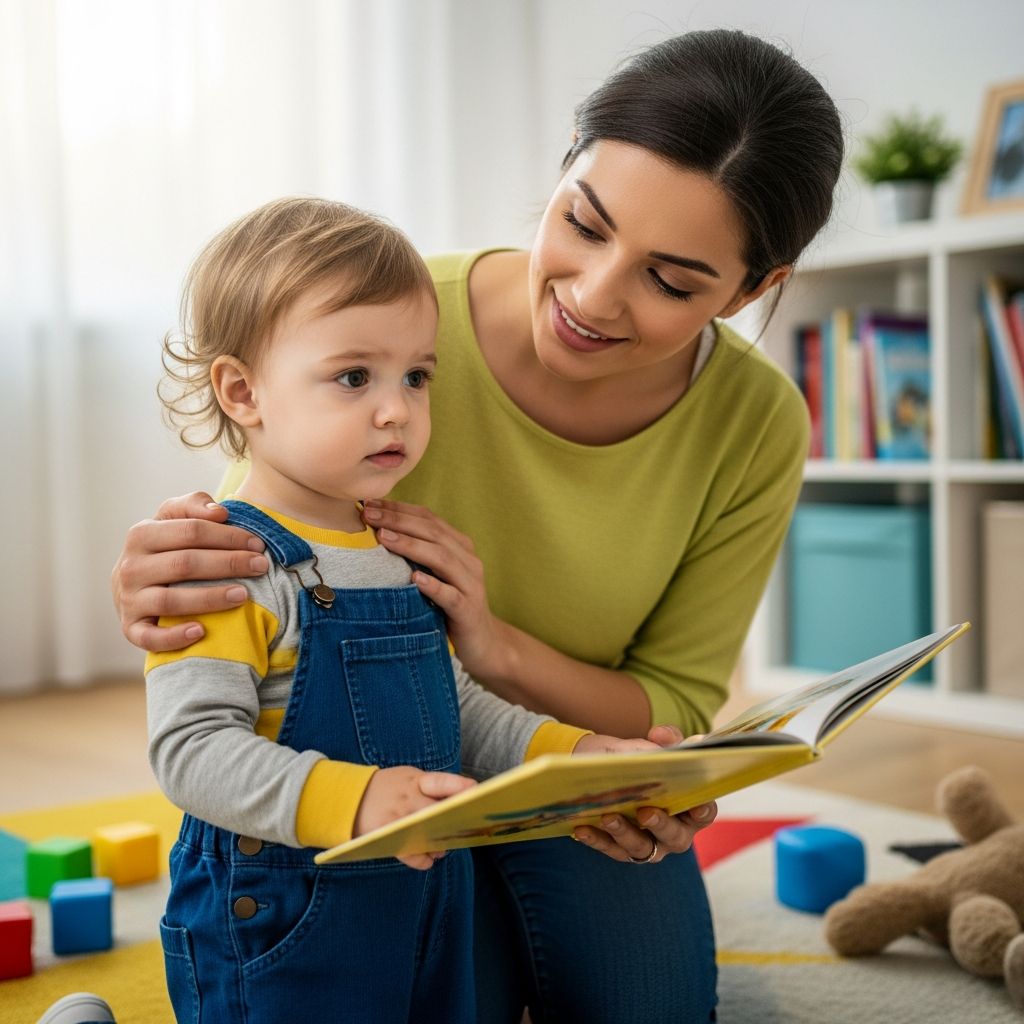
- Choose sturdy board books with clear pictures and few words; talk about the pictures instead of reading every line.
- Pause before turning a page to give your child a chance to point, vocalize, or gesture.
- Use simple, repetitive songs and rhymes, pausing at key moments to let your child fill in a sound, gesture, or final word.
Helping Your Child Without Adding Pressure
Anxious adults sometimes unintentionally create performance pressure around talking. Constantly asking a toddler to “say this” or “repeat that” can make communication feel like a test instead of a relationship. Children learn best when they feel safe, connected, and free to experiment.
- Focus on shared enjoyment rather than counting words.
- Offer invitations (“Your turn,” “Want more?”) instead of demands (“Say it!”).
- Respond warmly to all communication attempts, even if they are not clear words.
- Protect unhurried time together without multitasking or distractions.
Looking After Your Own Feelings
Worry about a child’s development can be intense, especially when other parents’ stories or social media posts amplify comparison. It is normal to feel fear, guilt, or frustration while navigating uncertainty.
Seeking support for yourself is just as important as seeking support for your child. Talking with trusted friends, family, or a counselor, or joining parent groups focused on development, can provide reassurance and practical ideas. Calm, emotionally available caregivers offer the best learning environment for toddlers.
Frequently Asked Questions
Is it always a problem if a 2-year-old isn’t talking yet?
Not always. Some children are late talkers who eventually use language well without intensive intervention. However, because it can be hard to predict which children will catch up and which may need ongoing support, it is wise to bring concerns to a pediatrician or speech-language professional rather than simply waiting.
Can learning more than one language cause a speech delay?
Growing up with more than one language does not inherently cause a disorder. Bilingual children may mix languages or show a different pattern of vocabulary distribution across languages, but they generally achieve key milestones within typical ranges. If a delay is present, it tends to appear in all languages, not just one.
What if my toddler understands everything but doesn’t speak?
A child who clearly understands language but uses few or no words may have an expressive language delay or may be a late talker. This pattern still deserves attention, as early support can help prevent frustration and ease the transition to more complex language later.
When should I request a speech evaluation?
Any time you feel uneasy about your child’s communication, you are justified in seeking an evaluation. Clear reasons to act include very limited words by age two, poor response to name or simple instructions, lack of gestures or eye contact, or loss of previously gained skills.
Does starting therapy mean something is “wrong” with my child?
Starting therapy does not define your child’s worth or potential. It is simply a way to provide extra support during a window of rapid growth. Many children attend a short period of speech-language therapy, gain skills and strategies, and then no longer require services.
Key Takeaways for Worried Parents
- Speech is only one part of communication; watch how your toddler connects, plays, and understands as well as how they talk.
- Some 2-year-olds are late talkers who simply need time and rich language exposure, while others benefit from early professional support.
- Red flags such as lack of response, limited gestures, or regression deserve prompt evaluation.
- Everyday routines, playful interaction, and reduced pressure create a powerful foundation for language growth.
- Supporting yourself emotionally helps you show up as the calm, responsive presence your child needs most.
Your child’s speech timeline does not define your success as a parent or your child’s future potential. With information, connection, and, when needed, professional guidance, you can navigate this season thoughtfully and lovingly.