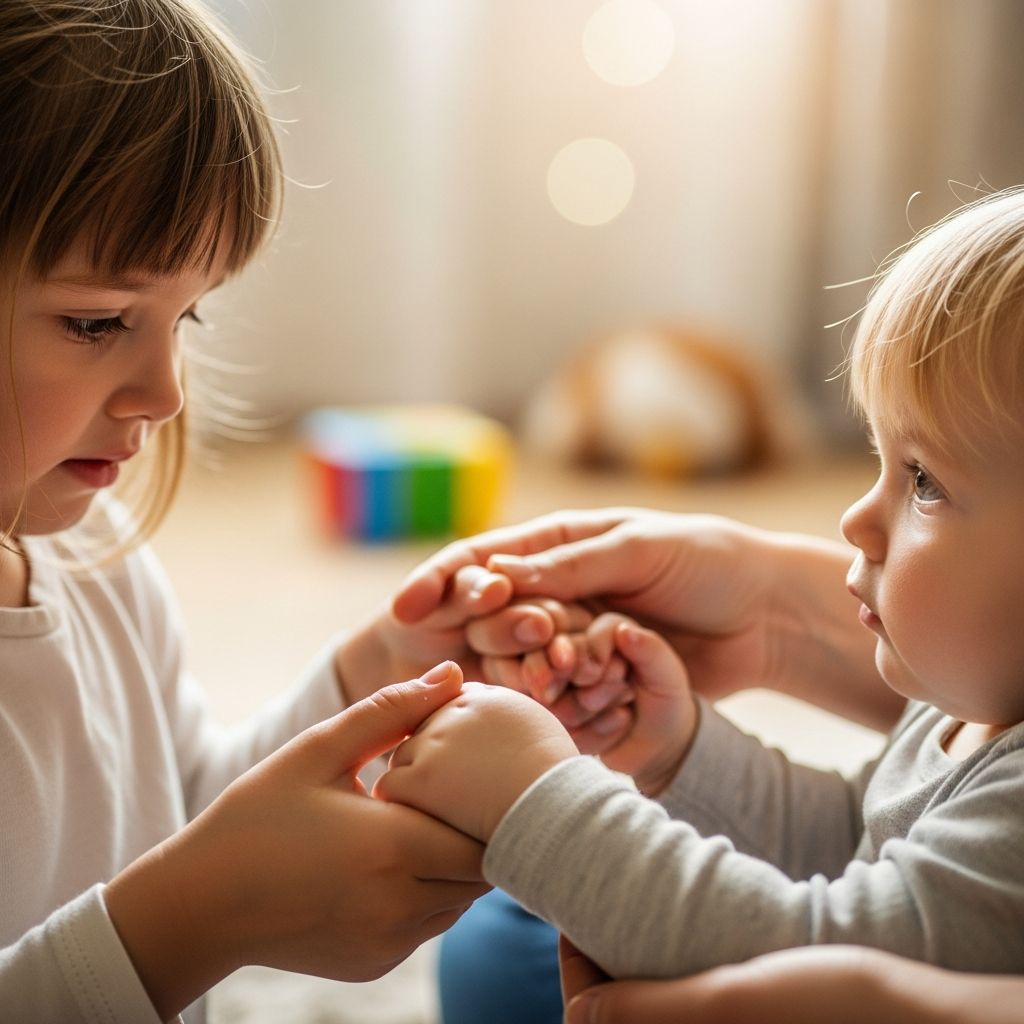
Many parents are shocked the first time their sweet 3-year-old hits a baby or younger sibling. It can feel scary, embarrassing, and confusing, especially when the older child “knows better” and has often been loving and gentle. This guide explains what is happening inside your child, what you can do in the heat of the moment, and how to reduce hitting over time without yelling, shame, or harsh consequences.
Why Three-Year-Olds Hit Younger Siblings
A three-year-old is still very young, even if they seem big next to a baby. At this age, children are driven by impulses and emotions far more than by logic or empathy. Understanding why hitting happens makes it easier to respond calmly instead of taking it personally.
- Emotional brain in charge: A 3-year-old’s ability to pause, think ahead, and control impulses is still limited, especially when tired, hungry, or overwhelmed.
- Big feelings about a small sibling: A younger child can stir up jealousy, fear of losing a parent’s love, or frustration about new limits and routines.
- Limited language skills: When a child cannot explain what they feel or need, their body often speaks for them through hitting, pushing, or grabbing.
- Curiosity and cause-and-effect: Some children experiment: “What happens when I hit? Does Mom run over? Does the baby cry? Do I get attention?”
Seeing hitting as a signal, not a moral failure, helps you step into a coaching role instead of a policing role. Your child is not trying to be “bad”; they are showing you they do not yet have better tools.
Common Triggers Behind Hitting
Not all hitting comes from the same place. Looking at what happens right before your child lashes out can reveal patterns and triggers you can work with.
Typical Triggers
- Jealousy and rivalry: The 3-year-old sees you holding, feeding, or praising the younger sibling and feels pushed aside.
- Protecting possessions: The baby or toddler grabs the older child’s toy, knocks over a structure, or crawls into their play.
- Overstimulation: Noise, crowds, transitions, or a long day without downtime can push a child past their coping limit.
- Attention-seeking: A child who feels invisible may discover that hitting instantly brings a parent running.
- Copying adult behavior: If a child often sees yelling, rough handling, or siblings pushing each other, they may mimic that.
- Exhaustion or hunger: A tired, hungry child has far less self-control and patience around a sibling.
Once you see the patterns, you can plan ahead: schedule food and rest earlier, protect special toys, or offer extra connection before predictable problem times, such as right before dinner or bedtime.
Immediate Response: What To Do the Moment Hitting Happens
In the heat of the moment, safety is the top priority. You can be firm and clear without being harsh. Your tone and body language teach as much as your words do.
Step-by-Step Response Plan
- Move quickly and calmly. Step between the children or gently move the older child away. Avoid yelling if possible; a loud, panicked reaction can add fuel to the emotional fire.
- Protect the younger child. Comfort and check for injuries first. This shows both children that safety is nonnegotiable.
- Set a clear limit. Use a brief, firm statement such as: “I won’t let you hit your sister. Hitting hurts.”
- Hold space for feelings. Expect crying, protesting, or tantrums. You can calmly say: “You’re really upset. I’m right here. You can be mad, but you may not hurt.”
- Delay lectures. Detailed explanations tend to go over a 3-year-old’s head while they are upset. Save teaching for when everyone is calm.
This approach sends a powerful message: all feelings are allowed, but not all actions are. The child learns that you will keep everyone safe and that you can handle strong emotions.
After the Storm: Gentle Teaching Moments
Once everyone is calm, your child is more open to learning new skills. Think of this phase as quiet coaching: you are helping your 3-year-old build a tiny emotional toolkit they can use next time instead of hitting.
Simple Scripts to Use
Keep your language short, concrete, and repetitive. Over time, children begin to repeat your words to themselves.
- Describe the situation: “You wanted the toy, and your brother had it, so you hit.”
- Reinforce the limit: “Your hands are for helping and playing, not for hurting.”
- Offer an alternative: “Next time, you can say: ‘My turn, please,’ or ask me for help.”
- Invite repair: “What can we do to help your sister feel better?” (A hug, apology, or bringing a toy are all options.)
Consistency is crucial. You may feel like you are repeating yourself endlessly, but repetition is how young children learn and internalize new behaviors.
Preventing Hitting Through Connection and Routine
Prevention does not mean you can completely eliminate hitting, but you can lower the overall level of stress and reactivity in the household. A connected child with predictable routines usually has fewer explosive episodes.
Daily Connection Rituals
- One-on-one “special time”: Even 10–15 minutes a day where you fully focus on the 3-year-old signals, “You still matter deeply.” Let them choose the activity.
- Warm transitions: Before you shift focus to the baby (feeding, diaper change), give the older child a quick cuddle or a playful ritual so they feel included rather than replaced.
- Physical affection: Hugs, lap time, wrestling games, or silly dancing release tension and meet a child’s need for closeness.
Connection does not mean letting your child be in charge or ignoring limits. It means filling their emotional tank so they are less likely to explode when small frustrations arise.
Structures and Routines That Help
| Area of Life | Helpful Routine | How It Reduces Hitting |
|---|---|---|
| Morning | Brief snuggle or play with the older child before caring for the baby. | Reassures the child that they are still important, easing jealousy. |
| Playtime | Set up a protected space for the older child’s special toys and projects. | Prevents frustration when the younger sibling knocks things over. |
| Meals and Snacks | Regular snack schedule; involve the 3-year-old in simple helper jobs. | Reduces hunger-related meltdowns and gives a sense of contribution. |
| Nap / Quiet Time | Daily quiet break with books, music, or rest, even if they no longer nap. | Lowers overall stress and reactivity in the afternoon. |
| Bedtime | Predictable routine with stories and cuddles for the older child. | Strengthens connection and allows processing of the day’s feelings. |
Teaching Healthy Ways to Express Anger
A 3-year-old needs concrete, physical alternatives to hitting. Simply telling them to “be nice” is not enough. Show them what they can do when big feelings hit.
Practical, Kid-Friendly Alternatives
- Words to use: Practice phrases such as “Stop!”, “My turn!”, “I don’t like that!”, and “Help, please!” through role-play games.
- Safe outlets: Offer a pillow to hit, playdough to squeeze, or a “stomping spot” where they can stomp out anger.
- Calming tools: Teach simple techniques like taking three deep breaths, blowing an imaginary candle, or hugging a stuffed animal.
- Problem-solving with you: Invite your child to brainstorm: “Next time you’re mad at your brother, what could you do instead of hitting?”
Make practice playful. Children remember games far more than lectures. You can act out silly scenarios with toys and let your child correct the toy that keeps “forgetting” not to hit.
Supporting the Younger Sibling
The younger child also needs protection and emotional support. At the same time, you want to avoid creating fixed roles of “aggressor” and “victim” that children grow into over time.
How to Support Without Labeling
- Comfort first: Pick up or sit with the younger child, name their feelings, and help them feel safe again.
- Avoid shaming labels: Stay away from phrases like “Your brother is so mean” or “You always hurt the baby,” which can cement unhelpful identities.
- Model boundaries for both: Show the younger child they can say “No” or move away, and show the older child how to respect those signals.
- Reinforce positive moments: Notice and comment when they play side by side peacefully or when the older child is gentle or helpful.
By balancing protection with respect for both children, you lay the foundation for a more equal, respectful sibling relationship over time.
When Parents Lose Their Cool
Even the calmest parent will eventually yell, threaten, or react harshly in a stressful moment. That does not mean you have failed; it means you are human. Repair is more important than perfection.
Repairing with Your Child
- Acknowledge your part: “I shouted earlier. That must have felt scary.”
- Share your intention: “My job is to keep everyone safe, and I’m working on staying calm when I’m mad.”
- Reaffirm the limit: “Hitting is still not okay, and I’ll help you find better ways when you’re angry.”
When you model taking responsibility for your own behavior, your child learns to do the same. You are teaching emotional skills by example, not just by words.
Realistic Expectations: Progress, Not Perfection
Parents often want a single strategy that makes hitting disappear overnight. In reality, change is gradual. As your child’s brain matures and you continue to guide them, hitting usually becomes less frequent and less intense.
What Progress Looks Like
- Hitting still happens, but less often or with less force.
- Your child pauses more often, sometimes using words instead of hands.
- They begin to repair on their own, offering an apology or a toy without your prompt.
- You notice you can stay calm more of the time and recover faster when you do lose it.
Every small step toward more self-control and empathy counts. Celebrate the wins, even if you are still in the messy middle.
Frequently Asked Questions (FAQs)
1. Should I punish my 3-year-old for hitting?
Firm limits are important, but harsh punishments often backfire at this age. Timeouts, yelling, or threats can increase fear and resentment, which fuels more misbehavior later. A more effective approach is to stop the behavior immediately, protect the younger child, and then coach your 3-year-old toward better choices once everyone is calm. Natural consequences like briefly losing access to the play situation that led to hitting (for example, moving to a different room with you for a reset) are usually more effective than punitive measures.
2. What if my child laughs when they hit?
Laughing after hitting is often a sign of nervous system overload, not enjoyment of hurting. The child may feel overwhelmed and not know how to handle the intensity of the moment. Stay calm, keep your limit firm, and focus on guiding their behavior rather than interpreting their laugh as cruelty. Over time, as your child learns safer ways to release tension and seek attention, that uncomfortable laughter tends to fade.
3. How do I avoid taking sides between my children?
Prioritize safety first by comforting the hurt child and stopping the aggressor, but remember that both children need empathy. You can say something like, “You are hurt, and you are very upset,” acknowledging each child’s experience. Avoid calling one child “the bully” or “the victim” and instead describe the situation neutrally while guiding them toward repair and more respectful behavior.
4. When should I worry that the hitting is a bigger problem?
Occasional hitting is common in early childhood, especially during transitions such as the arrival of a new sibling. Consider seeking professional guidance if the hitting is very frequent, severe, or accompanied by other concerning signs like extreme withdrawal, lack of responsiveness, or persistent aggression in multiple settings. Trust your instincts; if something feels off, getting support can help you and your child sooner rather than later.
5. Can siblings ever really get along after this rough phase?
Yes. Many close sibling relationships begin with a rocky start filled with rivalry and conflict. What matters most is how adults guide them: setting firm boundaries around safety, modeling respect, and making room for each child’s feelings. Over time, as children grow, they often develop loyalty, shared memories, and a deep bond that was shaped, in part, by how their early conflicts were handled.
Key Takeaways for Busy Parents
- Hitting is a sign of overwhelmed emotions and immature self-control, not a sign that your child is “bad.”
- Your calm, firm presence in the moment of conflict teaches safety and sets the tone for both children.
- Connection, routines, and practice with alternative behaviors gradually reduce aggression over time.
- Repair—both from you and from your child—is more powerful than perfection.
You do not need to be a flawless parent to guide your 3-year-old away from hitting. You simply need to stay committed to safety, connection, and steady, compassionate teaching. Over time, those small, everyday choices create a more peaceful home for everyone.