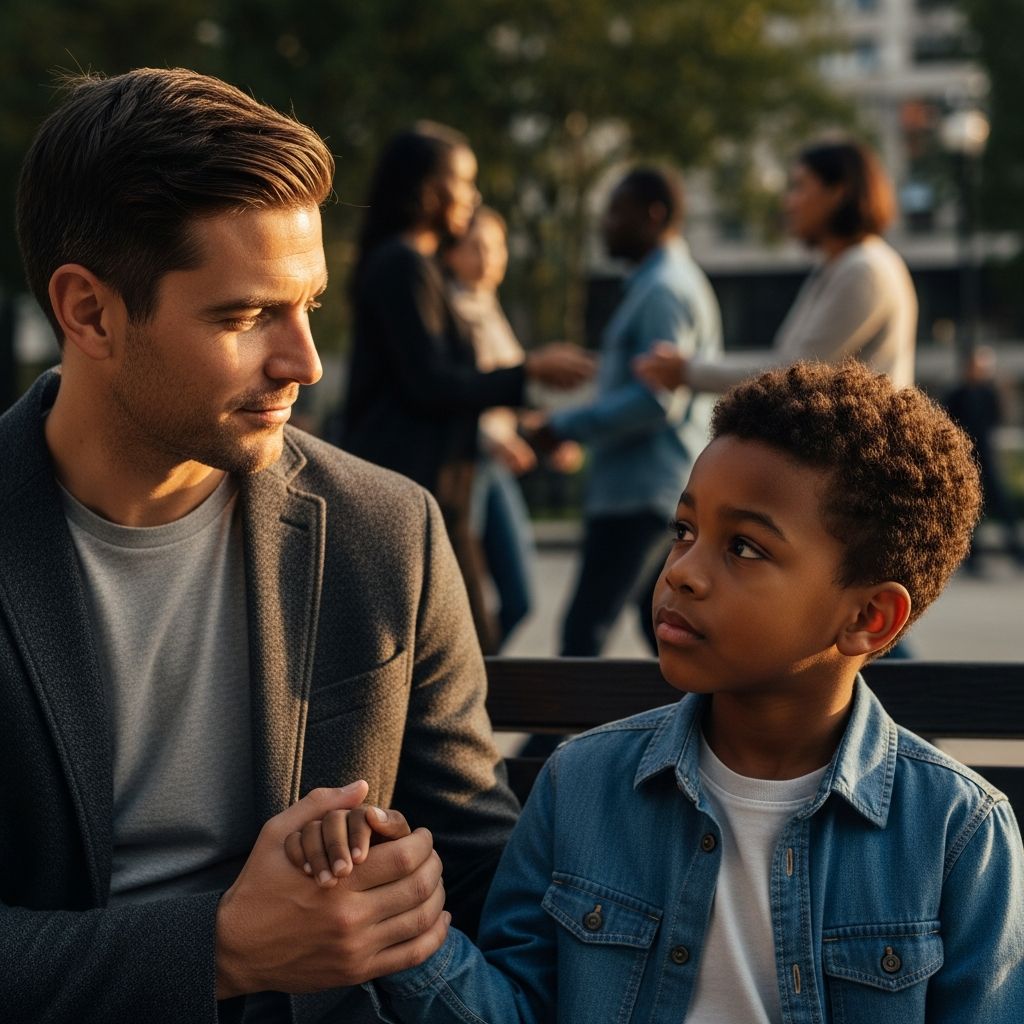
Parenting a child always reshapes a person’s life, but when a white father is raising a Black son, that transformation collides directly with race, history, and power in ways that cannot be ignored. The relationship becomes a daily lesson in love, fear, responsibility, and the uncomfortable truth that a child the father adores will be treated very differently by the world around them.
Seeing the Same World, Living Different Realities
A white father and his Black son may share the same living room, the same family dinners, and the same neighborhood, but they do not share the same social reality. The father’s skin often acts as insulation from the harshest expressions of racism, while the son’s skin makes him more visible, more policed, and more vulnerable.
This gap creates a painful paradox: a father can love his child deeply yet still lack the lived experience to fully grasp what that child will face as he grows into a Black man. Recognizing this gap is not a failure of love but a starting point for a more honest kind of parenting.
From Colorblind Comfort to Uncomfortable Truth
Many white parents grew up being told that “we’re all the same” and that good people simply do not talk about race. That mindset can feel comforting, especially for those who have never been targeted because of their skin color, but it does not match what Black children experience in schools, stores, or streets.
When a white father watches his Black son get followed more closely in a shop, disciplined more harshly at school, or treated with suspicion by strangers, the illusion of colorblindness cracks. What once seemed like an ideal turns into denial: pretending not to see race means pretending not to see the risks and injustices his son will face.
A Daily Education in Privilege
One of the hardest realizations for a white father is that his own safety and social comfort are part of an unequal system that endangers his son. He may notice how quickly he gets the benefit of the doubt from teachers, police, or other parents, even while his son receives suspicion, extra questioning, or harsher judgment.
This is not just an abstract concept of “privilege.” It shows up in everyday moments: who gets waved through a traffic stop, whose anger is considered threatening, whose mistakes are written off as “boys being boys,” and whose are treated as potential criminality.
Everyday Signals of Unequal Treatment
- Teachers assuming a Black boy is the aggressor in a conflict before hearing the full story.
- Store employees watching a Black child more closely than his white parent.
- Neighbors asking if the son “belongs” to the father or assuming adoption is the only possible story.
- Police responding more tensely when the son is in the car than when the father is alone.
The Emotional Weight White Fathers Carry
For many white dads, there is a painful tension between wanting to protect their sons and realizing they cannot fully shield them from racism. That awareness can create guilt, anxiety, and grief: guilt for having a level of protection their son will never share, anxiety about the son’s safety, and grief that innocence will be stripped away earlier than it should be.
Yet, that emotional weight can become fuel for change. Instead of being paralyzed by fear or shame, a father can choose to confront his own blind spots, learn from Black voices, and become intentional about building a safer, more supportive world for his child.
Learning to Talk About Race Without Breaking His Spirit
One of the most delicate tasks for a white father of a Black son is balancing realism and hope. He must tell the truth about racism without convincing his child that the world is only hostile or that his Blackness is a burden rather than a source of pride and strength.
This means replacing silence with structured, age-appropriate conversations. The goal is not a single heavy “talk” but an ongoing dialogue that grows with the child, mixing safety lessons, critical thinking, and affirmations of worth.
Age-Appropriate Conversations About Race
| Age Range | Focus | Key Messages |
|---|---|---|
| Preschool (3–5) | Differences and fairness | People have different skin, hair, and features; difference is normal and good. Some people are treated unfairly, and your family believes everyone deserves respect. |
| Early school age (6–9) | History and current unfairness | Racism has existed for a long time and still shows up today. If someone treats you badly because of your skin, they are wrong, not you. |
| Preteen (10–12) | Systems and safety | Institutions like schools and police can treat Black people unfairly. There are specific safety rules that keep you safer during encounters with authority. |
| Teen (13+) | Power, resistance, and agency | Your voice, choices, and community matter in challenging racism. You can critique injustice while still navigating systems as safely as possible. |
Preparing a Black Son for Encounters With Authority
Few conversations feel more heartbreaking for a white father than explaining to his Black son how to behave around police or other authority figures. The message is often not about guilt but about survival: how to reduce the chances that a misunderstanding escalates into something far worse.
These conversations do not exist because the child is doing anything wrong. They exist because the world reads his body through centuries of stereotype and fear, and the father understands that reality is not changing overnight.
Key Elements of a Safety Talk
- Explaining that some authority figures will see him as older or more threatening than he is.
- Practicing calm, clear responses and body positions that reduce perceived threat, while emphasizing that his dignity still matters.
- Sharing specific scripts (for example, how to respond when asked for ID or told to step out of a car).
- Clarifying that the responsibility for fairness always lies with adults and systems, not with the child’s behavior alone.
Building a Village That Reflects His Identity
No white father, no matter how loving or informed, can be his son’s only guide on race. His son also needs Black mentors, peers, and role models who can speak from lived experience about being a Black boy and, eventually, a Black man.
Curating that community is an active responsibility. It often means choosing schools, neighborhoods, churches, sports teams, or cultural programs that are not centered on whiteness, even if doing so makes the father leave his own comfort zone.
Practical Ways to Build Community
- Joining youth programs, sports leagues, or arts groups where Black children and adults are well represented and truly included in leadership.
- Seeking out Black pediatricians, barbers, coaches, or tutors who can normalize and affirm the son’s identity.
- Attending events, museums, or festivals that highlight Black history, culture, and achievement.
- Encouraging friendships with other Black kids and families, while also teaching the son to form healthy relationships across races.
Unlearning in Order to Lead
Raising a Black son forces many white fathers to confront teachings from their own upbringing that they never questioned before. They may remember being told to “respect the police no matter what,” “keep your head down and you’ll be fine,” or “everyone gets what they earn.”
Once they see how those messages fail to capture their son’s reality, they must unlearn them. That unlearning is not just about personal feelings; it is about refusing to pass on myths that could put their child at risk or convince him that racism is his fault.
Using Privilege as a Tool, Not a Shield
One major shift for a white father is deciding to treat his own social power not as something to hide behind, but as something to leverage on behalf of his son and other Black children. That choice can turn passive privilege into active allyship.
In everyday life, this can look like challenging biased school discipline, pushing for diverse hiring in youth organizations, confronting racist jokes in family circles, or backing policy changes that reduce harm to Black communities. It also means being willing to accept personal discomfort—awkward conversations, social friction, or even backlash—as a small price for his child’s safety and dignity.
Everyday Actions for Systemic Impact
- Documenting disparities in how his son and other Black kids are treated at school and bringing those patterns to administrators.
- Refusing to stay silent when friends or relatives minimize racism or blame victims for bias they face.
- Supporting local organizations that provide legal aid, mentoring, and educational support to Black youth.
- Voting and advocating for policies that address police accountability, school equity, and economic justice.
Protecting Joy as Fiercely as Safety
When the world feels dangerous, conversations about Black children can become dominated by fear. Yet a white father’s responsibility is not only to prepare his son for danger, but also to protect his capacity for joy, imagination, and self-love.
Centering only risk can unintentionally send the message that Blackness is mainly about suffering. To counter that, fathers must also celebrate their son’s brilliance, humor, creativity, and resilience, and consistently show him examples of Black excellence and everyday happiness.
Ways to Nurture Joy and Pride
- Stocking the home with books, shows, and music created by Black authors, artists, and heroes in many fields.
- Encouraging the son’s talents—whether in science, sports, art, or activism—and connecting him with mentors who share his background.
- Creating family rituals that honor Black culture, holidays, or historical milestones.
- Affirming his appearance and identity, including hair, skin tone, and cultural style, as sources of beauty and strength.
SEO-Optimized Key Takeaways
- White fathers raising Black sons must move beyond colorblind parenting and confront how racism shapes their child’s daily life.
- Open, age-appropriate conversations about race and safety are critical for preparing Black boys to navigate biased systems.
- Building a diverse, affirming community gives Black sons role models and support that white fathers alone cannot provide.
- Using white privilege to challenge institutions, not merely to protect one’s own family, is a core part of responsible transracial parenting.
- Protecting a Black child’s joy, pride, and sense of possibility is just as important as protecting his physical safety.
Frequently Asked Questions About White Dads Raising Black Sons
Is it enough to just teach my Black son to be respectful and careful?
Respect and caution are important, but they are not a complete strategy. Black boys can still face unfair treatment even when they do everything “right,” so they need both practical safety tools and an understanding that injustice is not their fault.
How do I talk about racism without making my son scared all the time?
Use simple, honest language and pair hard truths with stories of resistance, community, and love. Let him know there are dangers, but also many people—including you—working to keep him safe and to change unfair systems.
What if I make mistakes when talking about race?
Mistakes are inevitable, especially if you were not taught to discuss race growing up. When you slip, acknowledge it, correct yourself, and show your son that learning and repair are part of how caring adults behave.
How can I find Black mentors and role models for my son?
Start locally: community centers, churches, cultural organizations, sports leagues, and professional networks often include adults eager to support youth. Be transparent about your intentions, build genuine relationships, and respect boundaries rather than treating people as props in your child’s story.
What does it mean to use my privilege for good as a white father?
It means recognizing that people tend to listen to you, trust you, or fear you less because you are white—and then using that access to challenge discrimination instead of ignoring it. From school meetings to local politics, your voice can help open doors and shift norms that directly affect your son and other Black children.