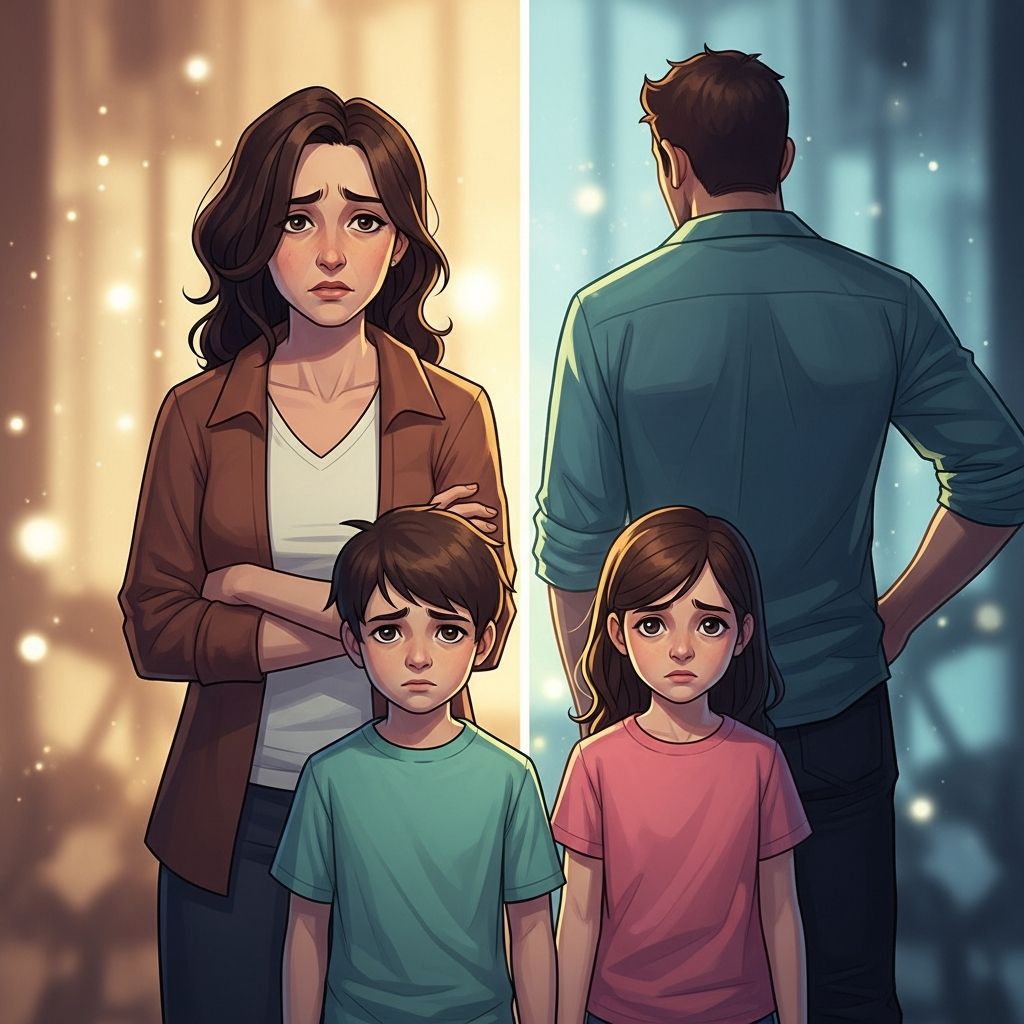
Living between your children and a partner who seems to resent them can feel like standing in the middle of a storm with no shelter in sight. You may love your partner deeply, yet feel sick watching how they talk to or treat your kids. You may also feel guilty, angry, confused, and completely stuck. This guide is designed to help you understand what is happening, protect your children, and make clearer, calmer decisions about your family’s future.
Understanding the Emotional Triangle
In a blended family, three powerful needs often collide: your children’s need for safety and belonging, your partner’s need for closeness with you and order in the home, and your own need to be both a loving parent and a loved partner. When these needs feel in competition, everyone can end up feeling threatened.
Instead of seeing this as “my husband versus my kids,” it helps to see it as a triangle of unmet needs. Your partner may experience your bond with your children as a threat to your intimacy with him. Your children may see your attachment to him as a threat to their security with you. You stand in the middle, trying to keep everybody from falling apart.
Is It Dislike, Resentment, or Harm?
Not every strained step-relationship means your partner “hates” your kids. There is a wide range of behavior from awkwardness and distance to open hostility and cruelty. Naming what you are actually observing helps you respond more clearly.
| Behavior Pattern | What It Might Signal | Urgency Level |
|---|---|---|
| Quiet withdrawal, avoids interaction, stays in another room | Discomfort, insecurity, fear of doing it wrong more than hatred | Low–moderate; needs communication and slow bonding |
| Frequent eye-rolling, sarcasm, critical comments about “kids these days” | Resentment, unrealistic expectations, feeling displaced or ignored | Moderate; needs boundaries, honest talks, possibly counseling |
| Singling your child out, blaming them for most problems | Scapegoating, unresolved anger, emotional immaturity | High; children need protection and you need support |
| Shouting, name-calling, intimidation, or threats | Emotional abuse and loss of control, regardless of intention | Emergency; safety plan, professional help, may require separation |
| Humiliating, shaming, or physically aggressive behavior | Abuse and serious boundary violations | Immediate protective action; non-negotiable |
Ask yourself, in writing if possible, what you actually see and hear on a regular day: exact tones of voice, typical phrases, body language, and your child’s reactions. This moves you from “I think he hates them” to “Here is what is really happening.”
Your Non-Negotiable Job: Protect Your Children
However complicated the adult relationship is, your first responsibility is to protect your children’s physical and emotional safety. Even if your partner had a hard childhood, feels overwhelmed, or says he “didn’t mean it,” children are not emotional punching bags. They should not be sacrificed to keep a relationship intact.
A child who grows up feeling targeted, blamed, or unsafe at home is likely to carry deep wounds into adulthood: difficulty trusting, people-pleasing, intense anger, or choosing harmful partners. Protecting them now is not only about their present comfort; it is about their entire future.
Why Some Partners Struggle With Stepchildren
Understanding some common reasons step-parents struggle does not excuse harmful behavior, but it can help you avoid seeing the situation as pure malice. Often, several of these dynamics are happening at the same time:
- Feeling like an outsider: Your children share history, routines, and private jokes with you. Your partner may feel like he is joining a club where he will always be second best.
- Competing for your attention: When you are exhausted from parenting, you may have little left for your partner. He may resent the time and energy your kids require, even if he knows in his head that they come first.
- Rigid expectations about respect: Some adults expect instant obedience and affection from stepchildren. When that does not appear, they feel rejected and respond with criticism or control.
- Unresolved grief and loyalty conflicts: Your children may still be grieving the loss of the original family. If they are cool, angry, or dismissive toward your partner, he may take that personally rather than seeing it as grief.
- Stress, financial pressure, and exhaustion: When someone is already stretched thin, the noise, mess, and emotional intensity of kids can trigger explosions.
None of these explain away cruelty, but they do show why some people feel cornered and lash out instead of stepping back with perspective.
Making Your Invisible Lines Visible
Most parents have internal lines they assume are obvious: “You never call my child names,” “You do not use sarcasm with a crying kid,” “You do not punish in anger.” But if those lines have never been clearly spoken, your partner may not understand how serious they are for you.
It helps to move from vague complaints to explicit boundaries. Instead of “you’re too harsh,” try “I will not allow our children to be mocked, insulted, or threatened. If that happens, I will step in and, if needed, I will remove them from the situation.” This is not a threat; it is a clear statement of your role as protector.
How to Talk to Your Partner Without Exploding
Hard conversations go better when they are not launched in the middle of a blow-up. Choose a calm moment, not directly after a conflict with the kids, and frame the talk as a shared problem rather than an attack.
You might say something like:
- “I see how stressed you are, and I know this is a big adjustment for all of us. At the same time, I am really worried about how things feel for the kids. I need us to find a different way to handle conflict so that they feel safe in their own home.”
- “When you say things like ‘you’re so lazy’ to my son, he shuts down and looks terrified. That crosses a line for me. I need us to find ways to correct behavior that do not involve insults or yelling.”
- “I want you and the kids to build a relationship, and I am willing to work hard on this with you. But I will always choose their safety. Can we talk about what support you need so this doesn’t keep happening?”
Notice that the tone here combines empathy (recognizing his struggle) with firm clarity (protecting your children). This combination makes it easier for your partner to stay open rather than defensive.
Clarifying Roles: Who Disciplines Whom?
One of the biggest flashpoints in blended families is discipline. Many step-parents feel it is their job to “straighten out” their partner’s kids, especially if they see behavior they label as spoiled, rude, or undisciplined. Many children experience this as unfair and intrusive, which fuels more resistance.
A rule of thumb that helps many families is: the biological parent takes the lead on discipline, especially early on. The step-parent’s first job is to build trust, not to enforce rules. Over time, as trust grows, the step-parent can step more into a co-parenting role with clear agreements.
Practical Agreements You Can Propose
Consider sitting down with your partner and creating explicit, written agreements around how children will be treated in your home. This turns vague hopes into something you can both see and revisit. Examples of agreements include:
- No name-calling, shaming, or swearing directed at children, even in anger.
- The biological parent steps in if conflict escalates beyond a calm conversation.
- Big consequences (loss of major privileges, grounding, etc.) are decided together, not in the heat of the moment.
- Every child gets at least a few minutes of genuinely positive interaction with each adult daily (a joke, a question about their day, a shared task).
- Disagreements between adults about parenting are discussed privately, not in front of the children.
If your partner refuses any form of agreement that protects the kids from verbal or emotional harm, that is important information. It tells you that the issue is not just stress or confusion; it is a deeper refusal to respect basic safety.
Supporting Your Children Directly
Even if you are working on things with your partner, your children need ongoing, direct support from you. They need to know, without question, that you see what is happening and take their experience seriously. Silence can feel like betrayal, even if you are trying to “keep the peace.”
Some ways to actively support your kids include:
- Name what they are feeling: “It looked like you felt scared and hurt when he raised his voice. It makes sense that you would feel that way.”
- Affirm that they are not to blame: Make it clear that no child ever “makes” an adult lose control or be cruel, even if the child’s behavior was challenging.
- Offer safe outlets: Encourage them to talk, draw, write, or move their feelings out through play, sports, or art.
- Reinforce their worth: Regularly tell them what you appreciate about who they are, not only what they do.
When to Consider Outside Help
Some patterns are too entrenched or emotionally charged to handle alone. In those cases, involving a neutral third party can make a powerful difference. Therapy is not a sign that the relationship has failed; it is a sign that you are taking the family’s wellbeing seriously.
Helpful forms of support might include:
- Individual therapy for you: To sort your feelings, clarify your boundaries, and build courage to act on what you know.
- Family or couples counseling: To work on communication, rebuild trust, and develop healthier patterns in a guided, structured way.
- Child or teen counseling: To give your children a safe place to speak freely without fear of upsetting you or your partner.
- Support groups for stepfamilies or single parents: To reduce isolation and hear from others who have walked a similar path.
Listening to Your Deepest Fears
Many mothers in this situation have private thoughts they barely dare to voice: “Have I chosen a partner over my kids?” “Will they hate me when they are grown?” “Is leaving worse than staying?” Rather than pushing these questions away, it is healthier to face them gently and honestly.
Try writing in a journal as if you were your future self, looking back in ten years. Which choice would that future self be most grateful you made: staying and working on things under certain conditions, or leaving to create a calmer, safer environment, even if it meant short-term upheaval? There is no universal right answer, but there is a right answer for your specific family.
Safety First: When You May Need to Leave
There is a difference between a flawed but willing partner and an unsafe one. A flawed partner may be defensive at first but is ultimately willing to reflect, apologize, and change behavior. An unsafe partner repeatedly crosses clear boundaries, blames the children, and shows no commitment to change.
You may need to consider separation, either temporary or permanent, if:
- Your partner regularly insults, intimidates, or threatens your children.
- There is any physical aggression, property destruction meant to intimidate, or reckless behavior around your kids.
- Your children show ongoing signs of fear: not wanting to come home, flinching, sleep problems, sudden drop in school performance, or self-harm talk.
- You have tried calm conversations and clear boundaries, and nothing has changed for a significant period.
Leaving is not a failure of commitment; it is an act of protection. Loving a partner does not require sacrificing your child’s safety or sense of worth.
Small Daily Steps That Help
While you are figuring out larger questions, there are small, consistent actions that can ease tension and soothe everyone’s nervous systems. These are not magic fixes, but they can support you in staying grounded and responsive instead of reactive.
- Build brief but regular one-on-one time with each child, even 10 minutes a day, where you are not talking about problems.
- Notice and acknowledge any tiny positive interaction between your partner and your kids, if it is genuine. This can gently reinforce better patterns.
- Establish simple, predictable routines (mealtimes, bedtimes, screen rules) so the household feels less chaotic.
- Take care of your body: sleep when you can, eat regularly, move your body. Physical depletion makes every conflict feel impossible.
- Limit adult conflict in front of the children. When you do slip, repair with them: “You saw us argue; that might have felt scary. We are working on better ways to disagree.”
Frequently Asked Questions
Is it normal for my partner to dislike my kids at first?
It is common for step-parents to feel awkward, disconnected, or even resentful at the beginning. They did not build a bond from birth the way you did, and they may be grieving their own losses. However, there is a big difference between initial discomfort and ongoing hostility. Discomfort sounds like “I don’t know how to relate to them yet”; hostility sounds like “your kids are the problem in my life.”
How do I know if I am “choosing” my partner over my children?
Ask yourself: when conflicts arise, whose safety and emotional wellbeing am I prioritizing? Do I regularly minimize my children’s experiences to keep my partner calm? Do I tell myself “It’s not that bad” when my body and my kids’ reactions say otherwise? Choosing your children does not always mean leaving; it means consistently acting as their protector and advocate, even if that upsets your partner.
Should I force my kids to accept or love their stepdad?
No. You can require basic respect and politeness, but you cannot require affection or trust. Those grow from repeated experiences of being treated kindly and fairly. Forcing closeness usually backfires, making kids feel more trapped and resentful. Focus on creating conditions where trust could reasonably grow: safety, predictability, and freedom to express their feelings without being punished.
What if my partner says, “It’s my house; my rules”?
Shared adult power in a home does not erase your non-negotiable duty to safeguard your children. Even if your partner is the primary financial provider, your children’s right to be safe does not depend on who pays which bill. You can acknowledge his role and still say, “As their mother, I cannot agree to rules or discipline that frighten or harm them. We need guidelines that respect everyone.” If he refuses any compromise that protects the kids, that is a serious red flag.
Can these relationships ever really heal?
In some families, yes. When a step-parent genuinely recognizes the harm, takes responsibility, and commits to doing deep personal work, significant healing is possible over time. Children are often more forgiving when they see consistent change, not just words. That said, healing cannot happen while harm is ongoing. The first step is always to stop the hurt, then rebuild slowly from there.
Empowering Yourself to Act
Feeling trapped is one of the most painful parts of this situation. Yet you have more power than it seems. You can decide what lines cannot be crossed. You can decide when and how to speak up. You can decide what kind of home your children will grow up in. None of these choices are easy, but they are yours.
You do not have to solve everything overnight, and you do not have to do it alone. One conversation, one boundary, one supportive gesture to your child at a time can begin to shift the balance toward safety and respect. Your love for your children is not a problem to be negotiated away; it is the compass that will help you find your way through this.