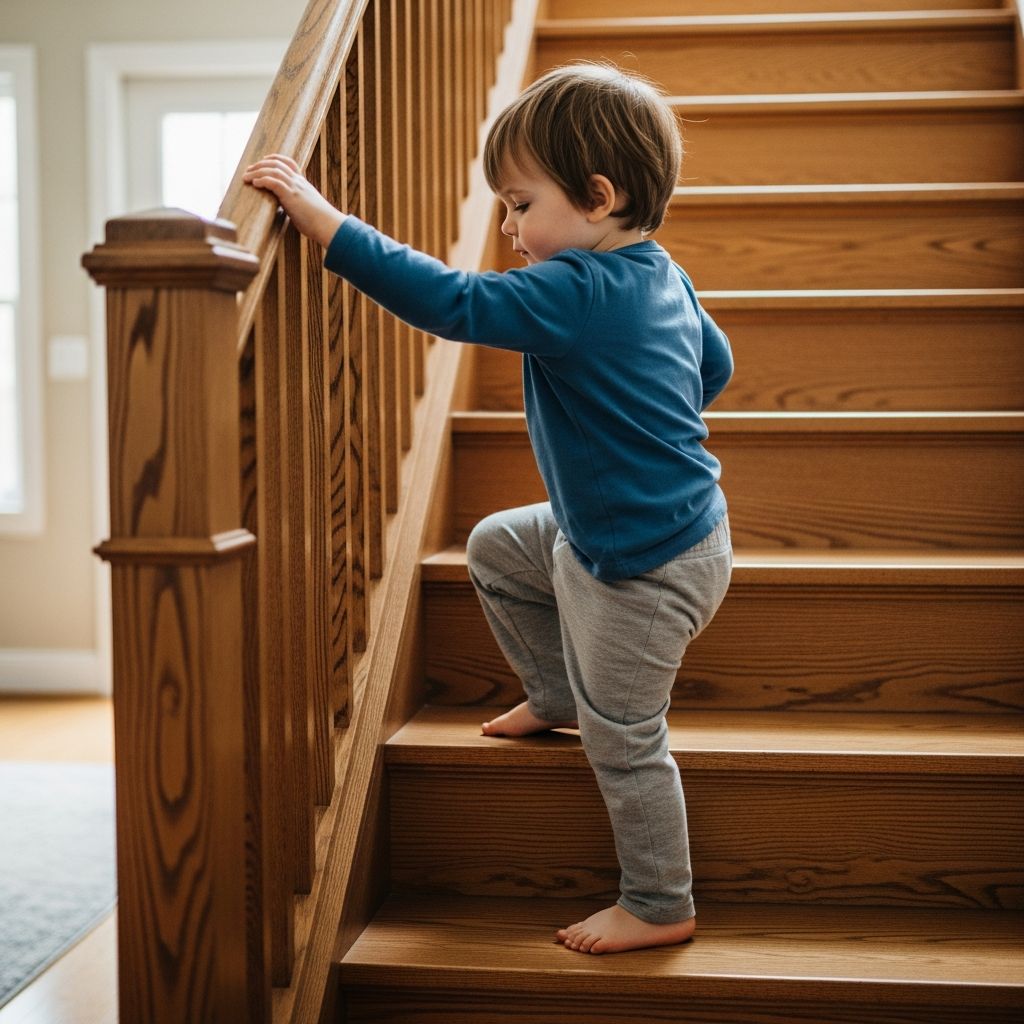
Between 27 and 36 months, toddlers typically achieve a significant gross motor milestone: walking up and down stairs while alternating their feet. This skill reflects maturing balance, strength, and coordination, building on earlier walking abilities.
The Journey from First Steps to Stair Mastery
Toddler gait evolves rapidly after independent walking begins around 12 months. Initial steps feature a wide base of support, short strides, and arms held high for balance. By 18-24 months, heel strikes emerge, arm swing develops, and the base narrows, resembling adult patterns.
Stair navigation marks a advanced phase. Early attempts involve leading with the same foot up and down (non-alternating or ‘marking time’), often requiring hand support. Progress to alternating feet—placing one foot on each step sequentially—usually occurs between 27-36 months, first ascending (easier due to hip flexor engagement) then descending.
- 24 months: Climbs stairs with support, same foot leading.
- 27-30 months: Alternates feet upward with railing grasp.
- 30-36 months: Alternates feet up and down, minimal or no support.
This progression stems from neuromuscular maturation, including central nervous system refinements, bone ossification, and foot arch formation.
Why Alternating Feet on Stairs Matters
Reciprocal stair climbing demands integrated skills: postural stability, proprioception (body position sense), and dynamic balance. It reduces double-limb support time, increases stride efficiency, and enhances propulsive force control via center of mass adjustments.
Research shows toddlers practice variably—short bursts on diverse surfaces—to adapt to environments, fostering a resilient perceptual-motor system. Mastering stairs boosts independence, spatial awareness, and confidence, linking to cognitive gains like pointing and talking around the same age.
Signs Your Toddler is Ready for Stair Alternation
| Pre-Milestone Indicators | Description | Typical Age |
|---|---|---|
| Stable Independent Walking | Narrow base, heel-toe pattern, natural arm swing | 18-24 months |
| Furniture Cruising & Standing | Pulls to stand, walks holding hands/furniture | 9-12 months |
| Experimental Gaits | Tip-toe, backward, sideways walking; speed increases | 15-21 months post-walking |
| Basic Climbing | Up/down low steps with same foot, hand support | 24 months |
Observe these to gauge readiness. Variability in practice, like exploring slopes or obstacles, accelerates skill acquisition.
Practical Strategies to Support Stair-Climbing Development
Create safe opportunities without rushing. Floor play from infancy builds foundations: tummy time (4 months), rolling (6 months), crawling (8 months).
- Safe Environment: Install gates, secure railings; avoid walkers, which delay skills.
- Encouragement: Hold hands initially; model alternating feet slowly.
- Play-Based Practice: Use low steps, colorful stairs; incorporate toys to motivate ascent/descent.
- Varied Terrain: Supervised practice on gentle slopes, textured surfaces for adaptability.
- Patience: Allow self-paced exploration; celebrate efforts to build confidence.
Shoes only outdoors post-walking; barefoot enhances feedback. Consult pediatricians at well-visits for motor checks.
Comparing Stair Skills Across Toddler Ages
| Age Range | Ascending Stairs | Descending Stairs | Support Needed |
|---|---|---|---|
| 18-24 Months | Same foot, handrail | Same foot or scoot | Full/partial |
| 25-30 Months | Alternating feet begin | Same foot primary | Handhold |
| 31-36 Months | Alternating, reciprocal | Alternating emerging | Minimal |
| 3+ Years | Independent alternate | Independent alternate | None |
Individual variation is normal; 10% walk independently later than 14 months.
Red Flags: When to Consult a Professional
Monitor for delays impacting daily function. Seek evaluation if by specified ages:
- 15 months: No independent steps.
- 18 months: Cannot walk unsupported or climb furniture.
- 24 months: No stair attempts (with/without aid).
- 30 months: Persistent same-foot climbing only.
- Persistent Issues: Toe-walking, asymmetry, frequent falls, favoring one side.
Early intervention like physical therapy improves outcomes for motor disorders. CDC milestones guide tracking.
Building on Stair Mastery: Next Locomotor Adventures
Post-stairs, expect running (3 months after proficient walking), jumping, quick turns, obstacle negotiation. These integrate with fine motor (scribbling by 18 months) and social skills.
Outdoor play enhances: balance beams for stability, hills for grades.
Frequently Asked Questions
At what age should my toddler alternate feet on stairs?
Typically 27-36 months, ascending first around 27-30 months, descending by 36 months.
Is it normal if my 2-year-old still uses the same foot on stairs?
Yes, at 24 months; alternation develops later. Monitor progress.
How can I encourage stair practice safely?
Use low steps, hold hands, supervise closely; ensure railings and no walkers.
What if my child skips crawling—will they still learn stairs?
Most do, but crawling strengthens precursors; tummy time compensates.
Shoes or barefoot for stair learning?
Barefoot indoors for sensory input; supportive shoes outside.
Long-Term Benefits of Early Motor Proficiency
Strong locomotion correlates with cognitive, social growth. Stair mastery signifies readiness for preschool activities like group games, boosting self-esteem. Ongoing variable practice ensures adaptability.
Parental involvement—modeling, cheering—amplifies gains. Track via apps or journals aligned with CDC checklists.
References
- Early Development of Toddler Walking and Other Locomotor Tasks — Physio-pedia. Accessed 2026. https://www.physio-pedia.com/Early_Development_of_Toddler_Walking_and_Other_Locomotor_Tasks
- Developmental Milestones For Walking In Children — YouTube (Health Channel). Accessed 2026. https://www.youtube.com/watch?v=GUgb4s_MCD4
- What to Expect After Walking — Milestones and Motherhood. Accessed 2026. https://www.milestonesandmotherhood.com/blog/what-to-expect-after-walking
- Learning to Walk — Pregnancy Birth and Baby (Australian Govt). 2023. https://www.pregnancybirthbaby.org.au/learning-to-walk
- Movement, Coordination, and Your 1- to 2-Year-Old — KidsHealth (Nemours). Accessed 2026. https://kidshealth.org/en/parents/move12yr.html
- Point, Walk, Talk: Links Between Three Early Milestones — PMC (NCBI/NIH). 2019-11-27. https://pmc.ncbi.nlm.nih.gov/articles/PMC6892347/
- CDC’s Developmental Milestones — Centers for Disease Control and Prevention (CDC). Accessed 2026. https://www.cdc.gov/act-early/milestones/index.html