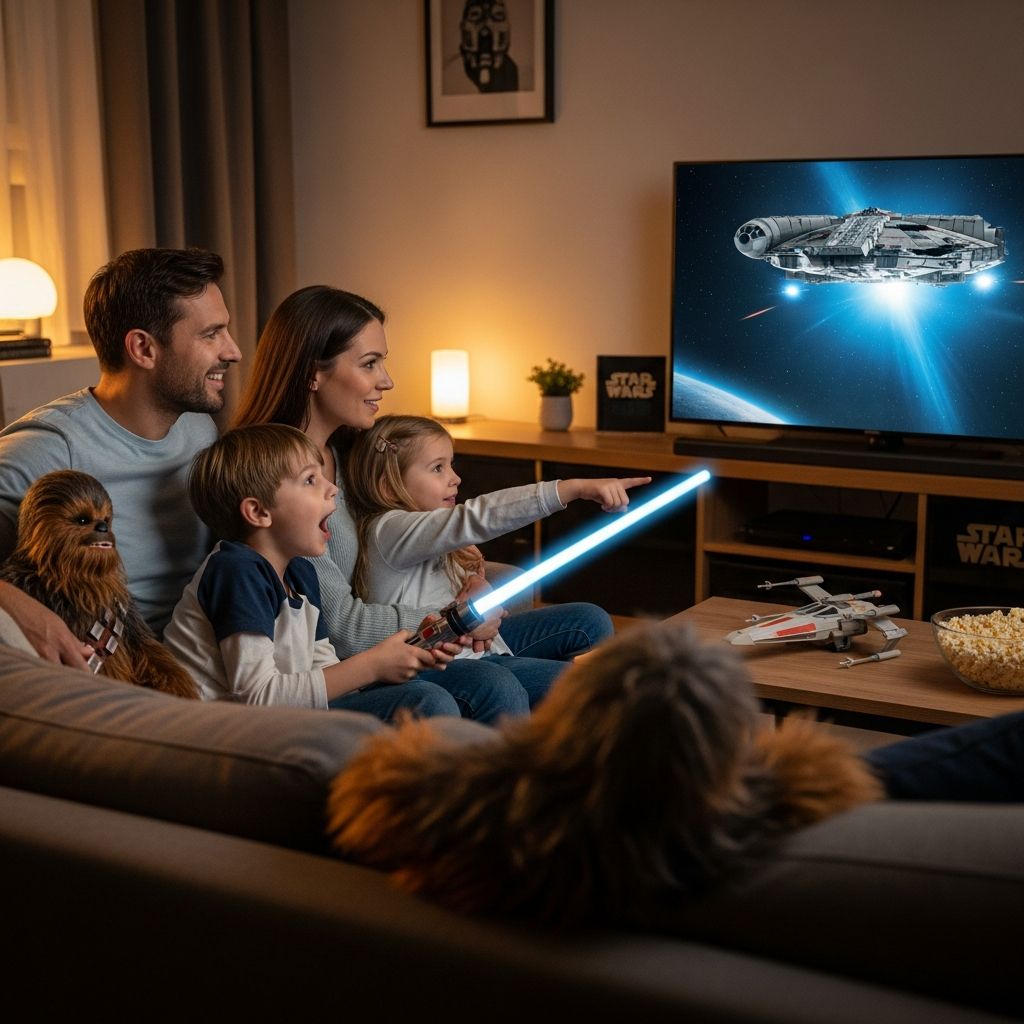
Choosing the right moment to introduce a child to Star Wars can feel strangely high-stakes for many parents who love the saga. The movies mix wonder, humor, friendship, and heroism with war, loss, and sometimes frightening imagery, so timing and preparation matter. This guide walks through what makes each era of the series more or less kid-friendly and offers practical strategies for tailoring a viewing plan to your child.
Why Star Wars Feels Different With Kids
For many adults, these films are tied to formative memories of theaters, toys, and playground lightsaber battles. Watching with a child means balancing that nostalgia with a clear view of what is actually on screen: blasters, monsters, tense battles, and the death of beloved characters. A thoughtful approach can preserve the magic while respecting a young viewer’s emotional limits.
- Most entries are rated PG or PG-13 and combine fantasy violence with intense emotional beats.
- The tone swings from lighthearted adventure to tragedy and moral ambiguity across different films.
- Parents often underestimate how disturbing certain scenes can be for sensitive or very young children.
Thinking ahead about your child’s temperament and current media experience is more important than memorizing the production order of the movies.
Key Factors to Consider Before Pressing Play
Before deciding which film to start with, take stock of who your child is right now, not who you hope they will be as a future fan. A thrilling scene for one kid can be nightmare fuel for another.
1. Age and emotional maturity
Age ratings offer only a rough guide. Two children of the same age might have very different reactions to the same moment of peril or loss.
- Under 7: Many kids at this age struggle with sustained tension, loud sound design, and repeated on-screen danger.
- 7–9: Better able to follow storylines and distinguish fantasy from reality, but still often rattled by betrayal, torture, or the death of a parent figure.
- 10–12: Usually ready for more complex plots and morally grey characters, though some scenes may still be overwhelming.
- Teens: Typically ready for the full range of the saga, including its darkest moments, provided there is room to talk afterward.
2. Sensitivity to violence and dread
Not all violence lands the same way. A blaster bolt in a fast-paced battle might not bother a child who is deeply unsettled by slow, suspenseful scenes with ominous music.
- Ask how your child reacts to existing media with battles, monsters, or tragic events.
- Consider whether they replay scary images in their mind at night or during quiet moments.
- Note if they are more disturbed by physical danger or by emotional harm, like betrayal and abandonment.
3. Attention span and pacing
Some films unfold as steady, classic adventures, while others assume patience for political plotting, heavier exposition, or extended emotional scenes.
- Younger kids may disengage during long dialogue sequences that set up galactic politics or backstory.
- Action-heavy entries can feel like sensory overload for children unused to big-budget blockbusters.
How Different Star Wars Eras Feel to Kids
The franchise spans multiple trilogies and stand-alone stories, each with its own emotional flavor. Thinking in terms of tone, not just release order, makes it easier to build a path that suits your child.
| Era | General Tone | Common Kid Reactions | Approximate Comfort Range |
|---|---|---|---|
| Original Trilogy | Classic adventure, clear good vs evil, hopeful endings | Excited by heroes and creatures; occasional fear during monster or villain scenes | Many kids enjoy from about 7+ with support |
| Prequel Trilogy | Bright visuals, escalating war, tragic downfall | Intrigued by spectacle and lightsabers; some disturbed by the final film’s darkness | Often best for 9–12+ depending on sensitivity |
| Sequel Trilogy | Modern pacing, intense battles, emotional conflicts | Engaged by new heroes; may be shaken by character deaths and relentless action | Frequently fits 10–13+ with discussion |
| Spin-off Films | More grounded war stories or heist capers | Older kids enjoy tension and stakes; tone may feel heavy to younger viewers | Often 12–13+ due to themes and body count |
Choosing a Starting Point
There is no single correct order for watching Star Wars with children. The “best” entry point depends on whether you want to prioritize simplicity, emotional safety, or narrative surprise.
Option A: Begin with a light, hopeful adventure
Starting with a film where good ultimately prevails, friendships are central, and the visual language of the universe is well-established can make the galaxy feel welcoming, not overwhelming.
- Pick an entry with a clear hero’s journey and minimal moral ambiguity.
- Avoid movies where beloved characters meet especially grim fates during the first exposure.
- Focus on installments where humor and camaraderie repeatedly relieve tension.
Option B: Start at the chronological beginning
Some families like to follow the story from its in-universe starting point. This can help kids understand how big political conflicts grew from personal choices, but it also means encountering darker material sooner.
- Early prequel films often feel visually bright and colorful, which can draw kids in.
- The tone, however, grows dramatically heavier by the final prequel, culminating in betrayal and tragedy.
- Parents who choose this route should be ready to pause or postpone the darkest chapter if it feels like too much.
Option C: Use a “bridge” film for older kids
For tweens or young teens who have outgrown most animated children’s shows but are still wary of sad endings, a mid-saga film with a mix of nostalgia and modern pacing can work well as a trial run.
- Look for an installment that introduces new heroes while honoring classic characters.
- Discuss beforehand that not every character will be safe, but that bravery and loyalty still matter.
Content Themes Parents Should Know
Across the saga, certain themes repeat with different levels of intensity. Understanding them ahead of time helps you decide what your child is ready to process.
Violence and combat
These films are framed around galactic conflict. Laser battles, dogfights in space, lightsaber duels, and large-scale clashes appear regularly. The style of violence ranges from stylized and bloodless to emotionally devastating.
- Early films often cut away quickly after a character is hit, lessening the impact.
- Later entries may include more drawn-out confrontations and visible consequences of warfare.
- Some storylines linger on fear, torture, or the destruction of entire worlds, which can feel abstractly terrifying to imaginative kids.
Family separation and loss
At the heart of the saga lies family: found, lost, and rediscovered. For children who have personally experienced divorce, adoption, or bereavement, certain reveals and deaths may hit close to home.
- Key characters grow up without one or both parents, sometimes without knowing why.
- Mentors and loved ones die on screen and may later reappear as ghostly guides, which can confuse younger viewers.
- Villains are sometimes close relatives, forcing heroes to struggle with love and loyalty amid conflict.
Moral complexity and redemption
While early installments paint a straightforward picture of heroes and villains, later films explore the possibility of redemption, failure, and compromise. Older children and teens can find this richly rewarding, but younger viewers may find it bewildering.
- Characters make mistakes with serious consequences for entire planets or orders of warriors.
- Some villains show signs of inner conflict or regret, raising questions about forgiveness.
- Not all heroic acts are rewarded instantly; sacrifice and ambiguity become more common over time.
Practical Viewing Strategies for Families
Once you’ve chosen a starting film, how you watch it together will shape your child’s long-term relationship with the series. A few simple habits can prevent overwhelm and encourage thoughtful engagement.
Pre-talks: Setting expectations
A brief conversation before the opening crawl can work wonders. The goal is to cue excitement without promising total safety from sad or scary moments.
- Explain that the story takes place in a distant galaxy where good people fight against an oppressive regime.
- Mention that laser battles and monsters will appear, but that you are there to pause if it feels too intense.
- Normalize mixed feelings: it is fine to cheer one moment and feel worried the next.
Watching together and using the pause button
Younger kids benefit when an adult watches alongside them rather than multitasking in another room. Being present makes it easier to spot discomfort and respond quickly.
- Pause during climactic duels or emotionally heavy scenes to check in and offer context.
- Ask simple questions like “How are you feeling?” or “Want to keep going?” rather than pushing through at all costs.
- Use breaks to demystify confusing plot points, such as why a character made a painful choice.
After-movie debriefs
Talking afterward turns a flashy space battle into a meaningful story about courage, loyalty, and consequences. It also lets kids release lingering tension through conversation, play, or drawing.
- Invite your child to describe their favorite scene and one moment they did not like.
- Discuss what made a hero admirable: kindness, bravery, honesty, or something else.
- Reassure sensitive viewers that the frightening parts are over and that you are available if scary thoughts return at bedtime.
Sample Viewing Paths by Age Group
These examples are not rigid rules, but they offer starting points for constructing a family-friendly viewing plan that grows with your child.
Early elementary (about 7–8)
For children who are just beginning to enjoy longer movies and can tolerate moderate tension, stick to the most hopeful, straightforward adventures at first.
- Begin with an optimistic film where the main hero learns about the larger conflict gradually.
- Delay movies with especially dark endings or depictions of betrayal until they are older.
- Be prepared to skip or fast-forward through brief sequences that are visually intense but not critical to understanding the plot.
Upper elementary to early middle school (around 9–11)
At this stage, many kids can handle more complex plot structures and are curious about how villains become who they are.
- Introduce films that show the rise of major antagonists and the political backdrop of the galaxy.
- Consider pairing heavier entries with lighter ones so the overall experience remains hopeful.
- Talk openly about themes of power, temptation, and responsibility.
Tweens and young teens (12+)
Older kids are usually ready to explore the full arc of tragedy, sacrifice, and redemption that runs through the saga, as long as parents remain open to candid discussion.
- Include stand-alone stories and the most intense main-saga films once you’re confident they can handle sad or ambiguous endings.
- Ask what they think about characters who walk the line between light and dark, rather than lecturing.
- Encourage them to connect the story’s themes to real-world ideas such as resistance, empathy, and the cost of violence.
Helping Sensitive Kids Enjoy the Galaxy
Some children desperately want to join their peers in loving Star Wars but are easily spooked by loud noises, suspense, or images of masked villains. A gentle approach can help them participate without pressure.
- Start with picture books, LEGO sets, or short, humorous clips featuring droids and friendly aliens.
- Watch key scenes with the volume slightly lower and lights on to reduce sensory overload.
- Allow them to leave or look away during intense moments while you quietly narrate what is happening in reassuring terms.
Over time, many sensitive viewers build confidence and are proud when they can handle more of the story than before.
Balancing Your Nostalgia With Their Needs
Parents who grew up with the saga may feel a strong desire to preserve specific twists or watch in the exact order that meant the most to them. Yet parenting through shared media often requires loosening that grip in favor of what serves the child in front of you.
- It is acceptable to rearrange, pause, or even skip a film if it collides with your child’s current emotional world.
- Story surprises matter less than your child feeling safe enough to keep exploring the galaxy with you.
- You can always revisit the series in a different order years later when they are ready to experience the story anew.
Frequently Asked Questions
Is there a perfect age for a child’s first Star Wars movie?
No single age fits every child. Many families find that somewhere between 7 and 10 works well for a first full movie, but this varies widely based on previous media exposure, sensitivity to violence, and interest in science-fiction. When in doubt, wait a little longer rather than pushing a nervous child.
Can I skip the darker films entirely?
Yes. While the tragic chapters add depth to the saga, your child’s wellbeing is more important than narrative completeness. Some kids are content to live in the lighter corners of the galaxy for years and only explore the heavier stories when they are older and ask to see them.
Will out-of-order viewing ruin the story?
Watching out of release or chronological order changes how certain revelations land, but it does not destroy the emotional power of the series. Children often experience these movies less as a single grand narrative and more as a collection of favorite characters, planets, and scenes shared with people they love.
What if my child is bored rather than scared?
Boredom can be a sign that a particular film’s pacing or political plotlines are better suited to older viewers. Try switching to a more straightforward adventure, taking breaks, or saving complex entries for later years when they can appreciate the nuance.
How often should we watch?
There is no ideal schedule. Some families space films out over months, using each one as a special event, while others dive into mini-marathons during holidays. The important part is staying flexible: if your child seems overwhelmed, slow down; if they are enthusiastically absorbing the story, you can continue at a comfortable pace.
Closing Thoughts
Sharing Star Wars with children is less about perfect curation and more about presence, empathy, and conversation. When you choose films with their age and temperament in mind, watch attentively, and discuss what you’ve both seen, the saga becomes more than a series of space battles. It turns into a shared language of courage, hope, and hard-won wisdom that can grow alongside your child for years to come.