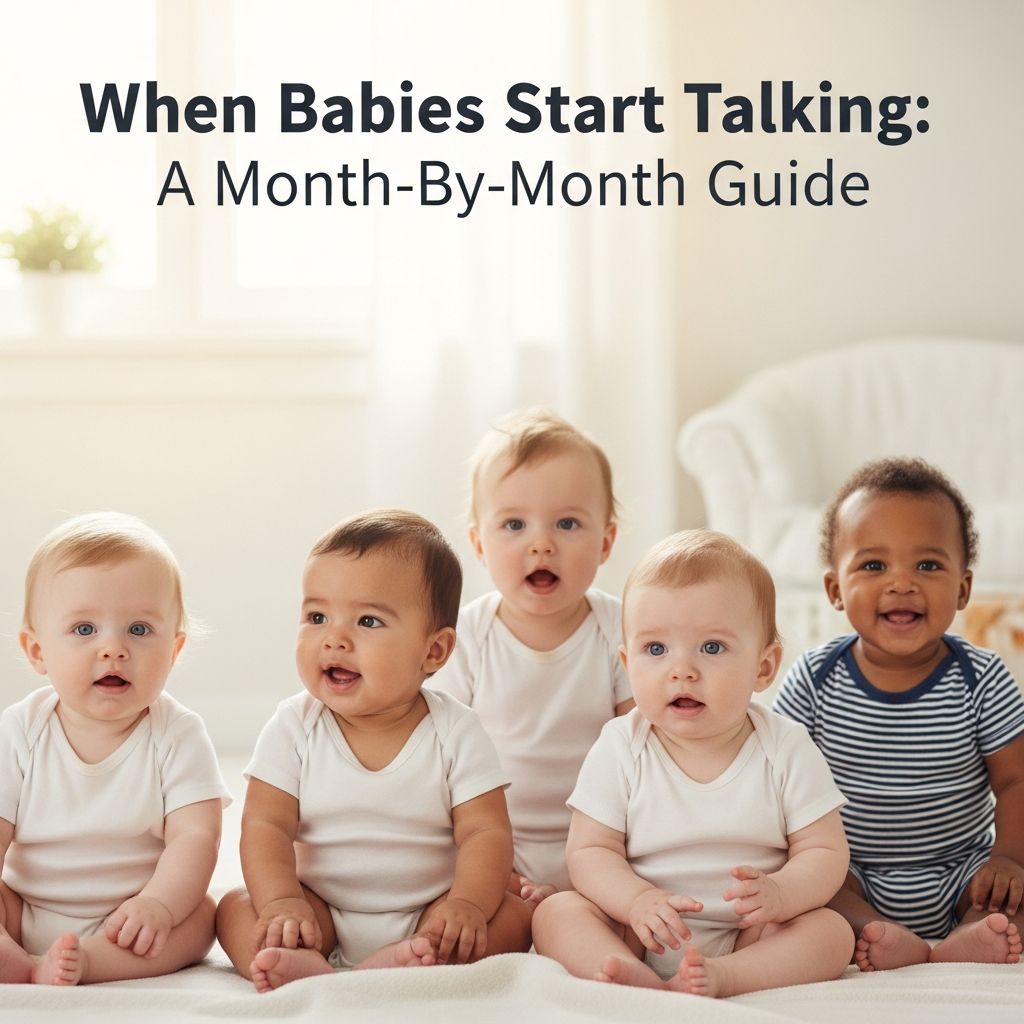
Babies begin communicating from birth, long before their first real word. Crying, cooing, babbling, and gestures all lay the foundation for talking, and most children say their first clear word around 12 months, then rapidly add new words through the second year.
Every child develops in their own way, but knowing the usual range helps you understand what to expect and when to ask for extra support.
From Crying to Conversation: The Big Picture
Speech and language development is a gradual process. Health organizations such as the National Institute on Deafness and Other Communication Disorders (NIDCD), the Mayo Clinic, and major children’s hospitals describe a similar pattern: early sounds in the first months, babbling in the middle of the first year, first words near the first birthday, and short phrases by age 2.
- 0–3 months: Cries, coos, reacts to voices and sounds.
- 4–6 months: Laughs, squeals, and begins babbling sound strings like “ba” or “da”.
- 7–12 months: Understands simple words, uses varied babbling, may say “mama” or “dada” with meaning, and a few other words near 1 year.
- 12–24 months: Vocabulary grows from a handful of words to around 50+ words, with simple two-word phrases like “more milk” by age 2.
Remember that language (understanding and using words) and speech (the sounds used to say words) are related but different skills, and both matter for communication.
Month-By-Month: Early Communication Milestones
The ages below describe what many babies can do by the end of each period, based on typical milestones reported by NIDCD, the Mayo Clinic, and children’s hospitals.
0–3 Months: Laying the Foundation
Even as newborns, babies are already learning how conversation works.
- Uses different cries to signal needs, such as hunger or discomfort.
- Quiets or smiles when hearing a familiar voice.
- Makes early cooing sounds like “ooo” and “aaah.”
- Startles or wakes to loud sounds, showing that hearing is active.
At this stage, babies are learning that their sounds bring responses from adults, which is the first step toward intentional communication.
4–6 Months: Cooing Turns Into Babbling
In the middle of the first year, sounds become more playful and varied.
- Turns toward new sounds or voices.
- Laughs, squeals, and experiments with volume and pitch.
- Begins to repeat simple combinations like “ba,” “da,” “ma.”
- Responds to changes in tone, such as a gentle versus firm voice.
This is when you may first hear classic baby babbling, where sounds start to resemble pieces of real words.
7–12 Months: Babbling With Meaning and First Words
Late in the first year, babbling becomes more speech-like, and understanding grows quickly.
- Recognizes own name and turns when called.
- Understands common words such as “cup,” “shoe,” or “ball.”
- Uses babbling strings like “babababa,” “mamama,” often with expressive tone.
- Follows simple directions like “come here” or “give me the toy.”
- By around 12 months, may say one or a few clear words such as “mama,” “dada,” or a favorite item name.
Many babies understand more words than they can say. This is normal and expected: comprehension usually leads expression.
12–24 Months: First Words to Short Phrases
During the second year, language often takes off.
- Between 12–18 months, uses several single words, though pronunciation can be unclear.
- Understands simple questions and can follow one-step instructions, especially with gestures.
- By around 18–24 months, vocabulary often reaches 50 or more words.
- Begins to combine words into two-word phrases, like “more juice” or “mama go,” by about 2 years.
- Can be understood by caregivers at least half of the time by age 2, even if some sounds are missing or swapped.
Some children move quickly through this stage; others gain words more gradually. Both patterns can be normal if understanding and social engagement are strong.
Typical Talking Timeline at a Glance
| Age Range | Understanding (Language) | Talking (Speech & Sounds) |
|---|---|---|
| 0–3 months | Recognizes caregiver’s voice; calms or brightens when spoken to. | Cries with different tones; begins cooing and simple sounds. |
| 4–6 months | Responds to tone changes; turns toward new sounds. | Laughs, squeals, and babbles with repeated syllables (like “ba,” “da”). |
| 7–12 months | Understands common words and simple commands. | Babbling becomes more varied; may say a few clear words by 12 months. |
| 12–24 months | Understands names of many objects and simple questions. | Uses single words, then two-word phrases by around 2 years; 50+ word vocabulary. |
What Influences When Babies Start Talking?
Many factors can affect the pace of speech and language development. Some are biological, while others relate to your baby’s environment and daily experiences.
Biological and Developmental Factors
- Hearing: Babies need to hear speech clearly and consistently to learn sounds and words. Undetected hearing loss can delay talking.
- Brain development: Language areas of the brain develop rapidly in the first three years, making this a sensitive period for exposure to speech.
- Individual temperament: Some babies are naturally more vocal, while others are quieter observers who may talk later but in bigger jumps.
- Medical or developmental conditions: Prematurity, genetic conditions, or neurodevelopmental differences can influence language timelines; early monitoring helps.
Environment and Interaction
- Amount of conversation: Babies who hear lots of child-directed speech and conversation tend to develop vocabulary more quickly, according to developmental research summarized by health agencies.
- Back-and-forth interaction: Daily “serve and return” exchanges (baby vocalizes, adult responds, baby answers back) support healthy communication and bonding.
- Reading and singing: Regular exposure to stories, songs, and rhymes supports word learning and sound awareness.
- Multilingual homes: Hearing more than one language does not harm language development. Children may mix languages at first but can develop strong skills in each language over time.
How Parents Can Support Early Talking
You do not need special programs or expensive toys to support speech and language. Simple, everyday interactions matter most.
Everyday Strategies That Help
- Talk during routines: Describe what you are doing during diaper changes, meals, and walks (“Now I’m putting on your socks”).
- Follow your baby’s focus: Talk about what your baby looks at or reaches for. Naming what interests them keeps language meaningful.
- Use child-directed speech: A naturally higher, sing-song voice with clear pronunciation helps babies notice the structure of speech.
- Pause for responses: After you speak, wait a moment. Give your baby a chance to coo, babble, or gesture back, then respond as if it were words.
- Repeat and expand: If your child says “ball,” you might answer, “Yes, big ball!” Repetition and small expansions model richer language without pressure.
Books, Songs, and Play
- Read from birth: Even tiny babies benefit from hearing stories and looking at simple pictures. Point to pictures and name them.
- Sing and use rhymes: Songs and nursery rhymes emphasize rhythm and sound patterns, which support later speech skills.
- Use gestures: Waving bye-bye, clapping, or pointing all support communication and help link words to actions and objects.
- Limit background noise: Very loud or constant TV and device noise can make it harder for babies to hear speech clearly and focus on voices.
When to Watch Closely and Seek Help
Developmental milestones are ranges, not strict deadlines, but professional organizations recommend checking in with a pediatrician or speech-language pathologist if you have concerns.
Signs to Discuss With a Professional
- By 6 months, does not respond to sounds or your voice, and rarely makes sounds like coos or babbles.
- By 9–10 months, does not babble with varied sounds or show interest in voices.
- By around 12 months, does not use gestures like pointing, waving, or reaching to communicate wants.
- By 15–18 months, uses very few clear words and seems to understand very little spoken language.
- By 24 months, says fewer than about 50 words and does not combine words into simple phrases.
- Any age: you notice a loss of words or social engagement, or you are worried about hearing.
The American Speech-Language-Hearing Association (ASHA) notes that early identification and intervention can improve outcomes for children with speech or language delays, making it important to raise concerns rather than “wait and see.”
Frequently Asked Questions About Babies Talking
Is it normal if my baby understands more than they can say?
Yes. Understanding almost always develops ahead of speaking. Many babies follow simple directions and recognize many words months before they say them out loud.
My child is quiet but seems to understand everything. Should I worry?
Some children are naturally quieter and may be “late talkers” while still understanding language well. Mention it at routine checkups; your pediatrician can monitor progress and suggest a hearing test or speech-language evaluation if needed.
Does screen time affect when babies start talking?
Research summarized by pediatric organizations suggests that passive screen time is less helpful than live interaction. Conversation, play, and shared reading are more strongly linked to language growth, especially in the first 2 years.
Will learning two languages delay my baby’s speech?
Growing up with more than one language does not cause language disorders. Bilingual children may have a different mix of words in each language, but overall communication can still be age-appropriate. Consistent, rich exposure in each language is key.
What if my baby’s milestones do not match the charts exactly?
Milestone charts describe what most children do by a certain age, but there is a normal range. Use them as a guide rather than a test, and talk with your child’s healthcare provider if you see multiple delays or if your instincts tell you something is off.
References
- Speech and language development from birth to 12 months — Great Ormond Street Hospital for Children NHS Foundation Trust. 2021-06-30. https://www.gosh.nhs.uk/conditions-and-treatments/procedures-and-treatments/speech-and-language-development-birth-12-months/
- Age-Appropriate Speech and Language Milestones — Children’s Hospital of Philadelphia. 2023-05-01. https://www.chop.edu/health-resources/age-appropriate-speech-and-language-milestones
- Language development: Speech milestones for babies — Mayo Clinic Staff. 2023-02-16. https://www.mayoclinic.org/healthy-lifestyle/infant-and-toddler-health/in-depth/language-development/art-20045163
- Speech and Language Developmental Milestones — National Institute on Deafness and Other Communication Disorders (NIDCD), NIH. 2023-04-13. https://www.nidcd.nih.gov/health/speech-and-language
- Developmental Milestones: Birth to 5 Years — American Speech-Language-Hearing Association (ASHA). 2022-09-01. https://www.asha.org/public/developmental-milestones/
- Ages and stages: 6–12 months; 12–18 months — Speech and Language UK. 2022-06-20. https://speechandlanguage.org.uk/help-for-families/ages-and-stages/
- Early Relational Health Developmental Milestone Timeline — American Academy of Pediatrics. 2023-10-01. https://www.aap.org/en/patient-care/early-childhood/milestone-timeline/