The Spectrum of Early Infant Mobility Development
Infant development follows a wide spectrum of normal variations, and mobility is no exception. While many parents anticipate their babies will crawl around 8 months, the reality of early childhood development is far more complex and individualized. Understanding the range of typical development helps parents maintain perspective and make informed decisions about their child’s physical growth.
Babies develop at their own pace, influenced by genetics, temperament, environmental factors, and opportunity for movement practice. Some infants begin exploring their environment through crawling as early as 6 months, while others don’t achieve hands-and-knees crawling until after their first birthday. Even more fascinating, research indicates that some babies skip the crawling stage entirely and transition directly to walking or use alternative movement patterns that are equally valid and developmentally appropriate.
Typical Crawling Timeline and Age Ranges
Research from major developmental studies shows that approximately 50% of babies begin crawling by 8 months of age. However, this statistic represents a midpoint rather than an expectation. The broader window for typical crawling development extends from 6 to 12 months, with variations occurring across this entire range without indicating developmental concerns.
The progression toward crawling begins months before babies achieve true hands-and-knees movement. Starting around 4 months, infants develop foundational strength through tummy time, learning to lift their heads and support themselves with their arms. By 6 to 7 months, many babies begin rocking back and forth on their hands and knees, building the coordination and muscle control necessary for forward movement.
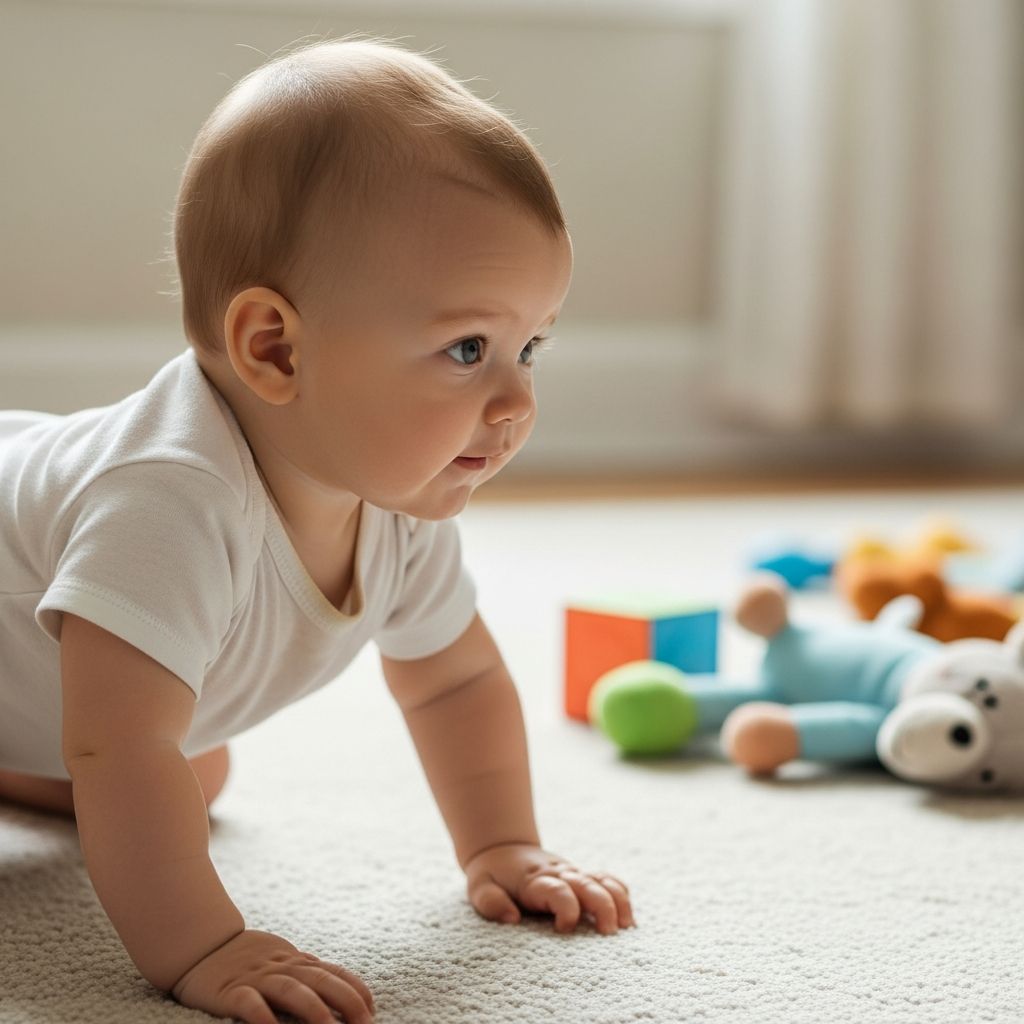
Between 7 and 8 months, belly crawling or commando crawling often emerges as babies use their arms to pull themselves across the floor while maintaining contact with their stomachs. This stage demonstrates significant progress in motor planning and strength development, even though it differs from the classic hands-and-knees pattern many parents envision.
Developmental Milestones from 6 to 12 Months
| Age Range | Typical Movement Pattern | Key Developments |
|---|---|---|
| 6-7 months | Rocking and pivoting | Building arm and leg strength; practicing coordination patterns |
| 7-8 months | Belly or commando crawling | Using arms to pull forward; developing directional awareness |
| 8-9 months | Backward crawling or hands-and-knees movement | Stronger leg muscles catching up to arm strength; increasing mobility speed |
| 9-10 months | Forward hands-and-knees crawling | Reciprocal arm and leg coordination; navigating obstacles |
| 10-12 months | Advanced crawling or cruising | Transitioning toward standing; preparing for walking |
Why Babies Crawl Backward Before Moving Forward
A fascinating developmental pattern observed in many babies involves backward movement preceding forward crawling. This occurs because infants’ upper body strength develops faster than their lower body strength during the first year of life. When babies begin coordinated movement, their powerful arm muscles naturally pull them backward as their leg muscles strengthen.
Backward crawling typically emerges around 8 months and usually transitions to forward movement within 2 to 4 weeks as leg strength increases. Parents often observe their babies appearing frustrated with backward motion, as they can see toys across the room but move away from them initially. This is a normal and temporary phase that represents appropriate development, not a cause for concern.
Alternative Movement Patterns and Atypical Crawling Styles
Not all babies follow the classic hands-and-knees crawling pattern that many parents expect. Infants demonstrate remarkable creativity and adaptability in finding movement solutions that work for their unique body mechanics and developmental readiness.
The “army crawl” or commando crawl represents one common variation, where babies remain belly-down while using their arms to drag themselves forward. Some babies adopt a “crab walk” pattern, moving sideways with hands and feet on the ground. Others practice “scooting” while sitting, propelling themselves forward with their hands while their legs remain in a seated position. These alternative patterns demonstrate that babies are problem-solving movement challenges in developmentally appropriate ways, even if they don’t match conventional expectations.
Research indicates that the specific crawling style a baby adopts doesn’t predict later physical capabilities or development. Babies who use unconventional patterns eventually achieve walking and running with typical coordination and strength. The variation in movement approaches reflects individual differences in body proportions, strength distribution, and learning preferences rather than developmental delays.
The Reality of Babies Who Skip Crawling Entirely
One of the most surprising findings in developmental research is that approximately 7% of babies skip the crawling stage entirely. These infants transition from sitting directly to standing and walking, completely bypassing any crawling phase. This outcome is not associated with later developmental problems or movement difficulties.
Babies who skip crawling typically move from supported sitting positions to pulling themselves up to stand, using furniture or adult support for balance. From this standing position, they progress to cruising along furniture and eventually walking independently. The motor planning and strength development achieved through standing and balance work provides sufficient preparation for walking, even without crawling practice.
Environmental factors significantly influence whether babies crawl. In climates with distinct seasons, babies born during winter months tend to crawl earlier because they reach the critical 6-month learning window during summer months when they wear lighter clothing and have more opportunities for floor play. Conversely, babies born in summer may delay crawling until the following spring when weather and clothing restrictions permit more ground-based exploration.
Environmental and Individual Factors Affecting Crawling Development
Multiple factors beyond developmental readiness influence when and how babies crawl. The physical environment, parental practices, cultural norms, and individual characteristics all play significant roles in shaping infant mobility patterns.
Environmental Influences
- Floor accessibility: Babies with regular, safe access to clean floor space for tummy time and exploration crawl earlier than babies restricted to playpens or carriers
- Clothing restrictions: Heavy clothing or cultural practices involving swaddling or restrictive wrapping can delay crawling onset
- Seasonal patterns: Warmer months facilitating outdoor play and lighter clothing correlate with earlier crawling initiation
- Surface variety: Exposure to different textures and slight inclines encourages motor experimentation and skill development
Individual Baby Characteristics
- Body composition: Babies with higher muscle mass or longer limbs may move differently than lighter or shorter infants
- Temperament: More cautious babies may take longer to attempt crawling, while adventurous infants move forward quickly
- Personality type: Some babies prefer observing before attempting new skills, extending the learning timeline
- Interest in mobility: Babies highly motivated by environmental exploration often achieve crawling faster than babies content with stationary play
Adjusted Age and Premature Infant Development
Babies born prematurely require special consideration when evaluating developmental milestones. Healthcare providers calculate developmental milestones using adjusted age rather than chronological age for infants born before 37 weeks of gestation.
Adjusted age is calculated by subtracting the number of months of prematurity from the baby’s chronological age. For example, a baby born 2 months early would be expected to achieve crawling around 10-12 months chronologically, or 8-10 months adjusted age. Using adjusted age provides accurate expectations and prevents unnecessary concerns about developmental delays in premature infants.
Healthcare providers typically recommend using adjusted age through the first 2 to 3 years of life for developmental evaluation. After this point, most premature babies align with age-matched peers, and chronological age becomes the appropriate reference point.
When to Seek Professional Evaluation
While variation in crawling timelines is completely normal, certain signs warrant professional evaluation. Parents should consult with pediatricians or developmental specialists if they observe concerning patterns in their baby’s overall movement development.
Signs Suggesting Professional Consultation May Be Appropriate
- Complete absence of intentional movement or weight-bearing by 10 months of age
- Significant asymmetry in arm or leg strength or coordination
- Inability to lift head and chest during tummy time by 5-6 months
- Persistent difficulty with balance or coordination beyond expected ranges
- Loss of previously acquired skills or motor regression
- Lack of interest in or curiosity about environmental exploration
- Stiffness or low muscle tone that impedes movement attempts
Early intervention services exist in all regions and can provide free or low-cost developmental evaluations for infants under 3 years old. These services focus on identifying developmental concerns early and providing family-centered support when appropriate.
Supporting Infant Mobility Development
Parents can encourage healthy motor development through simple, enjoyable practices that provide opportunities for movement and exploration without pressure or forcing specific milestones.
Creating an Environment That Promotes Movement
- Provide regular, supervised tummy time beginning in infancy, gradually increasing duration and frequency
- Offer a safe, clean floor space free from hazards where babies can move freely
- Dress babies in comfortable, non-restrictive clothing that permits full range of motion
- Minimize time spent in restrictive devices like bouncers, swings, or playpens during waking hours
- Create an engaging environment with toys positioned slightly out of reach to encourage reaching and movement
- Vary floor surfaces and environments to provide novel sensory and physical challenges
Interactive Practices Supporting Crawling Development
- Play alongside your baby on the floor, modeling movement and demonstrating exploration
- Provide verbal encouragement without pressure, celebrating effort and experimentation
- Use toys and objects positioned strategically to motivate movement across space
- Offer hand support or light guidance only when babies genuinely need stability assistance
- Allow adequate time for movement practice without rushing toward specific developmental endpoints
- Engage in playful interactions that build baby’s confidence and comfort with their moving body
Timeline from Crawling to Walking
Crawling represents one phase in a continuous progression toward independent mobility rather than an endpoint in itself. The timing of the transition from crawling to walking varies significantly among infants.
Research on American babies indicates that the average time between beginning crawling and taking first independent steps is approximately 4 months. However, this represents an average across a wide range. Some babies progress from crawling to walking within a few weeks, while others spend 6 months or longer perfecting crawling skills before attempting standing and walking. In rare cases, babies have been documented learning to crawl and walk on the same day, demonstrating the remarkable variability in typical development.
Cruising along furniture typically emerges around 9-10 months as babies gain confidence and strength in their legs. This intermediate stage provides practice in standing balance and weight-bearing that prepares for independent walking. The progression from crawling through cruising to walking represents the natural evolution of infant mobility, though the pace varies considerably among individual babies.
Frequently Asked Questions
Is it concerning if my baby isn’t crawling by 9 months?
No, not necessarily. Crawling typically occurs between 6 and 12 months, so 9 months falls within the normal range. As long as your baby demonstrates emerging motor skills like rocking, pushing up, or rolling, development is likely progressing appropriately. Monitor overall movement patterns and consult your pediatrician if you observe concerning signs in overall development.
Will my baby have coordination problems later if they skip crawling?
No. Research shows no connection between skipping crawling and later coordination difficulties or developmental delays. Babies who transition directly from sitting to standing and walking develop typical coordination and movement skills. The key is overall motor development progression, not specific milestone achievement.
How much tummy time does my baby need to develop crawling?
Newborns benefit from brief, frequent tummy time sessions throughout the day. By 3-4 months, aim for 5-10 minute sessions several times daily. Between 5-6 months, extend sessions to 15-20 minutes as your baby builds strength. The goal is gradual progression based on your baby’s comfort and readiness, not rigid time requirements.
Does my baby’s crawling style matter if they’re moving forward?
No. Whether your baby uses a commando crawl, hands-and-knees crawling, crab walking, or any other variation, the movement demonstrates healthy development. Different styles reflect individual differences in body mechanics and learning preferences, not developmental problems.
Should I be concerned if my baby crawls backward longer than expected?
No. Backward crawling typically precedes forward crawling by 2-4 weeks as leg strength develops. Continued backward movement is normal and temporary, representing appropriate strength development rather than a concern.
What should I do if my baby shows no interest in crawling?
Provide a safe, inviting environment with opportunities for floor play and movement exploration. Allow your baby to progress at their own pace without pressure. If your baby reaches 12 months without any forward movement attempts, consult your pediatrician for evaluation and guidance.
References
- Baby Crawling Stages: 7 Development Milestones — Mamazing. 2024. https://www.mamazing.com/blogs/guides/baby-crawling-stages-7-development-milestones
- When do babies crawl, and how does it develop? — Parenting Science. 2024. https://parentingscience.com/when-do-babies-crawl/
- When do babies start crawling: 6 tips to encourage crawling — Huckleberry Care. 2024. https://huckleberrycare.com/blog/when-your-baby-starts-crawling
- Steps Toward Crawling — ZERO TO THREE. 2024. https://www.zerotothree.org/resource/steps-toward-crawling/
- When Do Babies Start Crawling? — Lurie Children’s Hospital. 2024. https://www.luriechildrens.org/en/blog/when-do-babies-start-crawling/