Cheerios and similar oat rings are often one of the first snacks parents think about when their baby begins eating finger foods. But deciding when to offer them, how to serve them, and which versions are safest requires some attention to developmental milestones, nutrition, and choking risks.
This guide walks you through readiness signs, safety considerations, and practical tips so you can confidently decide when Cheerios fit into your baby’s feeding journey.
Typical Age Range vs. Developmental Readiness
Many babies are ready to try small, dry finger foods like plain oat rings sometime between about 7 and 12 months, depending on their skills. Some pediatric and nutrition sources suggest that most babies who are otherwise feeding on schedule can handle Cheerios around 9–12 months, although some are ready slightly earlier. The exact age matters less than your baby’s abilities.
Key Readiness Signs
Before offering Cheerios, look for these developmental cues that indicate your baby is ready for this type of food:
- Sits upright independently with good head and neck control, without slumping to the side or forward.
- Has lost the tongue-thrust reflex (no longer automatically pushes food out of the mouth with the tongue).
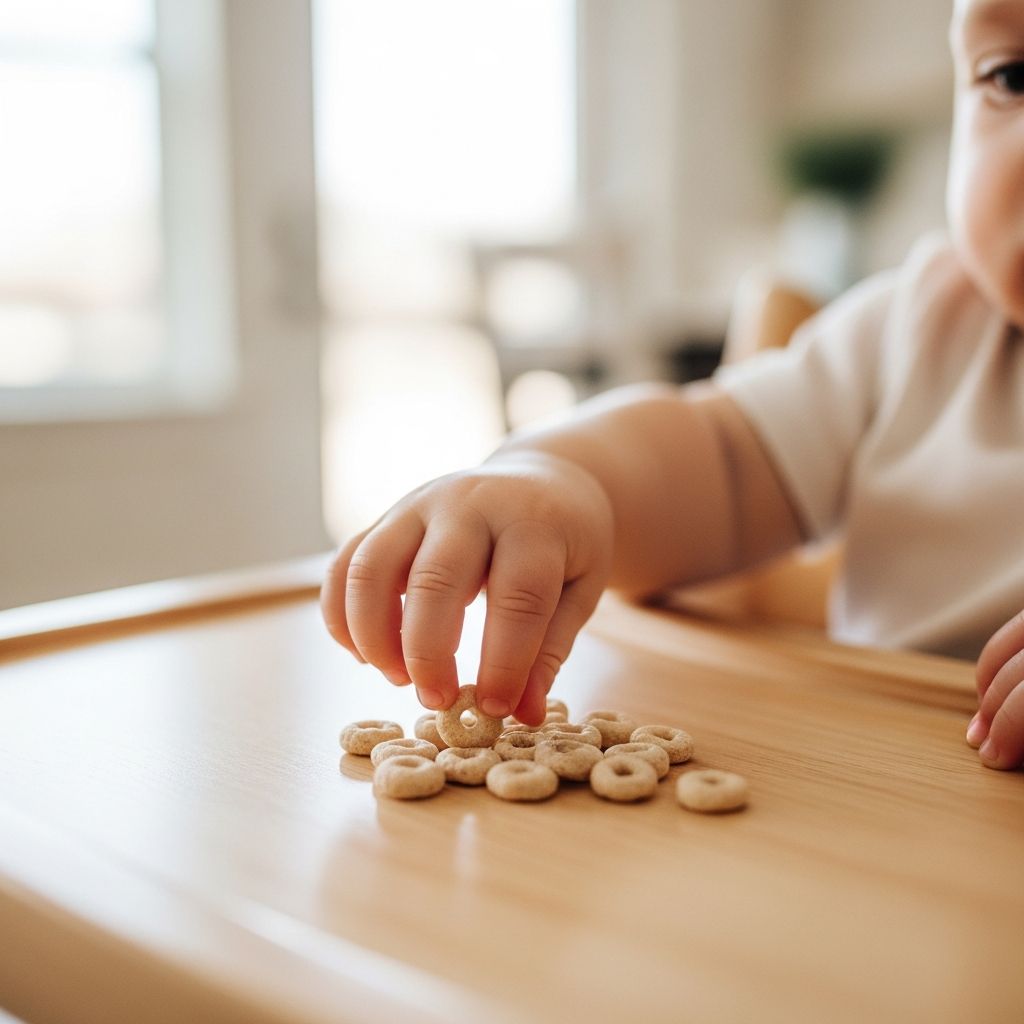
- Uses a pincer grasp, picking up small objects between the thumb and index finger rather than raking with the whole hand.
- Shows interest in food, leaning toward the table, opening the mouth, or reaching for what others are eating.
- Can bring food to the mouth and release it into the mouth intentionally.
- Demonstrates basic chewing or munching motions with gums or early teeth, even if not fully efficient yet.
These skills matter more than the calendar. A 10-month-old who still cannot sit steadily or pick up small items is not ready for Cheerios, while a 7–8-month-old with strong skills may be able to handle them under close supervision.
Age Guidelines at a Glance
| Baby Age | Typical Feeding Stage | Cheerios Readiness |
|---|---|---|
| 0–5 months | Breast milk/formula only | Too early; no solids yet |
| ~6 months | Beginning purees or soft solids | Usually not ready for dry cereal rings |
| 7–9 months | More experience with solids, starting finger foods | Some babies ready if milestones are met |
| 9–12 months | Increasing finger foods and textures | Many babies ready if they chew and sit well |
Are Cheerios a Choking Hazard?
Any solid food can be a choking risk if a baby is not developmentally ready or is left unsupervised. However, plain oat rings are generally considered a relatively low-risk finger food for babies who meet the milestones above because they soften with saliva and can be mashed with gums.
Why Development Matters More Than the Food
Choking is most often related to how a baby eats—posture, chewing ability, and size of bites—rather than the specific brand of cereal. Safe feeding organizations and pediatric dietitians emphasize that babies need to be seated upright, supervised, and offered foods that match their oral motor skills.
Research on commercial baby finger foods has found that oat rings are among the products that become soft and mashable after exposure to saliva, which decreases choking risk compared with hard, non-dissolvable snacks. Still, even with dissolvable foods, your baby must be watched within arm’s reach.
Practical Safety Tips
- Only offer Cheerios when your baby is fully awake and upright, strapped in a high chair.
- Stay at the table with your baby and avoid multitasking; be close enough to intervene quickly.
- Start with a small handful on the tray instead of filling the bowl, to discourage overstuffing the mouth.
- If your baby repeatedly gags hard, coughs excessively, or seems distressed, pause and reassess readiness.
- Avoid feeding in the car seat or stroller, where supervision and positioning are less ideal.
Plain vs. Flavored Cheerios: The Honey Question
Parents often wonder if honey-flavored cereals, such as Honey Nut varieties, are safe for babies. The concern stems from the well-known recommendation to avoid honey during infancy because of the risk of infant botulism.
Why Honey Itself Is Unsafe for Babies
Honey can contain spores of Clostridium botulinum, the bacterium that produces a toxin causing infant botulism, a rare but serious illness that can lead to muscle weakness, difficulty feeding, and breathing problems. Because infants under 12 months have immature digestive systems, they are especially vulnerable to this toxin. Public health authorities and pediatric experts consistently advise avoiding honey during the first year of life.
What About Honey-Flavored Cereals?
There is more nuance when it comes to processed foods containing small amounts of honey:
- Some pediatric sources recommend avoiding any honey-containing products (including honey-flavored cereals) until after 12 months as a simple, conservative rule.
- Other pediatricians note that the tiny amounts of honey in highly processed foods, which undergo manufacturing and heat treatments, are far less likely to cause illness, and that isolated accidental exposures are unlikely to be harmful.
To keep things simple and safest, many families choose to:
- Offer only plain oat rings in the first year.
- Introduce honey-flavored varieties and other products with honey as an occasional food after 12 months, once a child has a more mature gut and immune system.
Nutritional Considerations of Cheerios for Babies
Plain oat rings can be a useful snack or meal component, but they should not replace more nutrient-dense core foods like breast milk, formula, iron-rich meats, beans, vegetables, fruits, and fortified cereals designed for infants.
Pros of Plain Oat Rings
- Mostly whole-grain oats, which provide some fiber and complex carbohydrates.
- Typically low in sugar compared with many flavored cereals and cookies.
- Often fortified with vitamins and minerals, depending on the brand and region.
- Convenient, portable, and easy for babies to grasp and self-feed.
Points to Watch
- Sodium: Babies have very low sodium requirements; excess salt early in life may encourage a preference for salty foods later. One analysis notes that babies 7–12 months should stay below roughly 370 mg of sodium per day, while a toddler-size portion of plain oat rings (about 1½ cups) can provide roughly half of that. Check labels and keep portions modest.
- Added sugar: Flavored varieties are usually higher in sugar. Aim to limit added sugars in the first two years of life, as recommended by many dietary guidelines.
- Not a complete meal: Oat rings are a snack or side, not a replacement for protein, iron, fat, and other nutrients babies need for growth.
Step-by-Step: Introducing Cheerios for the First Time
Once your pediatrician agrees your baby is developmentally ready, you can use this simple progression to make the first Cheerios experience smoother.
- Confirm skills
Make sure your baby can sit steadily in a high chair, grasp small pieces between thumb and finger, and move food around in the mouth without constant gagging. - Choose plain, low-sodium cereal
Start with unsweetened oat rings. Check that the ingredient list is short and that sodium and sugar are relatively low for the portion you intend to offer. - Offer after they are calm and slightly hungry
Try mid-morning or mid-afternoon rather than when your baby is exhausted or extremely hungry. Serve water in an open cup or straw cup if your pediatrician recommends it. - Place a few pieces on the tray
Begin with 4–6 Cheerios on the tray. Let your baby explore, pick up, and mouth them at their own pace. - Observe closely
Expect occasional gagging as a normal protective reflex while learning new textures. Persistent distress, coughing without quick recovery, or difficulty breathing require immediate attention. - Gradually increase amount and frequency
If your baby manages the cereal well over several attempts, you can use small portions of Cheerios as part of snacks or meals a few times per week.
Allergies and Sensitivities
Plain oat rings are usually made primarily from oats. Oats are not among the most common childhood food allergens, which are dominated by foods such as cow’s milk, egg, peanut, tree nuts, soy, wheat, fish, and shellfish. However, any food can potentially trigger an allergic reaction.
Signs of a Possible Food Allergy
After introducing a new food like Cheerios, watch for symptoms appearing within minutes to a couple of hours:
- Hives, redness, or a new rash
- Swelling of the face, lips, or tongue
- Vomiting, repetitive coughing, or wheezing
- Sudden lethargy, paleness, or difficulty breathing
Any signs of breathing difficulty, facial swelling, or collapse are a medical emergency and require urgent care. For milder skin-only reactions, contact your pediatrician promptly for guidance.
Because Cheerios sometimes include trace amounts of other grains depending on the manufacturing line, be especially cautious if your baby has a known allergy to wheat or other cereals and discuss label reading with your allergist or pediatrician.
Cheerios vs. Other First Finger Foods
Parents don’t have to start with oat rings as the very first finger food. Some feeding specialists prefer to begin with very soft items or fast-dissolving puffs and move to harder textures later.
| Food Type | Pros | Considerations |
|---|---|---|
| Baby puffs | Very fast dissolving; good for early self-feeding practice. | Often low in nutrients; can still be overused as a “filler” snack. |
| Plain Cheerios / oat rings | More texture for chewing practice; low sugar; whole grain. | Require some chewing ability; not ideal for very early feeders. |
| Soft fruits & veggies | Nutritious; can be cut into safe, soft pieces (e.g., ripe avocado, soft sweet potato). | Need careful preparation to avoid large, slippery chunks. |
Frequently Asked Questions (FAQs)
Q1: What is the earliest age my baby can try Cheerios?
Most babies who are otherwise on track for feeding can handle plain Cheerios sometime between about 7 and 12 months, typically closer to 9–12 months. Focus on signs like sitting independently, pincer grasp, and chewing motions rather than a specific birthday.
Q2: How do I know if my baby is choking vs. gagging?
Gagging is noisy; your baby may cough, sputter, or make faces, but can breathe and usually recovers quickly. It is a protective reflex as they learn to manage textures. Choking is silent or nearly silent, and the baby may be unable to cry or cough effectively, with signs of distress or color change. All suspected choking requires immediate action and emergency help.
Q3: Can I soften Cheerios in milk or water for my baby?
You can let oat rings sit briefly in breast milk, formula, or a small amount of water so they soften more quickly, but they should still be easy to grasp. Avoid serving a bowl of cereal with a lot of liquid to younger babies, as they may struggle to manage both liquid and solid safely at once.
Q4: Are gluten-free or organic versions better for babies?
The best choice depends on your baby’s specific needs. If your child has celiac disease or wheat allergy and your pediatrician recommends avoiding gluten, choose certified gluten-free oat cereals and read labels carefully. Organic options may reduce exposure to some pesticide residues, but they are not automatically lower in sugar or sodium, so always check the nutrition facts.
Q5: How often can my baby eat Cheerios?
Cheerios can be one of several snacks or meal components during the week, but they should not crowd out more nutrient-dense foods. Think of them as a convenient, occasional finger food for practicing self-feeding and chewing, while prioritizing fruits, vegetables, proteins, and iron-rich foods at most meals.
References
- When Can Babies Eat Cheerios? — SneakPeek / Gateway Genomics. 2022-08-02. https://sneakpeektest.com/blog/when-can-babies-eat-cheerios/
- When can Babies Eat Puffs, Cheerios, & Other Foods Safely? — Your Kid’s Table (Alisha Grogan, OT). 2021-03-15. https://yourkidstable.com/when-can-babies-eat-cheerios/
- When Can Babies Have Cheerios? — Malina Malkani, MS, RDN, CDN. 2023-01-10. https://www.malinamalkani.com/blog/when-can-babies-have-cheerios
- When Can Babies Eat Cheerios? — Today’s Parent. 2020-09-17. https://www.todaysparent.com/baby/when-can-babies-eat-cheerios/
- I accidentally gave Honey Nut Cheerios to my baby! — Advocare Fairmount Pediatrics (Alexis Lieberman, MD). 2021-06-01. https://www.advocarefairmountpediatrics.com/i-accidentally-gave-honey-nut-cheerios-to-my-baby-by-dr-alexis-lieberman