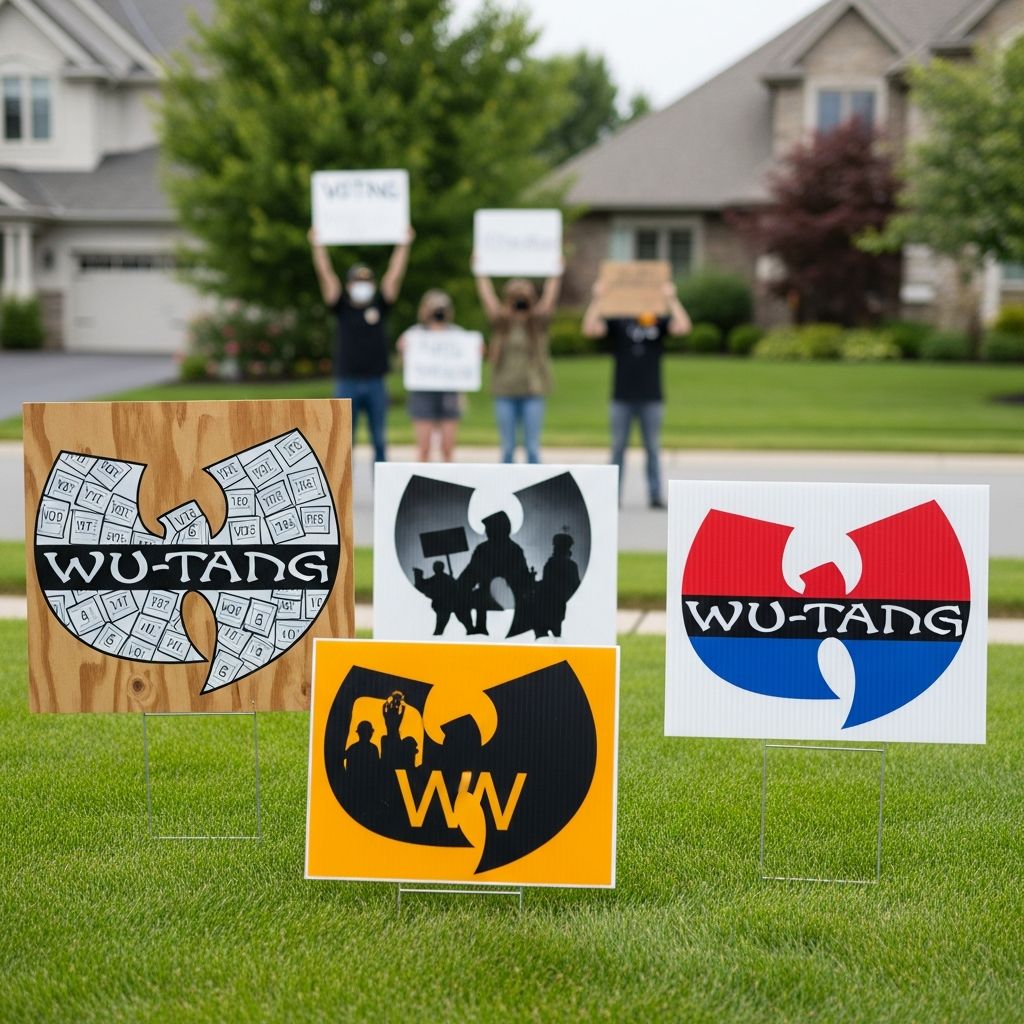
In recent election seasons, a peculiar trend has appeared on suburban lawns: novelty yard signs that swap candidate names for pop culture references, including the now-famous declaration that presidents are temporary but Wu-Tang is forever.
At first glance, these signs feel clever and harmless, yet beneath the joke lies a deeper story about political disengagement, cultural appropriation, and who can afford to treat elections as entertainment.
Beyond the Joke: What These Yard Signs Really Say
Novelty political signs work because they borrow the visual language of serious campaign signage and then twist it just enough to get a laugh. The colors, typefaces, and layout mirror official election branding, but the message shifts from endorsing a candidate to making a cultural in-joke.
This mash-up does more than deliver a punchline. It subtly communicates a position about politics itself: that the whole process is absurd, futile, or not worth engaging in with full seriousness.
- They signal an insider sense of humor to like-minded neighbors.
- They imply skepticism about both major parties or the system as a whole.
- They replace a clear political stance with a cultural identity claim.
Why Wu-Tang? The Power of Borrowed Cool
The use of Wu-Tang in yard signs is not random. The group carries a legacy of gritty storytelling, social commentary, and unapologetic Black cultural expression. When that legacy is repackaged as a novelty sign for suburban lawns, something important shifts.
What started as music rooted in struggle and marginalization becomes a decorative prop in neighborhoods where residents are often far removed from those original conditions.
- Wu-Tang embodies a longstanding critique of power structures and inequality.
- Suburban novelty signs flatten that critique into a catchy slogan detached from context.
- The symbolism moves from resistance to aesthetic—cool branding with little risk.
Humor, Distance, and Who Gets to Laugh
Political humor can be a vital tool for survival, especially for communities that face constant pressure. Satire has long been a way to challenge leaders and expose hypocrisy without directly holding formal power.
Yet not all humor functions the same way. When people with more social and economic security joke about elections, the stakes of that joke are very different from those for people whose lives will be directly shaped by policy outcomes.
- For vulnerable groups, elections can influence health care access, policing, and basic safety.
- For more insulated groups, elections may register more as a spectacle or a source of social tension to be defused with jokes.
- The same joke can be cathartic for some and dismissive for others, depending on who is laughing and why.
Privilege on the Lawn: Who Can Opt Out?
The ability to display a clever, noncommittal sign instead of a real political endorsement is itself a form of privilege. It assumes that, no matter who wins, your basic quality of life will remain relatively stable.
In many affluent neighborhoods, residents are buffered from some of the harshest consequences of policy decisions by wealth, job flexibility, and social networks. This buffer makes it easier to treat an election as background noise rather than an urgent turning point.
Markers of this “electoral distance” often include:
- Stable jobs that can be performed remotely or with strong workplace protections.
- Health insurance and savings that cushion medical or economic shocks.
- Minimal direct involvement with systems such as immigration enforcement, over-policing, or precarious housing.
- Social circles where most people share similar levels of security and outlook.
In that context, the novelty sign is less about defiance of power and more about signaling comfort: a way of saying, “This is all ridiculous, but we will be okay regardless.”
From Protest to Performance
Yard signs can serve many roles: clear political endorsement, quiet protest, community-building, or even personal branding. Novelty signs occupy a strange middle ground. They look like protest but function more like performance.
The message may be anti-establishment, but the act of displaying it is often low-risk, especially in communities where similar humor is socially rewarded and rarely challenged.
- They allow residents to present themselves as savvy, ironic observers of politics.
- They can shield people from difficult conversations about actual policies and candidates.
- They may even serve as a social filter, attracting like-minded neighbors while distancing those who expect more explicit solidarity.
Serious Stakes, Playful Signals
Every election shapes real lives, but some years make that reality impossible to ignore. High death tolls from disease, rising authoritarian rhetoric, and repeated assaults on civil rights raise the cost of political ambivalence.
In those moments, replacing a concrete endorsement with a joke sign can feel jarring. It sends a message—not only about humor, but about how far a person feels from the immediate fallout of public decisions.
- For some, the sign is a coping mechanism for overwhelming news and polarization.
- For others, it reads like a refusal to acknowledge the gravity of what is at stake.
- The gap between those perspectives often tracks along lines of race, class, and proximity to harm.
When Pop Culture Masks Political Silence
Using a legendary hip-hop group as a stand-in for a political statement is appealing because it feels safer than choosing a candidate. It gestures toward edge and rebellion without requiring concrete commitments.
But that substitution comes at a cost: it can mask a deeper form of political silence behind the language of taste and fandom.
| Element | Cultural Meaning | Political Function on a Lawn Sign |
|---|---|---|
| Wu-Tang name and logo | Symbol of hip-hop innovation, Black artistry, and resistance | Signals coolness and insider status without naming policy priorities |
| Parody of campaign design | Visual joke on standard election branding | Conveys cynicism about both parties and the campaign process |
| Absence of a real candidate | Refusal to participate in traditional political promotion | Creates ambiguity about actual voting intentions or values |
| Placement in affluent neighborhoods | Expression of taste within a relatively secure environment | Highlights that some can afford symbolic gestures where others cannot |
Is Political Humor Always a Problem?
Humor itself is not the issue. Jokes and satire have fueled powerful movements, toppled corrupt leaders, and kept people going through unbearable conditions. The question is not whether we should laugh, but what our laughter allows us to avoid.
A joke sign can either open the door to deeper conversations or slam it shut. It can be an invitation—”this is absurd, let’s talk about why”—or a shield—”this is absurd, so there’s no point in talking at all.”
Questions worth asking about joke-based political expression include:
- Does this humor punch up at power or down at those most affected by it?
- Does it spark conversations about concrete action or replace them?
- Would displaying this sign feel equally safe for someone without economic or racial privilege?
- Am I using this joke to connect with others or to protect myself from discomfort?
Taking Elections Seriously Without Abandoning Joy
It is possible to recognize the absurdities of politics and still treat elections with the seriousness they demand. The goal is not to drain public life of humor, but to use humor in ways that reinforce solidarity instead of erasing urgency.
People who enjoy novelty signs and political jokes can still anchor their public lives in action and clarity.
Constructive alternatives to purely novelty yard signs
- Pair a humorous sign with a real candidate sign or policy-focused message.
- Use the joke as an icebreaker for deeper conversations with neighbors about voting, local races, and community needs.
- Donate to organizations aligned with the cultural figures you reference, especially when drawing on Black art and activism.
- Volunteer, phonebank, or support mutual aid efforts so that your humor sits alongside tangible engagement.
Respecting the Roots of the Culture We Reference
When suburban homeowners borrow Wu-Tang’s iconography for jokes, they step into a cultural lineage shaped by inequality, policing, and economic exclusion. Treating that legacy as mere design deprives it of the history that made it powerful in the first place.
Respecting the culture means more than knowing a few song titles. It means listening to the stories, acknowledging the conditions that produced the art, and recognizing when your own safety depends on structures that others have spent decades resisting.
- Ask what it means to profit from or aestheticize symbols rooted in other people’s struggle.
- Consider whether your public displays of fandom align with or undermine the values those artists represent.
- Support living artists and communities through money, advocacy, and amplification—not just references.
Frequently Asked Questions
Are novelty political yard signs inherently bad?
Not necessarily. A novelty sign can offer comic relief, spark curiosity, or even soften the ground for difficult conversations. The problem appears when jokes become a substitute for any clear position, especially for people who are least impacted by harmful policies.
Can a Wu-Tang yard sign still be a form of protest?
In some cases, yes. For a person deeply engaged in politics, who also honors the roots of hip-hop culture and uses that sign as part of a broader pattern of action, the statement can carry real weight. But when it appears in isolation—without activism, voting, or solidarity—it risks functioning more as decoration than defiance.
Is it wrong to enjoy political jokes during serious times?
Enjoying humor is not wrong; it is human. The key is to stay aware of context. In times of crisis, people who are secure have a responsibility to remember that what feels like a stressful news cycle to them may be a matter of survival for others. Humor should not replace empathy or engagement.
What can I do if I like the sign but feel conflicted about what it represents?
Use that tension as a starting point. If you keep or display the sign, pair it with meaningful action: research candidates, vote consistently, talk with friends and family about issues that matter, and support communities whose cultural output you enjoy. Let the sign be a reminder that style should be backed up with substance.
How can homeowners avoid turning politics into a performance?
The simplest approach is to align visible symbols with lived choices. If a yard displays a message about justice, equity, or cultural pride, the household can commit to reflecting those values in how they vote, spend, and show up for others. When actions match aesthetics, public expression becomes less about performance and more about integrity.
From Clever to Conscious
Novelty Wu-Tang yard signs capture a certain mood: exhausted, skeptical, and desperate to find humor in a relentless stream of political drama. That mood is understandable, but the conversation cannot stop there.
In a world where some people’s safety hinges on election outcomes and others can shrug them off, it matters who gets to treat the process as a joke. The challenge is not to abandon wit, but to move from clever to conscious—using every sign, slogan, and pop culture reference as an opportunity to stand closer to those with the most to lose.