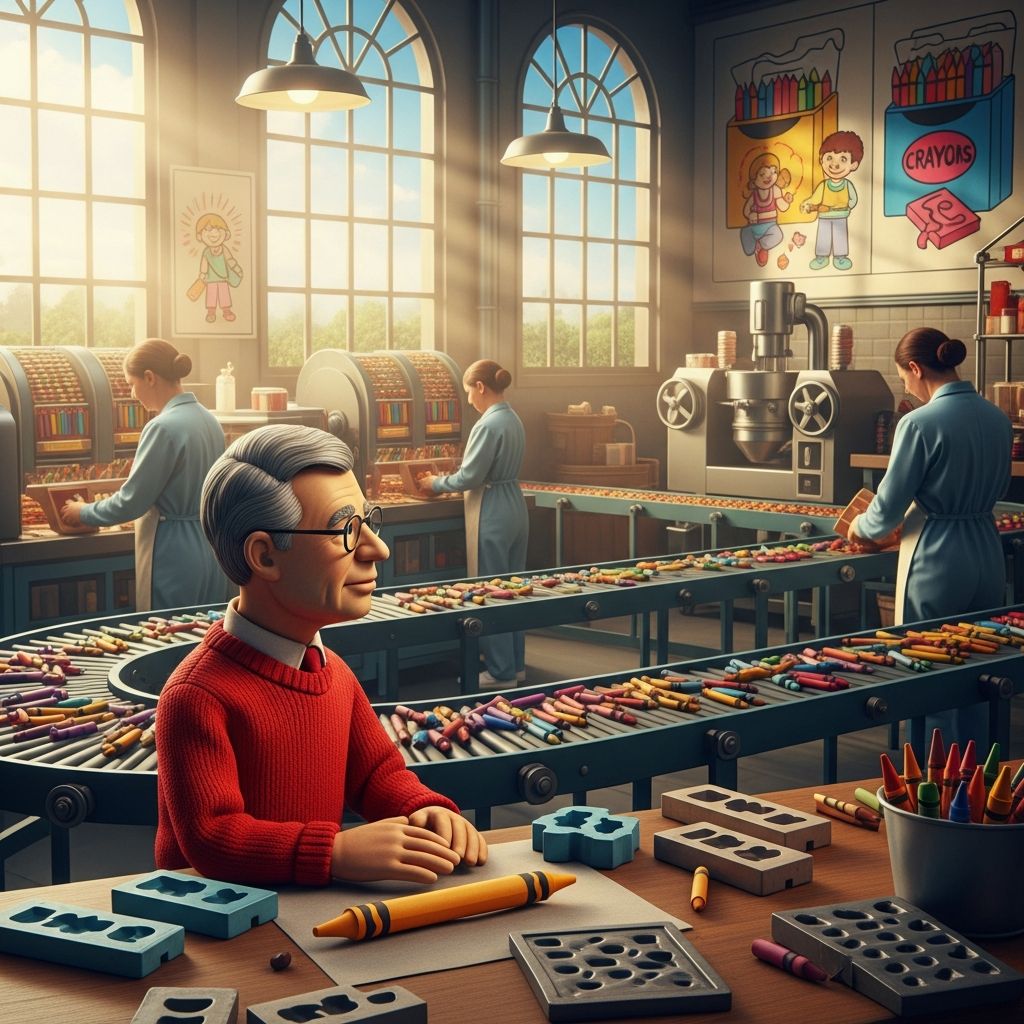
For many adults, one of the most vivid childhood memories is a gentle man in a cardigan introducing a short film about how crayons are made. That simple sequence, tucked into an episode of a children’s show, quietly shaped how an entire generation thought about work, creativity, and what it means to be part of a community.
More Than Wax and Color: Why That Factory Visit Stuck
On the surface, the crayon factory visit was a straightforward demonstration: machines, molds, labels, and boxes moving down a line. Beneath that, it framed work as something almost magical—an ordered, purposeful process through which ordinary people turn raw materials into objects that help children draw their worlds. For a young viewer, it was the first glimpse that behind every simple object lives a long, intentional story.
Many adults who watched that segment as children now remember not just the images but the feeling: the slow pacing, the close-up shots of hands, and the respect with which every step was shown. In a culture that increasingly prizes speed, that memory stands out precisely because it refused to rush.
- It made work visible instead of invisible.
- It honored the workers behind everyday objects.
- It treated children as capable of real, sustained attention.
What a Crayon Teaches About the Nature of Work
At the heart of that visit is a vision of work that feels almost countercultural now. Work is shown not as drudgery, nor as a glamorous performance, but as a steady collaboration of people and machines, governed by patterns, rhythms, and care. The factory line becomes a visual metaphor for how purposeful effort can bring order out of chaos.
In that world, each job matters. The person who pours the wax, the one who checks the color, the one who packs the boxes—everyone is framed as contributing to something children will love and use. That sense of shared purpose is a powerful antidote to the cynicism so many adults feel toward their own jobs today.
| Aspect | Implied in the Crayon Factory | Common Modern View |
|---|---|---|
| Purpose | Work serves a clear, tangible human need—helping kids create. | Work often feels abstract, disconnected, or purely financial. |
| Tempo | Deliberate, rhythmic, and repeatable. | Fast-paced, constantly shifting, always “on.” |
| Visibility | Process is transparent and knowable. | Much of the work is digital, invisible, and confusing to kids. |
| Human role | People are central and skilled. | Often overshadowed by automation and algorithms. |
How Slow TV Built Deep Curiosity
Today’s children live in an attention economy built on bright thumbnails and rapid edits. Against that backdrop, the factory film’s slow, unhurried style feels almost radical. By lingering on conveyor belts, close-ups of molten wax, and the quiet choreography of workers, it teaches children to look closely rather than just glance.
This “slow TV” approach assumes several things about children. It assumes they are capable of wonder without constant stimulation, that they can follow a process from start to finish, and that they deserve to see the world as it truly is, not only as a cartoon version. That respect is part of what made the sequence so memorable—and what many parents find themselves craving for their own kids.
- No voice shouting over the images, just gentle guidance.
- No jokes at the workers’ expense, only quiet admiration.
- No skipping steps; the process unfolds in real time.
From Crayon to Child: Making Feelings Visible
Crayons are not just tools; they are an early language. Children use them to draw homes, monsters, dreams, and fears that they cannot yet put into words. By showing how crayons come to life, the factory visit implicitly validates that inner world. It says, “What you draw matters enough that grown-ups devote entire factories to the tools you use.”
That message dovetails with a broader view of emotional life: every feeling is allowed, and every feeling can be expressed. When a child learns that a crayon begins as colorless wax and ends as a bright stick of possibility, it becomes easier to imagine that their own confusion or sadness might be shaped into something understandable too.
- Crayons turn invisible feelings into visible shapes.
- The factory dignifies children’s inner lives by dignifying their tools.
- Parents can echo this by asking, “Tell me about your drawing,” instead of judging it.
Parents Today: Caught Between Nostalgia and Burnout
For many adults who grew up with that crayon film, life now feels far less ordered. Work arrives as an endless stream of emails and notifications, not as a neat line of wax and labels. The promise that hard work would make things simpler, or that effort would always lead to stability, has often collided with layoffs, gig work, and a blurry boundary between home and office.
This is one reason the memory of a calm, comprehensible factory line hits so hard: it represents a childhood belief that the world could be understood, step by step. When adults rewatch it, they may feel a mix of comfort and grief—comfort at remembering that ordered world, grief that their daily reality feels messier and more precarious.
Translating Factory Calm Into Family Life
Parents cannot turn their homes into perfectly ordered assembly lines, nor should they try. But they can borrow some principles from that quiet factory tour to make family life feel a little more coherent and humane. The goal is not control; it is clarity.
Consider these simple, practical applications:
- Make processes visible at home. Instead of chores “just happening,” walk kids through how laundry, meals, or budgeting work, step by step.
- Slow down one daily ritual. Choose one routine—bedtime, breakfast, or cleanup—and intentionally move at half speed, explaining and involving kids in each step.
- Connect work to people, not just outcomes. When talking about your job, describe who it helps and how, not only that it “pays the bills.”
Helping Kids See the People Behind Products
One enduring gift of the crayon factory sequence is that it humanized production. Children saw that behind every box on a store shelf stand workers, machines, and choices. In an age of one-click ordering, this lesson is easy to lose—and important to recover.
Parents can cultivate that awareness through small, concrete conversations:
- When opening a package, wonder aloud together about who designed, built, and shipped it.
- Visit local businesses or maker spaces where children can talk to people who create with their hands.
- Encourage gratitude for workers children never meet—the delivery drivers, stockers, farmers, and factory teams behind everyday items.
Explaining Modern Work to Children
If a crayon factory makes work easy to visualize, many modern jobs do not. Writing code, answering emails, managing projects, or doing remote consulting can feel invisible even to the adults doing them, much less to their kids. Yet children still crave the same kind of clear, step-by-step understanding the factory film offered.
Parents can bridge this gap by thinking like that quiet narrator in the background of the tour: describe what is happening, why it matters, and how it helps others. Turning abstract work into a story helps children feel less shut out of adult life.
| Adult Job Feature | Child-Friendly Explanation Style |
|---|---|
| Answering emails | I’m sending messages so people know what to do next, like giving instructions in a game. |
| Writing code | I’m telling the computer how to do a job, step by step, just like the machines in a factory. |
| Project management | I’m helping a group of people work together so nothing gets forgotten, the way workers followed steps in the crayon line. |
Why Respectful TV Still Matters
The crayon factory visit represents a kind of respect for children that is rare on screens today. It assumes that they deserve honesty, that they can handle real images of work, and that their attention is worth cultivating rather than exploiting. It refuses to treat children as tiny consumers who must be constantly entertained.
For modern parents, revisiting that segment can serve as a quiet standard. When choosing media, the question becomes not only “Is this fun?” but “Does this see my child as a full person?” Programs and videos that slow down, explain, and dignify real people’s work still stand out—and still leave the deepest mark.
Reclaiming Wonder in a High-Speed World
When adults recall the crayon factory, what often surfaces is not a particular machine but a particular feeling: the sense that the world was both understandable and enchanted. Things did not appear out of nowhere. They emerged from places with smells, sounds, and people whose names might be unknown but whose presence could be felt.
Parents can reclaim a piece of that wonder by looking for the stories behind the objects already in their homes. A loaf of bread, a smartphone, a backpack, a pair of shoes—all are the end point of long, complex processes that, when described in simple language, can make a child’s world feel richer and more connected.
Practical Ideas: Bringing “Crayon Factory Thinking” Home
To make these ideas concrete, here are a few family-friendly activities inspired by the spirit—not the details—of that factory visit. They require very little preparation but can create lasting conversations about work, creativity, and care.
- Kitchen “factory tour.” The next time you cook together, narrate the process from raw ingredients to finished meal, letting your child “tour” each station: washing, cutting, mixing, heating, serving.
- Object origin stories. Pick one object a week—a toy, a snack, a household item—and research, at a child’s level, how it is made and who makes it.
- Process drawings. Invite your child to draw not only finished things (a house, a car) but steps in a process (planting a seed, building a tower, baking bread).
- Thank-you notes to unseen workers. Write or draw simple notes for mail carriers, custodians, or grocery workers to highlight the value of behind-the-scenes labor.
- Family “how things work” night. Once a month, let each family member explain something they know how to do—tying shoes, fixing a bike, editing a video—as if they were giving a mini factory tour.
Frequently Asked Questions
Why did the crayon factory segment feel so different from other kids’ TV?
It stood out because it moved slowly, showed real workers doing real tasks, and assumed children could follow a process without constant jokes or noise. Instead of using bright chaos to capture attention, it invited quiet focus and curiosity, which many viewers now associate with a rare feeling of calm.
What can parents learn from that factory visit today?
Parents can learn to make their own work more transparent, to respect their children’s attention spans, and to connect everyday objects to the people who make them. The segment is a reminder that explaining the world slowly and clearly can build both trust and wonder.
How can I explain my modern job to my child in a similar way?
Break your job into simple, visible steps, just as a factory film would: who you help, what you make easier, and what a typical “start-to-finish” task looks like. Using analogies—like comparing project steps to stations on a factory line—helps children picture what you do even if they cannot see your actual work.
Is it helpful to show kids old factory tours like this?
Yes, many children respond well to slower, process-based films because they relieve the pressure of constant stimulation and encourage observation. Pairing a viewing with hands-on activities—like drawing, building, or visiting a local workshop—can deepen the impact and show that the world is full of understandable systems.
How does this relate to helping kids manage big feelings?
Crayons give children a safe way to express emotions they cannot yet name, and seeing how crayons are made reinforces the idea that tools for expression are important. When parents respond with curiosity rather than criticism about what their children draw, they echo the same respect the factory segment showed for both work and imagination.
Coloring Outside the Lines of Nostalgia
The crayon factory sequence is not just a comforting relic; it is a quiet manifesto about how to treat children, workers, and the world of things. It suggests that even the simplest objects carry within them stories of effort, cooperation, and care—and that children deserve to see those stories with their own eyes.
In a culture that often tells parents to move faster and multitask harder, that memory invites a different approach: slow down, show the steps, honor the makers, and let curiosity set the pace. The crayons in a child’s hand are still more than wax and pigment; they are tiny invitations to keep coloring the world with that same mix of honesty, patience, and wonder.