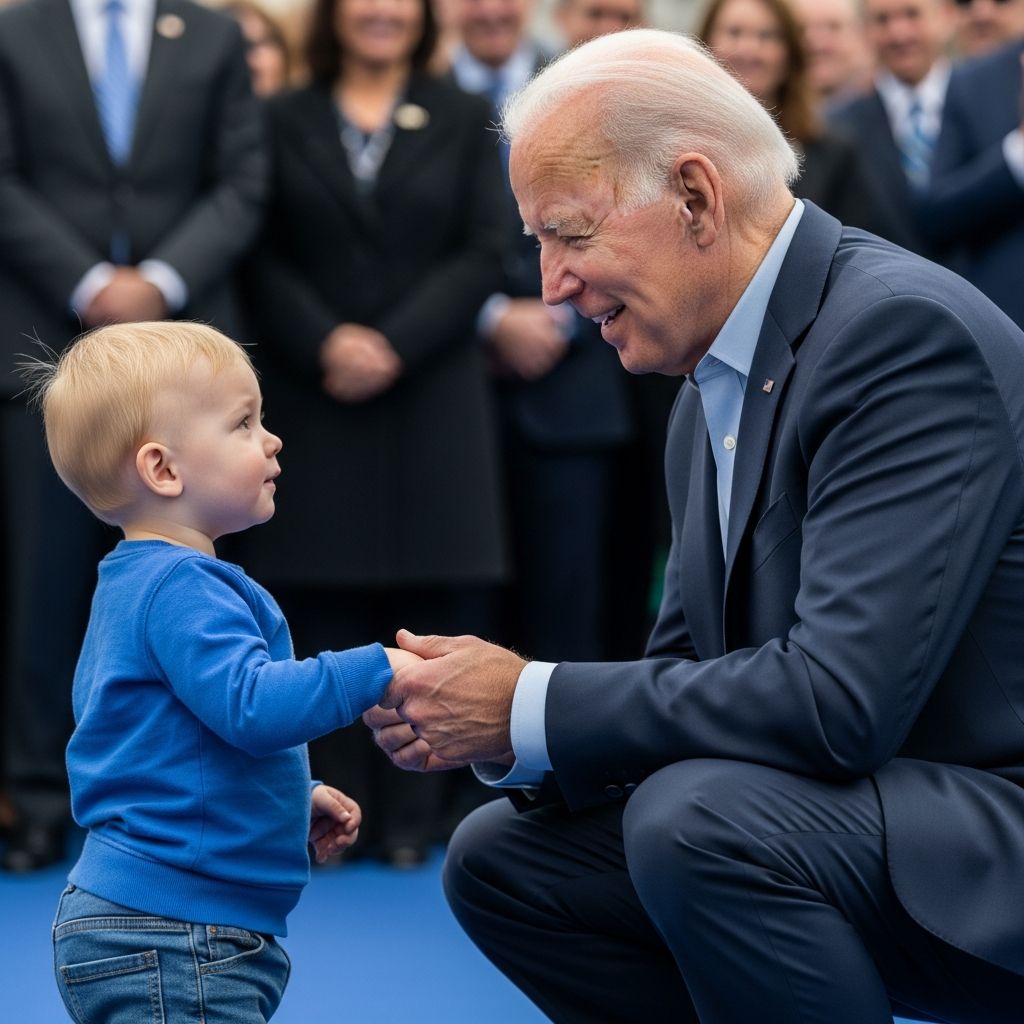
A short, funny viral clip of President Joe Biden interacting with a toddler has made the internet laugh, cringe, argue, and endlessly replay the same five seconds of video. Somewhere between the chuckles and the comment wars is a much more useful question for parents: what can families actually learn from moments like this?
This article looks at the lighthearted side of the incident, why toddlers react so strongly to unfamiliar adults, and how parents can turn viral political content into teachable moments about consent, boundaries, and media literacy—without scaring kids or overloading them with politics.
The Viral Joe Biden–Toddler Clip: What People Saw
In the now-famous clip, Joe Biden leans in toward a toddler during a public appearance, attempting a playful interaction that clearly lands very differently with the child. The toddler’s face says everything: surprise, confusion, and the kind of wary uncertainty every parent recognizes immediately.
Viewers reacted fast. Some people saw the moment as harmless grandfatherly teasing, others described it as awkward or inappropriate, and still others turned it into a meme. For parents watching, though, the clip can feel more personal, because it mirrors daily battles over hugs, kisses, and physical contact that kids may not want.
- Some adults saw affectionate play; others saw a boundary being crossed.
- Many parents recognized that toddler body language long before reading any comment section.
- The disagreement online often says more about adults’ politics than about the child’s experience.
Why Toddlers React So Strongly to Close Contact
To understand the clip, it helps to understand toddlers. At this age, children are only just learning that their body is their own and that they are allowed to feel comfortable—or uncomfortable—about touch. They may not have the vocabulary to say, \”Please don’t do that,\” but their faces and body language communicate that message clearly.
Even when an adult has good intentions, an uninvited close approach, loud voice, or goofy face can feel overwhelming to a small child. Sudden physical contact, like face-to-face closeness or unexpected touches, may trigger a fear response, especially when the adult is unfamiliar or surrounded by cameras and crowds.
- Toddlers rely heavily on nonverbal communication like pulling away, frowning, or going stiff.
- They are still learning that it is okay to say \”no\” to grown-ups, even friendly ones.
- Context matters: noise, strangers, bright lights, and attention can amplify a child’s discomfort.
Affection vs. Boundaries: Grandparent Energy in a Public Setting
For many viewers, Joe Biden’s interaction read as classic \”grandparent energy\”: someone older, used to being warm and physical with children, trying to play in a way that might have worked decades ago in private, but now unfolds in front of millions of people online. This gap between casual affection and modern awareness of boundaries is a big part of why the clip divided audiences.
Parents today often work hard to teach children that they can refuse hugs, decline kisses, and step away from physical touch that doesn’t feel right. When a public figure leans in close to a child who looks uncomfortable, it can clash with these newer expectations, even if the intention is playful and affectionate.
- Older generations may see casual teasing or physical play as normal.
- Younger parents often prioritize consent language and bodily autonomy.
- Public figures are judged not only on intent but also on the message their behavior sends.
Table: How Different Viewers Interpreted the Clip
The same few seconds of video generated very different emotional reactions. The table below highlights a range of responses and what often sits underneath them emotionally.
| Viewer Reaction | How the Moment Was Interpreted | Underlying Concern or Belief |
|---|---|---|
| \”It’s harmless and funny.\” | Sees the behavior as typical grandparent-style play with a shy child. | Belief that adults can show affection to kids freely if intentions are kind. |
| \”It’s awkward and out-of-touch.\” | Feels the interaction ignores modern norms about consent and boundaries. | Concern that older adults must update their behavior in public spaces. |
| \”It crosses the line.\” | Reads the toddler’s discomfort as a clear signal that wasn’t respected. | Strong focus on bodily autonomy and child safety around all adults. |
| \”It proves political bias.\” | Uses the clip to reinforce existing opinions about Biden, positive or negative. | Belief that public figures’ minor actions reflect their deeper character. |
Teaching Toddlers About Consent (Without Scaring Them)
One of the most useful angles for parents is to treat the viral moment as a reminder: consent education starts early, and it can be simple. Even toddlers can learn basic phrases, gestures, and habits that communicate their comfort or discomfort, especially around touch.
Parents do not need to introduce heavy, frightening topics to young children. Instead, they can quietly normalize the idea that kids get a say in how they are touched and that grown-ups should listen when they signal \”stop\” or \”no.\” The goal is not to create fear of adults, but to build confidence and self-respect.
Practical ways to teach consent to toddlers
- Model asking: Say, \”Can I give you a hug?\” and respect it if your child says \”no\” or turns away.
- Offer choices: Ask, \”High five, fist bump, or wave?\” when another adult wants to greet your child.
- Name body signals: Quietly narrate, \”You’re leaning away; that tells me you don’t want that right now.\”
- Back them up: If a relative insists on a hug, calmly say, \”We’re letting them decide about hugs today.\”
- Celebrate assertiveness: Praise your child when they say \”no\” or \”stop\” clearly about tickling or play.
Handling Relatives and Public Figures Who Mean Well
The viral clip resonates because many parents have faced a similar moment with a grandparent, neighbor, coach, or friendly stranger who pushes past a child’s boundaries without intending harm. Navigating that space can be awkward, especially when the adult is used to more hands-on affection or holds a position of authority.
Parents are usually the child’s best advocate in the moment. By stepping in calmly, redirecting physical contact, or giving the child a way to opt out, caregivers send a powerful message: \”Your comfort matters more than someone else’s feelings about how you should behave.\” Over time, this builds trust between the child and the parent.
Simple scripts parents can use
- \”We’re teaching them they can choose hugs. A wave is perfect today.\”
- \”They look a little overwhelmed. Let’s give them some space and try again later.\”
- \”High fives only today, please. They’re not in a cuddly mood.\”
- \”Thanks for being so sweet with them; we’re just following their lead on touch.\”
Media Literacy for Kids: Turning Viral Clips Into Teachable Moments
When older children or tweens come across the Joe Biden–toddler clip on social media, they may have questions that go beyond body language. They might ask why adults are arguing about it, what the big deal is, or why some videos are replayed and joked about endlessly online.
This offers a valuable opening to introduce basic media literacy. Parents can explain that short clips do not always show the full context, that people bring their own beliefs to what they see, and that not everything online is meant for kids, even if it is easy to find. Framing it this way helps kids feel less confused and more empowered.
Key media literacy lessons to share
- Clips are edited: Ten seconds of video rarely show what happened before or afterward.
- Adults disagree: Different people read the same moment through different values and beliefs.
- Public vs. private: Behavior that was once private is now recorded and judged by millions.
- Think before sharing: Ask kids to consider whether spreading a clip helps, harms, or just mocks.
- You can turn it off: Remind children they do not have to keep watching content that feels upsetting or confusing.
Politics, Polarization, and Parenting in the Comment Section
One glance at any comment thread about the Joe Biden–toddler moment shows how quickly a parenting issue turns into a political battlefield. People’s reactions often reflect preexisting feelings about Biden, public institutions, or the opposing political party more than a neutral assessment of the child’s experience.
Parents who want to stay grounded may choose to step back from online arguments and instead ask: \”What does my child need to feel safe, respected, and heard?\” By bringing the focus back to children’s real lives rather than internet debates, families can use political viral content as a quiet reminder to reinforce their own household values.
- Recognize when a debate is more about adults’ politics than kids’ wellbeing.
- Remember that public figures will make awkward or imperfect choices on camera, just as any adult might.
- Use the moment to clarify family rules about respect, touch, and listening to children’s signals.
How to Talk About Public Figures With Young Kids
The child in the viral clip is unlikely to care that the adult leaning in is the President of the United States; to them, he is simply a big, unfamiliar grown-up in a crowded space. Parents can use this fact to remind children that their boundaries matter the same way with every adult, whether that adult is a neighbor, a teacher, or a highly visible leader.
There is no need to dive deep into political ideologies to have this conversation. Instead, parents can emphasize universal principles: adults should try to make kids feel safe, kids can say \”no\” to touch they do not want, and it is always acceptable to move closer to a trusted caregiver if something feels off.
Child-friendly talking points about public figures
- \”Some adults are very famous, but they still must respect kids’ space.\”
- \”You can always come stand by me if you feel unsure around anyone, even someone important.\”
- \”Your body is yours, and you decide who gets close and when.\”
- \”If someone’s play feels too silly or too close, it’s okay to tell them to stop.\”
Frequently Asked Questions (FAQs)
1. Should parents show their kids the Joe Biden–toddler clip?
There is no requirement to show young children the clip, and for many toddlers, it will only be confusing or upsetting. If older kids encounter it naturally online, parents can sit with them, answer simple questions, and focus on what the child notices about the toddler’s facial expressions rather than launching into a political debate.
2. How can parents correct a public figure’s behavior without sounding disrespectful?
With children, it is possible to be honest and gentle at the same time. Parents might say, \”Sometimes even grown-ups make mistakes about how close to get to kids\” or \”That adult was trying to be funny, but it didn’t feel good to the child.\” This acknowledges the problem without demonizing the person, which helps children understand that everyone is capable of learning and changing.
3. Is it overreacting to worry about an awkward, playful interaction?
Taking a child’s discomfort seriously is not overreacting; it is part of building trust. Parents do not need to label every awkward interaction as dangerous, but they can still use those moments to reinforce that a child’s feelings and signals are important, even when the adult meant well or didn’t fully understand how their behavior looked.
4. How early should consent and body autonomy conversations start?
These conversations can start in toddlerhood but remain extremely simple. Everyday moments—like deciding whether to hug goodbye, choosing a greeting style, or saying \”stop\” during roughhousing—provide nearly all the material parents need. The key is consistency over time, not a single big talk.
5. What if grandparents or older relatives disagree with these new boundaries?
Many families experience generational disagreement over how much control kids should have over hugs and kisses. Parents can respectfully explain that they are trying to help children feel secure in their own bodies and that this approach is not a rejection of affection, but a new way of showing respect. Over time, relatives often adapt when they see the child become more confident and relaxed.
Key Takeaways for Modern Parents
The Joe Biden–toddler viral moment is, on the surface, one more internet clip destined to be replaced by the next news cycle. Yet the underlying themes—consent, boundaries, intergenerational differences, and media literacy—are here to stay and affect nearly every family.
- Use viral moments as quiet prompts to revisit how your family talks about touch and comfort.
- Support your child’s right to say \”no\” even when a well-meaning adult wants a hug or playful contact.
- Model how to interact gently with kids, especially when you are excited, playful, or in public.
- Teach older kids that short clips do not tell whole stories and that it is okay to step away from online arguments.
- Remember: your child is watching you more closely than they are watching any public figure.