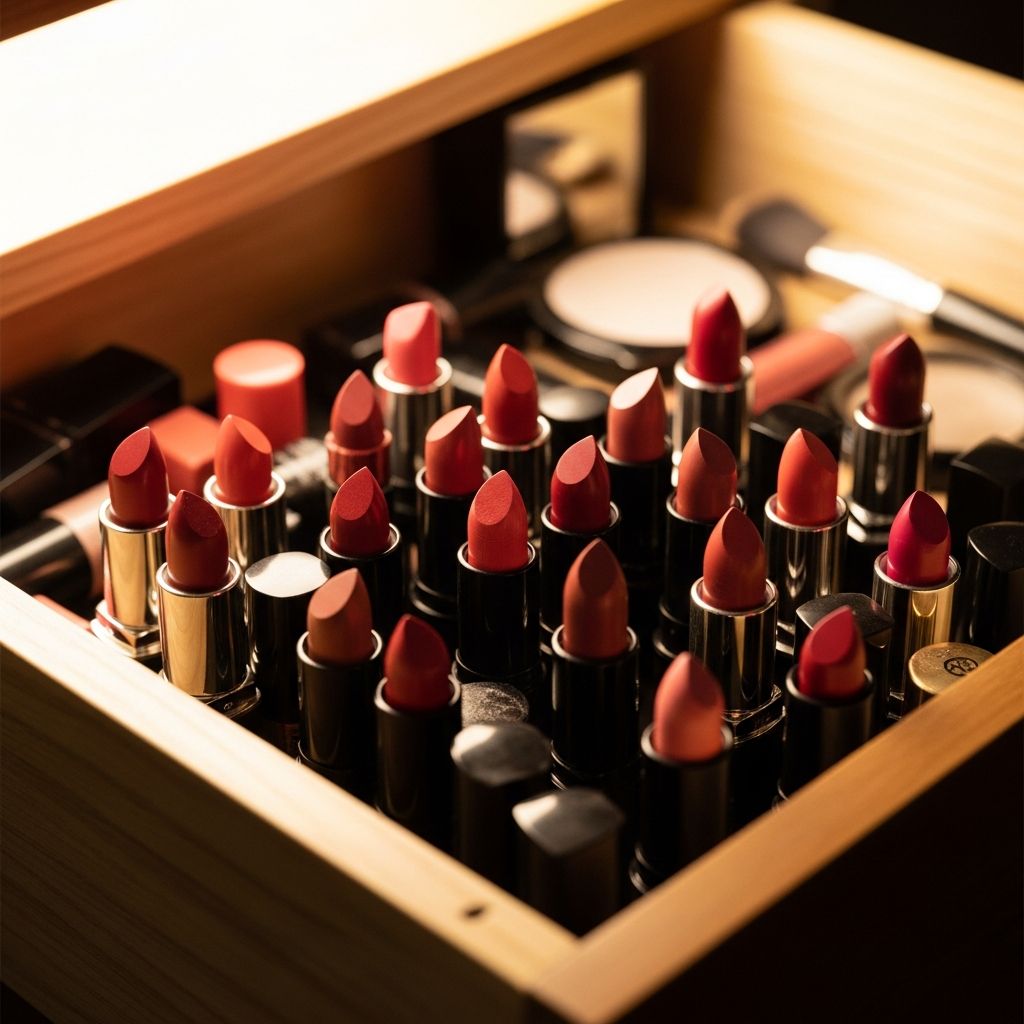
If you want to understand the story of a woman’s life, you can learn a lot by quietly opening the drawer where she keeps her lipsticks. Inside that cluttered space live old selves, half-finished chapters, quiet rebellions, and the shades she wishes she had been brave enough to wear outside the house.
This is not really about makeup. It is about how a simple tube of color becomes a mirror for who we were, who we are, and who we still hope to become.
Why Lipstick Becomes More Than Just Makeup
Across cultures and decades, lipstick has been more than decoration. It is often the first cosmetic a girl is “allowed” to wear, and for many women it becomes the one product they put on even when they skip everything else. This tiny object ends up carrying surprising emotional weight.
- Ritual: The swipe of color before a meeting, school run, or date becomes a grounding routine.
- Signal: Bright lips can announce confidence, seriousness, or defiance without a single word.
- Armor: For some, lipstick feels like part of their professional or emotional “uniform,” especially in spaces where they feel scrutinized.
- Memory box: Old shades recall old jobs, exes, cities, and seasons of life.
Historically, women in movements for political and social change have even used lipstick strategically. Suffragettes in the late 19th and early 20th century wore bold lips in public as an act of resistance, claiming visibility and autonomy in a world that preferred them quiet and plain. Feminist thinkers later developed the concept of lipstick feminism, arguing that embracing traditionally feminine presentation and sexuality can coexist with, and even strengthen, women’s political and social agency.
The Drawer: A Map of Past, Present, and Possible Futures
Open a typical lipstick stash and you rarely find a minimalist lineup. Instead, you see layers of identity shifts.
- Faded tubes: Once-worn colors from jobs you left, friendships that drifted, or cities you no longer live in.
- Impulse buys: Shades purchased on a bad day because hope in a tube was cheaper than therapy.
- Everyday heroes: The one or two reliable colors that have survived every clear-out – your comfort zone made visible.
- Dream shades: The daring red or deep plum you bought imagining a bolder version of yourself.
Even when most of those colors are never worn out of the house, they represent alternate versions of our lives we briefly considered. The drawer becomes a private gallery of “what ifs.”
How We Choose Colors: Psychology, Culture, and Mood
Color choices are deeply personal, but they rarely come from nowhere. They are shaped by culture, beauty standards, mood, and the stories we tell ourselves.
Common drivers behind a lipstick choice:
- Age and ideals: Bright lips are often associated with youth and vitality, which can nudge older women toward stronger shades or glosses that signal energy.
- Belonging: Certain workplaces, friend groups, or online communities have unspoken rules about what looks “appropriate.”
- Rebellion: Refusing to wear lipstick at all can be a conscious rejection of beauty expectations or a statement against what some perceive as a patriarchal ideal of femininity.
- Mood regulation: Putting on a favorite color can act as a small mood lift, similar to dressing up even when working from home.
| Shade Vibe | Common Inner Story | Typical Occasions |
|---|---|---|
| Bold red | “I am visible and unapologetic today.” | Presentations, dates, big nights out |
| Soft nude | “I want to look polished, not loud.” | Workdays, school events, family gatherings |
| Deep berry/plum | “I am allowed to be intense and complex.” | Evenings, creative spaces, reflective moods |
| No lipstick | “My face, my choice – this is me, unfiltered.” | Lazy days, protests against beauty norms, comfort-first moments |
When Lipstick Feels Like Pressure Instead of Play
There is a flip side. What can feel empowering to some feels suffocating to others.
Beauty standards are heavily gendered. In many professional and social contexts, women are expected to look “put together,” which often includes makeup. Research in social psychology has documented how appearance can affect perceived competence and hireability, particularly for women, creating pressure to conform to aesthetic norms even when it is costly in time or money.
In some societies and under some religious laws, women are forbidden to wear visible makeup or lipstick, turning an everyday habit into a quiet act of resistance when done in private. In others, not wearing it can invite criticism. Either way, an object that should be about self-expression becomes a tool of control.
Finding a healthy relationship with lipstick means being honest about the line between pleasure and obligation.
- If you feel guilt every time you go out barefaced, that may signal internalized pressure.
- If you feel ashamed for loving makeup because you fear it makes you “less serious,” that may reflect old stereotypes of what a feminist or professional woman should look like.
Feminism in a Tube: Powerful or Problematic?
The conversation about lipstick and feminism is not new, and it is not simple. Early feminist critiques viewed beauty standards as tools of patriarchy, arguing that time and money spent on appearance diverted energy from political and economic empowerment. Later, proponents of lipstick feminism proposed that embracing femininity and sexuality on one’s own terms can itself be a form of power and resistance.
The key differences lie in:
- Who decides? If lipstick is worn because “good women should,” it reinforces control. If worn because “this makes me feel like me,” it can support agency.
- Who benefits? When beauty industries set impossible standards, they profit from insecurity. When individuals selectively use beauty tools as self-expression rather than self-erasure, the balance of power shifts.
- What else is present? Lipstick alone is not liberation. Education, pay equity, safety, and rights matter more. But symbols can shape how women see themselves moving through those battles.
Smudges, Mistakes, and the Art of Laughing at Yourself
No one reaches adulthood without at least one tragic lipstick story: smeared teeth in a crucial photo, a color that looked chic in the store but neon in daylight, or a kiss that turned into unintended face paint.
These tiny disasters are oddly profound. They remind us that:
- Perfection is fragile. One rushed swipe can undo half an hour of careful effort.
- Most people are too preoccupied with their own worries to fixate on your smudge for long.
- The choice to laugh and move on is often more attractive than any flawless finish.
Psychologists studying self-compassion have found that people who respond to their own mistakes with kindness rather than harsh self-criticism tend to show better emotional resilience and lower levels of anxiety and depression. A crooked lip line may be a small, practical training ground for that kinder inner voice.
What Your “Everyday Lipstick” Secretly Says About You
Most people eventually settle on one or two “default” shades. Those choices often reflect deeper patterns in how they approach life.
- The Practical Neutral: You thrive on reliability. You like systems, lists, and knowing your shade will work with any outfit and any meeting.
- The Signature Bold: You enjoy being recognizable. You like a calling card – a color that says “this is me” before you introduce yourself.
- The Rotator: You rarely finish a tube because your preferences change with the weather, the news, or your playlist.
- The Minimalist: You own one lip balm with a hint of tint, and you are slightly confused by all this drama about lipstick.
None of these styles is better than the others. They simply reflect different comfort zones around visibility, routine, and experimentation.
Cleaning Out the Drawer: An Exercise in Letting Go
Occasionally, you open your drawer and realize half its contents are dried out, expired, or just not you anymore. Decluttering becomes less about storage and more about emotional archaeology.
Try this reflective clean-out:
- Sort by era: Group lipsticks you bought in similar life phases: university, first job, parenthood, a big breakup, a pandemic year.
- Ask one question per shade: “Who was I when I wanted this color?”
- Keep symbols, not clutter: If a shade represents a powerful memory, you can keep it as a memento. Everything else can go.
- Notice patterns: Do you collect “someday” bolds but wear only neutrals? That may mirror other areas of life where you hesitate to step into your bolder self.
Letting go of a shade you never wore can feel like admitting that certain imagined versions of yourself did not fully materialize. That is not failure. It is honest editing.
From Surface to Substance: Steps Toward a Healthier Beauty Relationship
Lipstick can be a doorway into bigger questions about how you relate to your body, your face, and your worth.
Consider these small but meaningful shifts:
- Name your reasons: Before buying a new shade, finish the sentence: “I want this because…” If the answer is “So people will finally see me as enough,” pause. If it’s “This looks fun,” enjoy it.
- Experiment in safe spaces: Wear the wild color at home first. Make dinner in it. Let your face adjust before introducing that version of you to the outside world.
- Practice no-lipstick days: Intentionally go bare-lipped in a few low-stakes situations. Notice what feelings come up and which belong to you versus to other people’s expectations.
- Broaden the definition of care: Remember that care for your lips is not only about pigment. Hydration, sun protection, and overall skin health also matter, and dermatology guidelines emphasize using SPF-containing balms to protect the delicate lip area from UV damage.
Frequently Asked Questions (FAQs)
Q: Is it shallow to care so much about lipstick?
Caring about how you present yourself is not inherently shallow. It becomes a problem only when your sense of worth depends entirely on appearance. Using lipstick as one tool of self-expression, rather than your sole source of confidence, can keep it in healthy perspective.
Q: Can loving lipstick still be feminist?
Yes. Many feminist scholars and activists argue that feminism is about expanding women’s choices, not policing them. If wearing lipstick is your genuine choice and not an obligation, it can coexist with – or even support – your political and personal autonomy.
Q: Why do I feel “unfinished” without something on my lips?
Habits create familiar cues. If you have used lipstick as a last step before leaving the house for years, your brain associates that ritual with being “ready.” Breaking or adjusting that association takes time and intentional practice, like gradually introducing bare-lip days in low-pressure contexts.
Q: Are there health considerations with frequent lipstick use?
Modern cosmetics in many countries are regulated for safety, but it is still important to check ingredients if you have allergies or sensitivities, and to replace old products to avoid irritation or microbial growth. Dermatologists also recommend protecting the lips from sun exposure using balms with SPF, since the lip skin is thin and vulnerable to UV damage.
Q: How do I choose a “signature” shade?
Start with your daily reality: your work environment, clothes, and comfort with attention. Try a few shades in natural light, photograph them, and notice how you feel in each picture. Your signature color is less about strict color theory and more about the one that makes you feel most like yourself.
References
- Sun protection for your lips — American Academy of Dermatology Association. 2023-04-15. https://www.aad.org/public/everyday-care/sun-protection/sunscreen/protect-lips
- What Does Wearing Lipstick Mean to You? — PriceScope. 2021-07-10. https://www.pricescope.com/community/threads/what-does-wearing-lipstick-mean-to-you.266079/
- Lipstick feminism — Wikipedia / various academic sources summarized. 2024-01-05. https://en.wikipedia.org/wiki/Lipstick_feminism
- Self-compassion and psychological well-being — Kristin D. Neff. Journal of Research in Personality. 2003-02-01. https://doi.org/10.1016/S0092-6566(02)00524-1