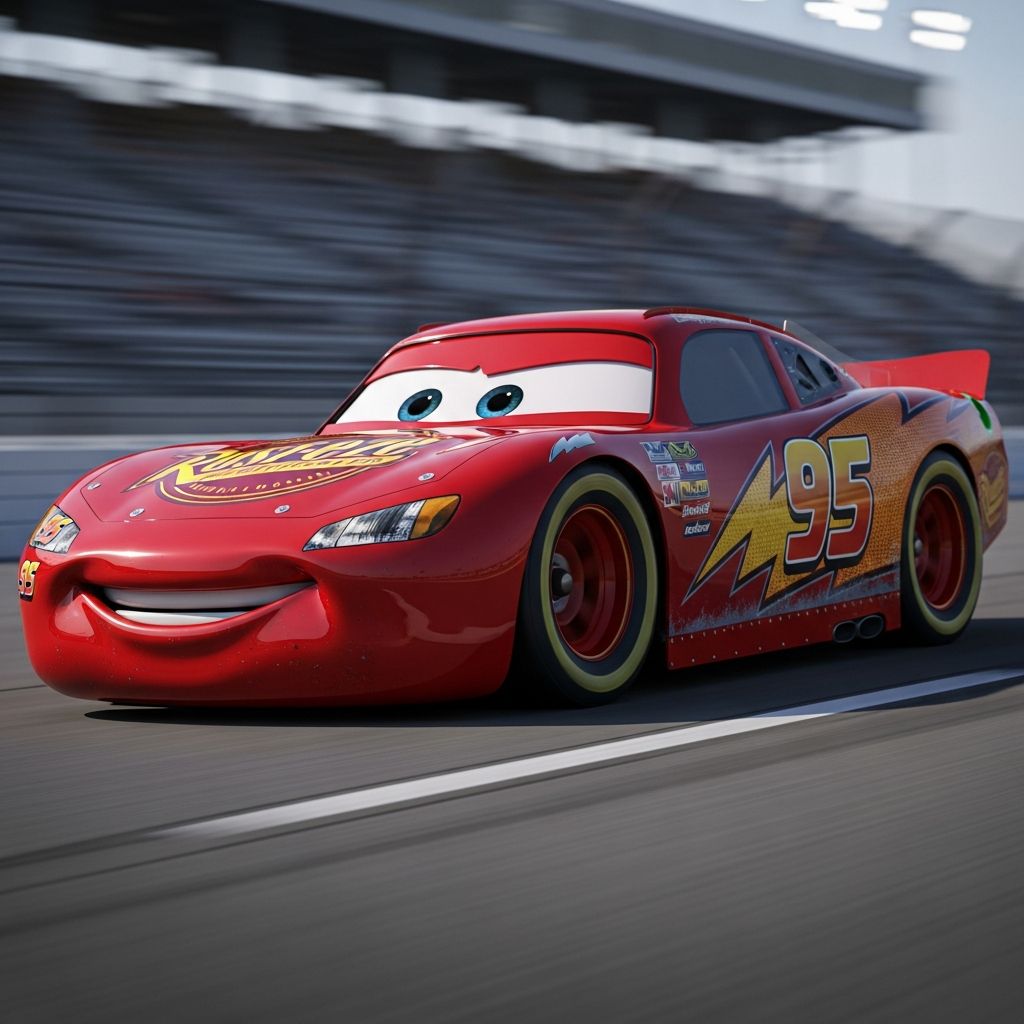
Lightning McQueen might live in an animated world, but his design, sound, and performance are deeply rooted in real racing history. Pixar’s artists and car consultants pulled from NASCAR stock cars, endurance racers, and American sports cars to create a character that looks and moves like a genuine high-performance machine.
This guide unpacks what kind of car Lightning McQueen would be in real life, how fast he could go, which race cars inspired his body and engine, and why gearheads instantly recognize real engineering DNA hiding beneath those cartoon eyes.
Lightning McQueen at a Glance
Within the Cars universe, Lightning is described as a purpose-built racing stock car with serious performance numbers that match real-world top-tier series.
- Body type: Custom-built Piston Cup stock car, similar to a NASCAR Generation 4 chassis
- Engine: Race-tuned V8, comparable to a 5.8–5.9 L NASCAR pushrod V8
- Horsepower: About 750 hp (on par with real Cup cars of the era)
- Top speed: Around 200 mph / 322 km/h
- 0–60 mph: Roughly 3.2 seconds
These are not toy numbers. They are taken directly from typical NASCAR Cup Series performance in the mid-2000s, when the first film was released.
Why Lightning McQueen Isn’t Just One Real Car
Fans often ask if Lightning McQueen is a Camaro, a Corvette, or some kind of futuristic supercar. In reality, he is a deliberate mash-up of several iconic machines, blended into a single, instantly recognizable hero car.
Pixar’s designers focused on three pillars:
- Silhouette and chassis: Classic NASCAR Generation 4 stock car proportions
- Aerodynamic cues: Elements from endurance prototypes and GT racers
- Styling flavor: Hints of American muscle and contemporary Corvettes
This fusion keeps him believable to racing fans while still letting him be expressive and appealing to kids.
Core Inspiration: NASCAR Generation 4 Stock Cars
If you had to pick one real vehicle category that best answers “What kind of car is Lightning McQueen?”, the clearest match is the NASCAR Generation 4 stock car that dominated American oval racing in the 1990s and early 2000s.
| Feature | Lightning McQueen (in-universe) | Gen 4 NASCAR Stock Car (typical) |
|---|---|---|
| Engine | Race V8, ~5.9 L equivalent | 358 cu in (~5.9 L) pushrod V8 |
| Horsepower | ≈ 750 hp | 650–750 hp |
| Top speed | ≈ 200 mph | ≈ 200 mph on superspeedways |
| Layout | Front-engine, rear-wheel drive | Front-engine, rear-wheel drive |
| Body construction | Tubular frame with race body shell (implied) | Tubular steel frame with composite or sheetmetal body |
Specific NASCAR traits visible in Lightning McQueen’s design include:
- Wide, low stance for stability at high speeds on banked ovals
- Large rear spoiler or wing to generate downforce
- Headlight decals instead of functional lamps (a real NASCAR cost- and weight-saving measure)
- Full-body sponsor graphics that echo real race liveries
These details align closely with the Cup Series cars raced in the early 2000s, before NASCAR’s later “Next Gen” redesigns.
Styling Cues from the Chevrolet Corvette and American Sports Cars
Although the core mechanical inspiration is stock-car racing, Lightning McQueen’s curves are sleeker than a pure NASCAR silhouette. The design team also drew from contemporary American sports cars, especially the Chevrolet Corvette C6 and its racing variant, the C6.R.
From these cars he seems to borrow:
- Rounded front fenders and a muscular hood bulge
- Short overhangs that give a compact, aggressive posture
- Smooth, flowing side profile instead of a purely boxy race shell
According to race coverage from the era, the C6.R’s pushrod V8 sound also influenced McQueen’s on-screen engine note, helping sell the illusion that he is powered by a thunderous American race engine.
Endurance Racing and Prototype DNA
Lightning McQueen races in a fictional series, but his designers clearly studied long-distance racing and aerodynamics from events like the 24 Hours of Le Mans. Cars like the Ford GT and Corvette C6.R showed how to combine brute V8 power with refined aero to achieve high speeds and stability on road courses.
Visual clues that hint at endurance and GT racing influence include:
- Clean underbody and front splitter-like shapes, which would help channel airflow
- Wide rear track for cornering grip on road circuits
- Pronounced rear deck that has room for a wing or spoiler
These touches let Lightning plausibly compete in both oval-style events and road-race style tracks shown across the film series, a flexibility that real GT and endurance cars share.
Technical Specs: How Fast Is Lightning McQueen?
For Cars 2, Disney and Pixar partnered with automotive outlets to publish approximate specifications for Lightning and his rivals. These numbers were chosen to be realistic for high-end race cars, rather than pure fantasy.
In-Universe Performance Figures
- Horsepower: 750 hp (race-tuned V8)
- 0–60 mph: ~3.2 seconds
- Top speed: ~200 mph
Automotive analysts have noted that these figures line up cleanly with mid-2000s NASCAR Cup Series cars and high-performance GT racers.
How That Compares to Real Race Cars
- Typical NASCAR Cup cars of the era ran around 750 hp and achieved 200+ mph on superspeedways like Daytona and Talladega.
- Modern supercars and GT racers, such as the Corvette C6.R or Ferrari 458 GT, often sit in the 550–700 hp range with top speeds between 180 and 205 mph, depending on series restrictions.
In other words, Lightning McQueen would not be out of place on a real entry list; his numbers are competitive with contemporary top-tier race machinery.
Design Details That Make Him Feel Real
Beyond raw numbers, a few subtle details help sell Lightning as a believable race car rather than just a cartoon shell.
1. Headlight Stickers
Lightning’s “headlights” are actually decals in the first film, something many viewers notice. Early 2000s NASCAR race cars also used painted or vinyl headlight shapes instead of functional lamps, because races were held in daylight or under track lighting and weight savings mattered more than visibility.
2. Sponsor Branding and Contingency Decals
His body is covered in primary sponsor logos and smaller contingency-style stickers on the fenders. This mimics how real NASCAR cars are wrapped with branding from teams, tire manufacturers, and technical partners.
3. Wheel and Tire Proportions
Lightning rides on relatively small-diameter wheels with tall, sidewall-rich racing slicks, much like real stock cars. The proportions look slightly exaggerated for animation, but the basic layout matches oval racing equipment.
4. Audible Engine Character
The deep, throaty roar of his V8 aligns with the sound of high-displacement American race engines, including NASCAR V8s and the Corvette C6.R’s powerplant. This consistency with real-world audio helps car enthusiasts immediately recognize the type of engine he is meant to have.
Is Lightning McQueen a Corvette, a GT Car, or Something Else?
Because of his curves and his clear Corvette influence, many fans assume Lightning McQueen is a direct stand-in for a Chevrolet Corvette. The reality is more nuanced.
| Question | Short Answer |
|---|---|
| Is he a production car you can buy? | No. He is an original, fictional race car design. |
| Is he based mainly on one real car? | Mostly on NASCAR Gen 4 stock cars, with added influences. |
| Does he share traits with Corvettes? | Yes, particularly styling and engine sound cues. |
Official character materials often describe him simply as a custom-built Piston Cup racing stock car, emphasizing that he does not correspond to a specific make or model from any manufacturer.
Why Pixar Grounded Lightning McQueen in Real Engineering
Pixar is known for extensive research, and the Cars franchise was no exception. The production team visited races, met with professional drivers and crew members, and studied vehicle dynamics so that their on-screen racing would feel authentic.
Grounding Lightning McQueen in real motorsport design yields several benefits:
- Credibility with car enthusiasts: Fans who follow NASCAR and sports-car racing can spot familiar design choices and technical details.
- Consistent world-building: The Piston Cup series feels like a natural extension of American stock-car racing history.
- Educational value: Kids curious about Lightning’s world get an informal introduction to concepts like horsepower, stock cars, and racing strategy.
Frequently Asked Questions (FAQs)
Q1: What specific kind of car is Lightning McQueen supposed to be?
Lightning McQueen is best described as a fictional Piston Cup stock car whose closest real-world counterpart is a NASCAR Generation 4 race car. His mechanical layout and performance numbers match that category, while his bodywork mixes in styling from Corvettes and endurance racers.
Q2: Is Lightning McQueen officially a Corvette?
No. Although he borrows some design cues from the Chevrolet Corvette C6 and the racing C6.R—especially in his curves and engine sound—he is not a licensed reproduction of any specific Corvette model. Pixar intentionally blended influences instead of tying him to one production car.
Q3: Could Lightning McQueen’s specs exist in real life?
Yes. His published specs—around 750 hp, 0–60 mph in about 3.2 seconds, and a top speed near 200 mph—fit comfortably within the performance envelope of real NASCAR Cup cars and top-tier GT racers from the mid-2000s.
Q4: Why does Lightning McQueen have headlight stickers?
In the first movie, his headlights are decals because real NASCAR stock cars of that era used painted or vinyl headlights instead of functional lamps. This saved weight and simplified bodywork, as races did not rely on headlights for illumination.
Q5: Does his design change across the Cars movies?
Yes. Subtle updates, such as different rear aero treatments and livery tweaks, echo how real race cars evolve over seasons. However, his fundamental identity as a wide, low, V8-powered stock car remains consistent throughout the trilogy.
References
- Cars Lightning McQueen: Fast, Fun, and Furious! — AmeriFreight. 2023-08-10. https://www.amerifreight.net/blog/cars-lightning-mcqueen-fast-fun-and-furious
- Exclusive: ‘Cars 2’ Racers Get Real Specs — Cars.com. 2011-06-22. https://www.cars.com/articles/exclusive-cars-2-racers-get-real-specs-1420663164625/
- What Kind of Car is Lightning McQueen From Cars? — MotorTrend. 2021-07-26. https://www.motortrend.com/features/what-kind-of-car-is-lightning-mcqueen
- Lightning McQueen — Pixar Wiki (Fandom). Accessed 2025-12-06. https://pixar.fandom.com/wiki/Lightning_McQueen
- 2012 NASCAR Sprint Cup Series Rule Book (selected specifications) — NASCAR. 2012-01-01. https://www.nascar.com/news-media/2012/01/01/nascar-rule-book/