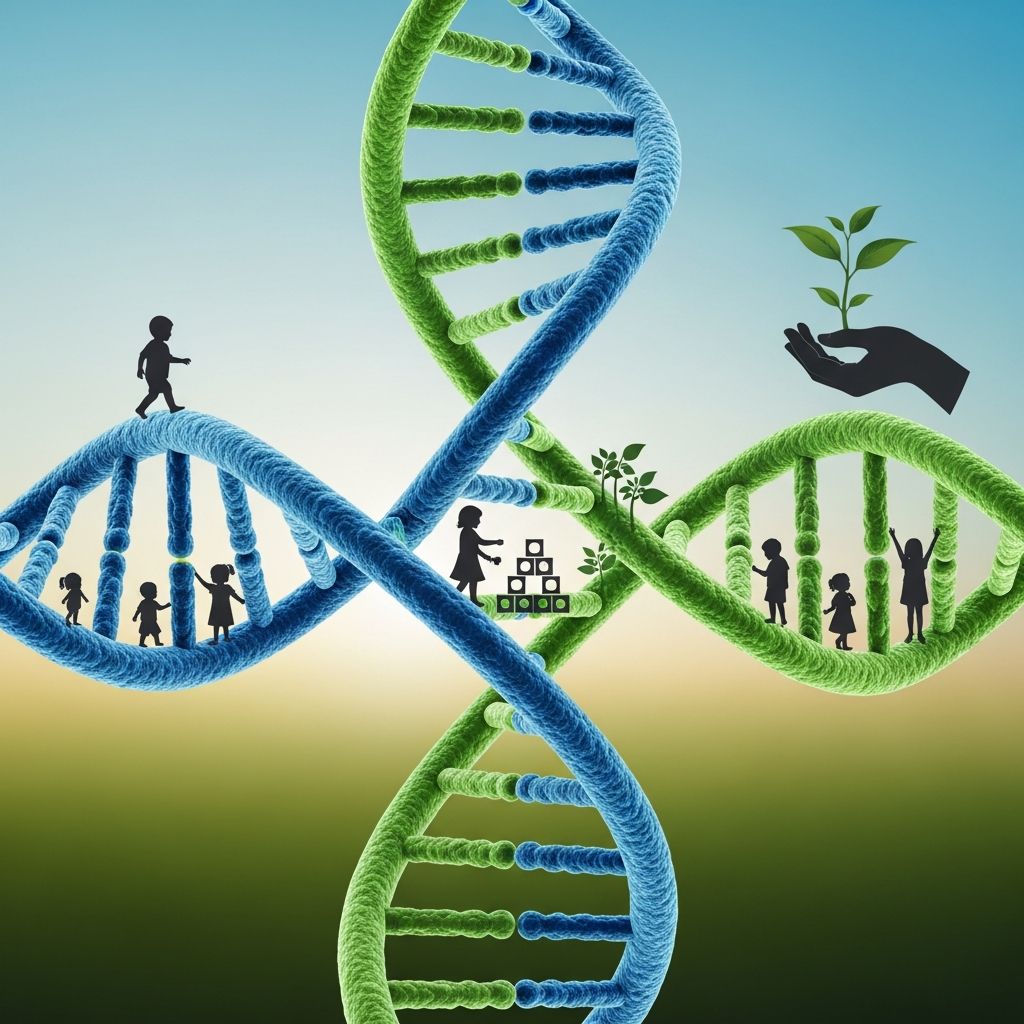
Every child carries a unique set of biological instructions written in a special chemical called DNA. These instructions help guide how they grow, how their body works, and even some aspects of their behavior and health.
This guide explains DNA and genes in clear language so you can better understand how heredity shapes your child.
What Is DNA in Simple Terms?
DNA (deoxyribonucleic acid) is the long molecule in almost every cell that stores genetic information — a bit like a very detailed recipe book for building and running the body.
- DNA is found mainly in the nucleus of cells, packed into structures called chromosomes.
- Each DNA molecule is made from smaller building blocks called nucleotides.
- Every nucleotide has three parts: a sugar, a phosphate group, and one of four bases: A (adenine), T (thymine), C (cytosine), or G (guanine).
The order of these bases — A, T, C, and G — is what gives the instructions, like letters forming words and sentences.
How DNA Is Built: The “Twisted Ladder”
Scientifically, DNA has a characteristic double-helix shape, which means it looks like a twisted ladder.
- The sides of the ladder are the sugar–phosphate backbone.
- The rungs are pairs of bases: A with T, and C with G.
- These base pairs are held together by hydrogen bonds, which are strong enough to keep DNA stable but weak enough to be opened during copying.
This clever structure lets DNA store large amounts of information in a small space and also copy itself accurately when cells divide.
From DNA to Genes to Chromosomes
Not every stretch of DNA carries the same type of information. Some parts are especially important for building the body and keeping it running.
Genes: Small Sections with Big Jobs
A gene is a segment of DNA that carries instructions for making a specific protein or for regulating how other genes work.
- Proteins do most of the actual work in cells: building structures, carrying signals, speeding up chemical reactions, and more.
- Each gene usually influences one part of the body or one process (for example, a protein in red blood cells or a pigment in the eye).
- Humans have thousands of genes, spread across their chromosomes.
Chromosomes: DNA Packed for Storage
Because DNA is so long, it has to be tightly packaged inside cells.
- DNA wraps around special proteins and coils up to form chromosomes.
- Most human cells contain 46 chromosomes, arranged in 23 pairs.
- One chromosome of each pair comes from the child’s biological mother, and the other from the biological father.
Each parent therefore passes on half of their chromosomes — and half of their gene versions — to their child.
How Kids Inherit Traits from Parents
Many things about your child, from eye color to certain health risks, are influenced by the combination of genes they inherit from both parents.
Gene Variants and Family Resemblance
Most genes come in slightly different forms called variants (or alleles). These variants can cause small changes in how a trait appears.
- Some gene variants affect visible features (for example, hair color or attached vs. free earlobes).
- Others affect less obvious traits (for example, how efficiently the body handles certain nutrients or how the immune system responds to infections).
- Because children receive a mix of gene variants from each parent, they often look like a blend of family members.
Dominant and Recessive Effects
For many traits, a child has two versions of a gene — one from each biological parent. How these interact can follow classic patterns:
- Dominant variants show their effect even if only one copy is present.
- Recessive variants usually show their effect only if a child inherits the same version from both parents.
- Some traits are influenced by many genes at once, along with environment (for example, height, body weight, or reading ability).
Nature, Nurture, and Your Child
Genes are powerful, but they are not the whole story.
- DNA provides potential, not destiny.
- Nutrition, sleep, exercise, relationships, education, and experiences all shape how genetic tendencies play out.
- Even brain development and learning rely on both genetics and environment working together.
What DNA Does Inside the Body
DNA’s main role is to store and share information, so that cells know which proteins to make, when, and in what amounts.
| Step | What Happens | Why It Matters for Kids |
|---|---|---|
| 1. DNA storage | DNA sequence holds instructions for building proteins. | Provides a stable “blueprint” for growth and maintenance. |
| 2. Transcription | A gene’s information is copied into messenger RNA (mRNA). | Allows specific instructions to be read at the right time and place. |
| 3. Translation | Cells use mRNA to assemble amino acids into a protein. | Generates proteins needed for muscles, hormones, enzymes, and more. |
| 4. Regulation | Other DNA regions control when genes turn on or off. | Fine-tunes growth, metabolism, and responses to stress or infection. |
Copying DNA: Why It Matters as Kids Grow
Every time a child grows, their cells divide, and DNA has to be copied.
- Before a cell divides, the DNA double helix unwinds and the two strands separate.
- Each strand serves as a template for building a new matching strand.
- Enzymes add new bases following strict pairing rules: A with T, C with G.
This process, called DNA replication, is usually extremely accurate, helping ensure that every new cell gets a correct copy of the genetic instructions.
What Are Mutations?
Sometimes, small changes, or mutations, occur when DNA is copied or damaged.
- Many mutations have no effect or are quickly repaired by the cell.
- Some mutations can slightly alter a protein and may contribute to disease risk or protection.
- Very rarely, a mutation may cause or strongly contribute to a genetic disorder.
Mutations can be inherited from parents or occur for the first time in a child.
Genetics and Children’s Health
Understanding DNA can help parents make sense of some health issues and medical tests their child may encounter.
Single-Gene and Chromosomal Conditions
Some health conditions are mainly caused by changes in a single gene or in chromosome number or structure.
- Single-gene conditions (such as certain metabolic or blood disorders) may be inherited in dominant or recessive patterns.
- Chromosomal conditions arise when there is extra, missing, or rearranged chromosomal material (for example, an extra copy of a chromosome).
Doctors sometimes recommend genetic testing to confirm a diagnosis, understand prognosis, or guide care.
Complex Traits and Common Conditions
Most common disorders, such as asthma, many heart conditions, or type 2 diabetes, do not come from a single gene.
- They typically involve many genes, each adding small effects.
- Environment and lifestyle (diet, physical activity, stress, infections, pollution) play major roles.
- Healthy habits can often reduce risk, even when a child has a genetic tendency.
Genetic Testing and Counseling
Families may encounter genetic testing in several settings:
- Newborn screening to detect certain treatable conditions early.
- Diagnostic testing when a child has unexplained symptoms or developmental differences.
- Carrier testing for parents planning future pregnancies.
Genetic counselors are trained specialists who can explain test options and results and help families navigate emotional and practical decisions.
How Parents Can Talk About DNA with Kids
Explaining genetics to children can be simple and reassuring. You can adjust the language to match their age and curiosity.
Key Messages for Children
- Every person has a special set of instructions inside their cells that helps make them who they are.
- These instructions come from their biological parents, but no one else has exactly the same set.
- Some things, like eye color, are strongly influenced by DNA; others, like kindness or talents, depend a lot on choices and practice.
Helpful Ways to Explain
- Use comparisons kids know, such as recipe books, blueprints, or codes.
- Focus on how everyone is both similar and unique.
- If illness is involved, emphasize that no one “caused” the condition by something they did.
Frequently Asked Questions (FAQs)
Q1: Do genes decide everything about my child?
No. Genes provide important instructions, but environment, experiences, and choices also have a strong influence on who your child becomes. Many traits, such as school performance or weight, reflect both biology and lifestyle working together.
Q2: Why do siblings look alike but not identical?
Each child receives a random mix of chromosomes and gene variants from their biological parents. That means siblings share many genes but not exactly the same combination, so they often resemble each other yet have their own unique features.
Q3: What is the difference between DNA and genes?
DNA is the full chemical molecule carrying genetic information, while genes are specific segments of DNA that contain instructions, usually for making a particular protein or regulating other genes.
Q4: Can lifestyle change my child’s DNA?
Lifestyle and environment usually do not change the basic DNA sequence in cells, though they can affect which genes are turned on or off. Certain exposures (such as radiation or some chemicals) can damage DNA, but cells have repair systems, and parents can help protect kids through healthy environments and habits.
Q5: When should I consider genetic counseling for my child?
You may wish to talk with a genetic counselor if your child has a known genetic diagnosis, unexplained developmental differences or multiple birth defects, a strong family history of a certain condition, or if your doctor has suggested specific genetic tests.
References
- Deoxyribonucleic Acid (DNA) Fact Sheet — National Human Genome Research Institute. 2024-01-23. https://www.genome.gov/about-genomics/fact-sheets/Deoxyribonucleic-Acid-Fact-Sheet
- What is DNA? Definition, Function & Structure — Cleveland Clinic. 2023-05-09. https://my.clevelandclinic.org/health/body/dna
- 10.2: Structure and Function of DNA — OpenStax Microbiology, LibreTexts. 2022-08-01. https://bio.libretexts.org/Bookshelves/Microbiology/Microbiology_(OpenStax)/10:_Biochemistry_of_the_Genome/10.02:_Structure_and_Function_of_DNA
- The Structure and Function of DNA — Alberts et al., Molecular Biology of the Cell, 4th ed., NCBI Bookshelf. 2002-01-01. https://www.ncbi.nlm.nih.gov/books/NBK26821/
- DNA structure and function — EBSCO Research Starters. 2017-01-01. https://www.ebsco.com/research-starters/health-and-medicine/dna-structure-and-function