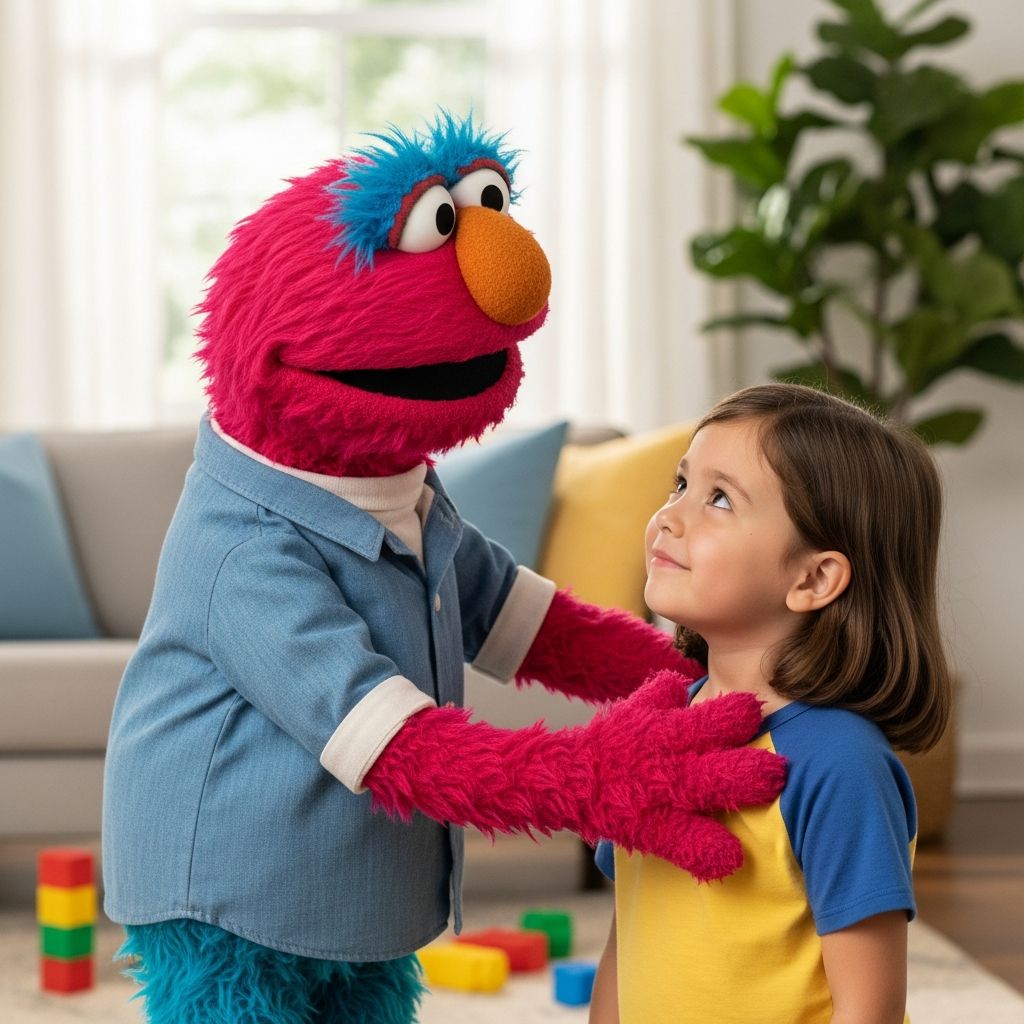
During the height of the pandemic, a short video of Elmo’s dad speaking directly to parents spread across social media, offering a gentle, almost startling message: you are doing a good job. Many caregivers felt hugged; others felt strangely angry or confused. How could a fictional father in a safely animated universe understand what real parents were carrying?
This article uses that moment as a springboard to examine what it means to parent under crisis, why simple praise can feel both comforting and infuriating, and how families can move from performative reassurance to practical change in daily life.
A Furry Voice in a Very Human Storm
Elmo’s world has always been about bright colors, clear rules, and kind grown-ups who eventually explain everything. In contrast, the early months of the pandemic were defined by uncertainty, isolation, and the sense that adults themselves had no script. When Elmo’s dad showed up on screens to thank parents for holding it all together, the message landed in the middle of that chaos.
For many caregivers, the video felt like the only adult-to-adult reassurance they were getting. It acknowledged that parenting duties had exploded overnight: remote school, constant supervision, nonstop meals, all while many parents were trying to work or worrying about work that had vanished. At the same time, the cartoon calmness of the messenger reminded people just how alone and unsupported they truly were.
Why Praise Alone Can Feel So Unsettling
On the surface, being told you are doing a good job sounds universally positive. But in the context of extreme stress, that praise can trigger some complicated reactions. Parents who were exhausted, scared, and sometimes failing by their own standards heard the words and immediately thought, “Am I?”
This emotional whiplash tends to show up in at least four ways:
- Validation: Some caregivers finally felt seen, especially those who rarely hear appreciation from partners, employers, or extended family.
- Guilt: Others replayed every moment of snapping at their kids, every screen-time compromise, and every cereal-for-dinner night, feeling they didn’t deserve the compliment.
- Anger: A few found the message infuriating, because kind words from a children’s character highlighted the lack of concrete support from real institutions.
- Confusion: Many held all of these responses at once, toggling between gratitude and cynicism like emotional double vision.
The Invisible Weight Parents Were Carrying
To understand why a simple “you’re doing great” felt so loaded, it helps to name what parents were actually juggling. For many households, there was a sudden collapse of every boundary that usually keeps life vaguely manageable: home versus office, weekday versus weekend, school time versus family time.
Behind the scenes, caregivers were holding an exhausting blend of visible and invisible work. The visible tasks were the ones everyone could see: snacks, homework help, diaper changes, endless dishes. The invisible ones were the mental lists of risks, rules, Zoom links, symptom checks, and the emotional labor of soothing scared children while suppressing their own fears.
| Visible work | Invisible work |
|---|---|
| Preparing three or more meals a day, plus snacks | Planning grocery trips to minimize exposure, budgeting for rising costs |
| Monitoring online classes or worksheets | Tracking log-ins, passwords, assignments, teacher emails, and deadlines |
| Playing with kids or supervising play | Constantly inventing new activities to replace closed playgrounds, sports, and visits |
| Working from home while kids are present | Adjusting expectations with bosses, worrying about job security, and reworking schedules nightly |
| Taking kids to appointments when possible | Checking public-health updates, weighing risks, and making judgment calls with incomplete information |
In this context, reassurance that “you’re doing great” can feel like praising someone for treading water with a backpack full of bricks, without offering to remove even one brick. The disconnect between the sweetness of the message and the sharpness of lived experience is what made the video so ripe for both heartfelt sharing and skeptical commentary.
The Sesame Street Fantasy of Competent Adults
The world of Sesame Street runs on a comforting assumption: there are always competent, kind adults somewhere off-screen. Problems get messy, but they never stay unsolved forever. Parents and neighbors work through disagreements with patience and explanations, often within a tidy 10-minute segment.
Many parents realized in the pandemic that their lives do not operate on that rule. The systems they expected to rely on – schools, health care, employers, extended family networks – were suddenly unreliable or overwhelmed. The appearance of Elmo’s dad, calm and collected, became a symbol of the imaginary village so many families wished they had.
Comfort vs. Responsibility: Who Should Be Supporting Parents?
One reason the video spread so widely is that it scratched an itch almost no one else was addressing: the need to recognize parents not just as caregivers, but as people under extraordinary pressure. Yet the fact that this recognition had to come from a puppet raises serious questions about who is actually responsible for supporting families.
When fictional characters deliver warm messages while real systems fail to provide child care, paid leave, or mental-health support, the praise can feel hollow. It risks shifting focus from structural solutions to individual resilience, implying that the main problem is parents not believing in themselves rather than parents being asked to shoulder unsustainable loads.
How “You’re Doing Great” Can Still Be Useful
Despite the contradictions, there is real value in the message if families treat it as a starting point rather than a final verdict. For many caregivers, hearing those words from any source opened up a new way of talking about their own effort, limits, and needs. It created permission to view survival as an achievement, not a failure of ambition.
Used intentionally, that phrase can become a tool for re-framing expectations inside a household. Instead of aspiring to pre-pandemic standards, families can ask, “What does ‘good enough’ look like for us right now?” and “What can we let go of without sacrificing our core values?” In that sense, the video’s greatest contribution may be the conversations it sparked, not the comfort it tried to provide.
Practical Ways Parents Can Reclaim the Message
Parents do not need to choose between rejecting the message as naive and swallowing it whole. There is a middle path where those comforting words are paired with practical changes in daily life that make them actually true in a sustainable way.
- Turn praise into a boundary: When someone – even a cartoon father – says you’re doing a great job, use that as justification to protect your limits. If bedtime stories slid from 30 minutes to 10, that can still be “good parenting” in an emergency season.
- Create family rules for overwhelm: Agree that when any adult says, “I’m at my limit,” tasks get reshuffled or something nonessential gets dropped, without blame.
- Redefine success weekly: Have a short Sunday conversation about what would make the coming week feel like “enough” rather than “ideal,” and write those goals somewhere visible.
- Model imperfection openly: When a day falls apart, narrate it to kids: “Today was rough. I yelled more than I wanted. Tomorrow I’ll try a different plan.” This shows children that good parents can still have bad moments.
Sharing the Load at Home
One quiet theme underneath the Elmo’s-dad moment is who, in a typical household, would be most likely to watch and share that clip. Often it was the parent already carrying the heaviest mental load, who then became responsible for transmitting its lesson to everyone else.
A more powerful use of that message is as a catalyst for rebalancing responsibilities rather than merely soothing the most overwhelmed person. If the adults in a home watch together and then ask, “What would make this less of a pep talk and more of a reality here?” the conversation can move from feeling seen to actually being supported.
- List all daily and weekly tasks, both visible and invisible, and assign them clearly instead of assuming one person “just handles” them.
- Rotate particularly draining jobs – like bedtime, virtual-school oversight, or morning routines – so no one parent becomes the default.
- Give one another protected downtime that counts as non-negotiable, the way a workplace would respect a scheduled meeting.
Talking With Kids About Overwhelmed Grown-Ups
One unexpectedly helpful aspect of the Elmo video was that it showed a parent talking directly about stress in an age-appropriate way. This gave caregivers a template for telling their own children, “This is a hard time for the grown-ups too,” without placing that emotional burden on kids.
Parents can borrow this approach while still staying anchored in their own values:
- Use simple, honest language: “It’s been a big, confusing time, and sometimes that makes me tired or grumpy. I still love you and I’m trying my best.”
- Invite kids into problem-solving: “What are some small things we could do as a family when everyone feels stressed?” This might lead to family walks, silly dance breaks, or quiet-time rituals.
- Reassure children of adult responsibility: Emphasize that it is not their job to fix the grown-ups’ feelings, only to share what they need and how they feel.
Self-Compassion That Goes Deeper Than a Meme
If Elmo’s dad offered a quick burst of emotional first aid, parents still need a longer-term practice that doesn’t depend on viral videos to feel worthy. Self-compassion for caregivers means treating one’s own struggles with the same understanding that a loving adult would show a child: mistakes are part of learning, not proof of failure.
This can sound abstract, but it becomes concrete in daily habits:
- Acknowledge one hard thing and one thing done well each day, even if the victory is simply “we got through it.”
- Notice the voice in your head when you drop a ball. If it sounds more cruel than what you’d say to a friend, practice replacing it with a kinder, truer statement.
- Allow rest to be a priority, not a reward. Exhausted parents are not defective; they are often responding normally to abnormal circumstances.
Beyond the Screen: Building Real-World Support
Ultimately, the tenderness of a puppet’s gratitude cannot substitute for tangible resources, but it can highlight how urgent those resources are. When a brief message lands so heavily, it is a sign that many parents are operating with an acute shortage of meaningful acknowledgment.
Families, communities, and institutions can treat that realization as a call to action. That may look like more flexible workplaces, policies that recognize caregiving as essential work, mutual-aid networks among neighbors, or simply more intentional care within friend groups. The real victory is not that Elmo’s dad thanked parents once, but that parents’ efforts become so consistently supported that such a message feels ordinary rather than extraordinary.
Frequently Asked Questions
Is it normal to feel angry at a “comforting” parenting message?
Yes. Feeling irritated or resentful when you hear “you’re doing a great job” during a crisis is a rational response, not a personal flaw. It often means your body and mind recognize that kind words alone are not enough to counterbalance the pressure you are under.
How can I tell if I’m actually doing a good job as a parent right now?
Perfection is not a realistic standard, especially during disruptive events. A more helpful measure is whether your children are generally safe, generally loved, and able to talk to you about their worries. If those foundations are in place, then rough days, shortcuts, and messy emotions can still fit within a picture of “good enough” parenting.
What if my parenting looks nothing like the calm, patient adults on kids’ shows?
Television parents are written to resolve conflicts quickly and model ideal behavior; real caregivers operate with less sleep, more demands, and no script. Instead of comparing yourself to fictional characters, compare yourself to your own values: Are you willing to repair after mistakes, keep learning, and come back to your kids even when things feel hard?
How do I ask for more support without sounding ungrateful?
Gratitude and need can coexist. You can appreciate emotional encouragement while clearly stating, “Thank you for saying that – what would help me even more is…” followed by specific requests, like taking a nightly chore, giving you an hour off duty, or advocating for family-friendly policies at work.
What’s one small step I can take this week?
Choose a single area where your expectations are unrealistic – maybe meals, screen time, or housework – and consciously lower the bar for seven days. Observe how your stress level changes. Use what you learn to adjust what “doing a great job” actually means in your current season of life.