How Children Communicate Through Artistic Expression
Children often struggle to articulate their feelings and experiences verbally, yet they possess a powerful alternative means of communication: art. Drawing serves as a natural outlet for emotions that may feel overwhelming or confusing to express through words. When a child picks up a crayon or marker, they are not simply creating a picture—they are engaging in a form of emotional communication that can reveal their inner mental landscape. This is particularly valuable for parents and educators who seek to understand what occupies a child’s mind and heart.
The significance of children’s artwork extends beyond mere entertainment or creative expression. Research in developmental psychology demonstrates that drawings function as authentic windows into a child’s cognitive development, perception of the world, and emotional state. Unlike verbal communication, which can be filtered or censored by a child’s desire to please adults, artwork often reflects unconscious thoughts and feelings that the young artist may not even realize they are expressing. This makes art a uniquely revealing tool for those who know how to observe and interpret it thoughtfully.
The Visual Language of Emotional Intensity
One of the most observable aspects of children’s drawings is the physical quality of the marks they make on the page. The pressure, speed, and pattern of their strokes communicate information about their emotional state in the moment of creation. Bold, forceful strokes, particularly when positioned close together, often indicate strong emotional intensity—this might manifest as determination, stress, anger, or passionate feelings about their subject matter. These energetic marks suggest a child expressing something that matters deeply to them.
In contrast, softer, gentler marks indicate a more relaxed emotional state and may suggest a calmer temperament or a gentler approach to their feelings. A child drawing with light, wavering, or broken lines may be communicating hesitation, insecurity, or uncertainty about their subject or themselves. These children appear to be thinking and processing as they draw, uncertain about what they want to create. Meanwhile, a child who draws with bold, continuous, freely flowing lines demonstrates self-confidence and a sense of security, having already visualized what they intend to create before their hand begins moving.
The quality of line work is particularly significant because it reveals not just what a child thinks about their subject, but how they feel about expressing themselves generally. A trembling, discontinuous, or meandering line can suggest difficulty in coping with unwanted realities or complex emotional struggles. When you notice such variations in your child’s drawings, it may be worth exploring what circumstances or feelings were present during the creative process.
Size, Positioning, and Relationships in Drawing
The spatial arrangement of objects and figures within a child’s drawing communicates volumes about their perception of relationships, hierarchy, and importance. In family drawings, the relative size of figures often reflects how significant or dominant a child perceives particular family members to be. A child who draws themselves as a large, prominent figure may be expressing confidence and a strong sense of self-worth, while a child who draws themselves noticeably smaller than others might be communicating feelings of being overlooked, shy, or less important within their family dynamic.
The physical distance between figures also carries meaning. Children who draw family members close together may be expressing feelings of connection and security, while those who draw themselves separated from others—perhaps with barriers between them—might be expressing feelings of isolation, disconnection, or conflict. The placement of figures on the page, whether centered or pushed to the edges, can reflect how a child perceives their role within their family or social group.
Anatomical choices in figure drawing also communicate emotional information. The absence of arms in figures is sometimes interpreted as indicating timidity or a non-aggressive nature, suggesting a child who may feel vulnerable or defensive. Conversely, exaggerated hand size in self-portraits may reflect feelings of power or, in some cases, aggressive tendencies. Tiny or absent feet can symbolize insecurity and instability, while emphasized feet might suggest a child seeking grounding and security. These visual choices, whether conscious or unconscious, provide parents with non-verbal information about their child’s self-perception.
Color Selection and Emotional Meaning
A child’s preference for and use of specific colors in their artwork can offer clues about their emotional preferences and personality characteristics. However, interpreting color choices requires caution and context, as numerous factors influence which colors children select. Art education, cultural background, age, and the specific importance of color to the task at hand all play roles in color selection. A child may subordinate color in favor of detail, or they may choose colors based on what is available rather than preference.
That said, when a child consistently gravitates toward particular colors across multiple drawings, additional meanings can be explored. Some color research suggests associations between color preferences and emotional states, though these should be understood as general patterns rather than definitive indicators. The way a child applies color—whether carefully controlled or wildly uninhibited, whether contained within lines or spilling outside boundaries—can reveal something about their approach to emotional expression and control.
It is important to recognize that color interpretation is highly influenced by individual, cultural, and developmental factors. Rather than assuming a specific emotional meaning based solely on color choice, parents are better served by observing color patterns over time and combining this observation with other elements of the drawing and direct conversation with their child.
The Critical Role of Conversation in Interpretation
Perhaps the most essential and frequently overlooked element of interpreting children’s drawings is simply asking the child about their work. Experts strongly emphasize that understanding the emotional content of a drawing requires verbal input from the young artist themselves. A drawing that appears dark and disturbing to an adult may have an entirely different meaning from the child’s perspective. The child’s own explanation of their artwork, the story they tell about it, and the feelings they describe provide invaluable context that visual analysis alone cannot supply.
When parents approach their child’s artwork with curiosity rather than assumption, they accomplish multiple goals simultaneously. They gather accurate information about what the child was thinking and feeling during the creative process. They validate the child’s emotional expression and artistic effort. They create an opportunity for deeper communication and connection. Most importantly, they avoid the trap of projecting their own anxieties and interpretations onto the artwork.
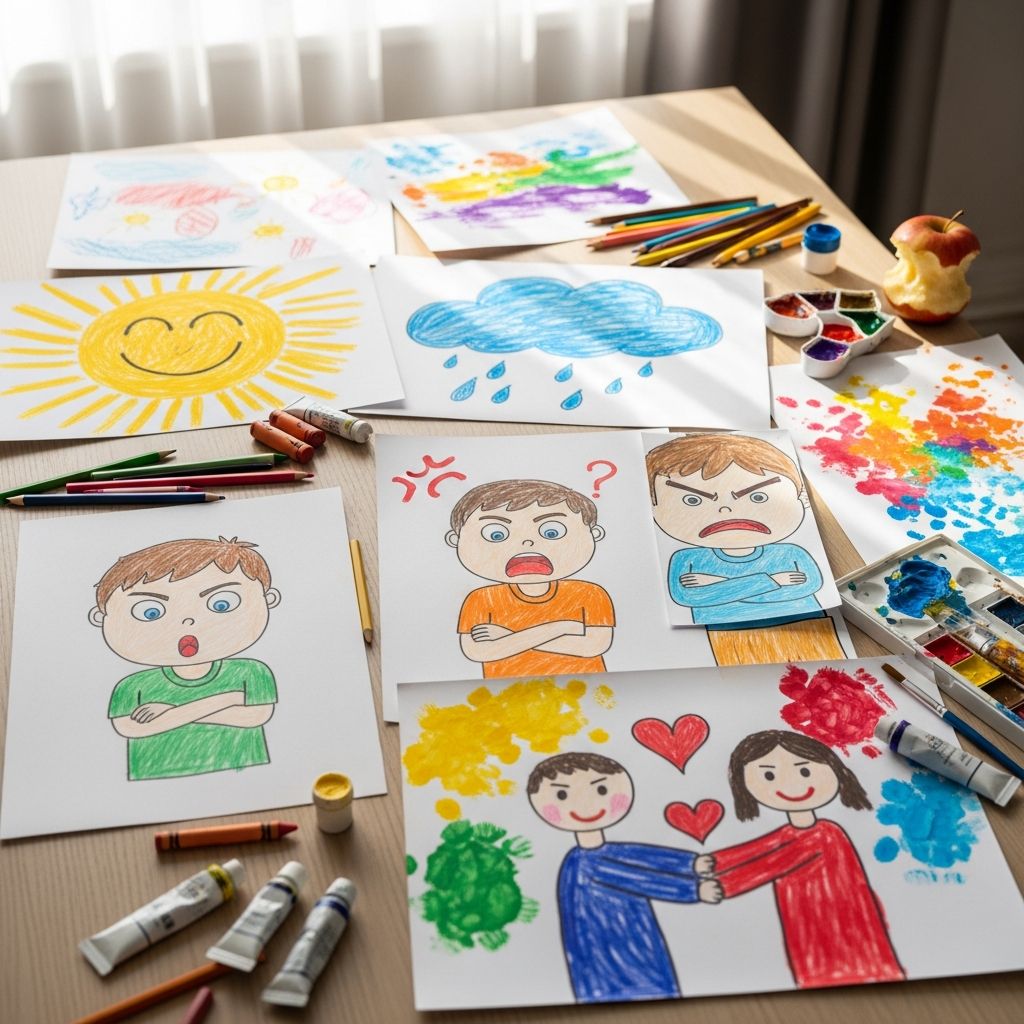
Research indicates that identifying what children choose to draw and the themes within their artwork may be more significant than analyzing how they draw it. A child who repeatedly draws pictures of storms, monsters, or frightened figures is communicating something important about their emotional landscape. A child who draws predominantly happy scenes with bright colors and smiling faces is conveying a different message. Asking “Tell me about your drawing” or “What was happening when you made this?” opens a dialogue that transforms a parent’s interpretation from guesswork into genuine understanding.
Developmental Stages and Age-Appropriate Expectations
Understanding a child’s age and developmental stage is fundamental to interpreting their artwork meaningfully. According to developmental psychology research, children’s drawing abilities progress through distinct stages. Very young children, ages two to three, engage in accidental realism, where marks on a page are largely unintentional or randomly placed. Children ages three to four move into failed realism, beginning to intentionally create marks but not yet able to represent their intentions realistically.
From ages four to twelve, children enter the intellectual realism stage, where they draw what they know rather than what they see, creating recognizable figures and scenes. Finally, from age twelve onward, children develop visual realism, where their drawings increasingly reflect what they actually observe. Interpreting a three-year-old’s scribbles through the lens of a ten-year-old’s drawing abilities would be fundamentally misguided. Each developmental stage has its own characteristics and expectations.
Additionally, all children develop their artistic abilities at slightly different rates, and individual style preferences vary considerably. Some children prefer detailed, careful drawings that may reflect a need to try very hard or perfectionist tendencies, while others favor looser, more spontaneous expression. Understanding your individual child’s typical style and developmental level provides essential context for noticing when something has changed significantly.
When to Be Concerned and When Not to Worry
A common concern among parents is determining whether their child’s artwork indicates a genuine emotional problem or developmental issue that warrants professional attention. Experts caution against drawing firm conclusions from isolated drawings. While research has identified some modest correlations between certain drawing characteristics and specific emotional or behavioral traits, these correlations are not strong enough to allow parents to work backward from a drawing and definitively diagnose a condition.
Instead of analyzing individual drawings in isolation, parents should observe patterns over time. When the same disturbing elements appear repeatedly across multiple drawings, or when a child’s artwork undergoes a sudden, dramatic change, this warrants closer investigation and possibly a conversation with a pediatrician or child psychologist. A single dark drawing does not indicate a problem; however, a sustained shift toward darker, more aggressive, or more anxious themes might suggest that something in the child’s life requires attention.
It is also crucial to remember that children’s drawings are simply one of several ways that kids express themselves, alongside speech, behavior, social interactions, and play. There is nothing uniquely magical or diagnostic about artwork itself. A child who draws frightening images might be working through anxieties in a healthy, creative way, or they might be reflecting genuine distress. The drawing itself is just the starting point for understanding, not the definitive answer.
The Importance of Avoiding Adult Projection
One of the most significant obstacles to accurately interpreting children’s drawings is the tendency for adults to project their own emotions, anxieties, and interpretations onto the child’s work. A parent who is worried about their child’s adjustment to a new school might see evidence of that worry in a drawing that the child created for entirely different reasons. An adult might interpret a figure as sad because of the adult’s own emotional state, when the child simply drew what came to mind without emotional intention.
This unconscious projection is remarkably common and difficult to recognize without deliberate awareness. Parents serve their children better by approaching artwork with genuine curiosity and openness, asking authentic questions rather than leading questions that suggest a particular interpretation. Instead of asking “Why is this figure so sad?” a parent might ask “Tell me about this figure” and allow the child to provide their own interpretation.
Recognizing your own emotional responses to your child’s artwork is an important part of accurate interpretation. When a drawing triggers strong feelings in you—whether concern, anger, or sadness—it may be worth reflecting on whether those feelings belong to the drawing itself or to your own anxieties and experiences.
Using Drawings to Strengthen Parent-Child Connection
Beyond the practical goal of understanding your child’s emotional state, engaging thoughtfully with their artwork serves a vital relational purpose. When children perceive that their parents are genuinely interested in their creative expression, they feel valued and understood. This reinforces the child’s willingness to continue expressing themselves through art and through conversation.
Rather than merely analyzing drawings for hidden meanings, parents can view artwork as an invitation into their child’s inner world and as an opportunity to deepen connection. Asking questions, listening to their explanations, and genuinely engaging with what they have created communicates that their thoughts and feelings matter. Over time, children often become more willing to share their emotions verbally because the foundation of safe, non-judgmental listening has been established through engagement with their art.
Key Considerations for Interpretation
- Ask your child directly about their artwork rather than relying solely on visual analysis
- Consider developmental stage and individual style before drawing conclusions
- Observe patterns across multiple drawings rather than focusing on single images
- Be aware of how your own emotions might influence your interpretation
- Notice both the physical quality of marks and the content of what was drawn
- Recognize that artwork is one of many ways children express themselves
- Seek professional guidance if you notice sustained, concerning changes in your child’s artwork
Frequently Asked Questions
Q: What does it mean if my child draws a lot of angry or aggressive figures?
A: Rather than assuming your child is angry or aggressive, ask them about the drawing. They might be working through a story they heard, processing something they observed, or simply exploring different emotions creatively. Context and your child’s explanation matter far more than the image itself.
Q: Should I be concerned if my child draws only dark colors?
A: Not necessarily. Color preference is influenced by many factors including age, art education, cultural background, and what colors happen to be available. Look for patterns over time and combine color observation with other elements and direct conversation with your child.
Q: How can I tell if my child’s drawing indicates a real emotional problem?
A: A single concerning drawing is unlikely to indicate a problem. Watch for patterns—when the same disturbing themes appear repeatedly or when your child’s artwork changes dramatically—consider having a conversation with your pediatrician or a child psychologist.
Q: Is there a “normal” way for children to draw at different ages?
A: Yes, drawing develops through recognizable stages related to age and cognitive development. Understanding where your child falls developmentally helps you interpret their artwork appropriately and notice genuine changes in their artistic approach.
Q: Can I really diagnose my child’s emotional state from their drawings?
A: No. While artwork can provide clues about what a child is thinking and feeling, drawings alone are not diagnostic tools. They should be understood as one form of communication among many, not as definitive evidence of emotional or behavioral problems.
References
- Interpreting Your Child’s Artwork — Artful Kids. 2010-03-01. https://artful-kids.com/2010/03/01/what-does-your-childs-artwork-reveal/
- Evaluating Children’s Drawings as a Means of Expression — PubMed Central (PMC). 2024. https://pmc.ncbi.nlm.nih.gov/articles/PMC12269769/
- 12 Must Know Facts About Children’s Drawing Interpretation — ISTE. 2021. https://upload01.uocslive.com/ISTE/ISTE2021/PROGRAM_SESSION_MODEL/HANDOUTS/114889080/12MustKnowFactsaboutChildrensDrawingInterpretation.pdf
- What Do Your Child’s Drawings Say About Them: A Peek Into Children’s Psychology — Little Sunshine’s Preschool. 2024. https://littlesunshine.com/blog/what-do-your-childs-drawings-say-about-them-a-peek-into-childrens-psychology/
- What Do Children’s Drawings Tell Us About Life at Home? — Parenting Science. 2024. https://parentingscience.com/what-do-childrens-drawings-tell-us/
- Learn to Decode Children’s Drawings — Novak Djokovic Foundation. 2024. https://novakdjokovicfoundation.org/learn-to-decode-childrens-drawings/
- Interpreting Children’s Human Figure Drawings — ERIC Education Resources. 2012. https://files.eric.ed.gov/fulltext/EJ864355.pdf