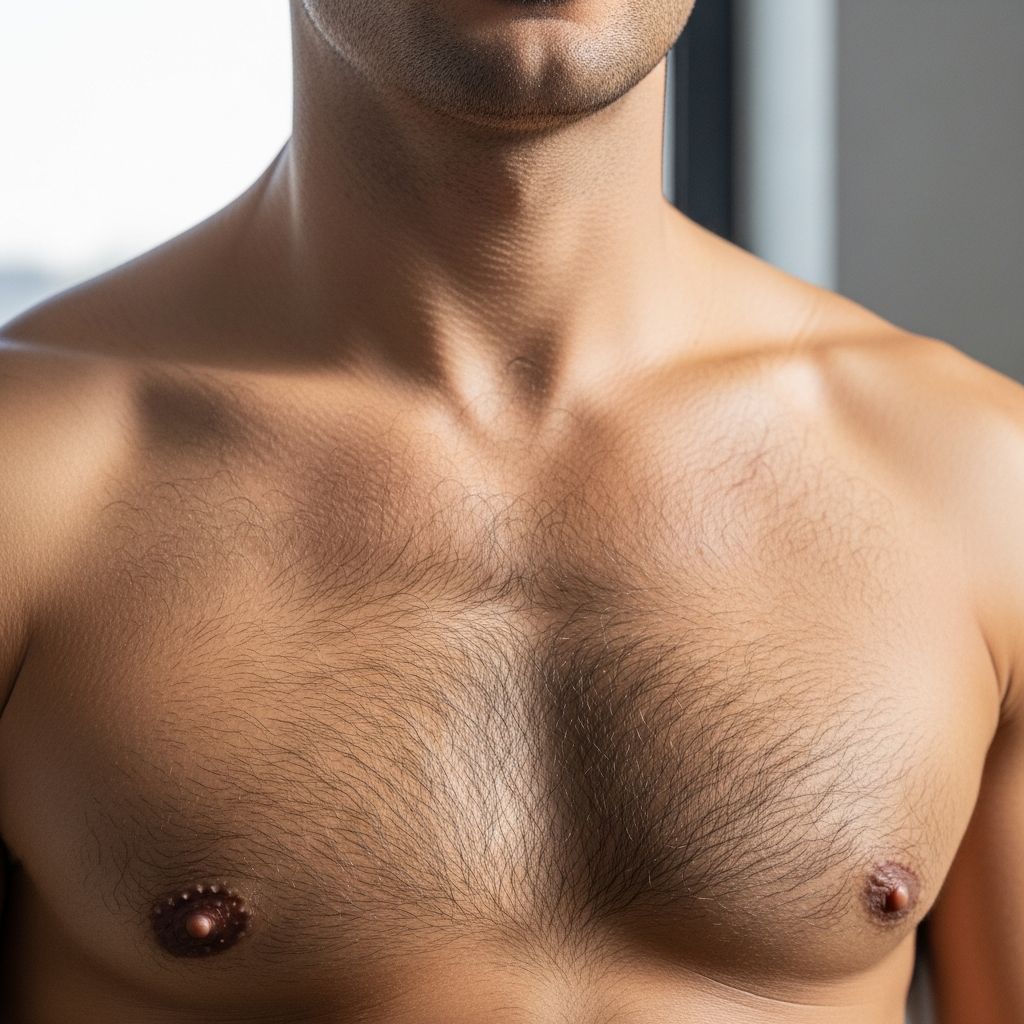
Male chest hair, often viewed through the lens of personal style or cultural trends, carries notable biological and health implications supported by research. Far from mere aesthetics, it serves protective functions, reflects hormonal health, and even correlates with certain traits like intelligence in studies. This article delves into these aspects, drawing from credible scientific insights to highlight why embracing natural chest hair might offer more than meets the eye.
Evolutionary Roots and Protective Roles
Chest hair in men traces back to human evolution, where body hair played key roles in survival. Early hominids relied on dense fur for thermoregulation, shielding skin from environmental extremes and parasites. Although humans largely lost widespread body hair around three million years ago to facilitate sweating and prevent overheating during endurance activities, residual chest hair persisted, particularly in males. Today, it continues to provide subtle protections: wicking sweat to aid cooling, cushioning skin against minor abrasions, and trapping pheromones that may influence social signaling.
Hair follicles are dynamic structures packed with blood vessels, nerves, and stem cells, contributing to overall skin integrity. Professor Des Tobin from the University of Bradford notes that these follicles enhance wound healing; areas with denser hair, like the outer arm, recover faster due to superior vascular supply and regenerative cells compared to smoother regions. For men, chest hair may thus bolster skin resilience during physical activities or injuries.
- Thermoregulation: Insulates in cold conditions while allowing sweat evaporation.
- UV Protection: Filters sunlight, reducing burn risk on exposed torsos.
- Parasite Defense: Historically deterred fleas and lice by making detection easier.
Hormonal Signals: Testosterone and DHT Connection
Chest hair density often mirrors androgen levels, primarily testosterone and its potent derivative, dihydrotestosterone (DHT). During puberty, these hormones convert vellus (fine) hair into terminal (thick, pigmented) hair on the chest, face, and abdomen. Men with robust chest hair typically exhibit healthy testosterone profiles, as confirmed by endocrinologist Nida Chammas, though genetics modulate follicle sensitivity.
A PubMed study of 184 Caucasian and Chinese men quantified this: Caucasians averaged a chest hair score of 3.0 (on a 0-4 scale) versus 0.8 for Chinese men, paralleling higher 5α-reduced androgen levels in the former group. This underscores ethnic variations but affirms hair as a testosterone biomarker. Optimal testosterone, boosted by exercise and diet, not only promotes hair growth but supports muscle mass, energy, and libido.
| Factor | Influence on Chest Hair | Health Implication |
|---|---|---|
| Testosterone | Triggers conversion to terminal hair | Muscle growth, vitality |
| DHT (via 5α-reductase) | Enhances density | Prostate health marker |
| Genetics | Determines pattern/sensitivity | Non-hormonal variation |
| Exercise/Diet | Boosts levels indirectly | Overall wellness |
Conversely, sparse chest hair doesn’t signal deficiency; receptor responsiveness varies. Monitoring via blood tests is advisable if concerns arise, per Cleveland Clinic guidelines on body hair functions.
Intelligence and Professional Correlations
Intriguing links exist between chest hair and cognitive prowess. A 1990s study by psychiatrist Aikarakudy Alias found 45% of male trainee doctors rated ‘very hairy’ versus under 10% in the general population, suggesting a hairy chest as a masculinity and health indicator potentially tied to intellect. Mensa members, the high-IQ society, also reportedly feature higher rates of thick chest hair, though methodologies warrant scrutiny due to age.
These findings imply androgens like testosterone, which foster chest hair, may concurrently support brain development. Higher prenatal testosterone exposure correlates with spatial reasoning strengths, a trait advantageous in fields like medicine and engineering.
Patterns, Asymmetry, and Normalcy
Chest hair isn’t uniform; a 1965 study of 1,400 white men aged 17-71 identified 15 patterns across sternal, infraclavicular, pectoral, and circumareolar zones. The prevalent pecto-sterno-infraclavicular type covers pecs, sternum, and clavicle ends. Asymmetry is standard, reassuring men with uneven growth that it’s biologically typical rather than anomalous.
Peripheral artery disease (PAD) exemplifies hair’s diagnostic value: leg hair thinning signals circulatory issues, as follicles demand robust blood flow. Chest hair, being central, less reflects such problems but underscores vascular health’s role in hair vitality.
Attraction Dynamics and Partner Preferences
Women’s chest hair preferences shift with life stages. A study of nearly 300 women revealed fertile individuals favor smoother chests, possibly linking to youth cues, while postmenopausal women prefer hairier torsos, associating it with maturity and stability. This may stem from heritable tastes or imprinting, where partners resemble fathers.
Hairy men are perceived as masculine and reliable husbands in some research, with 54% of women citing appeal. Body hair enhances sex appeal for many, boosting confidence in intimate settings.
Grooming Choices: Pros, Cons, and Tips
Shaving risks ingrown hairs and itchiness during regrowth; waxing offers smoother results but irritates follicles. Trimming maintains natural benefits while neatening appearance. Manscaped experts advise against full removal for most, favoring moderation.
To promote healthy growth: prioritize protein-rich diets, resistance training for testosterone, and gentle cleansing. Avoid over-waxing to preserve follicles.
Frequently Asked Questions (FAQs)
Does chest hair indicate high testosterone?
Yes, denser chest hair often correlates with elevated testosterone and DHT, though genetics play a role.
Is uneven chest hair abnormal?
No, studies confirm asymmetry and varied patterns are common across men.
Should I remove my chest hair?
It depends on preference; keeping it preserves protective benefits, but trimming is low-risk.
Can exercise increase chest hair?
Indirectly, yes—physical activity elevates testosterone, promoting growth.
Why do some ethnic groups have less chest hair?
Genetic differences in androgen sensitivity and receptors, as shown in comparative studies.
Health Monitoring Through Hair Changes
Sudden chest hair loss may flag hormonal imbalances, thyroid issues, or medications. Consult physicians for persistent changes. Conversely, excessive growth (hirsutism-like) warrants androgen checks.
In summary, chest hair embodies evolutionary legacy, health markers, and social signals. Whether au naturel or styled, it underscores men’s physiological diversity.
References
- Clinical and biochemical parameters of androgen action in normal men and patients with erectile dysfunction — Zhao TC et al. 1991-01-01. https://pubmed.ncbi.nlm.nih.gov/1827450/
- Body Hair: Types & Why You Have It — Cleveland Clinic. 2023-10-12. https://my.clevelandclinic.org/health/body/body-hair
- How being hairy can be good for you — IOL. 2015-05-04. https://iol.co.za/lifestyle/health/2015-05-04-how-being-hairy-can-be-good-for-you/
- How much difference your hair really makes to keep you cool or warm — University of Wollongong. 2023-01-01. https://www.uow.edu.au/media/2023/how-much-difference-your-hair-really-makes-to-keep-you-cool-orwarm.php
- What’s Great About Having A Hairy Chest, According To Science — Fatherly. 2023-08-28. https://www.fatherly.com/health/benefits-hairy-chest-science