Every once in a while, a clumsy, over-the-top action movie stumbles into something much more interesting than car chases and body counts: it reveals what many fathers secretly fear, hope, and wrestle with in the quiet moments nobody sees.
A revenge thriller about a snowplow driver whose son is killed may not sound like a parenting masterclass, yet buried beneath the gunfire is a messy but illuminating portrait of modern fatherhood trying to survive grief, masculine pride, and the pressure to “fix” everything.
The Snowplow Dad and the Myth of Control
At the heart of the story is a working-class father whose life is defined by routine, reliability, and invisible service: he clears the roads so everyone else can move safely, yet few people notice him until something goes wrong. This becomes a sharp metaphor for how many fathers understand their role—quiet, essential, underappreciated, and deeply tied to the idea of being useful.
When his son is killed, that sense of usefulness collapses. The father discovers the brutal limit of his control: all the years of hard work and protection could not prevent the one loss that matters most. The movie’s revenge plot is outrageous, but emotionally it grows out of a painfully recognizable urge: if a father cannot protect, he must at least punish.
- He measures his worth by what he can physically do for his family.
- His job becomes a symbol of competence, safety, and masculine value.
- The son’s death exposes how fragile that identity really is.
Grief as a Father, Not Just as a Man
Most action movies treat grief as a shortcut to violence: a family member dies, the hero loads a gun, and the rest is choreography. In this story, the father’s grief is clumsy, private, and practically unspoken. Instead of crying or asking for help, he retreats into plans, tools, and tasks—the emotional language he feels safest using.
The film hints at the kinds of grief fathers are almost never encouraged to show. He loses not just a child, but also a future: shared memories, unspoken apologies, and all the ordinary days he assumed they would still have. The revenge spree is less about justice than about refusing to live in a world where this loss is meaningless.
- He cannot articulate his pain, so he expresses it through action.
- He sees institutional systems fail his family, which intensifies his isolation.
- His grief is intertwined with guilt—he believes he should have seen it coming.
Why the Mother Disappears—and Why That Matters
The film sidelines the mother quickly, a frustrating creative choice that inadvertently highlights how stories about family pain are often framed as male journeys. Her response to loss—distance, withdrawal, the refusal to participate in her husband’s escalating violence—deserves far more space than it gets.
Yet even this absence says something uncomfortable about real families in crisis. Parents often grieve out of sync. One may crave revenge or answers while the other just wants to escape the reminders of what was lost. When fathers are centered as the sole agents of action, mothers become background players, even in their own tragedy, reflecting how cultural narratives often treat paternal rage as more compelling than maternal sorrow.
- The mother’s quiet exit mirrors how many women are pushed to the emotional margins of “heroic” male stories.
- The film unintentionally shows how incompatible grieving styles can fracture a marriage.
- Her absence challenges viewers to ask whose pain counts as plot-worthy.
Masculinity, Violence, and the Father Script
At first glance, the movie looks like another standard tale: a stoic man, a murdered son, and a long list of villains. But underneath the black comedy and stylized brutality lies an uncomfortable question: is this truly what a “good” man is supposed to do when his family is hurt, or is this merely what he has been trained to believe?
The father’s transformation from quiet worker to avenging figure is less a moral awakening and more a performance of the only script he thinks he has: real men do not talk about trauma, they neutralize it. The film’s dark humor often exposes how absurd this script is, even as it invites the audience to cheer on the spectacle.
| Model | Core Belief | Typical Response to Threat | Emotional Range Allowed |
|---|---|---|---|
| Traditional Avenger | Protection equals domination over danger. | Meet harm with greater force; restore order by eliminating enemies. | Anger, stoicism, occasional sarcasm. |
| Relational Caregiver | Protection equals connection, presence, and listening. | Address harm through support, boundaries, empathy, and community. | Sadness, fear, vulnerability, affection, and yes, anger too. |
The movie anchors itself in the first model but keeps bumping into the second. Every time the father interacts with a child or an innocent bystander, a different, softer masculinity flickers into view, only to be buried again under gunfire and bravado.
Fathers, Sons, and the Weight of Expectations
The murdered son functions mostly as a catalyst, but scattered references suggest a familiar dynamic: a father who assumes his child’s life is on a safe, predictable track, and a son navigating pressures and temptations his father barely understands. The tragedy explodes the illusion that being a decent parent automatically shields a child from risk.
The father’s refusal to accept the official explanation of his son’s death—tied to drugs and criminal activity—is not just a search for truth. It is a frantic refusal to see his child as anything other than innocent, because acknowledging complexity might require interrogating his own blind spots as a parent.
- He clings to an idealized image of his son as “not that kind of kid.”
- He never considers that love does not guarantee understanding.
- The gap between who he thought his son was and who his son actually was remains tragically unresolved.
When Revenge Collides with Another Father’s Grief
The movie complicates its own morality by introducing another father who has also lost a child to the same world of drugs and violence. Unlike the protagonist, this man has always lived inside the criminal system that caused the harm, and his response is as ruthless as it is heartbreakingly logical: if his child is dead, someone else’s must die too.
By placing these two grieving fathers on opposite sides of the law yet inside the same emotional hurricane, the film undercuts the fantasy that vengeance is noble when the “good” father does it and monstrous only when the villain follows suit. Both are trapped in the same equation: a child’s death can be redeemed only through another family’s pain.
- Each man believes he is restoring balance rather than multiplying suffering.
- Both define justice as proportional harm, not healing or prevention.
- Their mirrored rage exposes revenge as a closed loop that never actually brings a child back.
The Quiet Power of Protecting Someone Else’s Child
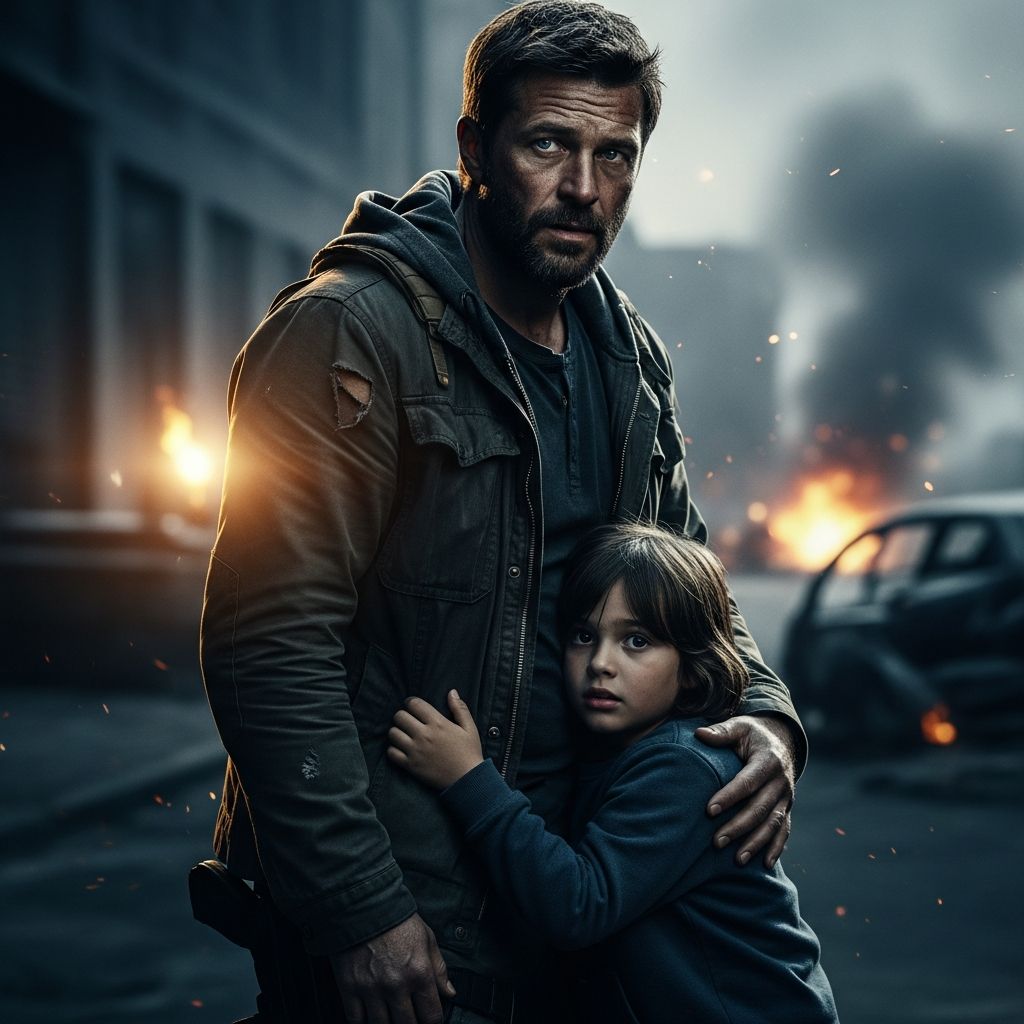
Some of the film’s most striking parenting moments happen when the protagonist ends up responsible for another man’s young son. Surrounded by violence and chaos, he switches modes: instead of acting as a punisher, he becomes a caretaker. He offers food, warmth, and reassurance; he shelters the boy from the worst of what is happening.
These scenes highlight a version of fatherhood that does not depend on biology, legality, or even morality. A man can be part of a violent chain of events and still make small, fiercely humane choices when a child is in front of him. The contrast is jarring: the same person who meticulously plans brutal revenge also quietly fastens a seatbelt or explains how a machine works to calm a frightened child.
- The father sees, perhaps for the first time, how terrifying his world looks through a child’s eyes.
- He discovers that protection is not only about eliminating threats but also about creating moments of safety and normalcy.
- In caring for another man’s child, he briefly becomes the dad his own son no longer has.
Work, Identity, and the Tools We Inherit
The snowplow is more than a quirky prop; it is an extension of the father’s body and a symbol of how men often define themselves by the tools they master. For years he has used this machine to make life smoother and safer for strangers. When he finally turns it into a weapon, the film underlines a harsh truth: any strength can also become a form of harm if it is driven by unresolved pain.
Parents unconsciously teach their children what to do with power—whether that power is physical, financial, or emotional. A father who uses his skills only to control or destroy sends a very different message from a father who uses the exact same skills to serve, repair, or comfort.
- Work can be a language of love when it is tied to service, not ego.
- The tools a parent controls become part of the moral landscape a child grows up in.
- Transforming instruments of safety into instruments of revenge blurs the line between protector and aggressor.
What This Movie Can Teach Real Parents
Despite its tonal whiplash and exaggerated body count, the film captures anxieties that feel very real in an age of opioids, school violence, and institutional failure. Parents watch their children move through an unpredictable world and secretly wonder: is doing everything “right” still enough?
The snowplow father’s rampage is not a model to copy; it is a cautionary tale about what can happen when love, fear, and masculine pride mix without any outlet for vulnerability. Real strength, the movie quietly suggests, might look less like vengeance and more like learning to sit with unbearable sorrow without turning it into someone else’s nightmare.
- Talking openly with children about risk does more to protect them than pretending danger does not exist.
- Allowing space for grief, therapy, and community support can keep pain from curdling into obsession.
- Redefining protection as presence and honesty reduces the pressure to play the invincible hero.
Practical Takeaways for Fathers Watching Violent Movies
Using a chaotic action movie as a parenting text may feel odd, but it can be surprisingly effective. Popular culture offers exaggerated versions of the impulses many parents already feel; the key is to use those stories as mirrors, not manuals.
When fathers watch a revenge thriller that centers on a grieving parent, they gain a chance to examine their own instincts before real tragedy strikes. The question is not “Would you do what he did?” but rather “What do you believe a father is for, and how do you want your child to remember you when they think about safety, love, and accountability?”
- Pause after intense scenes and consider what the character could have done instead of escalating.
- Notice which kinds of emotions the film celebrates (anger, toughness) and which it ignores (fear, tenderness, confusion).
- Use the story as a springboard for conversations with older teens about drugs, violence, and what real courage looks like.
FAQs: Fatherhood, Grief, and Revenge Stories
Is it healthy for fathers to relate to violent revenge fantasies?
Experiencing flashes of vengeful imagination when a child is threatened is common; it signals how deeply attached a parent is, not that they are destined to act violently. The danger arises when revenge scenarios become a primary coping mechanism instead of a fleeting emotional surge that is acknowledged and released.
What can this kind of movie actually teach about parenting?
It highlights the limits of control, the cost of emotional isolation, and the difference between protecting a child’s body and protecting their sense of safety and trust. By dramatizing the worst possible outcomes, it invites parents to think proactively about communication, boundaries, and the support systems they want in place before a crisis hits.
How should parents talk to teens about films that glamorize revenge?
Instead of banning these stories, parents can watch alongside older teens and ask questions that peel back the fantasy layer. Questions like “Who else is hurt by this choice?” or “What might happen after the credits roll?” encourage critical thinking and help teens distinguish between cinematic justice and real-world responsibility.
Does focusing on fathers erase mothers from the conversation?
It can, especially when stories treat maternal grief as a narrative inconvenience rather than a central emotional force. A more balanced approach recognizes that both parents—and caregivers of all genders—carry complex reactions to loss, and that centering only paternal pain reinforces a narrow, incomplete view of family life.
Can a deeply flawed movie still be valuable to parents?
Absolutely; the very clumsiness of a story can leave its themes more exposed, making it easier to see what it gets wrong about gender, grief, and justice. Parents do not need perfect art to spark meaningful reflection; they just need a willingness to look past the explosions and ask what the characters’ choices reveal about the stories a culture tells fathers about who they are supposed to be.
This uneven revenge thriller may never earn a place among the great films, but its portrait of a snowplow driver driven past the edge by unimaginable loss lingers for reasons that have little to do with style or plot. In his misguided fury, parents can glimpse both the worst version of their protective instincts and a challenge to imagine something better: a version of fatherhood grounded not in domination over danger, but in honest connection, shared vulnerability, and the courage to live with what cannot be fixed.